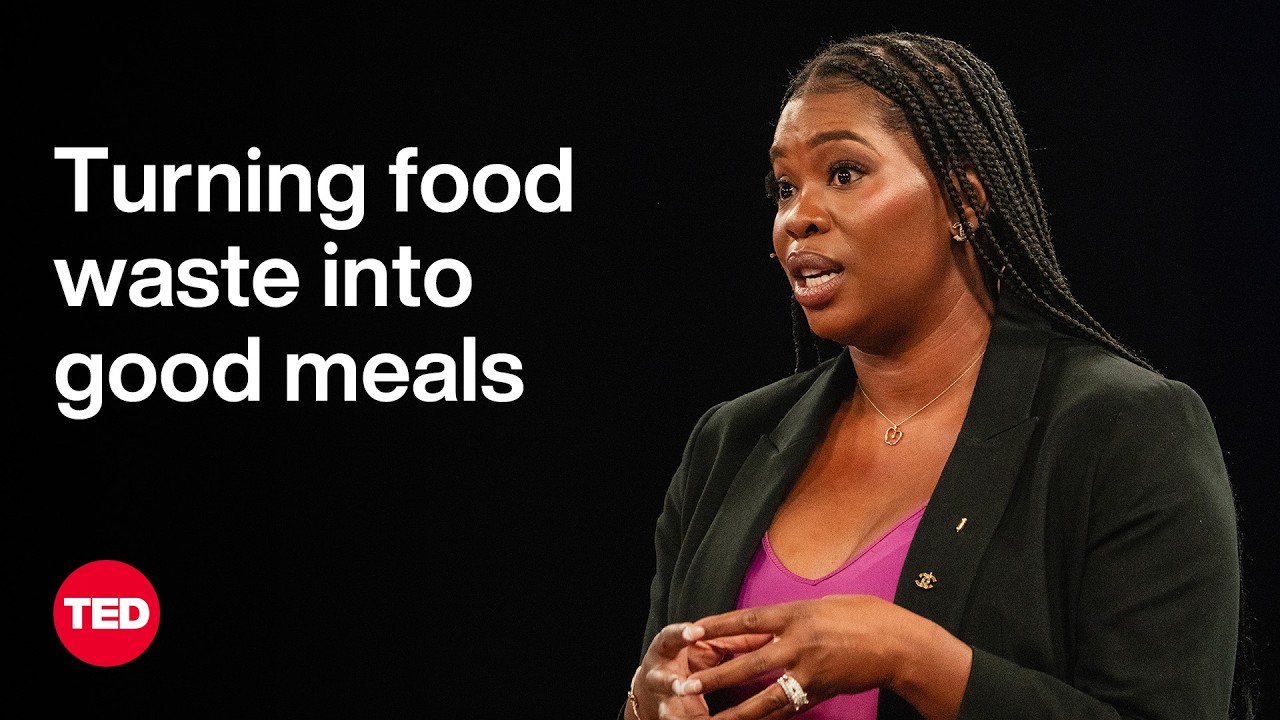
What if solving hunger isn't about growing more food but wasting less of it? Social entrepreneur Jasmine Crowe-Houston has made that idea her mission with Goodr, a platform that reroutes surplus food to people in need. In conversation with journalist and "TED Radio Hour" host Manoush Zomorodi, she shares how a viral moment led to a nationwide effort to fix the food waste problem. (Recorded at TEDNext 2024 on October 22, 2024)
Join us in person at a TED conference: https://tedtalks.social/events
Become a TED Member to support our mission: https://ted.com/membership
Subscribe to a TED newsletter: https://ted.com/newsletters
Follow TED!
X: https://www.twitter.com/TEDTalks
Instagram: https://www.instagram.com/ted
Facebook: https://facebook.com/TED
LinkedIn: https://www.linkedin.com/company/ted-conferences
TikTok: https://www.tiktok.com/@tedtoks
The TED Talks channel features talks, performances and original series from the world's leading thinkers and doers. Subscribe to our channel for videos on Technology, Entertainment and Design — plus science, business, global issues, the arts and more. Visit https://TED.com to get our entire library of TED Talks, transcripts, translations, personalized talk recommendations and more.
Watch more: https://go.ted.com/jasminecrowehouston
https://youtu.be/cjG0m9QUF34
TED's videos may be used for non-commercial purposes under a Creative Commons License, Attribution–Non Commercial–No Derivatives (or the CC BY – NC – ND 4.0 International) and in accordance with our TED Talks Usage Policy: https://www.ted.com/about/our-organization/our-policies-terms/ted-talks-usage-policy. For more information on using TED for commercial purposes (e.g. employee learning, in a film or online course), please submit a Media Request at https://media-requests.ted.com
#TED #TEDTalks #Food #Business
Оглавление (3 сегментов)
Segment 1 (00:00 - 05:00)
Manoush Zomorodi: OK, so I have been following Jasmine's career. She gave a TED Talk at TEDWomen five years ago -- Jasmine Crowe-Houston: Five years ago in December. MZ: Which is crazy. And I interviewed you three years ago, and now here you are. And so much has happened. JCH: Yes. MZ: You are more of a behind-the-scenes person. For people who don't know Goodr, explain your story, how you came to be so aware of food waste and what you are doing about it. JCH: Hi, everyone. I'm so excited to be back at TED. This is like, we have a relationship here. I mean, TEDx, TEDWomen, TED Radio, TEDNext. I mean, I'm going to name my next kid Ted. (Laughter) But, you know, I started Goodr here in Atlanta. I had created a homeless -- I would say, for people experiencing homelessness, a pop-up restaurant. And the concept really came to me after feeding and working with a volunteer group and making all these peanut butter and jelly sandwiches, going out to the streets and handing them out, and a man telling me, "Oh, I'm allergic to nuts. " And I thought, we just made 1,000 peanut butter and jelly sandwiches, and nuts are one of the number one allergies. And it made me think that dignity was lost in how we are serving our unhoused, in how we're serving people in need. And that too often we think, well, they're homeless or they're hungry, take this and be happy, forgetting the fact that they could have religious convictions, dietary restrictions, or they could plain out be allergic. And so I created this pop-up restaurant where I would rent tables and chairs and linens and print out menus and let people feel like they were dining at a restaurant. And a video went viral, and it was a 15-second clip. I'll never forget it, because it was before Instagram allowed you to have, you know, minute-videos, longer videos. So I woke up one morning really afraid because I had never, I mean obviously gone viral. And I was like, what's going on Facebook? I need to get off this app. It was like one of those things. And so I'm reading through millions of views and comments, and what people kept asking me was: Who donated the food? And the truth was, nobody, I was couponing, price-matching. I would start cooking on Friday, Saturday, go out and feed about 300-500 people every Sunday. And so I was like, I need to get this food donated. I went to Google, fully expecting to get a list of all the businesses that are going to donate food to me to help me keep feeding people. And I would, you know, live happily ever after. And instead I found about food waste. And I read an 86-page report by the Harvard Food Law Policy Group. And as I'm reading through this, at this point now into the wee hours of the morning, I'm getting upset because I'm thinking about the people that are lined up at 9am for my 3pm feeding every Sunday, because they know that there's not a lot of people that come out to feed during the week. They were living at the former Metro Atlanta Peach Tree Homeless Task Force. It was the only shelter in the city that would allow families to come. And that's so important. A lot of you all don't know, but if you are a homeless mother, you have a 15-year-old son, you guys have got to go to two different shelters. And so I was feeding all these people. I learned about food waste, and I became upset. And I was like, I'm going to solve this. I'm going to do something, to your point, better and “Goodr. ” And that's what got me started. MZ: So explain what Goodr does now, because from going to peanut butter sandwiches, it's impressive. JCH: So now we have a two-sided business model as it relates to food waste. We can help a business keep all of their food out of landfill. If it's edible, we're getting it to people in need that are people like me feeding people: shelters, safe houses, domestic violence centers, churches. One of our largest partners is communities and schools. We feed thousands of kids every week. So we keep edible food from going to landfill, and we are delivering it directly to people in need while giving all of our clients back a lot of data: how many pounds they're keeping out of the landfill, what does this mean for their CO2 emissions and their carbon footprint. And then we have a hunger side of our business, which was birthed during the pandemic, that really focuses on creating sustainable solutions to solve hunger. We build free grocery stores inside of schools. We have 28 right now around the country. We have grocery and meal delivery. During the height of the pandemic, Goodr delivered all the meals to Atlanta Public School students that got free breakfast and lunch but were learning virtually. So we made sure that they got food at home. So we really are solving hunger and food waste. MZ: So can you just explain -- Can we give her -- (Applause) Part of me is like, 40 percent, that's such a crazy statistic. JCH: It's a crazy number. MZ: Why, when you talk to the companies, nonprofits, like, what is happening that there is so much food available, but going nowhere? JCH: It's a startling number. If food waste itself was a country, it would be the third-largest country in the world. So it's a lot of food. So you think about that. Between the production, the transportation and the disposal
Segment 2 (05:00 - 10:00)
nearly two percent of all US GDP we spend on food that, you know, we never even eat. And I think what it is that the old guard is, we've always done it this way. We've always thrown it away, and this is how we do it. And of course, when I was first starting, people were like, oh, well, if someone gets sick and we'll get sued. And so Goodr said, hey, we'll take on all of that onus. We provide the packaging materials, we provide the labels. When nonprofits receive the food, it comes from Goodr, they sign hold harmless agreements. I have a multi-million-dollar liability insurance because the airport was my first customer, and we were driving on tarmacs, and I ended up having to get insurance that I wasn't quite ready for. But it definitely helped the business. And even with all of that, people will still say, "Well, we're just afraid. " Or, “Our lawyers just can’t wrap their heads around it. ” Or you know, “We’re going to compost everything, even if it’s edible. ” Which I’m still happier that it’s not going into landfill if it gets composted. You know, of course, Goodr, we deliver to hog farms, we have anaerobic digesters we'll take food to. So we want to keep it out of landfill. But feeding hungry people is not a priority for too many people in this country. And that's a problem. (Applause) MZ: Tomorrow, I am coming to see one of your facilities. JCH: I'm so excited about that, you're going to love it. MZ: From what I understand, it's bread day, so bread is going to be coming in from all different places, and then you are going to be sorting it. Some of it goes, as you said, to compost, if it's not for human consumption. JCH: Or to a hog farm. MZ: farm, which is amazing. JCH: Or a cattle farm, I think we have cattle farms now. MZ: Yes you do, I've seen that. And then some will go, of course, to people, to schools, to hospitals or wherever else. But talk to me more from the corporate side. How did you get people to come on board with this? Did something have to change when it comes to laws and forcing companies to do this? Is it because they want to be able to say to their customers like, we are a sustainable company. JCH: So what I used to do is I would go to the websites of the big hotel groups, the big food groups, and I would look at their sustainability reports. This is how I got the airport as a customer. And I went to them and I said, “Hey, I’m looking at your waste tonnage, and 27 percent of this, according to the EPA, is food. So you guys wasted 25 million meals. " Now I have no idea if that was true, but I looked at their sustainability report. I used the EPA's calculation that food was the number one thing in landfill, and I was able to go back to the Atlanta airport and say, "Listen, you guys are sitting in College Park, the children in this city are living in poverty, and all this food is going to waste. And this doesn't make any sense. " And so the airport became one of our first large-scale customers. And you think of all of the grab-and-go food items that goes to waste every single night if it's not for Goodr. And now that's why I need to be in more airports. But getting that before it goes to waste and getting it to Gateway Center before Georgia workforce, their third shift is coming out and building half of this city. A lot of men that are trying to transition out of homelessness, them getting that meal, putting this food in our grocery stores and families taking it home for free. This is what it does. So I think it was really about making people keep their promises. You know, like, hey, I won't say the hotel group, but they had on their website and this is someone I'm trying to pitch now, and I was like, you guys said you're going to cut food waste in half by 2025. This is in two months. Why have you guys not started? What’s the process? So a lot of times it's trying to hold their foot to the fire. MZ: Can we clone Jasmine? I want her holding all these companies accountable. (Applause) JCH: It’s about keeping -- I think we live for the announcement and we as people don't follow up. On the delivery, right? Because for someone to invest millions, I mean, I don't even know how much a Super Bowl commercial costs, but I've heard it's like a million dollars per 30 seconds. I could be wrong. But to invest two to three million dollars and not follow up on your promise? MZ: That's called greenwashing. JCH: Yes, and that's a lot of that. MZ: So you're not just in Atlanta, though now. You've grown a lot. JCH: Yes, so we are in 15 states, 26 markets. So this is where we have food moving and being donated. And then we have grocery stores in about five states, maybe six or seven now. But we are doing our food waste business obviously in more locations. MZ: Someone was asking me, they're like, but how do these companies keep track? Because it must be so random what they can get rid of. And I said, well, actually, there's an app for that. Which, when I first heard about your app, I was like, that seems weird, but actually it is really the linchpin in making this new system work. JCH: It's a logistics issue, that's really what I saw. So when and shout out to Jackie Chu, she runs TEDxAtlanta, and she convinced me to do my first TEDx Talk. And when I was talking to her about it, she was like, "Oh, I get it, it's a logistics problem. " And I was like, you get it. And that's really what it is.
Segment 3 (10:00 - 13:00)
Hunger is not an issue of scarcity. And we hear about that, right? We need to produce more food, we need to grow more food We are wasting 40 percent of it. It's really about logistics. How do we connect this excess food with the millions of people that need it? Seniors, their income doesn't change. We're going to be seniors, all of us. Some of us probably already are. But all of us, God willing. And once you get to that point, it doesn't matter then if toilet paper goes up, if bread or eggs are more expensive. This is all you have to work with. So it's really about how quickly can we match it. So we inventory everything it is that they sell. We create a very easy user experience where they click on the items, tell us how many, request the pick-up. We leverage the shared economy that's already out there, and that's how we've been able to grow to a lot of different locations. We don't have to hire our own drivers or purchase trucks and vehicles. Now we do have a couple, but what we leverage is a driver that's already out there. And drivers love it. They're like, "Oh my God, I'm feeding people, I'm getting paid to do it. " And they make it happen. MZ: So, literally, like, the person, let's say I'm working at a big company and I work, you know, in the cafeteria area, I take out my phone, and what do I do? JCH: Or it could go on your point of sale system and you click on the Goodr app, your menu is already there, and you're just clicking on the items that you have, saying, I’ve got 10 chicken breasts, I’ve got this. Our platform is calculating the approximate weight of those items. So we pull a lot of that data from US Foods, Sysco, whoever they're ordering their food from, and then it's calculating the tax value of those items at the time of donation, which is a critical offering to our clients. And once that food gets picked up, a nonprofit receives it. They sign for it like they would a UPS package, and a donation letter with a picture of that donation from that nonprofit automatically goes to our client's portal. So now they see everything that they've donated, the nonprofit it went to, and a tax deduction receipt for what they donated. (Applause) MZ: And the carbon that they've saved? JCH: Yeah, we have a corporate social responsibility impact report as well as a sustainability. And actually, I remember one of my angel investors, she sits on the board of IHG, who’s one of Goodr’s customers, and she messaged me last year at their board meeting in London. And she was like, "Goodr is on the board report. " They’re literally talking about how we’re cutting food waste with this company. MZ: So they're starting to show off by using you. JCH: As they should. (Laughter) It's such a good thing, yeah. MZ: Growth. I mean, we should be clear, you're not a nonprofit. You are a B Corp. Why is that important to you? Why did you decide to go for a for-profit company? Is it because that is something that you hope to scale? Where are the pros and cons with that? JCH: There was a couple things. One, I think the nonprofit was going to be a much harder old guard to get past because everybody always donates to the food bank. It's all we ever know, we've been doing canned food drives since we were eight. Our kids are still doing it in school now, and I felt like I was going to be spending a lot of time trying to gain respect in the nonprofit space. The biggest piece that I saw, though, was that businesses were already paying to throw this food away. So this was not newfound spin. They're already paying Waste Management, Republic Services, whoever their waste company is. Mind you, the waste industry is a trillion-dollar industry. None of us ever say, let's just keep our trash. We were like, is trash day missing? Oh my God, it's a hurricane, they didn't run today. We are paying for this on a daily basis. So when I realized that, I realized that this was not going to be newfound spin for these businesses. It was going to be a better spin. So dollar for dollar, we're a little bit more expensive. But the outcome, the return on the investment for our clients is far much greater than they would ever get from a traditional waste company. And so I do look at us as a triple bottom line, we're for people, we're for planet and we are for profit. (Applause and cheers)