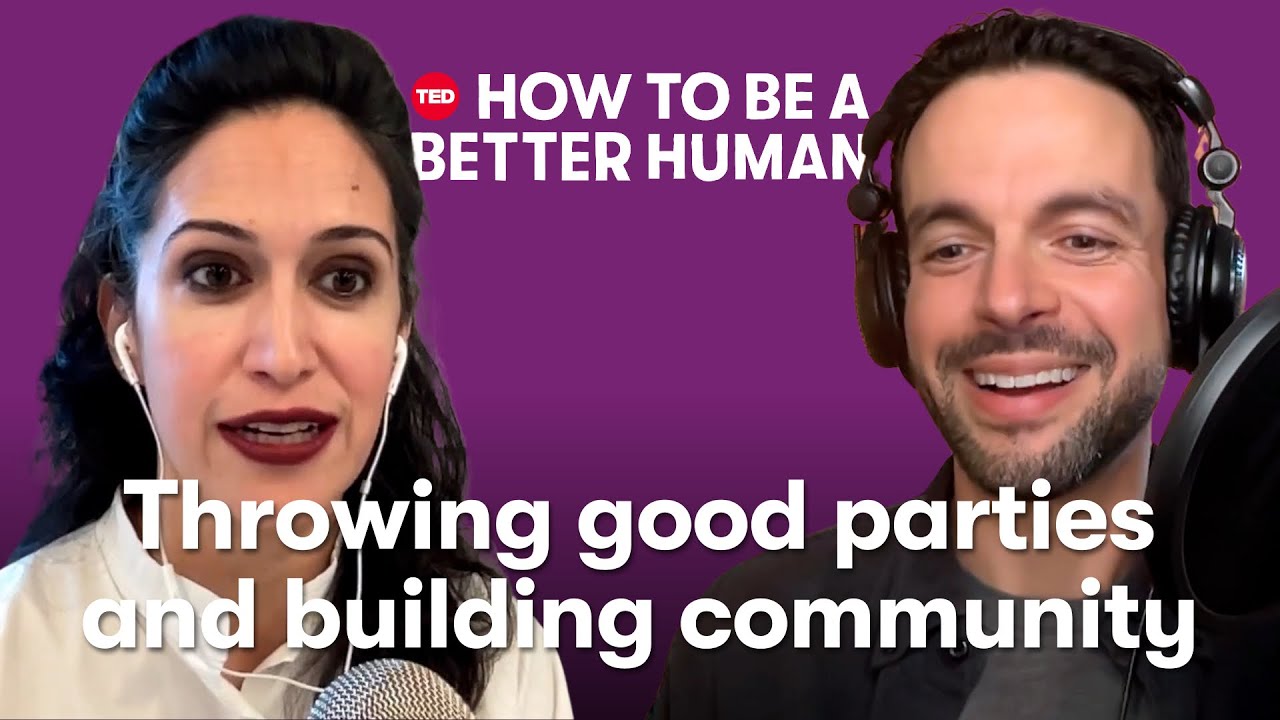
Throwing Good Parties (w/ Priya Parker) | How to Be a Better Human | TED
35:38

Throwing Good Parties (w/ Priya Parker) | How to Be a Better Human | TED

TED 29.01.2025 26 717 просмотров 524 лайков обн. 18.02.2026
Поделиться Telegram VK Бот
Транскрипт Скачать .md
Анализ с AI
Описание видео
Many of us are entering the new year with a similar goal — to build community and connect more with others. To kick off season five of How to be a Better Human, a podcast from TED, Priya Parker shares ideas on how to be the host with the most. An expert on building connection, Priya is the author of “The Art of Gathering: How We Meet and Why It Matters.” Whether it’s a book club, wedding, birthday or niche-and-obscurely themed party, Priya and Chris talk about how to create meaningful and fun experiences for all of your guests — including yourself. Check out the How to Be a Better Human podcast on your favorite podcast app: https://tedtalks.social/4gmAZt3 Follow TED! X: https://twitter.com/TEDTalks Instagram: https://www.instagram.com/ted Facebook: https://facebook.com/TED LinkedIn: https://www.linkedin.com/company/ted-conferences TikTok: https://www.tiktok.com/@tedtoks The TED Talks channel features talks, performances and original series from the world's leading thinkers and doers. Subscribe to our channel for videos on Technology, Entertainment and Design — plus science, business, global issues, the arts and more. Visit https://TED.com to get our entire library of TED Talks, transcripts, translations, personalized talk recommendations and more. https://youtu.be/xDDfUWic4CI TED's videos may be used for non-commercial purposes under a Creative Commons License, Attribution–Non Commercial–No Derivatives (or the CC BY – NC – ND 4.0 International) and in accordance with our TED Talks Usage Policy: https://www.ted.com/about/our-organization/our-policies-terms/ted-talks-usage-policy. For more information on using TED for commercial purposes (e.g. employee learning, in a film or online course), please submit a Media Request at https://media-requests.ted.com #TED #HowToBeABetterHuman #podcast
Оглавление (8 сегментов)

  1. 0:00 Segment 1 (00:00 - 05:00) 882 сл.
  2. 5:00 Segment 2 (05:00 - 10:00) 892 сл.
  3. 10:00 Segment 3 (10:00 - 15:00) 939 сл.
  4. 15:00 Segment 4 (15:00 - 20:00) 1035 сл.
  5. 20:00 Segment 5 (20:00 - 25:00) 989 сл.
  6. 25:00 Segment 6 (25:00 - 30:00) 980 сл.
  7. 30:00 Segment 7 (30:00 - 35:00) 994 сл.
  8. 35:00 Segment 8 (35:00 - 35:00) 83 сл.
0:00

Segment 1 (00:00 - 05:00)

from a very young age I began to realize that human connection is as threatened by unhealthy peace as it is by unhealthy conflict and I've learned uh Kicking and Screaming that actually learning to hold healthy heat isn't only good for communities and for groups and for friendships but is also a learnable skill and that in a group you can get better at this if you choose to try this is how to be a better human I'm your host Chris Duffy today on the show we are talking about Gathering and to me one of the most generous things you can do is to bring people together um I've been to a few parties in my life that were so unique and special that I will never stop thinking about them one is my friend will had this dinner party where it was a soup party so everyone just brought different kinds of soup and the party ended by 8:00 p. m. so everyone was at home and in bed by 9:00 to me that was a truly perfect Gathering a an event that I can think of no flaws with now that might not be true for you maybe you hate the idea of a soup party but as you're going to see in today's episode uh the perfect Gathering isn't something that's right for everyone it's something that's just right for you to guide us through Gatherings we have priia Parker the author of The Art of gathering and here's a clip from Prius Ted talk whether I was facilitating dialogues in Charlottesville or Istanbul or Amad the challenge was always the same Despite All Odds and with integrity how do you get people to connect meaningfully to take risks to be changed by their experience and I would witness extraordinarily beautiful electricity in those rooms and then I would leave those rooms and attend my everyday Gatherings like all of you a wedding or conference or a back to school picnic and many would fall flat there was a meaning gap between these high-intensity conflict groups and my everyday Gatherings now you could say sure somebody's birthday party isn't going to live up to a race dialogue but that's not what I was responding to as a facilitator you're taught to strip everything away and focus on the interaction between people whereas everyday hosts focus on getting the things right the food the flowers the fish knives and leave the interaction between people largely to chance so I began to wonder how we might change our everyday Gatherings to focus on making meaning by human connection not obsessing with the canipes hi there I am Pria Parker I am best known for my book The Art of gathering how we meet and why it matters I'm also a facilitator a strategic adviser and host of The Art of gathering digital course it feels like the beginning of the year is a time when a lot of people are thinking about putting new habits and routines into place and a lot of people are thinking about wanting community and wanting connection with people so are there special ways that we should be thinking about Gathering and planning for gatherings in the beginning of the year that can make it last all the way to the end of the year fortunately most of us whether we think about it at or not are gathering all the time anyway We Gather in our classrooms we GA Gather in our workplaces remote or in person We Gather to celebrate to witness people getting married to mourn to vote to dance it all off and part of what is unique about Gathering is that it's something that we've been doing since time and Memorial but so often the ways in which we are gathering are no longer serving us and it is a learnable skill to make the time that you spend with other people better more meaningful and sometimes that means actually Gathering less sometimes in our workplaces we need to be meeting less not more often it simply means actually to pause and ask this very simple but also radical question which is at the end of the day how do I want to be spending my time and with whom I've heard a lot of people talk about how if you want to like predict the kind of person you're going to be or what's going to happen in your life or you know um what your professional successes are going to look like the best predictor is to look at the people who you spend the most time with who do we want to be in our Circle have influence us and I think sometimes we don't think about it like that like who do we want to be more like because they're going to have an influence on us that we're not totally aware of in the moment so at the deepest level and it's not to say you know all of friendship is strategic it's actually saying something slightly different which is that in modern life unlike our ancestors we have the beautiful and terrifying opportunity to at some deep level choose who we pray
5:00

Segment 2 (05:00 - 10:00)

with or don't Who We Dine with or don't the majority of us are living with being neighbors with working with weding people who are different from us in some way shape or form and So within that level of choice what are the values of the people that you spend time with what are they competing over right I often I have a friend who says you know she was talking about um a person and she said you know part of her confusion is she doesn't know who her Joneses are and I said what do you mean by that and she said well everybody has Joneses you know that old saying like keeping up with the Joneses you can't apparently escape the Joneses but you can decide who they are and at some deep sociological simple banal level every set of group has its values has its Norms has the things that they compete over has a thing that make them laugh and at some deep level to begin to pause and ask who do I want to be my Jones's I certainly am not going to ask you to like name a person right that would be cruel but I am curious that's the B side of this podcast yeah yeah but like who are some people where you're like I don't want these to be my Joneses one way that I would frame it is like I like that my people around me are when we have like dinner together we're bringing Maybe not the best looking but like a home-cooked meal rather than buying some sort of really fancy expensive takeout and bringing that over to someone else's house and that's not to say that look if you love fancy takeout good for you but for me I'm glad that I come home to people who are like maybe we'll just make some pasta you know I you know groups have shared questions and I'm a conflict resolution facilitator and I work with groups that are experiencing some kind of transition or crisis and help them have the conversations that they been kind of avoiding having and one of the things that I find over and over again is that groups are relevant to the people in them when they share the same questions so for example the question might be in one group um how do I make the best arabat pasta known to man and in another group it might mean in a church for example what does closeness to God look like and part of the opportunity and you know at different moments in life we choose the groups that we are a part of and there but there are moments of transition often at least in the US after college or you know during college or at the kind of quarter life what's that currently called the quarter life crisis you know 25 like who are my people who do I want my people to be like even if you think about your job like what are the organizations if I enter an organization if I enter a tech company art studio if I enter a museum at the simplest level it's like groups carry implicit or explicit questions and as you are starting to navigate the groups of your life to think about is this how I want to be spending my time I don't know I'm kind of talking you know live here but do I want to be thinking obsessively like about like the shape of a caller in this season's fashion show right for some people the answer is yes I absolutely want to be thinking about that shape and I've been thinking about how the collar shape has changed over 250 years and I finally found my people right or do I want to be thinking about like the nature of a changing democracy or do I want to be thinking about like Pez dispensers and like 80s rock bands I I you know at some deep level when you long-term communities start to have shared questions and contentment in group life is when their questions are also the questions you carry it's really interesting that you frame it as share sh questions and not shared values which I know sometimes people talk about in groups um I feel like that's intentional you know I am currently working on my next book and part of what I'm looking at is looking at long-term sustainable communities particularly across difference and again in traditional communities our values at some level are passed down right my great grandmother's values my great-grandfather's values are perhaps the same values as mine or I've been told they should be and part of Modern Life is we can enter and exit as many communities as you want it's never been easier to exit a church or synagogue or mosque friendship or a marriage and so part of what ends up becoming interesting and sustainable is when the way a group spends its times or the questions that it asks and yes under underlying values are absolutely a part of it but give kind of a forward momentum they're they they they give a spark and a life um that is the opposite of flat
10:00

Segment 3 (10:00 - 15:00)

they allow people to kind of know what the collective project is um I remember years ago hearing David Brooks speak and he said no question worthy of pursuit is answerable in a lifetime and I'm a facilitator I think of my core craft like the thing that I have been working on for the last 25 years is how do you create and structure a conversation within a room that people are trying to avoid but know that they need to have how do you do it in a way that creates breakthrough that to me is a question worthy of pursuit I really loved your book um the art of gathering I thought was so it both is philosophical but it's also very practical and you already brought up how you um have worked in conflict resolution you've worked all over the world you've worked in Zimbabwe you've worked in the United States Middle East um something that I thought that I hadn't really heard about before is the idea that obviously we know there can be unhealthy conflict but that there can also be unhealthy peace um can you talk about that I'm biracial I'm bicultural my mother's Indian my father is white American when they announced their separation everyone was shocked because they never fought how could these people getting in divorce they don't fight and from a very young age I began to realize that human connection is as threatened by unhealthy peace as it is by unhealthy conflict and you know I know that I'm a conflict averse conflict resolution facilitator so like to this day right 20 years 25 years into this when the kind of you know things start getting heated my Palms sweat my heart starts beating and I know now know my body wants to flee and I think one of the reasons I'm a relatively effective facilitator is because I have deep empathy for the people in the room who also want a Jet right who also like get me out of here I've learned uh Kicking and Screaming that actually learning to hold health healthy heat isn't only good for communities and for groups and for friendships but is also a learnable skill and that in a group you can get better at this if you choose to try what would some of the first steps to um get better at holding healthy heat be what would you suggest for someone who's listening so first is to start becoming aware to be observant uh of your own conflict style are you conflict diverse are you conflict seeking sometimes I use the language are you a smoother over or a pie maker people come to you to kind of like cool things down or bring things together or are you more of like a poker or prodder or a troublemaker Chris do you feel like you know yours oh sir I'm 100% conflict diverse smoother over Peacemaker like that is C and also that's why I got into comedy too is like if I can make you laugh then we're all having fun the tension has been the I've pierced the bubble of the attention and we let it out with a laugh totally for sure that is me that's amazing well so many studies actually show that one of the most powerful forms of being able to hold healthy heat can you guess is humor could be yeah I believe that it's humor there was a study that showed um when they that there was a woman who could predict astronaut teams that were you know n at Nasa whether or not they'd be effective and the number one quality was humor mhm interesting I'll tell you I'd be the least effective astronaut of all time they would have a great time as I was vomiting in space but it would really be I would not be someone you want to go to space your joke would be the social lubricant of them not killing each other yeah they really quickly shoot me out through the air lock but in the moments before they did that I would definitely be having clap yeah exactly I mean humor is actually an amazing way in to holding healthy heat and and as you know as a comedian it's actually a learnable skill so know your conflict style become a comedian like Chris um and then third is starting to build the muscles particularly within a group conflict is deeply cultural there's there are societies that are conflict seeking and diverse and one of the core principles between those that are able to have conversations like these are the ones that separate people's opinions from theirselves but within again friend groups within teams of in the workplaces you can actually create intentional cultures of healthy heat there are two other ideas that I've heard you discuss before that I have really stuck with me and this feels very related to but one is as you're creating the format or the structure especially when you're dealing with something like heat that can you know too much can feel dangerous and too little feels unproductive I've heard you talk about this idea that as a host you want to have generous Authority whatever happens is going to happen that you actually it is more generous to take charge um so what does that look like in practice so the biggest mistake we make When We Gather is we assume that the purpose is obvious and shared yeah oh I know what a
15:00

Segment 4 (15:00 - 20:00)

birthday party is staff meeting wedding is right because we don't pause to actually ask why are we doing this what is the purpose why are we getting married we should ask that first why are we having a wedding we we tend to repeat old forms and the biggest shift if you remember nothing else from this conversation is to first ask particularly when it seems totally obvious why are we doing this what is the need here right if I'm turning 37 or 47 or 67 what is it in this moment in life in my life what's a need in my life that I might be able to address by bringing together other people is it Adventure is it curiosity is it Nostalgia is it feeling a sense of loneliness those are actually different formations of a party and part of the role of a host in Modern Life is particularly if you have if you're creating a sharper Gathering you're creating a gathering that might be a pickle ball tournament for people who have never played pickle ball before or a rave you know fill in the blank you need to really actually help people on board to begin to understand what that is and a good host you know Gathering isn't just about connection and love it is but it's also about power it is the radical decision to say I think a certain group of people should spend their time in a very specific way are you on board so a good host practices what I call generous Authority and that is using your power for the good of the group to help it achieve its purpose and so often we we abdicate our role as hosts because we don't want to impose on each other but when you actually have a specific idea then to actually help people understand what is that world that you're building and how do I be successful there you need to actually help protect people from each other connect them to each other and to the purpose and temporarily equalize them and to do that before anyone enters the room so generous Authority isn't like having people come in and be like this is what's this the hell is going to go it's actually pausing well before and beginning to think like okay what is a need in my life how do I actually begin to how do I begin to tell a story that invites people it's very simple way of thinking about it is host a gathering you want to attend but then bring people along people sometimes think like Gathering is inherently an extroverts game and um you've talked about how introverts are often the best hosts and it's because there are so many gather that they don't want to be at so if you can get if you can design the Gathering that you do want to be at it's going to be specific unique it's going to be more thoughtful so introverts are actually the same way that like as a conflict diverse person you're a better conflict mediator yes introverts are sometimes the best hosts and the best planners of gatherings absolutely I mean when I began to research my book The Art of gathering I started probably in 2012 I interviewed over 100 different types of gatherers from all walks of life a hockey coach a rabbi a photographer who has 10 minutes with a head of state and 19 bodyguards in the room like what does he actually do minute by minute to shift the room and one of the things I found over and over again was that many of the people other people told me who were amazing gatherers self-identified as introverts or often on the outside of things and I asked one of them why do you know why do you think this is and she said well I don't know about other people but I am so uncomfortable at so many of the Gatherings I go to that I began to create the Gathering I wish existed in the world and it seems like other people like them and it's not sort of relying on the Charisma of your personality it's actually having deep thought it's speaking structure into it so a journalist came to me at the when I came out with the art of gathering she was assigned to host a dinner party um based on Art of gathering principles and I was like I don't even know what that means ask this question what is a need that by bringing together A specific group of people you might be able to address and she was like I don't know if this really counts sounds a little weird you okay one note to self if your idea sounds a little weird keep going you're moving in the right direction that is such the rule for comedy as well if it doesn't sound weird it's probably boring and if it sounds weird people are going to love it yes and so this woman was thinking okay what's a need in my life she was like I don't know I'm exhausted and I was like okay tell me more she said well I'm a worn out Mom I'm a journalist but I'm also I I'm totally exhausted I was at she was like in fact the other day I was at a friend's house and she cut me a peanut butter and jelly sandwi swich and she fed me baby carrot sticks and I burst into tears and I was like why and she said because it been a long time since I was the one being taken care of I was like okay follow that thread right found a need found a pain found an ache what if I threw a dinner party for my other worn out moms great give it a name and she called it the worn out moms Hooten Nanny and I said give it great make it tighter make it more specific it is comedy and she said if you talk about your kids you
20:00

Segment 5 (20:00 - 25:00)

have to take a tequila shot right and she's all of a sudden it's like the building of a world and so the last thing I'd say is a gathering particularly when you're thinking of like what how could we spend our time it's an idea it's a promise it's the creation of a temporary alternative world and so part of gathering is you're telling people a story you're inviting them to choose one part of their identity and heighten it just for a night just for a morning or take an entirely new identity we Al so often think we have to success or meaning or a beautiful night is to unify the group but actually success or meaningful connection is when you complicate the individual one of the things that I took away most from your book and hearing you talking and doing research about you is this idea that um a good Gathering is actually you use the word disputable a lot that a good Gathering is something that someone could disagree with and say actually this isn't for me that like when we go for everyone's going to love it often no one really loves it everyone just doesn't have a problem with it so one example you gave is a woman who it was her birthday and she decided she wanted to have more of an adventure so she invited a bunch of people to wake up before the sunrise go to the ocean with her watch the Fisher women pull in their fish and then watch the sunrise and that's a thing where a lot of people are going to go I do not want to be awake at 4:30 in the morning so a no but the people who do it's the it's a real thing and it doesn't have to be that dramatic but I think this disputable piece really uh that really unlocks something for me because that's something I never thought about before it it's disputable it is not necessarily for everyone in the sense they're like I I'll I'll hit snooze on that invitation but also counterintuitively all of these cities show that actually when you have some amount of a little bit of shared struggle right at the moment where at the wedding it starts pouring rain and everyone starts you know screaming and then laughing and then pops their umbrellas and then they actually start realizing those umbrellas have no point they start just dancing in the mud right that's the moments we remember those are the moments where there's like a little bit of like a rip in the universe um and so disputable is both to sort of understand like who should emerge but it's also to push us a little is to help us get out of our kind of our everyday Loops or tracks I also think um if you're someone like me who is conflict diverse or doesn't want fears a lot of like imposing on other people or making them feel bad I just feel like it is such uh an important reminder and a gift to remember that people can say no I feel like I always underestimate how much people love to be invited to things even when they are going to say no it so rare someone is like how dare you invite me to that party that doesn't sound fun they're like that's so nice I don't want to do that I'm notna still want to be invited yeah I will just say personally if you invite me to an event that starts at 10 p. m. there is zero chance that I will be there I that is too late for me and I love to get the invite I love to know that you're about to you're going to go dancing from 11 to 4: that is absolutely unfathomable to me and yet I love that to know that you're doing it and so to actually have ties in which you're inviting each other to the things that you love but also giving each other off ramps is the key to long-term sustain sustainable relationships and friendships and to let give people the Dignity of letting them make the decision themselves so I have a one-year-old first child and before he was born I had uh a monthly Gathering that I would do I had moved to Los Angeles and we would I really wanted to get to know the city better and I also wanted to spend time with friends so we created this thing called the LA Adventure Club where we just went to a neighborhood that we hadn't gone to before we'd spend the hours of 10: to noon exploring a neighborhood and then we'd get lunch it was so fun it was great I did it like clockwork every month didn't miss one since uh our kid has been born I have done it maybe once or twice in a year and I feel the loss of it I'm just curious to get your take on like what happens when you have a gathering that really means a lot and then you kind of can't do it anymore or you're struggling to do it first congratulations thank you and second well welcome to life yes totally and you know so what I hear in what you're saying is at a very specific moment in time you had you saw a need you had energy around it turned out to be a shared need if people were like yes absolutely I want to go to Chris's Adventure Club and for a period of time all of the variables worked and then something changed so the first thing I would just think is when you start noticing this loss to ask is it the exact form that I deeply miss and do
25:00

Segment 6 (25:00 - 30:00)

you need to talk to your partner about making if this makes if this is a really really important part of you to continue to feel sane around are there other negotiations around the rest of the week uh that you are willing to kind of shift and that you actually do this you realize this is a really important part of your identity and your sense of friendship the second is everyone else still deeply attached to this form is this a workable form that because of all sorts of different reasons Saturday at 10:00 a. m. is disproportionately important and available to like the friends in our life third what is it about this form that I loved was it that it got me to different parts of the city was it that the frame of our mind because of the time of day or because we just knew it was Adventure had me interacting with friends in a way that we don't normally over pasta on a Saturday night can I create this in a different form and what might that be and then the last thing I'll just say is to give yourself some Grace and the Parenthood is a leveling there are massive shifts that are happening between you and your little family of three that need some space to take new forms and 0 to three is a really intense time for most family structures and it doesn't mean that all of your energy should just go towards your family the Surgeon General also issued a warning that parenting is in crisis right you need we need to have friends other identities but all of this to say is become curious about why you love this specific formation and then run some experiments to see what is the current next form now and to also give yourself some Grace to realize like there is a unique chemical composition here and what of this is sparking in me and knowing that it might take a new form as you grow that's really helpful I love that it also makes me think uh of I've an example I've heard you sometimes give when you talk about uh how an Artful rule can make a big difference in a community is of an online community that is actually a group of people who do not have children there's this Community we are childree and they created a really thoughtful rule where they said we are not for dating we are not going to be like to meet a romantic partner and that is just our rule that we're going to have all sorts of other connections but it's not going to be a dating or singles community and because that would change what we're going for here this was from a monthly newsletter I do that's free and open to the public and I did a newsletter about how popup rules that are deeply and well thought through we think of them as deeply restricting or controlling but a well-designed rule as any game designer will tell you actually allows the creation of a world and the protection of our world if this began to become a dating site it became a different set of questions mhm right a different geography of thought a g different geography of interest and they wanted to protect this very unique space online that was a closed and private community that you could choose to enter by asking what does it look like to have in our adult life to not have children and what are the unique conversations that people who chare who share those questions can have I didn't actually know that you um were involved in improv and that was a part of your background but it makes so much sense to me now that's a part of my background too and something I really love um I I'm thinking about and working on this book about humor and how we can have more laughter in our lives and develop humor um and part of the interview for that has been talking to these two I'm sure you know them but maybe people listening don't um two of the like most legendary improvisors these Chicago improvisors TJ and Dave um there's this kind of apocryphal story that they won an award right that uh that Dave pazy won this award for best improviser and then when he got up to get the award he said I've always been taught that my job is to make the other people look better so I'm sorry and I'll try and do better that was his accepted speech and it feels like so I feel that spirit that energy so much in you and your work is really trying to use your time to use your gifts to help other people to look better to do better to feel better um and there's that there's a real generosity to this which again I think is a little bit um counter to the maybe popular understanding of what a gathering what a birthday party is right it's like it's about me it's my wedding it's my birthday party it's my baby shower it's whatever and I think you're really you're trying to reframe this it feels like in way that actually is not about centering the person but rather centering the community I really it's a beautiful reflection and I really appreciate that I'm very touched by that I think you can absolutely Gather in a way that is deeply selfish and I think that unfortunately in our like over commercialized over capitalized like com deeply almost like branded life events it can actually become that right whether it's like the race to the Sweet 16 but it's actually all about the stuff
30:00

Segment 7 (30:00 - 35:00)

right or how much money is spent or in weddings like how much again how much money is spent and how it and these are like shows strategically historically tribally of status and at the deepest level part of like our Lon loneliness crisis I believe it's for many structural reasons it's for economic reasons it's for historical reasons and one of the Norms you said it earlier that I think leaves us from each other is this convoluted I don't know where it fully comes from it comes from a good place of like a desire to not impose on one another MH and that instinct to not impose it's become distorted somehow our quote unquote is leaving us deeply lonely I had a friend who um she lived in New York City she uh her father died and her father was an Egyptian immigrant two Germany and her father passed away and she went she flew back home to Germany to for the funeral she came back and I said you know how are you doing and she said it was really nice to be there um for my mother but I still feel a huge loss and it was sort of strange because none of my present life none of my adult friends none of who I've become living in the city for the last 15 years were there and so I feel this kind of like false limb of like there was this funeral but I wasn't funeral I was there my primary role was as I as I wanted it to be was to be your support to my mother and to see my childhood friends and so I said to her well what if we what if we hosted some kind of funeral and she said well what do you mean and I said well and I also felt kind of a loss like I as her friend that one of the biggest things that has happened in her entire life has happened and I didn't have a way to kind of like engage I I struggled to have for language for it we created this Shiva sort of sitting shiva from the Jewish tradition which she had within her extended family but it was also there's a Muslim Trad death ritual in Islam which she also came from that tradition where she kind of we kind of put together these different deep wisdoms and instincts that we want to be together but in this modern way and so very practically she invited I think it was 40 friends she invited she told them the story of what happened again tell the story bring people in she invited them to wear dark colors black or navy blue should they like she again she spilled It All Out please come at 6 p. m. we will start at 6:30 we will feed you at 8:00 p. m. there will be a feast please do not come or leave between the hours of 6:30 and 8: because we will be gathering and she sat in the middle of this kind of circle is the wrong word we're all like in a living room and she sat in a chair and she just told us stories about her father and she showed us photos of him and she laughed and she cried and we laughed and we cried and we started to realize like oh my gosh we thought this was just our friend actually she's exactly her father's daughter right and she and and then at the end she played a Surah that he would listen to every morning in the shower and then we closed and then we ate and it was so beautiful for all of us and and her Instinct in the beginning was like is this selfish I'm asking all these people to come and mourn for me no no I can't impose but at the deeper because she was willing to sit there she became a vessel it was a deeply generous act half of us were in the room crying for her but also for ourselves of the people that we've left of the selves realizing oh we haven't necessarily mourned the loss of people in our lives that the friends of ours haven't been able to see and part of what she was finding her way to was like a modern ritual in Modern Life where the people again I know I sound like a broken record you don't live or die or eat or breathe or in the same plot of land your entire life and so when we actually are deracinated and lose the rituals from which we came we need to replace them with something and and part of that is experimentation and when it is relevant and when it hits a need and when it's a shared need it might begin to stick and invite new rituals into our common culture together that's such a beautiful example you gave of your friend but I want to just also point out that even in the simple Gatherings part of what can make it feel really elevated and special and meaningful is just like having those rituals right having the thing that you start so for example like at our family dinner thing that we do one is we always end by taking a blurry picture of everyone there so it's just like you move the phone and everyone wag Waggles their heads as fast as they can and the picture comes out blurry and it's just like a funny little ritual and just that simple like ritual which he was explicit like I am creating a ritual so that this will feel like a ritual it has kept the thing going rituals give meaning to life rituals allow us to feel an obligation to something right like it's not rocket
35:00

Segment 8 (35:00 - 35:00)

science but for whatever reason we humans need rituals to bind us to each other to break us apart from each other and that it is both The Agony and the Ecstasy of Modern Life that we craft the rituals freia it has been such a gift to talk to you thank you so much for making the time and for being on the show thank you so much for having me and for modeling amazing hosting wow okay I'll take it n

Ещё от TED

Ctrl+V

Экстракт Знаний в Telegram

Транскрипты, идеи, методички — всё самое полезное из лучших YouTube-каналов.

Подписаться