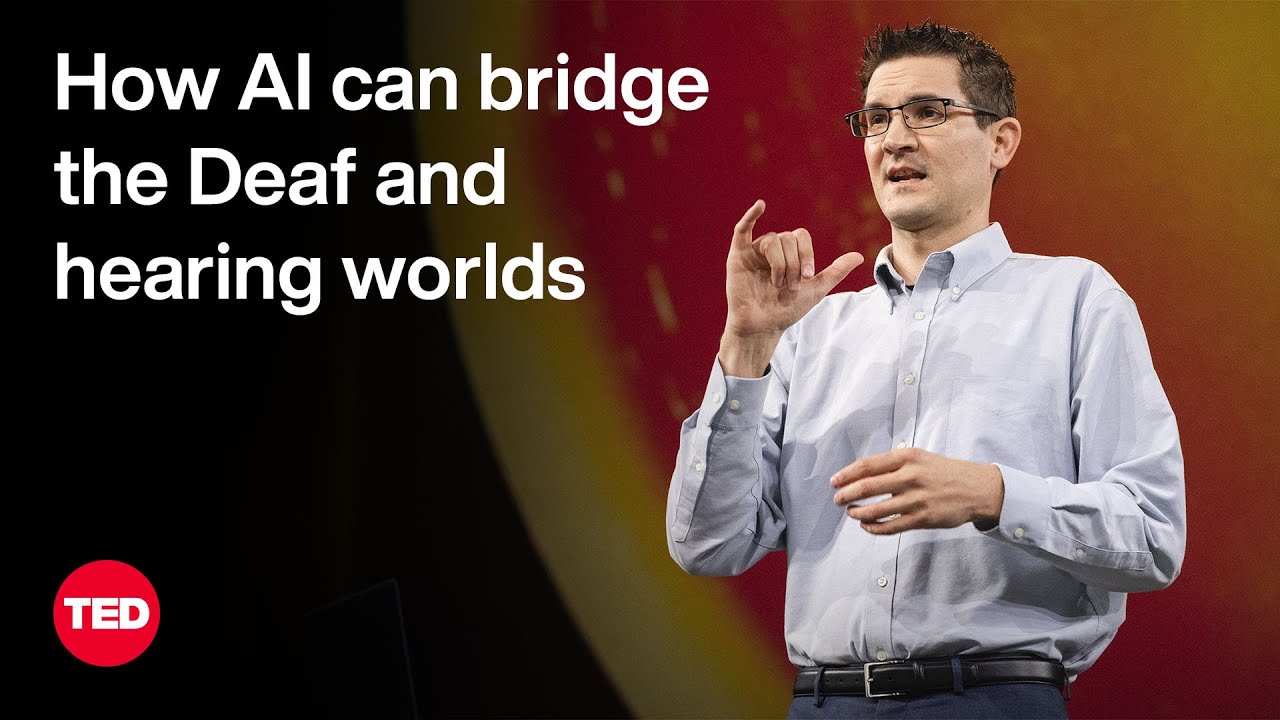
How AI Can Bridge the Deaf and Hearing Worlds | Adam Munder | TED
8:14

How AI Can Bridge the Deaf and Hearing Worlds | Adam Munder | TED

TED 16.01.2025 43 804 просмотров 1 187 лайков обн. 18.02.2026
Поделиться Telegram VK Бот
Транскрипт Скачать .md
Анализ с AI
Описание видео
Software engineer Adam Munder is on a mission to break down communication barriers between the Deaf and hearing worlds. In a live demo, he introduces OmniBridge — an AI platform that translates American Sign Language into English text in real time — and demonstrates how this tech could ensure every conversation can be fully understood, regardless of the participants' hearing abilities. Munder is joined onstage by ASL interpreter Christan Hansen and TED’s Hasiba Haq. (Made in partnership with Intel) (Recorded at TEDNext 2024 on October 22, 2024) If you love watching TED Talks like this one, become a TED Member to support our mission of spreading ideas: https://ted.com/membership Follow TED! X: https://twitter.com/TEDTalks Instagram: https://www.instagram.com/ted Facebook: https://facebook.com/TED LinkedIn: https://www.linkedin.com/company/ted-conferences TikTok: https://www.tiktok.com/@tedtoks The TED Talks channel features talks, performances and original series from the world's leading thinkers and doers. Subscribe to our channel for videos on Technology, Entertainment and Design — plus science, business, global issues, the arts and more. Visit https://TED.com to get our entire library of TED Talks, transcripts, translations, personalized talk recommendations and more. Watch more: https://go.ted.com/adammunder https://youtu.be/ros3INVOQEU TED's videos may be used for non-commercial purposes under a Creative Commons License, Attribution–Non Commercial–No Derivatives (or the CC BY – NC – ND 4.0 International) and in accordance with our TED Talks Usage Policy: https://www.ted.com/about/our-organization/our-policies-terms/ted-talks-usage-policy. For more information on using TED for commercial purposes (e.g. employee learning, in a film or online course), please submit a Media Request at https://media-requests.ted.com #TED #TEDTalks
Оглавление (2 сегментов)

  1. 0:00 Segment 1 (00:00 - 05:00) 559 сл.
  2. 5:00 Segment 2 (05:00 - 08:00) 282 сл.
0:00

Segment 1 (00:00 - 05:00)

Christan Hansen: Adam, wait. They need an interpreter. Now I'm ready. Go ahead. Hello, you guys need an interpreter. Thank you for briefly experiencing what it's like for me and millions of other Deaf people worldwide when we don't have an interpreter and we need to order a coffee, check into a hotel, or complete other daily tasks. What I was trying to share with you was a frustrating experience that my wife and I recently had. My wife is also Deaf and we took our daughter to a doctor's appointment. When we arrived, I'd asked for either an on-site or a virtual interpreter. Unfortunately, they told me neither were available, so I had to write back and forth with the receptionist at the front desk. To make matters worse, when the doctor came into the room, he said, "Oh, it's alright. We'll just have your daughter interpret for you. " So could you imagine going to the doctor's appointment and being told by the doctor that your seven-year-old is going to relay the information to you? This was just one example of the two different worlds that I navigate. In my personal life, I raise my kids, I manage rental properties, I flip buildings, and I'm working on a coffee roastery. In this world, I interact with hearing individuals every day: teachers, lawyers, real estate agents, contractors. Yet still to this day, I have to rely on a smartphone to text back and forth or write with paper and pen to the people I interact with. Then I have the professional world where I have succeeded, in part due to having two highly qualified interpreters. I have the same degrees, the same educational background, the same job responsibilities as my hearing peers. I solve the same engineering problems in a very competitive, fast-paced environment. But the playing field isn't level. And all of my daily collaborations, all of my meetings and presentations, everything hinges on my interpreters. I am very fortunate, though. My employer ensures that I have access to the same information that my hearing colleagues do. Unfortunately, this is not true for many Deaf throughout the world. Interpreters are very expensive and scarce. Where I live in Arizona, there are more than 1. 1 million individuals with a hearing loss. And only about 400 licensed interpreters. So there's scarcity of tools available for us, and our communication options are very limited. This puts us in a survival mode, forcing us to use the resources that are at our disposal. Writing back and forth on paper and pen, or using a smartphone to text is not equivalent to American Sign Language. The details and nuance that make us human are lost in both our personal and business conversations. So we're bringing the humanity back to these conversations. I've done that by building a platform called OmniBridge. So my team has established this bridge between the Deaf world and the hearing world. Bringing these worlds together without forcing one to adapt to the other. So we're using the power of AI to analyze thousands of signs in ASL and translate them into English. Now, thousands may seem small, but ASL is very complex. With slight nuance and changes in body language it can change the meaning of a sign. For instance, the sign "big. " Or "enormous. "
5:00

Segment 2 (05:00 - 08:00)

Today, with the advancement in compute on AI PCs, we're able to run our models locally without relying on the internet, which dramatically increases accessibility. So I'd like to show you an alpha version of this in action. And I want to show you how this could have changed my interaction at the doctor appointment had this been available. I'd like to invite Hasiba on stage. She's going to pretend to be our receptionist at the doctor's office. What you're going to see on screen is a bidirectional conversation, where the software will translate my sign into the blue text, and Hasiba's spoken English will be in gray. Hasiba: Hi, how's it going? [Hi, how's it going? ] (Applause) [I am good. ] [I will like to use your technology to communicate with you. ] Hasiba: Sure, we can use OmniBridge. Could you tell me the name of the patient? Sophie's my sister's name. That's so fun. What's Sophie's date of birth? Perfect. The doctor's going to be here with you shortly. [Thank you so much. ] Hasiba: Thank you. (Applause and cheers) AM: So thank you. You can see that with this there's much less confusion and frustration. And the receptionist and I were able to establish a connection. The best thing of all is that my daughter just had to be the patient. So we're changing the world through the power of AI. Not just revolutionizing technology, but enhancing that human connection. My team is focused on using the AI PC, and the power of AI to humanize and include to really, truly level the playing field. It's two languages, signed and spoken, in one seamless conversation. Thank you. (Applause)

Ещё от TED

Ctrl+V

Экстракт Знаний в Telegram

Транскрипты, идеи, методички — всё самое полезное из лучших YouTube-каналов.

Подписаться