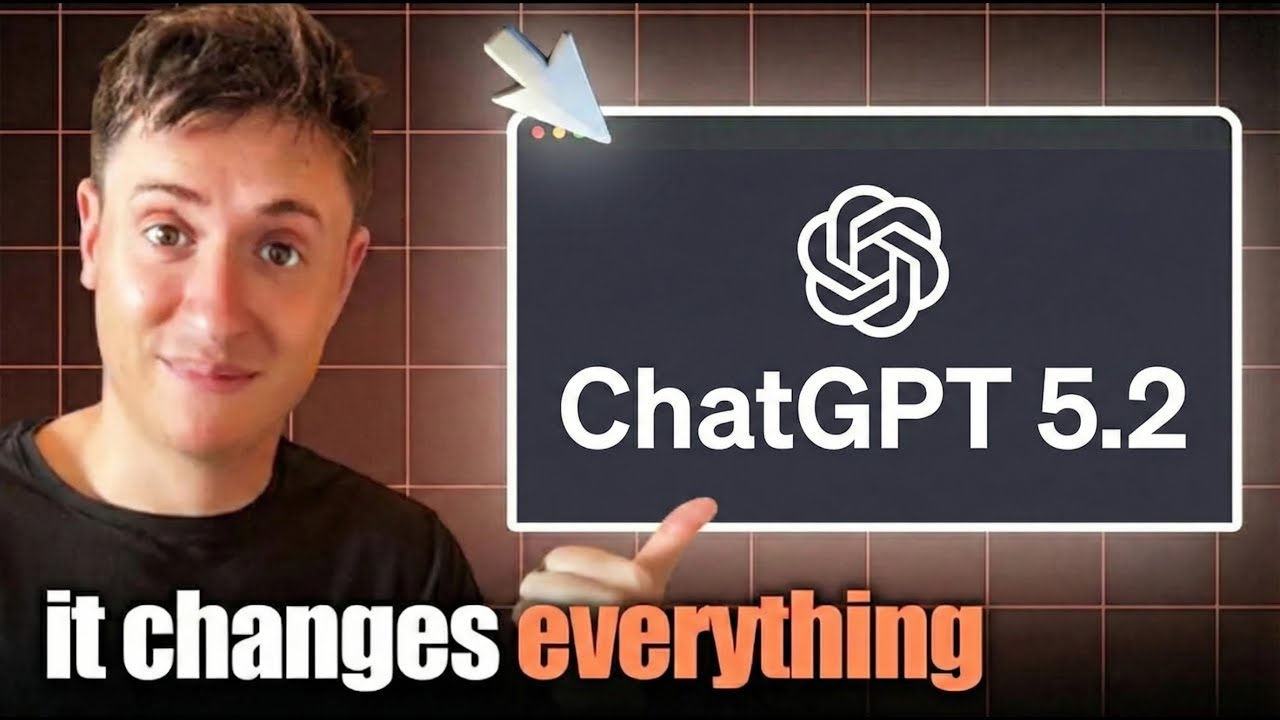
ChatGPT 5.2 is INCREDIBLE. Here’s how to use it in 14 minutes
Machine-readable: Markdown · JSON API · Site index
Описание видео
ChatGPT 5.2 just dropped and it's amazing. Here are all the strengths, weakness, and a master workflow.
Join the Vibe Coding Academy: vibecodingacademy.dev
Sign up for my free newsletter: https://www.alexfinn.ai/subscribe
Follow my X: https://x.com/AlexFinnX
My $300k/yr AI app: https://www.creatorbuddy.io/
BUSINESS PROMPT:
You are my brutally practical cofounder. I’ll give you my background + interests. Your job: generate app + business ideas that are actually shippable and sellable, not generic “AI habit tracker” trash.
My profile
Career/skills: I'm a content creator who makes tweets and videos about vibe coding
Interests/obsessions: AI, technology, entrepreneurship, investing, business
People I can reach / distribution: 55,000 on youtube and 300,000 on X
What I refuse to build: super massive, expensive, large scope projects
Time/complexity limit: 2 months
Platforms: iOS app or web app
Output rules
Give 8 ideas. Each must have:
Name (2–4 words)
One-sentence pitch
Target user
Pain it solves (specific)
MVP in 5 bullets (smallest real thing)
Why this wins (1 clear differentiator)
Monetization (price + model)
Fast distribution angle (how you’d get first 100 users)
Build time estimate (Weekend / 1 week / 2–4 weeks)
Then pick the best 1 and give:
a 30-second founder pitch
a 7-day execution plan (Day 1–7, concrete)
the first 3 screens (or pages) it needs
Hard constraints
No saturated ideas (todo, generic journaling, generic habit tracking, generic “AI chatbot wrapper”).
At least 3 ideas must be “weird but plausible” (novel combo of my interests).
Keep it tight. No essays.
STOCKS PROMPT:
You are my AI equity research analyst + data engineer. Use your tools (web browsing + market data + code) to produce an investor-ready output.
Universe:
* Analyze these AI-related tickers: NVDA, AMD, AVGO, TSM, ASML, MU, ARM, MSFT, GOOGL
* Benchmark: S&P 500 (or SPY)
Rules:
* You MUST browse the web for current info and cite sources for every key claim (earnings, guidance, major partnerships, regulatory issues, major product roadmap, competitive threats).
* Use market data tools for prices/returns when available; otherwise retrieve from reputable sources.
* No fluff. If you can’t verify something, say “unverified” and move on.
Deliverables (in this order):
1. Action Log (8–20 bullets)
* Briefly list what you did (e.g., “Pulled price history,” “Read latest earnings,” “Extracted guidance,” “Built spreadsheet,” “Generated charts”). No internal reasoning, just actions.
2. Spreadsheet (create a downloadable file)
Include one row per ticker with columns:
* Ticker, Company, Sub-sector (chips/cloud/software/etc.)
* Current price, 1D %, YTD %, 1Y %, 3Y % (if available)
* Market cap, Forward P/E (or N/A), Revenue growth (latest YoY), Operating margin (latest)
* “Moat score” 1–5 and moat drivers (short)
* Key risks (short)
* 3 bull catalysts (short)
* 3 bear catalysts (short)
* “What would change my mind?” (one line)
3. Charts (generate at least 2)
* Chart A: Indexed performance over the last 12 months for all tickers vs SPY (start = 100)
* Chart B: Max drawdown over the last 12 months (bar chart)
4. Research Summary (tight)
* For each ticker: 3-bullet bull case + 3-bullet bear case + 1-sentence moat
* Then: rank top 3 “best risk/reward” and top 3 “most fragile,” with one sentence each explaining why.
5. Sources
* List sources used per company (links/citations).
Timestamps:
0:00 Intro
0:30 Benchmarks
1:04 Strengths and weaknesses
1:50 Business prompt
5:45 Other strengths
6:38 Stock researching
9:09 Other strengths
9:49 Weaknesses
12:28 Pricing
12:42 When to use it