My Brutally Honest Advice About Joining Google (after 9 years)
10:36

My Brutally Honest Advice About Joining Google (after 9 years)

Jeff Su 29.07.2025 49 890 просмотров 1 195 лайков обн. 18.02.2026
Поделиться Telegram VK Бот
Транскрипт Скачать .md
Анализ с AI
Описание видео
The Workspace Academy - https://academy.jeffsu.org/workspace-academy?utm_source=youtube&utm_medium=video&utm_campaign=185 After 9 years at #Google and interviewing hundreds of non-technical candidates, I'm sharing the insider strategies that actually work; based on real #hiring data and firsthand experience from both sides of the #interview table. Let’s dive in! *TIMESTAMPS* 00:00 How to join Google 00:12 Strategy #1 02:13 Strategy #2 04:01 Strategy #3 06:22 Strategy #4 07:29 Strategy #5 09:12 Strategy #6 *RESOURCES MENTIONED* The Workspace Academy - https://academy.jeffsu.org/workspace-academy?utm_source=youtube&utm_medium=video&utm_campaign=185 Google Ads webinars: https://adsonair.withgoogle.com/ My Job Search Playlist: https://www.youtube.com/watch?v=Tt08KmFfIYQ&list=PLo-kPya_Ww2x1PzbqzmPPC5v7fCYhrK4z Case Interview Secrets: https://amzn.to/4o4XtUB Case in Point: https://amzn.to/3IPkGdm *BUILD A POWERFUL WORKFLOW* 📈 The Workspace Academy - https://academy.jeffsu.org/workspace-academy?utm_source=youtube&utm_medium=video&utm_campaign=185 ✍️ My Notion Command Center - https://www.pressplay.cc/link/s/DE1C4C50 *BE MY FRIEND:* 📧 Subscribe to my newsletter - https://www.jeffsu.org/newsletter/?utm_source=youtube&utm_medium=video&utm_campaign=description 📸 Instagram - https://instagram.com/j.sushie 🤝 LinkedIn - https://www.linkedin.com/in/jsu05/ *MY FAVORITE GEAR* 🎬 My YouTube Gear - https://www.jeffsu.org/yt-gear/ 🎒 Everyday Carry - https://www.jeffsu.org/my-edc/
Оглавление (7 сегментов)

  1. 0:00 How to join Google 47 сл.
  2. 0:12 Strategy #1 359 сл.
  3. 2:13 Strategy #2 346 сл.
  4. 4:01 Strategy #3 444 сл.
  5. 6:22 Strategy #4 188 сл.
  6. 7:29 Strategy #5 318 сл.
  7. 9:12 Strategy #6 255 сл.
0:00

How to join Google

I worked at Google for a total of 9 years and during that time I've also interviewed hundreds of non-technical applicants. So here's my honest advice for those of you looking to rest invest. I mean grind and grow. Let's get started. Strategy number one, foot in
0:12

Strategy #1

the door. In a nutshell, to maximize your chances of getting into Google with no technical background, apply for sales roles. And since internal mobility is relatively easy, transfer to your target team in a year or two. First, to be clear, I'm not putting down a sales team. It's just simple math. Let's go through some real numbers. By the time I left Google, the global ratio of full-time sales to marketing employees was 6:1. In greater China, where I was based, it was even more extreme. 15 sales openings for every one marketing opening. Here's the kicker. The skills required for sales and marketing are broadly interchangeable, especially at junior levels. If you don't believe me, take a look at Google's own career site and compare the job descriptions for sales roles and marketing roles. Coming back to the 15 to1 ratio, if a 100 candidates are competing to just get into Google, all things being equal, their chances of getting to sales is 15 times higher than getting into marketing. When applying to sales, you want to target roles with these keywords. Account manager, large customer solutions, LCS, or account manager, account strategist, Google customer solutions, GCS. These are the ad sales teams. By joining LCS or GCS, you'll become an expert in the company's largest revenue driver, Google Ads. And this becomes an even bigger asset when you apply for internal transfers since most other business teams support the ads ecosystem. Speaking of transferring, unlike most other companies, Google actively encourages internal mobility. They often post openings on an internal jobs board first before sharing externally. And they also have global rotation programs. Project Voyager for sales, APMM for marketing, APM for product management, just to name a few. To close the loop, I'm living proof the strategy works. I joined Google as an account manager in the GCS team before transferring to marketing via the APMM program 2 years later. The skills I gained in sales from hard skills like Google Ads to soft skills like storytelling were instrumental to my success in marketing and now as an online educator. So, it's an excellent
2:13

Strategy #2

entry point into Google. Strategy number two, join as a contractor first. This is a pretty controversial topic, so I'll try to be as objective as possible. For context, according to the New York Times, Google employs over 100,000 contractors through outside agencies compared to over 180,000 full-time employees, FTEEs, from their latest filings. These contractors often work alongside Googlers, but with different salary and benefit structures. Three reasons you might want to consider this route. First, the barrier to entry is lower. Contractors go through fewer interviews, and the interviews themselves are less rigorous than those for full-time positions. Second, contractors get the inside track. They gain direct exposure to Google's culture, internal tools, and most importantly, people who can refer them. When full-time positions open, they're the first to know and can prepare ahead of external candidates. Third, I don't have the official stats to back this up, but anecdotally, I've observed the success rates for converting to an FTE is two to three times higher than that of joining as an external candidate. Just think about it from the hiring manager's perspective. Why would they want to go through the trouble of vetting dozens of external candidates when they already know someone who can do the job? All that being said, conversions are nowhere close to guaranteed. So, here's some tough love advice I might get a lot of hate for. First, you have to work your ass off. Yeah, it's going to feel unfair when you work harder than some FTEEs while enjoying fewer benefits. Just tell yourself you'll get back at Google by resting investing once you're in. No, but real talk, Scott Galloway says it best. The system may need fixing. Until then, you have to stand it. Better yet, develop the skills and strategies to prosper within it. Second, contractors must pass the same hiring bar as external candidates. But again, you have the inside track. FTEEs who know and like you will help you prepare, which is a massive unfair advantage external candidates can only dream of. Strategy
4:01

Strategy #3

number three, authentic referrals. All studies on the topic show referred candidates are three to four times more likely to be hired than online applicants. At Google, this difference is even greater given the sheer volume of applications that we I mean Google receives. On a tactical level, almost every referred candidate receives at least a first round interview. I know this firsthand. My classmate Aash referred me nine years ago and that gave me a huge unfair advantage. But here's the thing, Aash and I weren't friends back then and you might not know anyone who works at Google. So what should you do? Here are two techniques. The first is generic but loweffort. Open up LinkedIn. Search for secondderee connections who work at Google. Then ask your mutual firstderee connection for introduction and set up a coffee chat to learn more about their role. This is very important. Do not ask for referrals during the first chat. It feels forced, inauthentic, and when Googlers submit referrals, they can check, I don't know this person, which kills a referral. So, you might get notified that you were referred, but you weren't. The inconvenient truth is that earning the referral takes time and effort. Come prepared to the chat with smart questions that a Google search can answer. Follow up within 24 hours with a thank you note, and a week later, show them that you've acted on their insights. Put simply, make referring you a no-brainer. And for specific tactics, you can check out my job search videos, which I'll link down below. The second tactic is extremely effective but high effort. Assuming you want to join the ad sales team, search for Google Ads webinars, sign up and attend these workshops, and now you have a natural and authentic opening to message these speakers on LinkedIn with learnings from their session. Almost no one will be willing to do this, so when you do, the Googlers will take you seriously. Obviously, this is just one specific example. The broader strategy is to attend Google hosted events, take notes, and build authentic connections with speakers through thoughtful follow-ups. Sarah Johnson, a career coach I respect, puts it perfectly. Introductions are social currency. If someone is willing to make connections for you, they are essentially giving you a blank check. And the value is determined by you. By the way, over the past nine years, I've actually trained over 6,000 Googlers on a productivity workflow that eliminates mental and digital clutter. So, if you want to get organized at work, you can check out my Workspace Academy course link down below. Strategy number four
6:22

Strategy #4

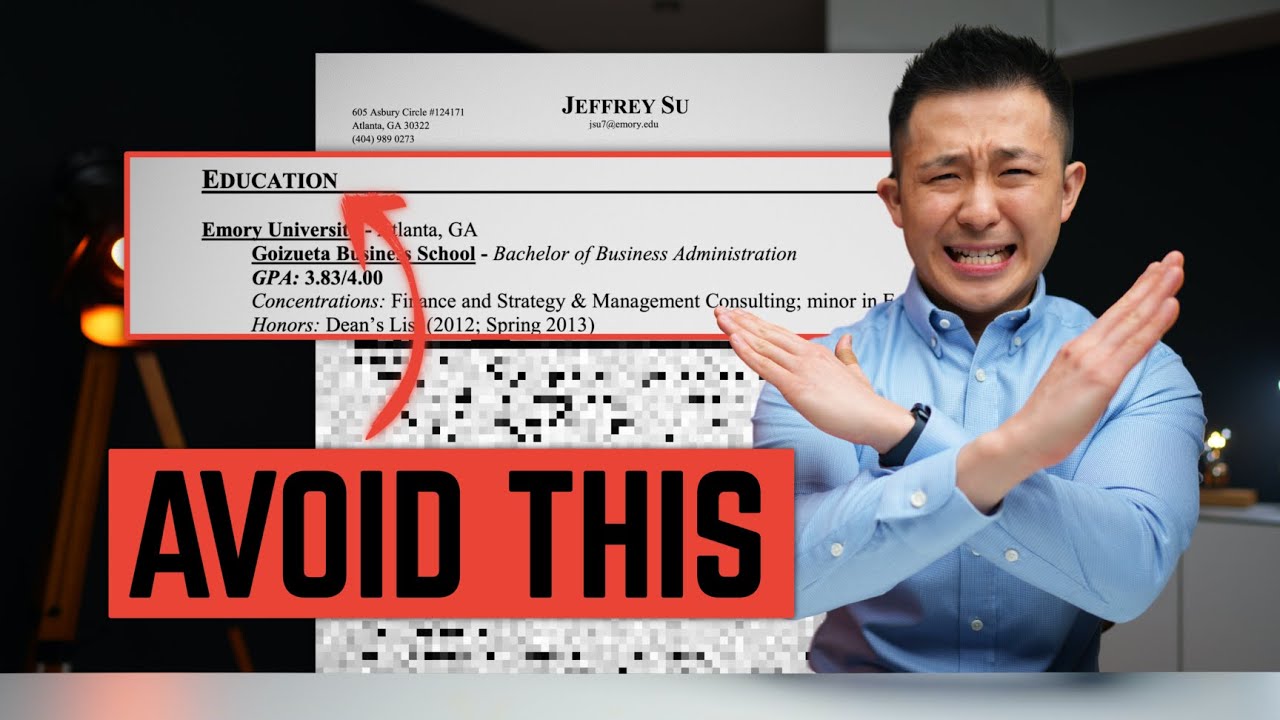
follow the XYZ framework. This is the easiest strategy to implement, yet only two to three out of every 10 applicants I reviewed got it right. In a nutshell, Google recruiters explicitly recommend the XYZ bullet point framework for résumés. accomplished X as measured by Y by doing Z. Example one, instead of a generic bullet point like managed a marketing campaign, we write grew lead generation by 25% in one quarter by launching a meta lookalike campaign. Example two, instead of created a community that meets weekly to share best practices, we write increased internal tools adoption by 13% in four weeks by leading weekly lunch and learns for sales and marketing teams. Hiring managers and recruiters love this framework because it forces us the applicant to showcase impact grew lead generation by 25%. Instead of listing tasks managed a marketing campaign and for those of you thinking but Jeff my role doesn't have quantifiable metrics I have an entire video on how to use catchupt to identify authentic metrics for any role even if you are taking care of sick family members. So check it out
7:29

Strategy #5

after strategy number five interview like a consultant. For context, Google interviews cover four categories: general cognitive ability, GCA, role related knowledge, RRK, leadership, and googliness. The GCA questions are usually the trickiest because there's no correct answer. It's your thought process that matters. For example, here's a real GCA question. Tell me about a time when you were required to quickly learn a complex process. Now, hit pause for a second and think about how you would answer this question. If you immediately started thinking of examples that fit the criteria, learn a complex process, that would be the wrong approach. Instead, you want to start off with a clarifying question like, does this have to be a professional experience or can it be something from my personal life? Not only do you buy yourself time to come up with a strong answer, you also demonstrate critical thinking skills. I've made multiple videos tackling these types of questions linked below, so I won't waste your time here. In addition though, I highly recommend reading either case interview secrets or case in point. Although these two books were written with consulting interviews in mind, their frameworks are 100% applicable to all four Google interview categories. Pro tip, if you make it to the interview stage, be prepared to share your favorite Google product and why. Although interviewers are supposed to pick questions from question banks, they're human. So after hours of backto-back interviews, they sort of gravitate towards fun questions. So, what's your favorite Google product? Comes up way more than you would expect. Obviously, AI is all the hype right now. So, you might be tempted to say Google Gemini, but that's what everyone else is saying too, right? So, unless you have something really interesting to say. For example, Jeff Sue's Google Gemini tutorial changed my life. Uh, pick another product that you have a good
9:12

Strategy #6

story about. Strategy number six, don't join Google. Ironically, this might be the most controversial part of this entire video, which is saying something. If you are a fresh graduate, my honest advice for you is to not join Google straight out of college. Don't get me wrong, Google employs some of the brightest people I've ever met. Has best-in-class tools and processes, relatively speaking, and just ridiculous perks and benefits. But that's exactly the problem. Over the past 9 years, I've noticed a lot of Google babies, people who start their career at Google, they face two unique challenges. First, they develop this warped expectation of corporate life. Google sets this impossibly high bar, making it painful to adapt anywhere else. Second, as a result of being so spoiled, they get too comfortable. They stay when they should leave, explore, and bet on themselves. And yearby year, they become less competitive in the real world while growing more dependent on the Google bubble. Obviously, this doesn't apply to everyone, and I'm sure I'll receive a lot of push back in the comments, but I sincerely believe the I went through in my first full-time job in consulting and the resilience I developed as a result set me up for success in Google and beyond. If you're applying to Google, leave your questions down below. If you are a Googler or ex Googler, I'd love to hear your opinion on my takes. See you on the next video. In the meantime, have a great one.

Ещё от Jeff Su

Ctrl+V

Экстракт Знаний в Telegram

Транскрипты, идеи, методички — всё самое полезное из лучших YouTube-каналов.

Подписаться