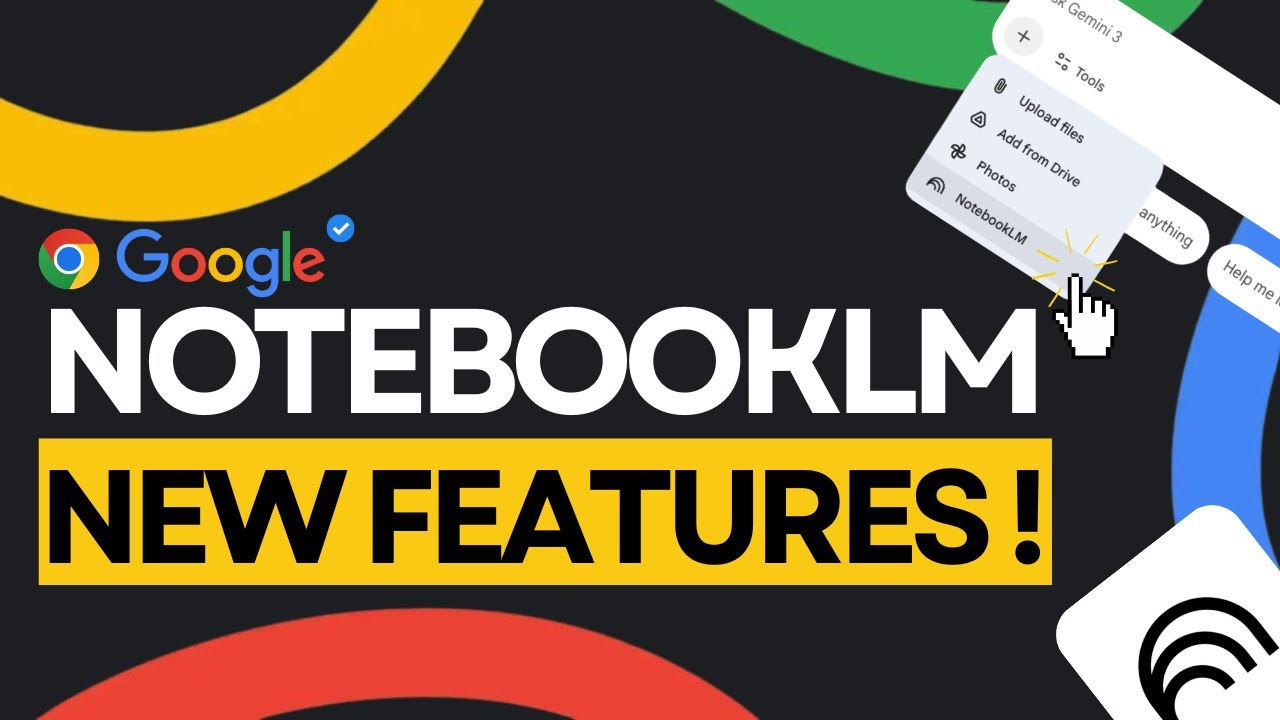
Google NotebookLM Just Got a Major Upgrade: Deep Research!
8:09

Google NotebookLM Just Got a Major Upgrade: Deep Research!

Universe of AI 26.10.2025 74 279 просмотров 1 809 лайков обн. 18.02.2026
Поделиться Telegram VK Бот
Транскрипт Скачать .md
Анализ с AI
Описание видео
Google’s NotebookLM just got a massive AI-powered upgrade — introducing Data Tables, Deep Research Mode, and the new Artefact System. In this video, we break down what these features are, how they work, and why they could completely change how you research, write, and organize knowledge. 🔍 What’s New: • Data Tables — turn messy notes into structured comparisons • Deep Research Mode — AI that explores your sources for you • Artefact System — a smarter way to generate summaries, tables, and slides 💡 Why It Matters: • Smarter research automation • Seamless integration with Google Docs, Drive & Slides • Huge time-saver for students, analysts, and creators 0:00 - Introduction 0:45 - What is NotebookLM 1:42 - NEW Data Tables 3:08 - NEW Deep Research 4:28 - Other NEW Features 5:18 - Why it Matters! 6:02 - How to try it 7:23 - Conclusion 🔗 My Links: 📩 Sponsor a Video or Feature Your Product: intheuniverseofaiz@gmail.com 🔥 Become a Patron (Private Discord): /worldofai 🧠 Follow me on Twitter: /intheworldofai 🌐 Website: https://www.worldzofai.com #notebooklm #googleai #deepresearch #datatables #airesearch #UniverseOfAI #googlelabs #aitools2025 NotebookLM, Google NotebookLM, Deep Research Mode, Data Tables, Google AI, Artefact system, NotebookLM update 2025, AI productivity, research automation, AI tools, Universe of AI, AI for students, AI for researchers, AI for business strategy, ChatGPT alternative, Google AI tools 2025, Perplexity vs NotebookLM, AI note-taking, Google Labs

Оглавление (8 сегментов)

  1. 0:00 Introduction 123 сл.
  2. 0:45 What is NotebookLM 133 сл.
  3. 1:42 NEW Data Tables 211 сл.
  4. 3:08 NEW Deep Research 206 сл.
  5. 4:28 Other NEW Features 113 сл.
  6. 5:18 Why it Matters! 119 сл.
  7. 6:02 How to try it 209 сл.
  8. 7:23 Conclusion 118 сл.
0:00

Introduction

Google's Notebook LM just got a massive upgrade. I'm talking data tables, a new artifact system, and an advanced deep research mode that could completely change how you do research, organize notes, and even write reports. If you've been using Notebook LM to summarize articles, pull insights, or keep your ideas organized, this update takes it to another level. And if you haven't tried it yet, this might be the reason to finally make the switch. In today's video, we'll break down what each of these features does, why they actually matter, and how they stack up against other tools out there. Stick around till the end because we'll also cover how these upgrades could transform workflows for students, creators, and strategy professionals.
0:45

What is NotebookLM

professionals. Let's start with a quick recap. What is Notebook LM? Notebook LM is Google's AI powered research notebook. You upload your PDFs, Google Docs, transcripts, whatever you're working with, and Notebook LM lets you chat directly with your own sources. It summarizes documents, answers questions with citations, and helps you connect ideas across different files. Think of it like having an AI research assistant that lives inside your notes, train only on your material, not random internet data. Over the past few months, Notebook LM quietly became one of Google's most underrated AI tools. It already supports multimedia notes, citations, references, and even basic audio summaries. But now, Google's preparing for the next leap, turning notebook LM from a summarization tool into a full-fledged research and analysis engine. The first big leak
1:42

NEW Data Tables

data tables, introduced through something Google calls an artifact. So, what's an artifact? Artifacts are basically new document types inside Notebook Ella. You already have text artifacts like summaries or essays, but data tables are a brand new structured artifact designed for organizing and comparing information. Imagine you upload five industry reports inside of Notebook LM and it gives you a long paragraphs of text. It automatically builds a table comparing metrics across them. revenue growth, market size, customer satisfaction, whatever you define for it. It's like having a spreadsheet that fills itself in. From early previews, it looks like you'll be able to pull quantitative data from multiple sources, arrange it into rows and columns automatically, and even sort or filter insights visually. So if you're analyzing five AI startups for a report, Notebook LM could generate a clean table comparing valuation, funding rounds, team size, and product focus all within seconds. And for professionals like in strategy, finance, or analytics, that's a huge timesaver. It's bridging the gap between a textbased AI and an actual structured analysis tool. But that's only half the story because Google isn't stopping at structured data. It's going after something much bigger. Next up, the most anticipated one, deep research mode. If you used
3:08

NEW Deep Research

Notebook LM before, you know it already has a fast research feature. It scans your uploaded docs and gives quick, concise answers. But deep research takes that idea and supercharges it. Instead of just answering your questions, can autonomously explore your sources and even expand beyond them. Think of it like telling the AI, "Find everything I should know about renewable insurance trends in Canada. " And it goes out, reads your files, cross-checks public web data, and come back with multiple layered report complete with summaries, tables, and cited references. It's not just summarizing anymore. It's synthesizing knowledge. And if that sounds familiar, that's because it's very similar to what Perplexity's Pro Search or Entropics projects are trying to do, except this time it's all happening inside Google's ecosystem. Why this matters? You don't have to manually upload every file or Google each question. It can build context over time, connecting dots between your own documents and verified web sources. And it creates a structured knowledge base that actually grows smarter the more you use it. But of course, this raises some big questions. Accuracy, source bias, and how much autonomy we really want to give these AI systems. We'll come back to that later.
4:28

Other NEW Features

Notebook LM is also getting smaller but surprisingly powerful workflow upgrades. One is a slides generation artifact where Notebook LM turns your notes into presentation decks automatically. You'll be able to generate structured slides with bullet points, charts, or even images pulled from your research sources. Then there's an infographics feature designed for people who want to visualize insights quickly. Think onepage summaries, diagrams, or visual mind maps. And last, Notebook LM is improving how it handles multissource integration, combining PDFs, docs, and URLs in one coherent workspace. These aren't flashy headline updates, but they're the glue that will make deep research actually usable in day-to-day workflows. So, why does all of this
5:18

Why it Matters!

matter? Because Notebook LM is quietly redefining what a research assistant means. For years, we've had AI models that can write. Now, we're seeing AI tools that can think across information, understand your files, connect ideas, and present them in structured formats. If you're a student, this means fewer late nights manually compiling citations and research tables. If you're in business, it means faster strategy briefs, market scans, and reports. And for creators or YouTubers, imagine feeding all your sources into one project and letting Notebook LM generate accurate summaries or visuals you can use in your videos. This is the direction AI tools are heading. From reactive chat bots to proactive research partners. Now, before you get too
6:02

How to try it

excited, we need to talk about what's not confirmed yet. These features, data tables, deep research, and slides are still in early testing, and some may roll out gradually or behind Google Apps invites. There's also the question of accuracy and privacy. Deep research might read external web data, meaning results could be biased, hallucinated, or limited to publicly available content. And if you're working with confidential docs, you'll need to confirm how Google handles data storage, especially for enterprise users. Basically, powerful features, but double check before you feed in sensitive data. So, how can you get ready for this next phase? Here's what I would suggest. Join the weight list or enable labs access. Notebook LM updates usually appear first in Google Labs or Workspace Labs. Number two, organize your source material. Now, clean folders, rename documents, and tag files by topic. Deep research will perform better with structured data. Number three, test hybrid workflows. Try combining notebook LLM summaries with sheets or slides to see where automation saves you time. And number four, for professionals, think about how this fits into your research or strategy process. What could be automated? What still needs human review? Treat it like a co-pilot, not a replacement. To wrap it
7:23

Conclusion

all up, Notebook LM is evolving from a simple note summarizer into a true research engine. Data tables bring structure, deep research brings discovery, and artifacts tie everything together in one ecosystem. It's Google's quiet play to compete with Chat GPT's custom GPTs and Tropics projects and Perplexities Pro features, but with the advantage of being deeply integrated into Drive, Docs, and Slides. Let me know in the comments which of these features would you use first? Data tables for structured analysis or deep research for automation and exploration. If you found this breakdown helpful, drop a like, subscribe to Universe of AI, and we'll see you next week for another deep dive into the future of intelligence.

Ещё от Universe of AI

Ctrl+V

Экстракт Знаний в Telegram

Транскрипты, идеи, методички — всё самое полезное из лучших YouTube-каналов.

Подписаться