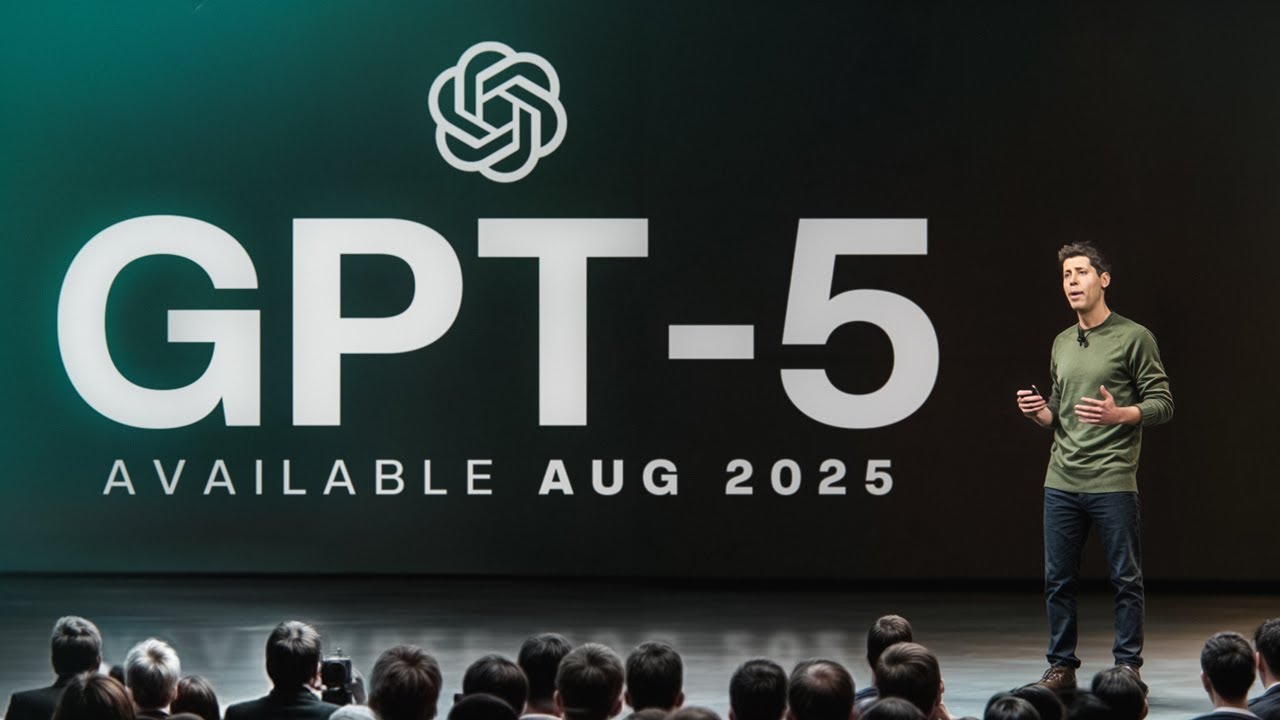
Sam Altman: The Elon Musk of AI — GPT-5 & the AGI War
25:23

Sam Altman: The Elon Musk of AI — GPT-5 & the AGI War

AI Master 15.08.2025 6 205 просмотров 134 лайков обн. 18.02.2026
Поделиться Telegram VK Бот
Транскрипт Скачать .md
Анализ с AI
Описание видео
#sponsored 🚀 Become an AI Master – All-in-one AI Learning https://aimaster.me/pro 📹Get a Custom Promo Video From AI Master https://collab.aimaster.me/ Use code AIMaster to get $99 off your plan on CustomGPT! https://customgpt.ai?fpr=arthur67 Sam Altman’s rise, the GPT-5 hype, and the AGI war with Elon Musk — who really controls the future of AI? This documentary traces OpenAI from its nonprofit roots to today’s billion-dollar power struggle: boardroom drama, safety vs. speed, and the race to build AGI. You will find: — Altman’s path from YC to OpenAI CEO — Musk’s split and the birth of xAI (OpenAI vs xAI) — The 2023 OpenAI board coup and Microsoft’s role — Safety, regulation, and why the stakes keep rising — Who benefits if AGI arrives first? — If you care about ChatGPT, GPT-5, and who’s steering AI, this is your one-stop deep dive. Subscribe for more tech docs and breakdowns. #samaltman #elonmusk #gpt5 #openai #agi #chatgpt #ai 0:00 - Intro 01:29 - Early years 02:45 - First AI ideas 06:47 - Difficult years 10:10 - The Plunge 12:33 - The Breakthrough 14:40 - On AI’s Secret Service 16:16 - The Coup 19:01 - Day 4 21:35 - Elon Musk 24:11 - What about...?

Оглавление (11 сегментов)

  1. 0:00 Intro 301 сл.
  2. 1:29 Early years 213 сл.
  3. 2:45 First AI ideas 675 сл.
  4. 6:47 Difficult years 572 сл.
  5. 10:10 The Plunge 398 сл.
  6. 12:33 The Breakthrough 335 сл.
  7. 14:40 On AI’s Secret Service 293 сл.
  8. 16:16 The Coup 477 сл.
  9. 19:01 Day 4 439 сл.
  10. 21:35 Elon Musk 434 сл.
  11. 24:11 What about...? 172 сл.
0:00

Intro

Open AI. I mean, you seem somewhat frustrated with them. You were one of the big contributors early on. — I am the reason OpenAI exists. — Why do you think he's so frustrated or disappointed with the direction that Open AI has gone? — Um, I mean, you should ask him. Elon tries all sorts of things for a long time. — It's a lie. Straight up. — It's a straight up lie. — How you feel personally today about all this? — Tremendously sad. I grew up with Elon as like a mega hero. The single biggest reason they're happening is because of me. — The company is not for sale. Neither is the mission. We're happy to buy Twitter if you want to talk about that. — Like it doesn't have to change the world. Like — you know, we started Open Eye together and then at some point he like totally lost faith. — We do all of this because we believe the AI is going to be a technological and societal revolution. It will change the world in many ways. And we're happy to get to work on something that will empower all of you to build so much for all of us. Samuel Harris Alman, Sam for short, CEO of OpenAI, the creator of Chad GBT, Dolly and Sora. Everyone who's even remotely interested in AI knows this name now. Seen as an innovator and a visionary, his life story is not a usual one. Born in an ordinary family, has proven to be nothing but ordinary since the early days of his life. But how could a kid who used to code for Mac become a tech titan? This is a crazy story of how a regular Chicago kid became the face of AI.
1:29

Early years

Sam was born on April 22nd, 1985 to a dermatologist and a real estate broker. Very normal on the surface, right? Except by the time he was eight, he was already programming on a Macintosh his parents got him. He was that kid, super curious, always into something new and laser focused when he found something that interested him. Classmates saw him as friendly but insanely determined. He wasn't just a computer wiz, though. He also had that early entrepreneur gene. When he was 12, he ran a small online business flipping baseball cards. By 19, he dropped out of Stanford's computer science program to co-found Loop, location-based social app. Chances are you've never heard of Looped, and honestly, neither had I. But back then, the idea of letting friends see where you were in real time felt pretty fresh. that helped Loop score his first big investments. Anyway, Loopt didn't turn into a gigantic hit that was eventually acquired in 2012. But that whole journey took Sam from being just another coder to a real entrepreneur. Plus, it put him on the map with Y Combinator, basically a bigname startup incubator that gave Loop some of its funding. Sam quickly became a star in that world and well, the rest is history.
2:45

First AI ideas

Back in the early 2010s, AI was just starting to show its true potential. It wasn't exactly everywhere yet, but there were these key moments like IBM Watson crushing it on Jeopardy and Google's DeepMind winning at Go that really caught Sam's eye. He knew something big was in the horizon. You could say he was a total dreamer and he started feeling limited by the usual tech stuff around him. Photo sharing apps, gig economy services, and all that jazz. Sure, Sam was already killing it as a startup kingmaker held in companies like Airbnb and Dropbox get off the ground. He was successful. He was respected, but still in the comfort zone of familiar territory. Then he got obsessed with one big idea, AGI, or artificial general intelligence. Sam later admitted he saw AGI as maybe the most transformative invention humanity could create. Something that might help us elevate humanity, but also be a world changer. So massive you could say this time it's different. After spending a while stuck in this idea, Sam and a few other visionaries decided to switch gears completely. In December 2015, they founded OpenAI with a goal that was simple but also massive. make sure AI's progress was safe and beneficial for all. Money was never the main reason. He always saw AI as a tool that could shape a brighter future. Sure, that might sound a bit high-minded or pompous, but hey, Sam is a dreamer. Naturally, you can't talk about OpenAI without mentioning the founding crew, Jessica Livingston, Peter Theal, and of course, Elon Musk. These days, Musk and Alman have a pretty complicated relationship, but back in 2015, they were on the same page, sharing big ideas. Today, we have Elon Musk. Elon, thank you for joining us. — Yeah, thanks for having me. — We all know how that story went though. In early 2018, Elon left OpenAI and soon became one of its loudest critics. So, yeah, things changed big time, but that's a tale for another day. When all this was happening, there were no assistance of any kind, unless you count Siri. So Sam had to do everything himself like working with company data. Now you can just use Chad GBT. But back then, let's be honest, most broad AI models might have huge training sets, but when it comes to detailed specific info, like your company's internal dogs or some weird product specs, they usually crash and burn. I've had to correct so many AI answers that sounded sure of themselves, but were totally off base. That's where Custom GBT AI flips the script. they are sponsoring this video and you just upload your stuff, documents, website text, YouTube content, even files straight from Google Drive and the platform builds a specialized model around your data and as the result you get super accurate responses backed by real citations. I can feed it some obscure internal files and get perfectly onpoint answers every time. And they don't train their models on your data unlike certain big names. You know who I mean. Custom GBT makes privacy a priority. If your business deals with sensitive or proprietary info, that alone might be worth every penny. Where custom GBT really shines is deployment. Once your custom agent is set up, you can put it anywhere. Your website, Slack, customer portals, even behind a payw wall if you've got a software service or knowledge product. That kind of flexibility just isn't something Chad GBT can do out of the box. And guess what? It's not just small startups or AI nerds like me messing with it. Big hitters like MIT, Adobe, and Dropbox are on board. They're also the only startup listed alongside OpenAI, Meta, and Amazon as a Gen AI immersion leader. Pretty insane company to keep. So, if your business needs accurate private domain specific answers, and you are done trying to juryrig solutions with oneizefits-all tools, custom GBT is absolutely worth your time. The link is in the description.
6:47

Difficult years

description. Like with any big project, the first few years can be brutal, and Sam's journey was no exception. He didn't just drop everything at Y Combinator all at once. Instead, he tried to juggle both roles. By day, he was YC's president. By night, he was an AI enthusiast funding research. Sort of like Batman. If Batman spent his nights debugging instead of fighting crime, was almost as if he was asking himself, "Am I really ready for this? " Everyone knew pushing for human level AI was a huge gamble. It could take decades, soak up billions of dollars, and put them in direct competition with tech giants who had way more resources. And let's not forget, OpenAI started off as a nonprofit. So, the usual money-making models didn't apply. How on earth would they pay for everything? But Sam had a powerful ace up his sleeve. Paul Graham, the guy who first spotted his potential back in 2014 and made him president of YC. Funny enough, Paul almost stopped OpenAI from happening, at least indirectly. He was originally not keen on funding Sam's first startup, Looped. He actually tried to brush Sam off by emailing that maybe this Stanford sophomore should apply next year. Sam's legendary reply, I am a sophomore and I am coming. That sealed the deal. He flew to Boston, wowed Paul and Jessica Livingston, and Jessica later said, "From the first moment we met him, we realized this kid is wise beyond his years. " So Paul ended up becoming Sam's mentor and eventually one of his best friends. He taught Sam how to lead without trampling on the people he worked with. Scale that's not so common even in Silicon Valley. Sam also had Elon Musk in his corner back then, serving as a sort of philosophical guide, making sure Sam's vision stayed somewhat ethical. Every dreamer needs someone to keep them grounded, right? And seriously, why stop? All that's limiting you is your imagination at this point. Just dream something and bring it to life. And for all of you struggling to visualize stuff, use AI toolfinder for finding the right AI tool for your needs. chat with our bots to learn more about AI or just have a voice chat with my digital copy. And there are also tons of educational materials and unique videos you won't find anywhere else. We want Geek Academy to become the biggest and most useful hub for AI enthusiasts in the world. So, click the link below to join and make this dream come true. Sam's big light bulb moment happened when he met Ilia Sudskver, who would later become OpenAI's chief scientist. The lessons Sam learned about neural networks from Ilia really solidified his ideas. Suddenly, OpenAI wasn't just a bunch of dreamers. It had money, clear vision, and a concrete plan backed by real tech expertise. At this point, you might think Sam was like Steve Jobs at Apple, big picture visionary who doesn't really get his hands dirty in tech. That couldn't be farther from the truth. Even years after OpenAI kicked off, Sam is still rolling up his sleeves and jumping into development, he's not just the face of the company. He's also part of the code and algorithms that drive it forward. — Welcome to our first ever OpenAI Dev Day. We're thrilled that you're here and this energy is awesome.
10:10

The Plunge

— By 2019, Sam was at a serious crossroads. keep riding the success wave at Y Combinator or jump head first into his passion project open AI. He chose the dream. Sam stepped down from running YC and shifted all his focus to open AI taking on a new role as chairman moving their headquarters to San Francisco and building a kind of allstar squad of developers, researchers, and engineers. The company grew at lightning speed, pulling in top talent from everywhere in preparation for a massive release. Around that time, they made a pretty bold move. They switched to a cap profit model so they could attract more funding. Was a tough call. Some worried they strayed from their original nonprofit mission, and that's when Elon Musk famously lost its cool, but folks inside Open AI still say nothing really changed in their core goals and plans. And hey, the new approach did pay off in a big way because it opened the door for Microsoft to invest over a billion dollars, plus all the crazy computing power that came with it. That's when OpenAI as we know it truly took shape. Also, in 2019, OpenAI introduced GBT2 and it was so shockingly good at generating text that they actually held back the full version for fear it could be misused. Almost no one outside the tech world noticed since most people couldn't even get their hands on it. Still, GBT2 was proof that their strategy was working, the technology was solid, and the ultimate dream was still within reach. Then in June 2020, OpenAI revealed GBT3, which took it up about 10 notches, bigger, bolder, and seriously more powerful. The world called it a huge leap forward, and every new breakthrough after that kept raising the bar. GBT3 could turn out code and then they unveiled Dolly in 2021 which could whip up images out of thin air. With each release, Sam Alman and the team showed they weren't just pushing boundaries, they were shattering them. How do you use Chat GPT every day? I hope that a few years from now when you ask that, I'll say I use it for most things that I do. Like every few months I find new ways to use it. It's obviously still terribly integrated into most people's workflows, but that's just going to get better and better.
12:33

The Breakthrough

— Even with all these WS under their belt, OpenAI was still kind of flying under the radar. Sure, Dolly was cool, but it didn't exactly break the internet. And the GBT models basically stayed looked up in testing zones like a science experiment from the 1970s that worked in a control lab, but had never been truly unleashed. Sam decided it was time to take a big risk and let the technology lose on the world. What happened next was honestly like a nuclear explosion. When Chad GBT 3. 5 dropped in 2022, it felt like everybody on the planet went wild. Geeks, office workers, teachers, you name it. Practically overnight, Chad GBT shot to the top, becoming the world's number one AI. Chat GPT is technology accessible and free to anyone on the web that — definitely heard of it. Chat GPT has been held as a game — with a special focus on chat GPT the revolutionary new language model developed by open AI with the ability 5 days after launch they were already at a million users. Internally though all that sudden success made the open AAI team a bit nervous. They scrambled to add safety filters and set up usage policies because let's face it, nothing kills a good thing faster than people using it for, well, not so good things. Rivals started popping up trying to get their share of the spotlight. But Chad GBT was already miles ahead, rolling out new features seemingly every week, running on a powerful platform and spitting out way fewer hallucinations than the rest. Now nearly 3 years later, it's hard to overstate just how massive Chad GBT's impact was. The current AI race is basically down to a handful of big contenders with the occasional surprise newcomer like Deepseek. But at this point, all the tools look pretty similar, do mostly the same stuff, and did pretty well. And yet, Chad GBT was and still is sitting right there at the top.
14:40

On AI’s Secret Service

top. If you thought everything just magically fell into place after that, think again. Things were only getting started. And Sam had no idea what was coming next. On May 16th, 2023, he actually sat in front of the US Senate. Yeah, the actual Senate. And practically begged them to put strict AI laws in place. So get to the perils issue though, cuz I know — well that's one. I mean that is a peril which is you slow down American industry in such a way that China or somebody else makes faster progress. He didn't mince words, saying something like, "If this technology goes bad, it could go really bad. Picture it. A kid from St. Louis who wasn't even 30 yet, telling senators how this tech might either remake the world or ruin it. " Tell me that doesn't give you serious Oenheimer vibes. It's safe to say this wasn't the spotlight Sam had been chasing, but after spending so much time running Y Combinator, he was smart enough not to just hide under a desk. He knew the weight on his shoulders. Not long after he revvepped up in Washington, Sam kicked off what was basically an AI world tour. Instead of singing stadiums, though, he was hopping between 22 different countries in just a few weeks to chat with leaders about the future of AI. From London's Downing Street to Paris's LSA Palace and then all the way to high-tech forums in Asia. At this point in the story, you'd think would be all cheers and high fives, right? But in reality, that moment of glory was about to be cut short. Turns out a coup was brewing right under Sam's nose, and he never saw it coming.
16:16

The Coup

Almost like a scene straight out of 1985 when Steve Jobs got booted from Apple. Sam Alman found himself blindsided in November 2023. The OpenAI board of directors, including his buddy and chief scientist, Ilia Sitzkabber, showed him the door with some vague statement about him not being consistently candid. Translation: They basically fired him from the company he built. There's a lesson here. It's this. Never let your board haul too many cards over you. On top of that, this felt like a personal betrayal. The very people Sam had trusted lost faith in him. And for what? talking too little while he was busy, you know, advancing humanity. But the board forgot one huge factor. Their move would blow up in the media and suddenly Sam was the hero. While the board looked like the villains, at least he wasn't totally alone. OpenAI President Greg Brockman resigned on the post to protest the decision and stand by Sam. Now that's real friendship. That's what friends do. They help, they support, and they lead. Even though he had his allies, those days must have been a huge test of character. Do you fight back, run away, or just let the crisis crush you? For Sam, those first 48 hours were probably a total nightmare. But he's nobody's fool, and he's got powerful friends like Microsoft CEO, Satia Nadella. Just 3 days after the cool, Nadella basically rode in on a white horse, announcing that Microsoft had hired Altman to lead a new AI research team. Was it for real or a bluff? For a hot minute, it looked like Sam might bald to Microsoft and leave OpenAI in the dust. Talk about Game of Thrones level intrigue. What the board didn't see coming was Sam's vision and how fiercely people believed in it. I'm not going full MLK on you here, but the whole OpenAI staff basically launched a rebellion of its 770 employees signed an open letter saying they'd quit and follow Sam to Microsoft if the board didn't bring him back. I can't recall a more dramatic show of loyalty ever. That's the power of a real vision, uniting people to work for something bigger than just personal gain. Sorry if I'm getting a bit emotional, but honestly, this story is so epic, it practically begs to be turned into a best-selling novel. — I want to close with the words of Professor Hawin once more. We need to take learning beyond the theoretical discussion of how AI should be and take action to make sure we plan for how it can be. We stand on the threshold of a brave new world. It is an exciting yet precarious place to be and you are the pioneers. I wish you well and I wish you well, too. By day four of this unscripted boardroom
19:01

Day 4

drama, everything flipped. The board surrendered. Sam Alman came back as OpenAI CEO and the old board members stepped down. Victory doesn't even begin to describe it. Was straight up proof that powerful vision can beat out corporate red tape any day. Usually, after a corporate shakeup like this, you'd expect heads to roll. But Sam, well, he didn't need to do any of that. He knew his entire team had his back, so why go firing everyone? Even the people who had wronged him were more or less forgiven. I susver, the co-founder who helped give Sam the boot, actually apologized, saying he deeply regretted it. Meanwhile, Sam's crisis time buddy, Microsoft CEO Satia Nadella, earned major brownie points by stepping in so quickly, basically cemented the Microsoft OpenAI alliance. At that point, the two were pretty much inseparable. And let's not forget how this whole ordeal impacted Sam's public image. Before people saw him as a super smart visionary, but after getting kicked out and then invited back with open arms in a matter of days, Sam became the face of AI. Almost overnight, his reputation went from brilliant founder to living legend. In the weeks after he returned, Sam moved fast to patch things up. He put together a new board with folks who had practical minds and shared OpenAI's vision. Then following a short review period, Sam found himself back on OpenAI's board of directors by March 2024. Of course, no one gets through crisis like this without a few scores. Sam had to rebuild trust both inside and outside the company. — I think some of the tech companies, the big tech companies, the generation before us got stuff very wrong. — People couldn't help but wonder why on earth had the board felt the need to drop the nuke in the first place. As things calm down, one exboard member said they were worried Sam was moving too fast and leaving them in dark. And honestly, if we're talking about a tech that some folks think could pose a threat to humanity, keeping secrets is a pretty bad look. Thankfully, Sam listened. Open AAI rolled out better oversight and clear processes, making sure everyone felt safer about where AI was heading. And you can see it in the updates they release these days. Before the cool new features sometimes launched a bit rough around the edges, maybe even halfbaked. Now each release is a lot more polished, well tested, and with fewer glaring wait that could be a problem moments. And for a tech that's reshaping the world, that's exactly what we need.
21:35

Elon Musk

Okay, so let's circle back to Elon Musk for a moment. Remember when I mentioned how he left the company and then started publicly calling them out? Well, turns out he never really let go the idea of getting even with Sam Alman. — Well, wait a second. That's the exact opposite of what I gave the money for. — Yeah. — Uh, is that legal? That doesn't seem legal. — Here's the quick backstory on why Elon's so ticked off. OpenAI was originally set up as a nonprofit, and for a while it actually ran that way. But when Elon couldn't get the majority equity he wanted, basically complete control over the company's future, he stepped down, convinced it was doomed without him. But over time, Elon got louder and louder about how OpenAI was abandoning its humanitarian mission in favor of well profits. In February 2023, he even tweeted that OpenAI was created as an open-source nonprofit organization to counter Google, but now it's become this closed source maximum profit machine effectively controlled by Microsoft. Not what I had in mind at all. By early 2023, Elon's frustration was really obvious. Chad GBT took off like wildfire. Microsoft's investment in OpenAI kept growing and Elon started freaking out that OpenAI was now controlled by Microsoft. He even blocked OpenAI from using Twitter data to train its AI, saying it was only fair. Yeah, sure. But all this drama barely made Sam Alman blank. He still had his morning copy without a care in the world. And then boom, Elon sued Alman and OpenAI in California, claiming they totally ditched the original mission. The lawsuit said that teaming up with Microsoft and launching GBT4 for big books basically towards OpenAI's philanthropic promise. Honestly, I didn't see much of a case there, but it still rocked Sam and his team for a bit. Alman's crew fought back, saying Elon's accusations were empty and fueled by jealousy. A bunch of internal memos and emails leaked out in the process, painting Elon in a not so great light. But what really stood out was Sam's calm under pressure. In one memo to his team, he wrote, "Was never going to be a cakewalk. The attacks will keep coming. " Eventually, the court sided with Sam and Elon dropped that lawsuit. But he wasn't done yet. He refiled in federal court, this time accusing Alden Open AI of misleading him and even bringing up RICO charges, basically accusing them of organized wrongdoing. So, now it's looking like we're heading for a big dramatic showdown in the court.
24:11

What about...?

Sam Alman's story is still very much unfolding. Every challenge he faces seems to push him further along this epic path of transformation. Whether he's dodging Musk's legal haymakers, convincing regulators that AI can be used responsibly or trying to stay a few steps ahead of some very tough competition, Sam keeps moving forward. Trial after trial, setback after setback, victory after victory. And let's be real, he's got plenty more battles ahead. But if his life story so far proves anything, it's that a strong dream can overcome just about any obstacle. So never stop dreaming, my friends. Dream big, and sooner or later, you will make it happen. And of course, keep growing, keep learning, and keep watching our videos. Make sure to join Geek Academy by clicking the link in the description. Thanks for tuning in. Peace out. Compression is like the secret to intelligence. I had to meditate on that for a long time and I'm sure I still don't fully understand it, but there's something deep there.

Ещё от AI Master

Ctrl+V

Экстракт Знаний в Telegram

Транскрипты, идеи, методички — всё самое полезное из лучших YouTube-каналов.

Подписаться