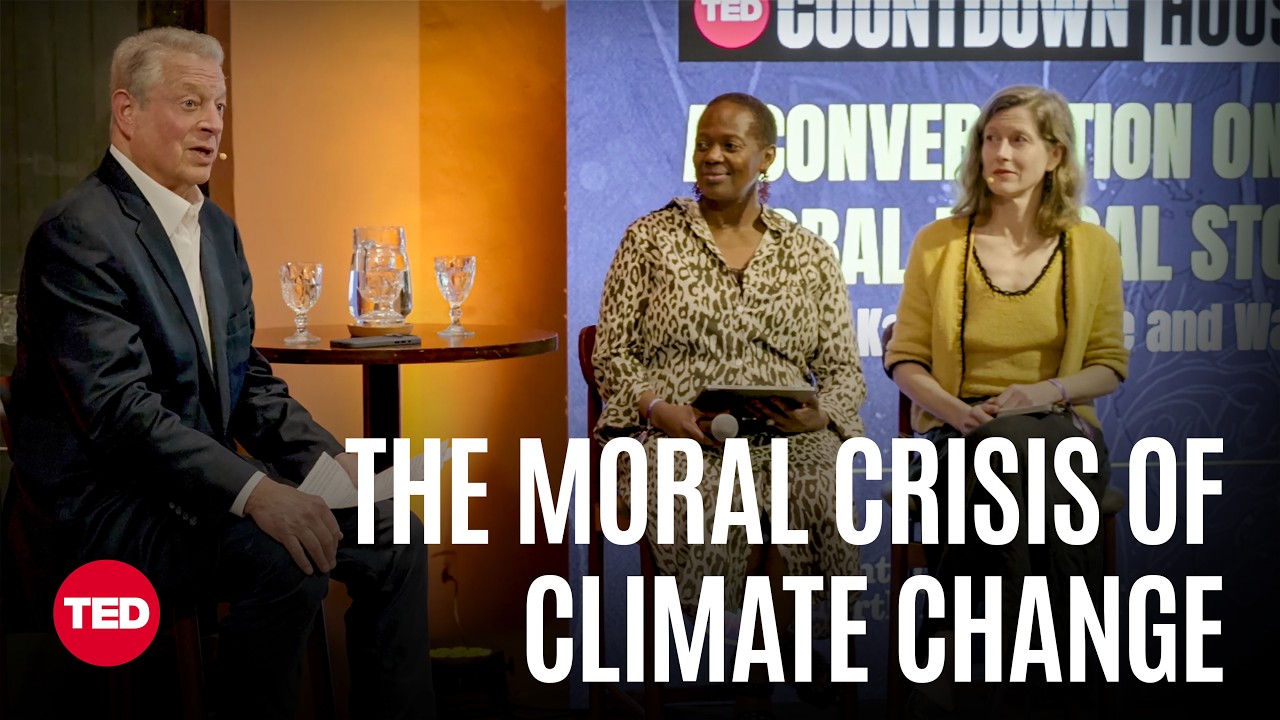
The Ethical Case for Taking On the Climate Crisis | Al Gore, Wanjira Mathai and Karenna Gore | TED
56:40

The Ethical Case for Taking On the Climate Crisis | Al Gore, Wanjira Mathai and Karenna Gore | TED

TED 03.01.2026 14 282 просмотров 213 лайков обн. 18.02.2026
Поделиться Telegram VK Бот
Транскрипт Скачать .md
Анализ с AI
Описание видео
For the first time in climate negotiations, leaders are asking the question that actually matters: not just how do we solve the climate crisis, but why aren't we? Join Nobel laureate Al Gore for an in-depth conversation with Wanjira Mathai and Karenna Gore, co-leaders of the Global Ethical Stocktake: an urgent, values-first reset that seeks to center justice, phase out fossil fuels and elevate Indigenous and Global South leadership. Discover the initiative that's making fossil fuel lobbyists squirm and climate veterans hopeful — before the world moves on to COP31. (Recorded at TED Countdown House on November 14, 2025) Join us in person at a TED conference: https://tedtalks.social/events Become a TED Member to support our mission: https://ted.com/membership Subscribe to a TED newsletter: https://ted.com/newsletters Follow TED! X: https://www.twitter.com/TEDTalks Instagram: https://www.instagram.com/ted Facebook: https://facebook.com/TED LinkedIn: https://www.linkedin.com/company/ted-conferences TikTok: https://www.tiktok.com/@tedtoks The TED Talks channel features talks, performances and original series from the world's leading thinkers and doers. Subscribe to our channel for videos on Technology, Entertainment and Design — plus science, business, global issues, the arts and more. Visit https://TED.com to get our entire library of TED Talks, transcripts, translations, personalized talk recommendations and more. Watch more: https://go.ted.com/globalethicalstocktake https://youtu.be/3bbSk3899Po TED's videos may be used for non-commercial purposes under a Creative Commons License, Attribution–Non Commercial–No Derivatives (or the CC BY – NC – ND 4.0 International) and in accordance with our TED Talks Usage Policy: https://www.ted.com/about/our-organization/our-policies-terms/ted-talks-usage-policy. For more information on using TED for commercial purposes (e.g. employee learning, in a film or online course), please submit a Media Request at https://media-requests.ted.com #TED #TEDTalks #ClimateChange
Оглавление (12 сегментов)

  1. 0:00 Segment 1 (00:00 - 05:00) 743 сл.
  2. 5:00 Segment 2 (05:00 - 10:00) 766 сл.
  3. 10:00 Segment 3 (10:00 - 15:00) 755 сл.
  4. 15:00 Segment 4 (15:00 - 20:00) 712 сл.
  5. 20:00 Segment 5 (20:00 - 25:00) 839 сл.
  6. 25:00 Segment 6 (25:00 - 30:00) 732 сл.
  7. 30:00 Segment 7 (30:00 - 35:00) 813 сл.
  8. 35:00 Segment 8 (35:00 - 40:00) 756 сл.
  9. 40:00 Segment 9 (40:00 - 45:00) 729 сл.
  10. 45:00 Segment 10 (45:00 - 50:00) 862 сл.
  11. 50:00 Segment 11 (50:00 - 55:00) 802 сл.
  12. 55:00 Segment 12 (55:00 - 56:00) 299 сл.
0:00

Segment 1 (00:00 - 05:00)

And it's such an honor to be here with Wanjira and Cora. I hope you can imagine what a pleasure it is for me to be here with Karena, but also with Wanjira. We've known each other for so long. Wera's been in my home in Nashville. And uh we're here to talk about the global ethical stock take. This is a new initiative in COP 30 that frankly in my view somebody should have thought of a long time ago. Taking stock of how many barrels of oil and how many tons of coal that's one thing. But taking stock of how we're doing on the spectrum of right versus wrong is really at the heart of the challenge that the world faces in attempting to solve the climate crisis. It is really a groundbreaking initiative and it took 28 cops before the phrase fossil fuel was ever even mentioned. But now that it's been mentioned the focus is really intensifying. So Wera and Karina you two have served as co-conveners of the global ethical stock tag helping to gather input from Africa and North America respectively. So I'd like to start by asking you both, each one of you for your perspective on what makes this global ethical stock take so important to the negotiations underway here in Berlin. Wer, why don't you start? — Thank you so much. It's great to be here with you again. It was wonderful to have you in Nairobi. Wonderful to see every we've had a great time this week talking exactly about that. Um the global ethical stockic in many ways in my mind is like a reset. Yesterday we were reminded by Lance Tobiana that when the 1. 5 degree um statement was placed into the Paris agreement it was thanks to civil society. the people and over time that has become people have become more and more peripheral. The tech the technical has taken over and it's time for a reset. In her wisdom, Marina Silva decided that this would be the cup. And let's remember, she was courageous to actually convene five stock takes across the world. I think she attended most of them and center justice in the process over a whole year said that this will be the COP where the lens through which we see solutions will have to be ethical — and that we cannot address the climate crisis if we make ethical issues and values an afterthought. For me that's everything because in that coded in that is that we have to center people. indigenous people, local communities, those who are most affected. I I'm starting to like the thought of the global majority that the most impacted large majority of those who've done the least that we cannot ignore that and that also made us a lot fiercer about how we show up here and also remember we are moving on to G the G20 in South Africa the very first time it's being held in Africa. They will not believe what will hit them just because we will be talking about this issue and centering it constantly. — Fantastic. — Well said, — Cora. — Well, um, thank you so much to Ted Countdown House. Uh, and, uh, I want to say that this is a great honor for me to be a part of the global ethical stocktake. Um, I am delighted to be here with my father. I'm so happy and honored to be in the company of oneai who's such a wonderful leader in the world. Um, and I've learned a lot from you. Thank you. And um, I am not a cop insider. I haven't been somebody that's been at all the cops and following every single move of it. I have been at the Center for Earth Ethics, which had our 10-year anniversary last year. and we draw from the world's faith and wisdom traditions to face the ecological crisis and we explore the moral and spiritual dimensions of climate and um so when this was announced as an idea the global ethical stock take it was a great deal of excitement and I have to say that picking up on what each of you has said it feels like the time is so ripe um and this is the missing piece. Um there after 29 cops, as you've said, we know what the problem is and we know
5:00

Segment 2 (05:00 - 10:00)

what we need to do about it, but we don't necessarily from the data and the science and the technology know how to do that. And in order to know the how, we need to know the why. And it really strikes me that sometimes people lose faith in this process because it seems as if the why is about sustaining current systems that are very inequitable that um that involve a hoarding of material wealth by the few. Um that involve a continued disassociation from the natural world that we evolved in from our cultures, our communities, our deepest values. And so if through the global ethical stock take we can really face not only the the moral stakes in terms of of the suffering and the death and the loss that actually will occur. Some people complain that's doom but it's actually in the lens of the global ethical stock take. We don't have to have that conversation. Is it doom? Is it optimism? Is it pessimism? It's just what the stakes are. It's doing a moral ethical stock take. these choices will have consequences. And I think that the other thing that we can do is look at issues of uh how one draws a circle of moral concern. It's one of the things that happens in ethics. You know, there's different types of ethics, professional ethics, so on. The way the circle of moral concern is drawn depends on who's doing the ethics and what the ethics are applied to. applied to the whole earth. We need to look at the fact that those who are most impacted by the climate crisis are simultaneously those that are least likely to have uh a say in the decisions that are being made um and least likely to have caused the systems that are causing the harm. And so for those three, the poor and marginalized people of the world, future generations, all non-human life, we need to keep that present in the room. the global ethical stocktake has done that. It does that. It shines that light constantly even knowing that it's here. And so that makes a difference. And then we also have to ask about accountability. Um you know at Union Theological Seminary where I where the center for ethics is based there was a way in which people began uh classes when I first went there by saying who are you accountable to? Say your name and And at first I thought that was kind of off-putting, but I understood it after a little while. It's actually very real. It's it's uh it explains your something about your consciousness and presence. And so it was named early on that the fossil fuel industry's participation was a problem. And I think that drawing a circle of moral concern, understanding who people are accountable to with that type of transparency and connecting to our deepest values makes the global ethical stocktake exactly the right platform, vortex, force uh for this moment and I'm so happy to be a part of it. — Thank you. Thank you very much. So, — one of the groups that has been um shortch changed, I don't know quite what the right word is, is the global south. Uh and Wera, you come from the global south. You've been one of the most distinguished leaders uh in Africa for two decades now. By the way, I happen to see you on the cover of Forbes Africa as the co cover lady and uh one of Time's most uh one of Time magazine's most 100 most influential people in the world. So, you're really you're cleaning up here. Uh but Africa has uh fastest growing continent. uh a and it has 60% of the prime solar resources in the world but gets only 2% of the climate finance that is allocated in the world. uh and that is part of the structures that you said Karen some people are trying to keep them in place but really our objective is to be accountable to all the people of the earth including future generations including non-human life so in the midst of this h Africa has been responding in its own energetic and unique way and it's not always seen and understood in the rest of the world how as one of the great leaders in Africa how has Africa been responding to this and um what could the rest of the world learn from the way Africa is now responding? That's a really good question because we just
10:00

Segment 3 (10:00 - 15:00)

came out of the Africa climate summit in Addis um a country that has made a conscious decision to phase out immediately fossil fuel vehicles that is Ethiopia — deciding that actually it's not because they are emitters cuz they're not — but it's because it makes economic sense. This is a country with 90% renewable energy in the grid. They said, "Let's invest in the energy we have. " The forces and the the opportunities are aligned for Africa to leverage and leap into the future and not invest in the past because it makes more sense for us. And there you're seeing that happening in Ethiopia. You're seeing countries and governments investing in local manufacturing, local opportunities to increase demand for renewable energy. This is all happening despite what others are saying. Actually, it's in spite of any doom and gloom. They're so busy doing the hard work. And this is what's really important about the African story right now. — The common but differentiated responsibilities must remain and it was centered in the Africa global ethical stockic. But immediately after that was the opportunity to see Africa not as a challenge but as a at the hub and the center of solutions that actually the world will not address the climate crisis without Africa unlocking its renewable energy resources its uh in the critical minerals that are responsible for the renewable energy and the fastest and youngest growing workforce. These are the resources of the future. They will be the opportunities to decarbonize deeply. If we are honest with ourselves to deeply decarbonize, you will have to move some of these real industries, data centers to places where there's 90% renewable energy. Those are the opportunities Africa is working on, investing in and creating the political opportunity and sending political signals that is the business we want to do. The business of the future and not past. Yeah, fantastic. And the African leaders uh summits have been quite inspiring to me. Karina introduced me to Reverend William Barber III in the US who often the second sorry you also introduced me to his son but uh William Barber II often quotes a line from scripture and my faith tradition about the stone that was rejected by the builder which then becomes the keystone in the new architect's design and Africa is now in a place where it might become one of the real leaders in the world. You you mentioned Ethiopia, Kenya's also making great progress. Zambia is making great progress. Nigeria, the biggest country in Africa finally eliminated the subsidies for diesel and as a result the incredible boom in solar panels there is just startling the world. So and Karen was telling me also she was at your Africa stock take and tell me what happened at the end with Kumi Nadu. — Well you know one as we said a lot of what and I liked this about the Africa stocktake. It's it didn't spend a lot of time on what others must do for us. It spent a lot of time reminding people that Africa will not be defined by the deficits, but by what we can actually do for ourselves, but that there is an absolute moral obligation to decarbonize and phase out fossil fuels. Yeah. — So Kumidu and everybody who knows him knows that he's now leading the non-prololiferation treaty stood up and faced the COP presidency because we had President Korea there, we had Anna Tony there and of course we had Marina Silva and said if you as the COP presidency are serious and here we are the global ethical stopake, you must take this issue on head on because the phase out of fossil fuels is non-negotiable. And now Marina even right now this morning is leading the effort at COP 30 to develop a roadmap for phasing out fossil fuels. So I'm so glad that both of you were there when that happened. Now Karena, you co-led the North American uh ethical stock take which comprises not just the United States but also Canada and Mexico, Greenland, Bermuda, uh some island nations. But the elephant in the room here at COP 30 is of course the US absence and the US departure from the Paris agreement. US is still the largest historic source. China will soon rec claim that title but the US has a moral obligation to weigh in. Uh what is your take now on how Americans are contending
15:00

Segment 4 (15:00 - 20:00)

with the climate issue in the absence of any leadership from the US government? — Well, I think the United States of America is going through a moment. Um uh we all know ourselves, our friends. Sometimes people have those times. they're just going through something and then um hopefully come back stronger than ever. And I think that um there one thing I would name is that and obviously so diverse uh to talk about what Americans are thinking is very difficult. But I would say that I sense so much dissonance uh in the United States of America that feels like it can't possibly continue forever. You know, um dissonance between people's uh experience. We've had these in talking about climate, we've had these uh heat waves and stronger storms and droughts and wildfires and um and also people live with a lot of the pollution. Of course, that is situated largely in low-income communities and in communities of color and uh and that is a big part of the story. But by and large, it feels to me like many Americans are deeply unhappy with the lifestyle, with the culture, with the society. There's so much there's a lot of anxiety and um and I would say of course that has socioeconomic uh dimensions to it and it's not fair, but it seems rather across the board honestly. Um, and I think that the dissonance um is so stoked by our culture of distraction and screens and you know to be it's not incidental to the climate crisis obviously that so often we're in we're just people spend 90 I think the statistic is something like 90% of time indoors and then on that you know much of it on screens and um there there's so much uh emphasis on consumerism and commodification of everything And so I feel that um that uh the way in which Americans are processing this um is about to change because the dissonance is not tenable in the long term. Um I think things you know there's that saying darkest before dawn things get so bad. there's a distillation of this idea of of denial of the climate crisis of an embrace of greed and selfishness um and materialistic values and so on. And I think that um that in some way it's catalyzing something on a deeper level. And I can I'll stop there and just say the global ethical stock take um was a really wonderful opportunity to look at uh it was North America as you say it wasn't only the United States of America but within the United States of America we have a lot of deep legacies and lineages and heritage to work with um and to dig deeper and to find those voices that can represent uh from what that um what the best that's happened in that country is was such a pleasure and an honor. And so just to give an example um we uh so the environmental justice movement I mentioned before about the location of the toxic sites and where most people are experiencing the impacts. Um in 1991 there was the first national people of color uh conference on the environment in Washington DC and it was convened pe uh by actually the United Church of Christ played a role in this. Um but there was a and they had done this study in 1987 called toxic waste and race which tracked and mapped and this is where data is very important you know to this movement um that this was that was being dumped in um in mainly black and indigenous communities toxic waste and the smoke stacks and so on. So the 1991 conference came up with the 17 principles of environmental justice. And right in talking to the people that were there and the leaders of the environmental justice movement in the United States which include Robert Bullard and Benjamin Chavis and Peggy Shepard and uh others um there was a realization that they all remembered. Yeah, we went to Rio right after in 1992. And wasn't that amazing that all of the UNFC and all of these conferences started there and there were conversations that were already they
20:00

Segment 5 (20:00 - 25:00)

already knew about what we were talking about. The very first principle of um of and of the 17 principles talks about mother earth ecological unity of life. — You know it is about justice and fairness and it's also about a expanded consciousness of where we are of the reality that we're living in on this living planet. So to have the voices from and somewhere in the official and some in the self-organized from this the environmental justice movement in the United States that comes from a deep place that's very American and it's not just about you know the face that we're showing to the world on the biggest stage right now. It's about the depth. And I think I'd also like to mention two other quick things which is one is you know we opened uh we were able to open with the Hodnoni better known as the Irakcoy um Thanksgiving address uh which is often called the worlds before all else. We had Sophia Palace Anandaga young woman um give this address and before and this is ancient from a culture that is indigenous to that region um and was very influential actually on the founding of the United States in many ways. — So some of the key concepts that made their way into the US Constitution checks and balances for example three brand that came from the — Hosoni Confederacy of the six nations of the Irakcoy. So to have but they will say that we left out uh this is what Hodnosi people would say we left out two things we left out nature — and women. — So we opened the um the global ethical society North America with the Thanksgiving address with Sophia Palace. And what it is, it's acknowledging and thanking all of the beings of the natural world. The winds, the sun, the waters, the berries, the fish, the birds. I mean, I'm sorry. Forgive me for paraphrasing this way. I'm just trying to communicate it quickly. Please don't mean to be disrespectful, but just to convey that this is the consciousness that we lack. And you've seen with this, you know, I don't want to call it a trend. I think there's something quite serious and heartfelt about it with land acknowledgements which are very, very important. And I've always felt that there's something in there of that yearning. You know, it is about what was unfair in the past and who did [clears throat] something wrong and the loss that hasn't been acknowledged and the pain, but it's also about the land actually where we are. So to begin with that Thanksgiving address to have a moderator who was Tyino was the first people to encounter Christopher Columbus. There's a lot of Tyino rooted people in New York City because they're Puerto Ricans. Uh, and so, um, anyway, I'm saying these broad brush strokes, but I just I'll close, but I just want to say, you know, grow as an American growing up the way I did, um, which was a little bit vicarious, campaign trail politics, so exposed to the political culture, the electoral process, very much with a extremely idealistic view of who we are, who we were are as Americans. And um and you know it's at a certain point in and this is before this current administration I had this realization through you know education of various kinds not just in higher institution education places but in but life that you know I grew up thinking gosh we're so great as Americans because we threw off the colonizers you know we got rid of colonization it's so great that's who we are and then at a certain point I was like wait a minute we are the colonizers right uh oh And the complexities of that are of the essence of a global ethical stock take. It's not that simple. And to be able to look internally and then use this modality of this global ethical stock take they call it the balanso the balance. I love how they call that in Portuguese. Um is actually not just to you don't need to feel guilty and shame and all of that primarily just demonstrate the other way. walk the other way. And I think that's what we're being given the chance to do. And I saw and I learned that so much from you, Wera, as well. — Colonization has come up. — Yeah. — And one of the many uh legacies that complicates our path forward now is the history of colonization in Africa. some of the uh long-running conflicts in Africa really were not there prior to colonization when different groups were pitted against one another. How is that still an important legacy that must be addressed uh in Africa? — You know, it's so interesting because I think my mother's generation obsessed more about colonization than my generation does. M — and it's interesting to see that because
25:00

Segment 6 (25:00 - 30:00)

we are turning our eyes and our demands for responsibility on the leadership — because our governance systems are responsible for the next phase. It is to them that power was handed. We remind them and it a lot of what we struggle with today is not thanks always to colonization alone. The foundations may have been set and they were, but we have leaders who have continued the legacy of exploitation. to exclude and to impoverish by enriching themselves. We're calling them out. I don't know how many people know that — a country like Kenya, the average age of Kenyans today is 19 years old. — Wow. — 80% are under the age of 35. They have no time to agonize about what may have happened. They're looking into the future and they're holding governments accountable. We have young people who have been lost their lives challenging governance systems and saying no, we shall not be exploited by our own people. — So I think the current obsession is on leadership. We don't have much time. We've got to transform economically. We cannot adapt against poverty. And poverty is the number one SDG for a reason. We've got to focus on ensuring that people are not the hungriest and the poorest and facing the most dramatic impacts of climate change. When you are on the edge, it doesn't matter what sort of help comes, you're on the edge. And so I think it is a completely different conversation than we've had in the past because when you have young people who are looking for jobs today who are looking at their leaders and saying you have the keys, how come it's still this way? So there's a bit of a different conversation now. — Yeah. But if I could persist a little bit on the the word colonization, some of our mutual friends who are activists in Africa use the phrase fossil fuel uh colonialism with I mean in the developing world as a whole uh 100% of the increased global warming pollution emissions in the years ahead will be from developing countries. Yet developing countries only get 18% of the fossil fuel of the finance for the sustain for the green revolution. Uh a and yet they get almost half of the finance for building yet more fossil fuel facilities and the resource curse that Nigeria and many other nations in Africa have suffered. So the global fin system for allocating capital still has a legacy from an earlier era. A and is that now changing in Africa? I would say, you know, we then are using neoc colonialism — to define some of these new structures that have borrowed the patterns of exploitation, patterns of exclusion and definitely the fossil fuel industry is one because we know we have 60% of the world's best solar potential. Why not invest in that? Like you said, 2% of investments in solar. Why? I called my friend who is a negotiator for Botswana here on loss and damage and I said I'm going to be speaking about global ethical issues. How are we doing on the loss and damage fund especially given the realities of the storms that we've seen horrific Jamaica 30% of their GDP wiped out in that storm. We couldn't possibly be waiting for more evidence that the loss and damage fund needs investment. She wrote back that it has less than 1% of what's needed. That is the injustice we've got to be addressing. That is the neoc colonialism because wherever those funds are being because we're told the resources are there — but they're clearly not going where they need to go. — And those are the real issues that are being centered here by the global ethical stockic. And that's the colonialism if you want to use that word. But we have to distinguish it and say it's new because it's these new forms that are being inspired — by the patterns of extraction and exclusion. — So um the money that's needed for the sustainability transition is sometimes uh sometimes the focus is on uh government to government aid. But in reality, if you look at, you know, last year, 93% of all the new electricity generation installed worldwide was uh solar, solar and wind and renewables. Uh but it's unevenly distributed. Uh and
30:00

Segment 7 (30:00 - 35:00)

where did the money come from for that? By the way, 75% of the money came from private investors, — but most of that went to the rich countries and not to the developing countries where it's most needed. The emissions reduction that can come from building new solar and wind and batteries and EVs etc. in developing countries reduces emissions. Uh there are three times as many opportunities there. And I know that out of the global ethical stock take, partly from uh Africa, partly from North America, uh came this number one priority that I've heard Marina emphasize, which is let's get back to the priority of phasing out fossil fuels. And this has come up in it came up in the North American stock take as well. How do we do that? How can a focus on the difference between right and wrong, ethics of the decisions we're making help us get there? — Well, I think it is helping us. The uh IWL said the way to what write wrongs is to shine the light of truth upon them. And I do sense that even the fact that this light is shining is making a difference. I mean, we know there are a lot of fossil fuel lobbyists at this cop, more than ever, I'm told. So, that hasn't changed. But I do think that knowing that there is an ethical lens is uh is itself has an effect. Um, and I would say that you know, yes, the the difference ethics is essentially the difference between right and wrong and the implications for our behavior. um as individuals and collectives and um it is most powerful uh when there is a deeply felt and more widely shared sense of right and wrong that's out of step with both laws and social norms and most — if I could interrupt briefly this is Ka's become one of my principal teachers by the way over the last 10 years that she's been doing this and so when you look just I'm sorry to interrupt you but this difference between the general understanding of right and wrong as it has evolved. — Uh the difference between that and what the laws and policies tell us is right and wrong. We saw that in the civil rights movement. anti-apartid and now we're seeing it in the climate issue. — Yeah. So one of the things that we have to face up to is that most of what is causing the climate crisis is perfectly legal and even socially encouraged. — Right? So — and financially subsidized is is a reflection of those things. So it's not it's also important I think there's a concept that from um ethics that I think is useful here called from structural evil. this woman Cynthia Mo Lebeda who was at Union Theological Seminary drawing on the work of sorry to be so academic um of Dietrich Bonhofer who uh was at Union and he actually went back to his native Germany to oppose Hitler back uh during the Third Reich and was uh executed by the Nazis. So he has some moral authority as well as having been this theologian. And so one she talks about the elements of structural evil. One of the key characteristics is that it easily masquerades as good. So when you look at why fossil fuel development continues to be uh in there, it's because they make a moral claim. They don't they don't, you know, abandon the idea of moral claim. They say it's for development. It's for ending energy poverty. It's for and this is so dissonant with the facts that as we know them that we have the renewable energy uh capability. people uh have worked very hard including yourself on getting that financing, getting that technology up to speed and so on. So it's becoming untenable to make that false moral claim um that somehow uh this fossil fuel development and continuing that is going to be um good for the world. Uh but they're still trying and which makes the global ethical stock take all the more important. So I think that um bringing this lens and bringing this modality and as it came up I can say in the North America diagonal it came up in several ways. One of the ways it did was that um Robert Bullard who was from as I said in the environmental justice movement who was in that 17 principles he said the very last thing he said in his thing he said just basically stop the fossil fuels. He said that this is really the main thing to do. Um and it came up in uh in the idea of fossil fuel non-prololiferation treaty from Sapora Burman. It came up um from David Suzuki and Fletcher Harper to
35:00

Segment 8 (35:00 - 40:00)

get rid of the lobbyists in the COP. It came up in many ways. So there's no way with the president of the COP uh sitting there and the leadership and also Selwin Hart the the representative of the secretary general of the United Nations um who we should acknowledge Antonio Gutierrez has been a voice of moral clarity um for really I think an extraordinary leader and and he was represented by someone who said look fossil fuel companies are making record profits right now. It's not as if they're just doing all right financially. I mean, it's actually morally obscene. And so, there has to be a way in which um it's human perception that needs to change. And to do that, we have to look at what drives human perception. And that is values. It is the way we communicate. You know, there's so many aspects of this stock take. We just started it. So, we're just learning how to do it. But it's also drawing from the deepest impulses and wells of human wisdom and culture. So when you invite those people in, indigenous peoples, faith leaders, you know, people that are poets and musicians, people really know how to do this. kind of a different skill set than data science, you know, and we deserve as human species and we owe each other and future generations all of what human intelligence has to offer, you know, it really is as I was saying, we were talking about the other day as if our the intelligence of our species is on trial right now and we aren't going to make it unless we draw from those other forms of intelligence. And this is also a way to do that. — Thank you. So in the ethical stock take, how do we um how do we best understand the the truth about the impacts of this systemic crisis? And I want to turn to you Anjira because Africa is suffering so many of the impacts of the climate crisis uh in your native Kenya. Uh I was struck by the fact that there 300,000 refugees already in tent camps in Kenya, some from the civil violence in Sudan and the Horn of Africa, which itself has been driven by the droughts and the food access crisis, the climate crisis has worsened. Um but the projections of temperature increases and humidity increases that may make more areas physiologically unlivable. Uh h how do we un how do we best understand the way to deal with those impacts? I I'm sure you're hearing it from your fellow Kenyans and as an African leader for the whole continent, you're seeing it all over Africa. — Absolutely. In fact, that was a really strong feature of the Africa stocktake. The fact that African science and African le science and knowledge, indigenous knowledge and indigenous wisdom is called upon right now. Why? Because food systems that were resilient to some of the worst and most deepest uh extremes of climate are the ones that will see us through as the food basket gets more challenged. We have supply chains that are coming from so far away when we already know that we have food systems locally that dealt with extreme events. — Food systems that helped water systems recover and trees and vegetation and restoration methodologies that were used to restore landscapes. We had cultural traditions that were about caring for each other in times of difficulty. Those are the ones that were centered by a lot of the leadership who are local community leaders, women like Hindu, women like Cecil Jabet who are mobilizing women to rediscover orphaned crops and orphaned foods, traditional methods of cooking and processing food that don't rely on modern technology. These are the real investments in resilience that we are seeing at the local level because you know one of the most important things is the climate crisis ultimately is local — and the solutions that will make a difference are local too. — So we are really looking at that and those were centered. One of the women who spoke from Zambia said we actually have 90% of the investments in science on Africa are not by African scientists — invested in science African science but not by African scientists. So investing in local knowledge systems is one of the biggest outcomes of the values we need to center. Your mother Wangari who I had the privilege of knowing as a
40:00

Segment 9 (40:00 - 45:00)

dear friend is known for planting trees and the green belt movement and you have brilliantly led that movement onward. But she's also been known for uh promoting the use of local seed varieties in village gardens to rely on plant varieties that have stood the test of time that are well adapted to each particular region. And she taught uh mainly women but all the villagers to create a sustainable food supply in there. But now in Kenya as in many places around the world the large seed companies like the I can't remember the exact percentage more than twothirds of all the seeds are controlled by three companies and these laws have been passed that actually now make it illegal to save the seeds that the villagers h have been relying on. And I understand the reasons for it and the old way of thinking decades ago was well the green revolution has really helped to fight hunger and there's a lot of truth to that. But with the climate crisis worsening the food uh challenges these local seed varieties become even more valuable. How is Africa well first of all Kenya but how is Africa dealing with this? But that's also why we had the Africa Foods and Seed sovereignity alliance centered at the ethical stocktake because this is a very serious issue. You know the wisdom the genius of the green belt movement was really not even to teach women. Women already knew it's to remind them that their wisdom is actually incredibly important for this moment. that do not allow anybody to come and tell you that this is other than the best technology in the world. That was the genius of the movement. It was reminding us to invest in our own seed systems. That sharing seed from one farmer to the other was the only way to get the best possible seed. You know, I remember when my mother was asked by the Ministry of Environment, how could women who have no diplomas be planting trees? You need a diploma to plant a tree. And she said, "You don't need a diploma. " Then she said, "You can call my women foresters without diplomas. " Because they were generating better quality planting material than the forest department was. Why? Because they look at the trees and the ones they like, the best ones, they invest, they pick the seeds, they plant them, they have a 100% germination. the ones that came from the center uh the government center 60% they don't germinate at all sometimes and these foresters without diplomas were the heart of a movement that now has deep confidence and is fighting that very policy that farmers cannot share seed. So no, we had that we have an army of people and farmers who are refusing to be convinced that some seed from somewhere else is better than the one they know. — Ah yeah well said well said. — As a footnote I just want to note that your mom also did have a diploma as the first P woman PhD in East Africa. uh but so she had an authority in speaking to these others that they could not uh ignore so easily. Uh so the role of the relationship between nature and climate uh Karina one of the lessons I've learned from you is embodied in a quote from Thomas Barry um that you taught me. Uh the universe is not a collection of subjects. It — correction collection — what did I say? Not a collection of objects. — It is a communion of subjects. Sometimes the teacher has to teach twice. Uh but let me say it the right way. The universe is not a collection of objects. It is a communion of subjects. So it's often the case when we are working on the climate crisis that some people say well we need to give equal focus on the crisis of the sixth great extinction the the crisis in nature they're actually intimately connected and most climate advocates understand that this has also come up in the global ethical stock take correct — absolutely um so really I think one other uh asp aspects of ethics I find compelling is uh just how you see a problem um in whether you look at cause
45:00

Segment 10 (45:00 - 50:00)

and effect in a clearer way. So you could use the word karma from the indic traditions uh to think about this as well the cause and effect. So we've all been around climate conversations that are mainly about uh effect, right? Like how do we and I don't mean to disparrage adaptation as a field. Obviously it's incredibly important. Um so when I say that uh I mean something slightly different um but as if there's nothing we can really do to stop this from happening and so what are how are we going to cope with it and put the band-aids on it and so on. Um but in obviously in any situation and especially as we've heard people say like this is a this is a crisis that um we need to look at the roots right not just the leaves and so um looking at what is the root cause on the material plane um I like to uh think about it the way that Gus Beth has forwarded and you know Gus uh well and as do you um a great thinker are about two modern mega trends. So if we think about how recent this is right in our species in earth history that we've been living this way. Um the modern mega trends are pollution and depletion essentially. So pollution into that thin shell of atmosphere that is the sky and depletion of the carbon sinks which is also of course habitat um for other species as well as for human beings. Um and so either one of those things would have an imbalance to do both of them at an increasing pace and scale um in the past, you know, several hundred years is what's gotten us into this mess. Um but that's the material plane. So what is the deeper level of cause? Why are we doing that? Um and fundamentally it's the illusion that we are separate from the rest of nature. That is the deepest level of cause and we are having this wakeup call that we're not and we can read it in and know it in different ways. But one of the things is that other living beings are our are our relatives as indigenous people would say. It's not just a set of of objects or resources for us to consume and extract from for our economies. It's actually our relatives in an interdependent web of life. Our food is other living beings. That's what the food is. I mean, it sounds so silly sometimes talking about this because it is obvious, but we've been so conditioned out of it um in modern uh society. And so, you can look at um I like to think about uh I don't those crises as different, biodiversity and climate, because the root cause is the same. M — um and uh you know there are different ways I've heard some people say well I really care mainly about human beings. I want to center human beings. It's important to realize of course that you know human rights we're you're dealing with people around the world who have been dehumanized out of being respected and treated as if they are in another classification. And that of course I know there's a great deal of important regard that we have to pay there. But the idea that um in indigenous you know cosmologies that even with the the food that is eaten whether it's the salmon for the winam winu people or the buffalo for uh for the lakota Dakota Nakakota people the great buffalo nation teate the um the ways in which um the gwitchin um and the caribou the food source is the most sacred animal. It's not you eat something but you revere it and you take care of it. its habitat and home. That type of deep connection to other species. It doesn't mean that that you know you're living in a kind of covenant. Um and that way of thinking and of course being here in Brazil uh in this place that is so deeply nurtured and nourished and fed with the indigenous and even mucho the word that they're using for this COB 30 as a call to come together in collective action. We need to remember that mindset that way of thinking where we regard other species of life as this is their home. It's not just canary in the coal mine. Although there's some people that might like to think of that and that works, whatever works. Um that if we see that the animals are affected, so will we be. So we better watch out for that. But it's deeper than that. It's that we are we're in this community of life. So I think it's a it's actually um [snorts] far from competing. I think it's actually the doorway through which we can walk into the next phase. — Wow. Okay. So I have uh I'm going to put one final question to the two of you about the future of the global ethical stock take. A lot of people are now
50:00

Segment 11 (50:00 - 55:00)

saying this should become a permanent part of the cop process going forward and my understanding is that your leader Marina Silva is now proposing that be the case. What should be the future of the global ethical stock take? You know the truth is Marina as I said uh Minister Marina in the in her wisdom and of course courage set this reset for us but taking it forward has to be all our responsibility. And what that means in is that whatever work we do every single day is to consciously think about what the moral values and ethical lenses are we are called to think about. So I'll I'll give you an example for us at the World Resources Institute where we work on Yes. nature, climate, people, making bets on cities and how they evolve and grow, making bets on how we protect forests and restore forests. But again, centering people because it is lives, livelihoods, cultures, and identities that are the why. These are the why we do this work that we do that with the absolute consciousness that it is not because it's work we have to do but it is because everything we depend on is anchored in our values towards others and I think the harmony of other living things was at the core that in at the very foundation if we do not honor the contract to each other then we will not see the phase out of fossil fuels. crisis ended in the way that it needs to be. That actually we have a in the African ethical stockic we have this concept mucho when we welcomed the Brazilians the South African ancestral blessing in the very beginning evoked this prayer of Ubuntu very similar I am because you are. And then we heard about another cultural tradition. My outbreath is your inb breath. I mean there are so many traditions that call on us to remember that we cannot but be connected and we our wisdom. I loved what Karina said about our intelligence be as a species being on trial because the truth of the matter is with everything we know, we surely shouldn't be making the sort of decisions we make. So everywhere in every room, if we continue to make sure that our negotiators, our governments are centering the global ethical stock take, mention it in every opportunity you get. We would love to hear from you what happens in those rooms and how those negotiators can take action. But we are reminded that the we are here the Paris agreement was thanks to people pushing and insisting that we center the common but differentiated responsibility agenda. We can do it but we all have to do it. — And it was due to our friend Cristiana Faggeras too who was around here earlier today. Karen, what do you think the future ought to be for the global ethical stock take? — For my part, I think it should continue. I uh I think one of the things I'd like to say about it is that um is that there were these five questions that they put forward. The under there was one underlying question and if you look at the official COP 30 Brazil team's page of global ethical stocktake, it begins with like there's one basic question. if we know what we need to do to solve to face the climate crisis, why are we not doing it? But then there are five underneath there and they really thought about it and it went through different phrasings and of course it's translated into English and so on and and so but they're interesting that what the questions are. So I won't take up too much time by reading them all, but I just want to say that one of the things I really like about this approach is it you know a lot of times people are very weary of how we talk about these problems, right? Because it seems like lots of fingerpointing and clubbing over the head and you know kind of you and then this optimism or pessimism all this kind of stuff. this is questions that are actually quite disarming um in their sort of overview approach. Um and I just want to say on one level, you know, I'll just mention two of them. Uh the second one is why do we maintain production and consumption models that harm the most vulnerable and jeopardize the 1. 5 mission? Why do we maintain uh production and consumption levels? Well, there's an answer to that. Actually, there are lots of answers to that. It has to do with that we're actually it's not only about greed. It's partially that. But it's partially that
55:00

Segment 12 (55:00 - 56:00)

people are asked to be consumers. We measure success and tell people they're doing well if they hoard a bunch of stuff. Like, why don't we look at these social norms and actually ponder them instead of just repeating them and going through the motions of them? Well, why is that? Well, in part because the global economy is the thing of jobs and that's how people get. So, we're really looking deeply at the systems and structures that underly our modern civilization, — but we're it's being done carefully and and in a way that invites in joy and space for grief when necessary and so on. So, I think it's incredibly healthy and necessary. The other one I was going to mention in this context was the third one which is what can be done to ensure wealthy countries accelerate the uh transition to and provide finance to the most vulnerable. So that is in there. It's not the common but differentiated responsibilities and so on. And I think that looking at where people are calling for systemic change, different voices, different ways of communicating, it must continue. I don't know exactly how the system works as to where it lives and so on and who does it, but I'm here to serve and especially if I get to do so alongside Wira and uh and Marina is a great leader um of this and of course it will be many people. It won't be a select few um it will be many people and the self-organized dialogues and the way that it catalyzes and going forward I think will be a movement. It's called you know this they've talked about a movement of movements And that's a good way to think about the global ethical stock

Ещё от TED

Ctrl+V

Экстракт Знаний в Telegram

Транскрипты, идеи, методички — всё самое полезное из лучших YouTube-каналов.

Подписаться