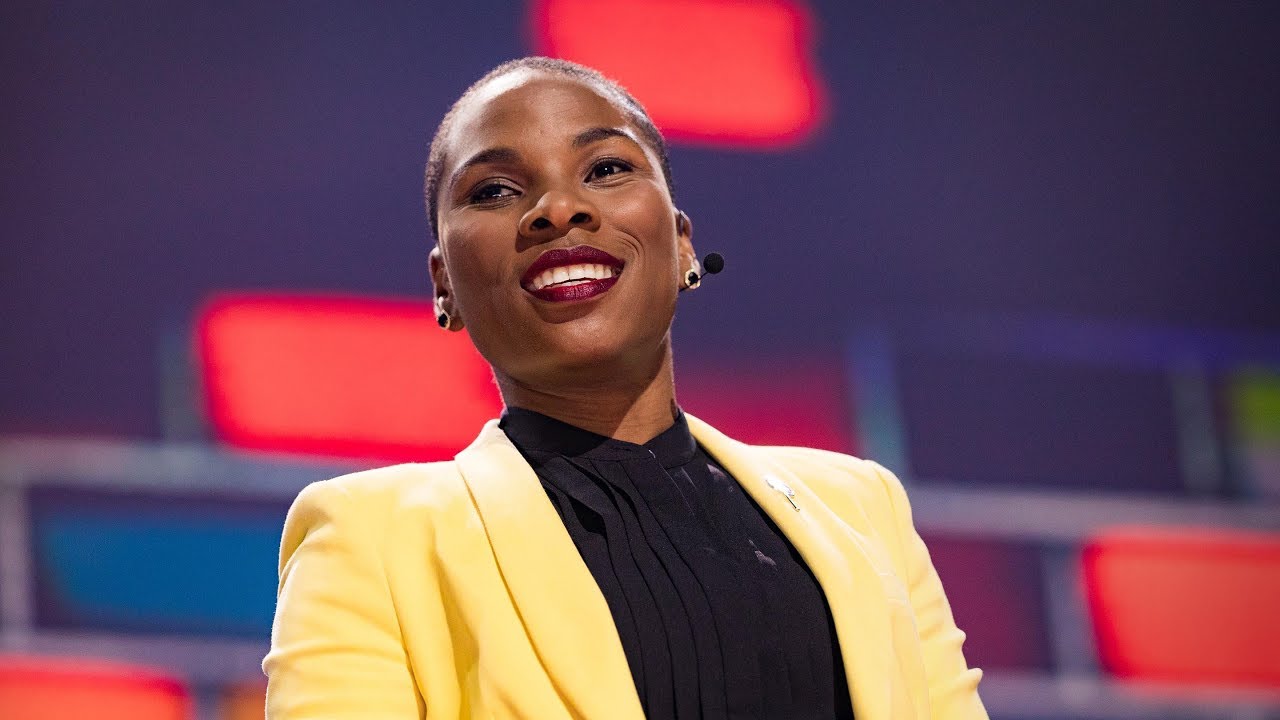
Can AI help people without a traditional credit history get access to fair loans? Impact entrepreneur Mercedes Bidart shows how AI is letting informal entrepreneurs in Latin America transform "invisible data" on their phones into a financial identity, helping them get credit and grow on their own terms. (Recorded at TEDAI Vienna on September 26, 2025)
Join us in person at a TED conference: https://tedtalks.social/events
Become a TED Member to support our mission: https://ted.com/membership
Subscribe to a TED newsletter: https://ted.com/newsletters
Follow TED!
X: https://www.twitter.com/TEDTalks
Instagram: https://www.instagram.com/ted
Facebook: https://facebook.com/TED
LinkedIn: https://www.linkedin.com/company/ted-conferences
TikTok: https://www.tiktok.com/@tedtoks
The TED Talks channel features talks, performances and original series from the world's leading thinkers and doers. Subscribe to our channel for videos on Technology, Entertainment and Design — plus science, business, global issues, the arts and more. Visit https://TED.com to get our entire library of TED Talks, transcripts, translations, personalized talk recommendations and more.
Watch more: https://go.ted.com/mercedesbidart
https://youtu.be/rGOTVtXkaRs
TED's videos may be used for non-commercial purposes under a Creative Commons License, Attribution–Non Commercial–No Derivatives (or the CC BY – NC – ND 4.0 International) and in accordance with our TED Talks Usage Policy: https://www.ted.com/about/our-organization/our-policies-terms/ted-talks-usage-policy. For more information on using TED for commercial purposes (e.g. employee learning, in a film or online course), please submit a Media Request at https://media-requests.ted.com
#TED #TEDTalks #Technology
Оглавление (4 сегментов)
Segment 1 (00:00 - 05:00)
I grew up in a family of small business owners in Argentina. My parents ran a curtain and carpet shop, so I witnessed first-hand how difficult it is to grow a business. Trust and support from their community were key in keeping the business alive. But I decided not to continue with my family business. Instead, I studied political science. I was obsessed with how technology could support the growth of businesses like my parents'. And that curiosity led me to MIT, where in 2019, my Master’s thesis in AI and economic development got awarded funding to become a real-world pilot. And that's how I ended up working in informal settlements in Colombia. In these neighborhoods where I did my research, you didn't need a credit card to buy lunch. It was enough for the shopkeeper to know who you were. If your mother had a good record with loans, if you said hello in the mornings, if you had a shop that was known by the neighbors, they will front you the rice, the sugarcane, the bread. The economy didn't run solely on cash. It ran on trust. That invisible currency that is built over time. And I noticed something. Those same principles I saw growing up in Argentina were alive in Colombian businesses, too. In many Latin American neighborhoods, trust has always been the strongest currency. A good name. But here comes the contradiction. When this same person goes to a bank and asks for a loan to grow this business, they will be rejected. They will tell them, “You don’t have a collateral. You don't have a financial history. There's no way we can prove who you are." In many Latin American neighborhoods, this is the case. And in Latin America, half of our population is excluded from formal credit. After a decade working at the intersection of financial inclusion and urban development, I dedicated my life to answer one question. What if what makes you credit-worthy in your neighborhood, trust, could also make you credit-worthy in the eyes of a bank? What if your word could be part of the risk assessment? What if we can scale the access to capital by making your potential measurable? What if trust could be measured with AI? So before I tell you more, I want to share a little bit of how all this started. Since I was a child, I dreamed of changing the world. And that's why I studied political science. I thought I was going to do it through policy. But then I realized policy was not moving at the speed people needed to. So I turned to technology. Technology doesn't recognize any geographic boundary. So at MIT, my classmates and I started working on a local project to define local marketplaces for communities, platforms where they can upload what they are selling and become visible in their community. We started visiting these businesses to help them to upload more pictures of their products into the marketplace and become known and start selling more. And we noticed that they weren't growing their sales. So when we asked them why, their answer was very simple. They didn't have enough money to buy more supplies. Even though they were running these businesses for years, they couldn't get more inventory. They couldn't get any access to working capital to buy more inventory. So we noticed something. We were not facing a visibility problem. We were facing a financial exclusion problem. And the deeper I went, the more I learned something that we usually don't say enough. Being poor is very expensive. Products cost more when you can just afford them in small quantities. If you can't buy a whole bottle of shampoo, you end up buying a sachet. If you can't buy groceries for the whole week, you end up buying by the day, and you always end up paying more. And when it comes to credit, in the financial sector, the cost is even higher. When you don't have a credit history or bank account, your only option is to access the predatory lenders.
Segment 2 (05:00 - 10:00)
The "gota-a-gota", the loan sharks, and they come at brutal cost. They don't ask you for paperwork, but they could charge you 20-percent interest rate per week, even per day, and they are violent and abusive. So I will tell you the story of Maria. She's a Venezuelan migrant living in a low-income neighborhood in Colombia. She makes these beautiful handcrafted bags, and she gets custom orders from her clients. So before she sells and she gets paid, she needs to make the order. So she needs to buy the materials to make that order happen. As Maria is a migrant, she doesn't have a bank account, she doesn't have any credit history, so her only option to buy those materials is to ask for money from these predatory lenders that are really, really dangerous. Unfortunately, Maria in Latin America is not the exception. She's actually the rule. She's the rule in Latin America. Millions of microbusinesses. Microbusinesses like hers are everywhere. They are from the corner shop to the restaurant to the beauty salon. Actually, almost every business in Latin America is a microbusiness. Ninety-nine percent of our businesses are micro, and they contribute one third of our GDP. But still, they cannot even access one dollar from a bank. Why? Because they don't have the paperwork the financial system was built to require. So Maria might not have a credit history, she might not have a bank account, but she has a phone. And there's where we saw the opportunity. Not to change who they are, but to change how they are seen. So when we started, there was no data about this economy and this segment of the population we wanted to help. And, you know, that's one of the main problems with AI. Models can only predict what they have already seen. So we understood that if we wanted to start helping this population, we needed to build a data set ourselves. As this population we're talking about are informal entrepreneurs, then there's no record, there's no data. So you become invisible to the system. So in traditional banking, the way they give out a loan is usually, you know, the risk officer goes to the house of the person, checks the business with their own eyes, talks with the neighbors, sees if actually that business exists and they make the decision based on their experience that usually comes with bias, it’s subjective, and it’s really slow. So at that point, when we started to build the data set, we were actually building the local marketplaces where people were uploading the products of what they were selling. And we noticed that the images themselves were full of economic signals. We could see if there were customers in the back, if the product was handmade, if there was potential for that product or service to be sold in that neighborhood. So the data was there, but just not in the format that the banks were trained to read. So when we started building the data set, we started small. Super small. We started giving out 10-dollar loans, just enough for entrepreneurs to refill their inventory and enough for us to start growing the data set. And we were very intentional to whom we were giving the loans. Half of the people we were serving were women, because if we want AI to be fair, then it needs to learn from everyone. So people like Maria the artisan, they might not have a credit history, but she has a phone that is full of clues about her daily economy. She has a Facebook page where she uploads the products she's selling, She has, you know, text orders that she's receiving. She has had this phone for years, she has videos of the products in her phone. So we built a suite of scores, AI-powered models, that take these invisible data into a financial identity. This is all the data we are processing. But I will concentrate on three specific scores that are proprietary and that have been done by us. One of the main scores we have is looking at text messages, short-code text messages, where we are getting bill payments, order confirmations, mobile recharges
Segment 3 (10:00 - 15:00)
any transactions that have been done in digital wallets or bank accounts. And by using an LLM model and machine learning, we can detect patterns of income, of spending, of disposable, available balance per month. It's a kind of open banking, but instead of using a bank account, we are using telecom data. Another score we have developed is using videos. We replace that visit that usually the risk officer is doing to the houses of people, that is usually very expensive and it takes a lot of time. We replace it by users sending a one-minute video of their business, where they explain what they are doing, and using computer vision, we can get their stock, their inventory, their tone of voice, what they are saying about their business, their localization, the type of business, and all the potential that it has. We are detecting their willingness to pay. And lastly, we developed one that is connecting into their social media. Right now, most of businesses, even if they are informal, they are present online. They have a Facebook page or they have an Instagram. So when they apply for the loan, they sign up into their social media and we can get their videos, their pictures, So we use, again, computer vision, the same one we did for the other type of videos. But also we get the likes, the comments, the engagement they are having, their profile bio, and we detected that a business that has a really strong social presence and online presence has more probability to pay back. So all this data flows into our models and we detect patterns and signals that can tell us can this person be trusted with a loan if they never had one before? And after three years, we can go beyond just saying yes or no. That in fact, we do it in just seconds. We can also say how much they can repay, when and under what conditions. This is allowing us to simulate the interest rate, the number of installments, we can also detect for seasonal impact. So this is allowing us to offer credit that is actually supporting people's everyday needs and that are tailor-made for them. It's not just one financial product that we are trying to sell to everyone. It's actually understanding what do you need for your business. So we have validated this approach. After all these three years, we demonstrated that we can use this type of data to understand the informal sector. Our business and our models have reached an accuracy levels on top of 0.83, which is at market standards. We have served more than 26,000 entrepreneurs. Our models have been trained with more than 150,000 data samples of informal entrepreneurs with millions of data points. But it is not just supporting the entrepreneur and their family. This is changing the financial system. What usually took years to be built, or maybe we don't have it at all, a credit history, now can take just months. We are building a live financial monitor of the financial well-being that can be updated daily, so you don't need to wait years to be eligible for a loan. And this is allowing the informal sector to access loans from the formal banking system for the first time. Artificial intelligence is not magic. It's a tool. One that can help us process millions of data points no human risk officer could ever reach, could ever read, watch or analyze at scale. AI, of course, is improving efficiency. But if we design it with intention, it becomes more than efficient. It becomes fair, and it allows us to see value where others were seeing risk. It's allowing us to see gold where others saw stones, and it's allowing us to offer services at scale, while at the same time honoring the local knowledge, culture and context. It’s allowing us the hyper-personalization of financial services. And to say yes to someone like Maria. To say yes to someone like my mom all those years ago when she started the business. And to millions of women entrepreneurs that we are pushing this economy forward. You say yes, not because of a bank statement, but because of millions of quiet signals
Segment 4 (15:00 - 15:00)
that tell us that she shows up, she delivers, and she can be trusted. (Applause)