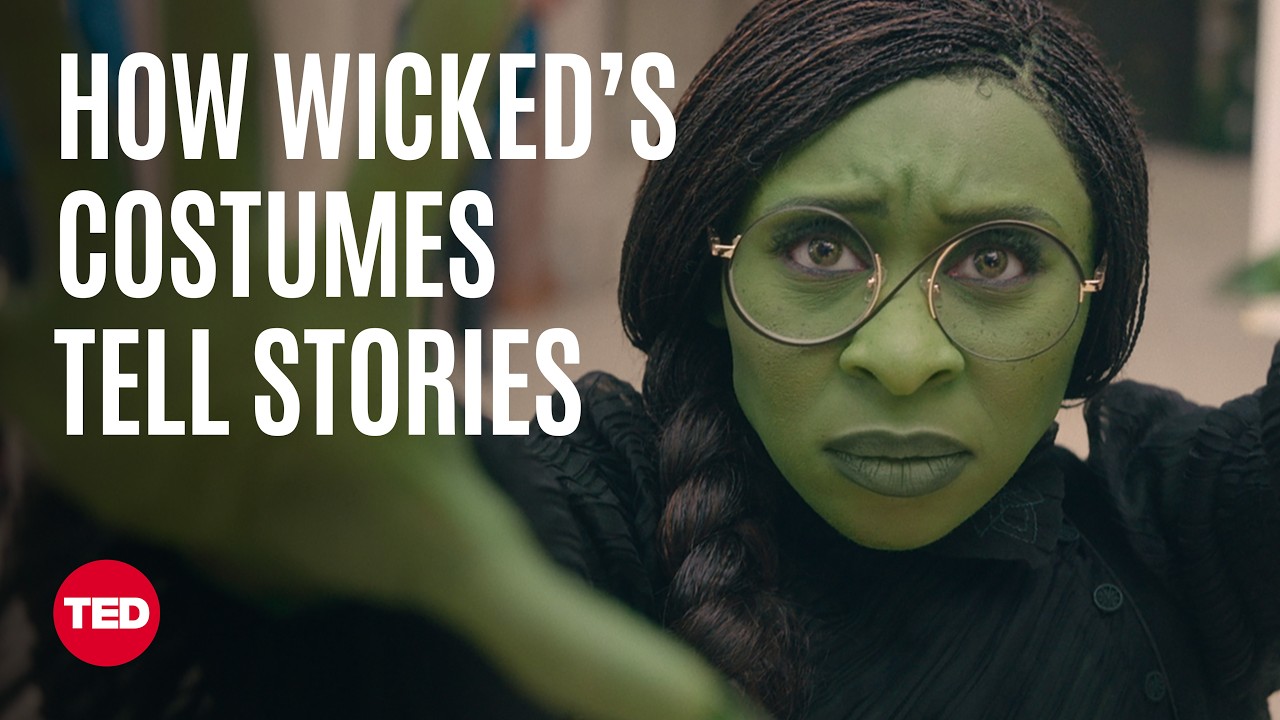
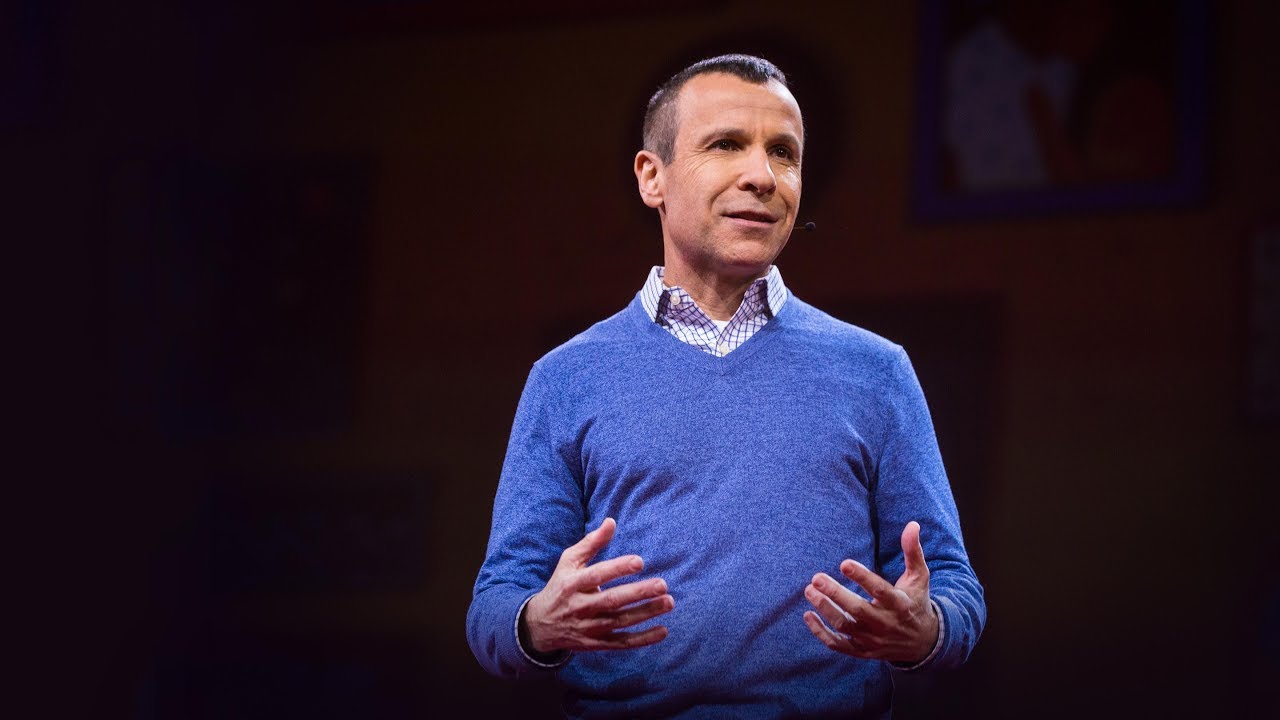
If you've ever been swept away by the worlds of "Wicked," "Hamilton" or "West Side Story," you've seen Paul Tazewell's breathtaking costumes. The Oscar-winning designer (whose work features in "Wicked: For Good") explores the subconscious language of clothing and how it shapes who we view as heroes — and who we view as villains. (Followed by a short Q&A with TED's Monique Ruff-Bell) (Recorded at TEDNext 2025 on November 9, 2025)
Join us in person at a TED conference: https://tedtalks.social/events
Become a TED Member to support our mission: https://ted.com/membership
Subscribe to a TED newsletter: https://ted.com/newsletters
Follow TED!
X: https://www.twitter.com/TEDTalks
Instagram: https://www.instagram.com/ted
Facebook: https://facebook.com/TED
LinkedIn: https://www.linkedin.com/company/ted-conferences
TikTok: https://www.tiktok.com/@tedtoks
The TED Talks channel features talks, performances and original series from the world's leading thinkers and doers. Subscribe to our channel for videos on Technology, Entertainment and Design — plus science, business, global issues, the arts and more. Visit https://TED.com to get our entire library of TED Talks, transcripts, translations, personalized talk recommendations and more.
Watch more: https://go.ted.com/paultazewell
https://youtu.be/BZflSdA4Q44
TED's videos may be used for non-commercial purposes under a Creative Commons License, Attribution–Non Commercial–No Derivatives (or the CC BY – NC – ND 4.0 International) and in accordance with our TED Talks Usage Policy: https://www.ted.com/about/our-organization/our-policies-terms/ted-talks-usage-policy. For more information on using TED for commercial purposes (e.g. employee learning, in a film or online course), please submit a Media Request at https://media-requests.ted.com
#TED #TEDTalks #Design
Оглавление (3 сегментов)
Segment 1 (00:00 - 05:00)
What makes someone wicked? Is it the color of their skin? Is it the story we've been told? Or is it what they wear? How do we make those judgments? What clues do we rely on? What assumptions do we carry, sometimes without even realizing it? As a costume designer, it's my job to use those assumptions, for better or for worse. People often assume my job is all fabric and sequins, dresses, buttons, maybe a good hat. In truth, my job is about perception. I am a storyteller, and my medium, my language, is clothing. Through silhouette, color and texture. I shape how you see someone before they speak a word. I decide whether you lean forward with curiosity or pull back with suspicion. When I put a character in a shade of scarlet, or wrap them in velvet, or cut them up in sharp black lines, I'm asking you to feel something about them, instantly, silently. That's what fascinates me. How simple fabric can tell us who is a hero and who is wicked. I seek out a thematic hook in every project. Something human, something that allows me to find myself in the story. I'm not just decorating a character, I'm telling a parallel story, one that lives in the clothing. Costumes are not static. They move with the body. They evolve. Sometimes they even tell lies. They reflect growth, conflict, resolution. I can telegraph an entire emotional arc in the fit of a jacket, the fraying of a hem, the way fabric breaks down under stress. What's extraordinary is this: you feel it, even if you don’t realize it. Costume is a subconscious language. I'm using your power of perception to lead you through the story. This manipulation of perception carried me to "Hamilton." At its core, "Hamilton" is a story of us versus them. Colonists versus empire. Immigrants versus the establishment. But Lin-Manuel Miranda handed me something radical. He said, "I want the audience to see our Founding Fathers through today's lens." So imagine that challenge. Black and brown bodies dressed in 18-century coats and breeches, rapping about revolution. History reimagined in real time. I design period silhouettes, yes, but with restraint. Neutral tones on much of the ensemble, while allowing their skin to show through, and the power of their voice to ring true in center stage. And then, in contrast, King George III appears in full regalia, bewigged, jewelled, painted in perfect detail from his portraitist. He is the Old World, they are the New. That visual duality, modern bodies in period shape, versus one man preserved in all his pomp, is what makes the story of democracy unfolding so compelling. It takes the historically familiar to frame a modern perception of how our nation was formed. And suddenly, there's Thomas Jefferson. Tommy Kail, our director, and I, decided, let's make him a rock star. So on struts Jefferson in flamboyant purple, modeled after a pop icon. Not by chance. That was a statement. History isn't dry or static. It's alive. It's charismatic. It's complicated. Even in subtle contrast, like Hamilton's vibrant green suits versus Burr's muted raisin palette. I was planting seeds, setting up a visual duel. Until finally, at the end, the two men stand together, both in black capes, equal in power, equal in tragedy, balanced, not in life, but in history's memory. The costumes weren't decoration. They were commentary, a way to ask whose history is this?
Segment 2 (05:00 - 10:00)
And who gets to own it? From the Founding Fathers, I jumped to 1950s New York with Spielberg's "West Side Story." Again, us versus them, Jets versus Sharks, white versus Puerto Rican. For the Jets, I leaned into blue-collar toughness. Denim, polos, sneakers, the uniform of boys rooted in concrete. For the Sharks, I turned to Latin textiles, vibrant florals, colors inspired by sun and sea, but cut with elegance and aspiration. These young men and women were dressing for a life they were yet to claim. I rejected the impulse that these two gangs are just mirror images of each other, separated by language and skin color. At the same time, I clung to what was iconic, like Anita's dress, but gave it my own twist. And then the dance at the gym, that iconic scene where the two worlds collide. I let the colors bleed together, warm tones crossing cool, fabric echoing across lines. Because even in conflict cultures mix, the borders are never as fixed as we pretend. Design here could have perpetuated stereotypes, but my goal was to dismantle them, to give both sides dignity, authenticity, complexity. The tragedy of "West Side Story" isn't that these two sides were so different. The real antagonist was the city itself, a system of development and displacement that was tearing their neighborhoods apart. Both gangs were fighting for ground they would lose regardless. Costume allowed me to underline that truth. The beauty wasn't in the separation, it was in the blend. Then came "Wicked." Elphaba, the Wicked Witch of the West, has green skin. She wears black. We're very familiar with the "Wizard of Oz" story that tells us the Wicked Witch of the West is evil. Beside her, Glinda sparkles in pink and glitter. These colors confirm who is good and who is wicked. Or so we think. But when I read the script more closely, I realized Elphaba is intelligent. She’s compassionate. She’s misunderstood. Glinda, on the other side, isn't always kind. I wasn't designing stereotypes. I was designing questions. Who decides who is worthy of respect and who is shunned? Who decides who is cherished and who is ostracized? Who decides who belongs and who is cast out? As a black gay man entering into a field that wasn't always comfortable with my presence, I know what it feels like to be othered, to be misjudged at first glance. Maybe that's why I'm drawn to stories about marginalized characters. "Wicked" isn't just about a witch. It's about anyone who has ever been judged without speaking a word. Why put so much care into costumes? Because clothing carries memory. A dress, a chair, a lamp, these things hold the fingerprints of their makers. They capture a culture at a particular moment in time. They embody our aspirations and our biases. The clothes we wear, the furniture we sit on, the art we hang on our walls, these things are costumes too. They shape our identity. They create culture. Design is never neutral. So I ask the question again. What makes someone wicked? It isn't the color of their skin. It isn't the story that we've been told. And it isn't what they wear. It's our perception. It's the costume we've been handed and whether we choose to believe it. My job, my joy, is in making you reimagine the answers to those questions. Because wickedness can be designed. And if it can be designed, then maybe together, it can be redesigned. Thank you. (Cheers and applause) Monique Ruff-Bell: Paul, I have a quick question for you. It was beautiful to see your journey of inspiration.
Segment 3 (10:00 - 10:00)
Now with the release of "Wicked for Good" is there going to be an evolution in the costumes, with the lead characters, with the evolution of the story? PT: Absolutely, yeah. And it's a continuation of how they evolve. And I mean, that's really what I'm talking about, you know, is that, you know, to create a reality even within the world of fantasy is what helps the story relate to other people or helps people relate to that story. MRB: Absolutely. And when will we see the magic of your handiwork again, after "Wicked for Good?" PT: Oh gosh, who knows? (Laughter) I would say look to Broadway first, and then, hopefully, again on the big screen. MRB: OK, thank you so much, Paul. (Applause)