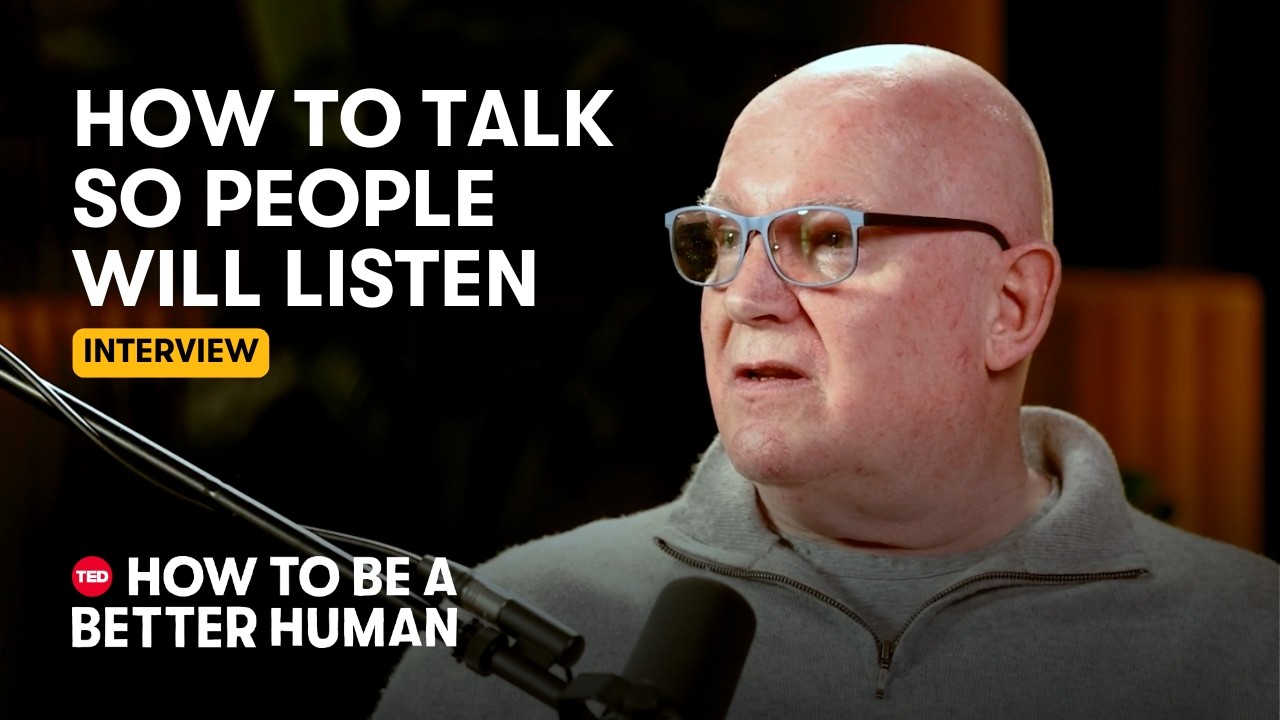
What’s more important in communication— the content or the delivery? Julian Treasure is a five-time TED speaker and the author of Sound Affects: How Sound Shapes Our Lives, Our Wellbeing and Our Planet, and he argues conscious listening is an invaluable tool for elevating conversations. Julian joins Chris to give advice on how to speak better, the listening method that could save your marriage, and how to be comfortable in silence.
Follow
Host: Chris Duffy (Instagram: @chrisiduffy | chrisduffycomedy.com)
Guest: Julian Treasure (Instagram: @juliantreasure | LinkedIn: @juliantreasure | Website: https://www.juliantreasure.com/)
Links
Sound Affects: How Sound Shapes Our Lives, Our Wellbeing and Our Planet
How to Be Heard
Subscribe to TED
Instagram: @ted
YouTube: @TED
TikTok: @tedtoks
LinkedIn: @ted-conferences
Website: ted.com
Podcasts: ted.com/podcasts
Join us in person at a TED conference: https://tedtalks.social/events
Become a TED Member to support our mission: https://ted.com/membership
Subscribe to a TED newsletter: https://ted.com/newsletters
Follow TED!
X: https://www.twitter.com/TEDTalks
Instagram: https://www.instagram.com/ted
Facebook: https://facebook.com/TED
LinkedIn: https://www.linkedin.com/company/ted-conferences
TikTok: https://www.tiktok.com/@tedtoks
The TED Talks channel features talks, performances and original series from the world's leading thinkers and doers. Subscribe to our channel for videos on Technology, Entertainment and Design — plus science, business, global issues, the arts and more. Visit https://TED.com to get our entire library of TED Talks, transcripts, translations, personalized talk recommendations and more.
https://youtu.be/SuaxadRqJpM
TED's videos may be used for non-commercial purposes under a Creative Commons License, Attribution–Non Commercial–No Derivatives (or the CC BY – NC – ND 4.0 International) and in accordance with our TED Talks Usage Policy: https://www.ted.com/about/our-organization/our-policies-terms/ted-talks-usage-policy. For more information on using TED for commercial purposes (e.g. employee learning, in a film or online course), please submit a Media Request at https://media-requests.ted.com
#TED #TEDTalks #HowToBeABetterHuman
Оглавление (7 сегментов)
Segment 1 (00:00 - 05:00)
the human voice. It's the instrument we all play. It's the most powerful sound in the world probably. It's the only one that can start a war or say I love you. And yet many people have the experience that when they speak, people don't listen to them. Why is that? How can we speak powerfully to make change in the world? Since you've become known as an expert on speaking and sound and the actual sound of your voice, there's a lot of pressure on the sound of your voice. — And of course, today you're interviewing me on a day when I've got a croaky voice, which happens to the best of us. So, I apologize for that. I'm taking menalyptus things. I've got lots of medications which will help with the condition, but you have to go with what you've got on the day. But there are exercises you can do to improve the voice and to, you know, it's like going to a gym and working on your muscles and then you've got more strength when you're out doing anything. It's the same with the voice. — It's also interesting to me because I think that often when people think about how to talk so people will listen, — they focus kind of exclusively on the content — but not on how the words are delivered. It's really interesting that you reframe it so that it's not just what you're saying, it's also how you say it. Both are really important. I asked that question to Chris Anderson actually um for my book, How to Be Heard. I interviewed him and I said exactly that. Which is more important, Chris? And he said, "If I had to choose," they're both important. If I had to choose, it's actually content because I will listen to somebody delivering really important or weighty information in a boring way, I'll stay with them. But if somebody is speaking nonsense brilliantly, it's just irritating. — So that's true. Nevertheless, it is very frustrating if somebody's giving you a really big gift and doing it badly, you know. And I always say one of the greatest visualizations when you go on stage to give a talk is that you're giving a gift. — You know, imagine six-year-old a wonderful present and how you feel at that moment. You have a big smile on your face. You're happy. You're excited. That's how you feel when you're going on stage to give the gift of whatever it is you're going to say to people. That's a wonderful way to be. And it helps enormously to have that visualization. And it moves you away from being concerned about yourself — and much more into a relationship with the audience which is generous and happy and based in love. — It also focuses you on what's really important, right? Which is people don't really care if you look perfect or if you are stumbling a little bit over your words. They care about what you're giving them and what you're offering them. If you give someone a huge gift, that's a that is going to be a positive moment for them. — Yeah. So, but you want to give the gift beautifully as well. — So, you know, you drop it on the floor and it's something's lost. — So, it's just the same with the delivery. Yes. You've got a wonderful thing to give them, but you want to give it in an elegant and beautiful way, the way that's going to get it received in the best possible way. So, delivery is very important as well as content. You can't just have one of them. You need to have both. you go travel all over the world giving talks in front of hundreds and thousands of people. So you're very unusual in that you talk in this professional way, but for a regular person, I think probably the most common times when they'll have to give some sort of public talk or a presentation at work or maybe they give a speech at like a wedding or a party. Yeah. Um are there other moments that people ask you about a lot? actually oneto ones uh you know when it's somebody that they find a bit intimidating for example or they don't feel heard uh they don't feel that somebody's listening to them and that's one of the biggest questions I get is how do I get somebody to listen to me yeah so all of these situations where you feel less than — you don't feel big enough you don't feel good enough that's a situation where it's tough and where you have to work through it — well let me turn that question back around and ask you the question that everyone asked then how do you make people listen when you don't feel like you're being listened to. — Well, the way to not to do that is to say to people, you're not listening very well. That doesn't go down extremely well with people. They get upset. And I'm a great fan of what I call contracts or agreements with people. So, for example, Chris, I've got something really important to say to you. Have you got five minutes to give me your undivided attention? — Absolutely. I know you were just role playing and 100% I'm already in, though. Yes, you have five minutes. And if you say no, I say okay, if now is not good, when would be good, — we make an appointment. And then if I start talking and you start doing your email or sending a text, I think I have a right to say, Chris, you did say you give me your undivided attention for this. So even somebody who habitually isn't very good at listening or is very distracted or always has something in their hand, those people can still be made appointments with and it's a very powerful way to get yourself heard and even to teach them the power of effective listening which does require
Segment 2 (05:00 - 10:00)
total focus. One thing that I wonder about with people like that is sometimes you have this kind of very brief window at the when you start talking to someone where they're judging is this worth my time? attention? And I feel like there's the positive and the negative side which is if you can communicate it in a way that makes it worth their attention, they'll continue giving it to you. But the other side is even for me, someone who I speak professionally, I don't feel like that's a big insecurity for me. Um, if I know that I've lost someone's, if I've I can see them say, "What he's saying isn't important. I'm not going to pay attention. " It really gets me in my own head and then I start feeling insecure and it's hard for me to even think I should win them back after that. There's a great system you can use to try and avoid that because the mistake many people make is they work with uh what's called an inverted Mento pyramid, which is to say the preamble. So, thanks for listening to me, Chris. and uh you know this happened, this happened really the reason I want to talk to you is this and so on and so forth. So, what I'd like to ask you is this. — Right at the bottom, you know, it's like those emails you get where you read seven paragraphs before you get to the bit which is actually asking you what they want. Turn it round. Start with Chris, I'm talking to you now because I need you to do this for me. — The reason is this. And if you're interested, here's the background for what happened. So, the pyramid is that way. You start with the point. M — if you always start with the point it's like I would say to people if they're devising content for a talk there's an old system that they used to have the essaists used to do this which is say say say say what you're going to say it then say what you said — so you summarize at the beginning and the end you give people the reason it's like um if why first then you have them with you they understand why it is they should then give you their attention for the rest of whatever it is you're going to I've heard um doctors sometimes refer to this as like the doors stop moment where they have the whole checkup and then right at the end as the person's leaving the room they go, "Oh, and by the way, is it a problem that I have a boil on my foot? " That's you know, that's a very graphic example, but they say the thing that was the real reason they made the appointment at the very end after everything else. — Yes. Which is unfortunate. If you imagine the thing as a pyramid and you do the why at the beginning, then you captivate people immediately. as long as there's a reason for them to listen to it. And presumably you've thought about that. There's a concept I teach a lot in my work which is the relationship between speaking and listening is circular. — It's not linear. It's not I speak you listen. There is this circle going on all the time because the way I speak affects the way you listen. — And the way you listen affects the way I speak. As you just said, you know, if you feel somebody's attention wondering, you start getting nervous and having to work harder and pressure mounts. So, this is a circle that's going on all the time in a context. Now, here we have a lovely context of a completely quiet room, microphones, everybody can hear everything that we're saying. That's not always the case, is it? — You know, you wouldn't want to propose marriage to somebody in a noisy Starbucks — shouting at the top of your Well, you might, but you know, you have to think about might get a different answer. — You might. So we need to be conscious also of the context around us and try and optimize that. So that's about listening to the sound around us. Is this the best sound it could be? And then being conscious of the fact that everybody listens in a different way. And it's a huge mistake. That's very common. People assume everybody listens like I do. — They do not. And once you get that, it changes everything because you start asking the question, what's the listening I'm speaking into? So, what's your listening now? Right now, I can tell you're listening to me very attentively. You're looking at me. You're giving me signals that show me you're with me and so forth. If you were loling back in your chair, staring at the ceiling, you know, I'd have a different feeling. — Yeah. So, what's the listening I'm speaking into is a great question to be asking because you can then adapt your delivery whether it's pace, tone, vocabulary, body language, content, it all can be changed to fit the person you're talking to. That's how you hit the bullseye instead of missing the target altogether. It also is really interesting to think about this for me because I think there's quite a lot of information out there about how to speak and how to make yourself be heard especially in this kind of you know self-help um optimization space. There's a lot about how to be the person where people listen to them. Um and that's kind of very self argrandizing. There's a lot of ego in that. there's much less in how to listen, how to be generous, how to give the attention to someone else. And what one thing that's really resonating with me about what you're saying is the um the idea that when we listen really well, it's this virtuous cycle where the whole conversation, we get to speak better because we are listening well and
Segment 3 (10:00 - 15:00)
the whole thing feeds on each other. I'll give you a number. My TED talk on speaking, which is the one that's gone completely ballistic and is the top 10 of all time, has been seen by five times as many people as my TED talk on listening. — Now, that says something to me. You know, we're in a world where we're very keen to be heard but not so interested in listening. — And that doesn't work very well if you think about it. If everybody is speaking to be heard and nobody's listening, that's a fail. So listening to me is the foundational skill and it's the thing that is I think in danger in the world today. We're seeing the lack of listening all around us in polarization, demonization, trolling, you know, aggression, rudeness, the conflation of opinions with facts, which I talked about in that TED talk on speaking, you know, as dogmatism, one of the seven deadly sins of communication. — That's all around us now. And it's all founded in not listening to other people, being in oneself. You know, I'm right, you're wrong. That's the way it works at the moment. It's so wrong. We're not in a zero sum world. — Two people can be right and have different views because they're in their own perspective. They've got their own history, their own values, attitudes, beliefs, their own listening positions, their own everything. And they can have very different views and both be right. You know, people do everything and say everything for a reason. And once we start to accept that and listen to understand other people, that's a different world. And that's the world I want to try and generate. That's why my focus, my whole purpose in the world now is to generate listening. — Let me just ask you this, which is in really like a practical way. If I want to make my voice sound better, I can warm it up. There's all sorts of vocal warm-ups that you can find that you have taught people. I can drink hot tea. I can do all these things that make my voice sound better. What are the practical like exercises that people can do to listen better rather than speak better? Well, first is to rediscover your connection with silence. You know, over half the world's population lives in cities now and very rarely experiences silence or nature sound, which is another topic entirely. So, we evolved over maybe 300,000 years. Homo sapiens has been here and 3 million years before that our ancestors we evolved in pretty quiet situations bird song water wind and so forth we're now in a very different situation uh and we're dealing with noise all around us so it's very difficult for us to listen because we become numb and silence is the baseline there are different qualities of silence I could go on about silence for a long time silence is amazing it is a sound and it's a very important sound. Getting silence into your life is a very excellent way of resetting your ears. Reacquainting yourself with a baseline from which you can then work and listen aresh. It is refreshing. Simply 3 minutes a couple of times a day is very helpful. So you might have to go and lock yourself in a bathroom or a closet or something in order to get it in a city and absolute silence not necessarily the quietest thing you can get. Of course, if you're lucky enough to live near nature, you can go and do shinyoku, forest bathing, get out into nature and listen to beautiful s tranquility as well. That's also good for you. So doing that and getting away from the noise, that's a very good thing to do in the first place. And then I have some exercises for listening skills in conversation particularly like this. I mean you're doing one of them very well all the time now which is rasa which is receive. That is to say, pay attention. Look at the person who's speaking. Appreciate the little things you're doing like nods — and, you know, eyebrow blinks, raised eyebrows, smiles, head bobs, all of those. Exactly. All of those kind of things. — Uh, the S is summarize, which you've been doing as well. Uh, often uses the word so. It's a very important little word that got abused for years when everybody was starting every sentence with the word so. So, what you've what I've understood is this. Or so what we're saying is this. So what I got is that right? Checks receipt. And then the A is ask questions. Ideally open-ended questions. Why, what, which, when, where, who, those kind of questions that do not permit the answer yes or no. So Russa, receive, appreciate, summarize, ask. That oils conversation very well. And actually a man told me after I taught him that, he came back months later and said, "You saved my marriage with that thing. " — Wow. So it's very effective in conversation. So there's a couple of steps on the way to becoming a better listener. Silence. Rasa. — I would say I am challenged the most by silence. I like to fill silence. I like
Segment 4 (15:00 - 20:00)
to fill have jokes or laughter or overlapping conversation and that's something I've really had to learn about. And one of the ways that I have learned about it is by professionally interviewing people because something that I think is kind of journalism 101, interviewing 101, and yet is such an incredibly effective tool, I am always shocked by how well it works is ask the question and then don't say anything. Even if they don't answer right away, let them fill the silence. It's always interesting if you just fight. I have to really fight my urge to ask you a question and then clarify. If I just keep it quiet, it's incredible how something else will come up in there. Another thing that strikes me about silence is in your book sound effects. You have four sections. And one of the sections is silence that is just as important as nature sounds as in these other big types of noise. Um, and yet I think many of us don't often think of silence as that powerful or something that we need to listen for. — It is so powerful. You know, in your job, as you just said to me, if you ask a question, shut up and let the person, even if it even if you have to wait. — That's not the only situation in which silence is very effective. Salespeople. — The research I've just seen recently shows that most salespeople speak 60 65% of a call and listen 35%. It's the wrong way round. In fact, the sweet spot for closing is to reverse that entirely. listen 65% and speak 35%. And any great salesperson would tell you the most important part of the conversation is listening. — And if you're closing in a sales conversation, you ask the question and do not say anything for the longest time you can. It can get very uncomfortable. You might have to hold your leg like this and just sit waiting. But if you do that, the result is always that the person will come back with some sort of question that you can answer. So it's really important and the biggest mistake I see with people on stage is gabbling is filling every moment. — That's where the you know ums all those fillers come from is the uncomfortable feeling when there's silence. So you know I can do a thing on stage when I'm talking I can just stop. — That's my max right there. That's where I got uncomfortable. So, if I'm standing there and I've stopped and I'm not looking uncomfortable or flustered or going red or, you know, the audience know there's nothing going wrong and they're going, "Ah, it's nice. A bit of peace and quiet. What shall I have for lunch? " You know, and — that's what I'm always thinking, by the way. — We all have a little pause. You can stop for the longest time. Really, 3 to 5 seconds is nothing. — And silence is such a powerful tool. When you make a really important point, you can say this and then stop. and let it settle and then you know the thing will move on. So being comfortable with silence I think is the foundation of all powerful speaking really. — You also have uh an acronym for how to speak well. That's hail. Talk us through what hail is. — Okay. Hail which means to greet or acclaim enthusiastically which is nice. Uh it stands for honesty which is to be clear and straight not use jargon not confuse people. not try and impress people with big words or you know complex ideas always what's the listening I'm speaking into what kind of language is going to get this across in the most effective way so honesty clear and straight the A is authenticity which means being yourself now I love Susan Kane's talk I remember I met Susan after that talk and said do you know your life is going to change completely after you did that she gave a wonderful talk about the importance of valuing introverts — and Actually, interestingly, when I'm on the speaking circuit, the vast majority of the professional speakers that I meet are introverts, — and I am. — We've all learned to go on stage and project and do a job and be comfortable with a thousand people looking at us. Nevertheless, we're introverts. And being authentic to yourself, I don't go on stage and do all sorts of, you know, running about and whooping and hollering. That's not me. — So, I'm very still on stage. I'm quiet and I talk in a sort of genuine sincere way. That's who I am. Pretending to be somebody else, it never really lands. Unless you're an actor or you're doing a part, in which case, brilliant. But if you're talking as yourself, be yourself. You are enough. The I is integrity, which means being your word. If you say it and then you don't do it, people learn that pretty quickly. And your words just evaporate like puddles in the sun. They go. And the L perhaps surprisingly is love. And I don't mean romantic love. I mean wishing people well. As you walk on stage, you know, we
Segment 5 (20:00 - 25:00)
talked earlier about the idea of giving a gift. You know, when I go on stage and if I feel I've got a gift to give people, I'm happy. And I, you know, I have a little acronym for the moment you're on the spot. It's another fourletter four letter fourletter acronym Bess which is as you walk to the spot breathe in because your voice is just breath and it's good for nerves as well to do that expand your awareness to see the whole room if you can take your stance and there's a great visualization I can give you for that and smile because you're happy you're going to give a gift and then you get people smiling back and you've made a relationship with the audience which is positive and The smile one is interesting because I feel like that's one that I remind myself of a lot consciously. Someone the way it was once told to me is if you're ever not sure what to do with your face, try smiling. And it is amazing how dramatically that changes the tenor of an interaction if I just instead of giving them this dull kind of intimidating face, if I smile and then we start having a I mean you obviously don't want to be smiling if they're telling you a tragic story then it's disturbing. But most of the time it really does change things to have that kind of openness on your face — when it's intentional. — You know, there are people I've met who smile almost constantly because they've learned that, you know, they don't feel enough or there's something they're trying to make connection all the time and there's a dis discomfort about it. So they're smiling all the time that becomes meaningless. So, one of the great things I love about speaking and particularly speaking on stage is it's the time when I'm probably most conscious. You better be conscious if there's a thousand people looking at you. — When are you going to be conscious? If not, then — and I think a lot of the work that I do and a lot of what I talk about both speaking and listening is really about consciousness. It's about becoming a more conscious human being. So when on stage it's conscious gesticulation, conscious stance, conscious of the connection with the audience and the listening I'm speaking into. Conscious of the way that dynamic is working. You know, are they looking tired? Is it just after lunch? You know, I often get that what's called the graveyard slot. You probably do as well. Oh, he's a TED speaker. He can deal with that. We'll put him on at two just when everybody's tired and so forth. So being conscious of the whole situation um you know when I go into a big venue going to see the AV guys you know we've got wonderful crew here. Hello I'm Julian. How are you? You know making connections with people because all of it matters. All of it has an effect. So I love that whole process of switching on and being conscious about every step. the tech, the prep, the rehearsal, you know, the checks, the people around, uh, and then the walking on stage and doing your best job to deliver. I was very lucky with that last TED talk. I'd done four in successive years before that. So, I had practice — and so fortunately, I was able to do that one really well, which, you know, was quite important because if you're going to stand on the TED stage and speak about speaking, — that's the bar is high. — Yeah. That's sticking your head above the parapit big time — for me with both speaking and listening. I come at this as someone who professionally has worked in comedy but also I used to teach fifth grade and an elementary school and I'm always so struck by how especially hail all of those pieces are so much what it takes to talk to kids and kids are such perfect barometers of whether you are being honest, authentic, whether you have integrity and whether you're coming with love. — Yeah. because they haven't learned how not to do that. — Yeah. And they'll just tell you like that's not true or you're not. If the biggest thing that I learned in the classroom was it is so you have such a tendency as a teacher, especially a new teacher to say in our classroom, we do not throw paper into the trash. We get up and we put it in. And kids go, "Okay, well, if that's a rule, there's always at least one kid that says, "Well, I'm going to test if that's a rule. " And then they throw the paper in the trash and you don't do anything. They go, "Okay, well that's not a rule then. " There was no integrity behind it. — And adults are like that, too. They're just a little sneakier about it, I think. — Yeah. It's so true. So, I think integrity is one of the most difficult things in life because we all like to impress people or to be liked and we will say things to get liked. So, ego is the driving force behind a lot of behaviors which are not very helpful. You know, one of the things I talk about is internal listening. Listening inside to the voice inside you. And lot a lot of people have a very negative voice. There's a critic in there going, "You idiot. Don't get on that dance floor. You'll mess that up. Don't do that. You know, all that kind of negative selft talk. And the answer to that is to realize that you're not that voice. If you're not that voice, who are you? You're the one listening to the voice. — And the voice may be a part of you that's been damaged in the past. It's a fragment which is trying to stop pain from happening again. But if you're the
Segment 6 (25:00 - 30:00)
one listening, you're the king or queen on the throne. The jester's coming up and giving you that. You can tassel its head and say, "Thanks. Now go away. I'm going to do it anyway. So that kind of awareness of ego I think is really important especially where it comes to integrity and to stopping the mouth from running off and making promises that we can't writing checks we can't cash. — How do you think about humor and laughter as a part of this as well? One of the classic tips that people say is start with a joke or you know and I think that for me is often a shorthand because when you're standing in front of a room of a thousand people or if two people it's hard it's a little hard to know whether you're connected or not but if they laugh you instantly have that well we must be connected because they are there's this feedback immediately. So how do you think about that? — Well it's lovely to do if that's you authentically. — So you're a comedian that's brilliant. I'm not. And I would feel uncomfortable walking on stage with a prepared joke — because I probably wouldn't deliver it brilliantly. And there's nothing worse than a joke that falls flat. — Yeah. Agree. — The tumble weed is blowing down the street. — Anyway, let's move on. You know, it's not a comfortable moment. So, if you feel proficient, if it's really what you do, if you're a funny guy, be a funny guy. If you're not, my style of humor would be more to share what's going on for me in a kind of ironic or gently amusing way, which again makes that connection with the audience. Um, maybe something's happened on the way there or whatever it may be. Now, I don't do that at the beginning of a talk because the talk, I want them to get the why. — So, I don't do small talk. Yeah. Hey, it's a bit hot in here, isn't it? Oh, it's great to be with you. I'm really excited to be here in, you know, Vancouver. What a lovely city, isn't there? Do you live here? You know, no, I don't do any of that because I want them to have the why very clearly upfront. And in fact, when I'm doing my talks on listening, I walk on stage and just say listen and then stop for a long time. And then we talk about what's that? That's the sound of listening. It's a very important sound. Why is it important? And so forth. So when you're starting something, you can grab attention. You can make a controversial statement of some kind. Did you know this? Or you know, here's something that you're going to disagree with. You can ask a question. You can give them a huge result that they would like. Would you like to dot dot? Whatever it is, it's the why. And it's very important that that's the pinnacle of your pyramid. Everything flows from that. Then I might make jokes. I might be, you know, in my own little way gently amusing, — but I'm not going to crack gags. do routines. I'm not going to try and do, you know, standup because that's not who I am. It would be inauthentic. — Yeah. I think that authenticity piece is something that it is intuitive and it but it's also not obvious and it's really difficult. One question that I have for you that it can be about authenticity, other things as well is what when someone else is speaking, what should we be listening for? I talk about listening positions and that's very important. There are lots of ways you can listen and there are many models of this out there. So people talk about active listening. I talk about conscious listening. That's the thing I like to talk about because the whole conversation to me is about consciousness. And listening for is one listening position. It tends to be what I would call critical listening which is what's in this for me? Where's the value in this? Is this important? Is this useful? Should I go somewhere else? You know, um, and you get a lot of that. I mean, the most uncomfortable situation, anybody who's been to, for example, an exhibition, you get those conversations where people are always looking over your shoulder to see if there's somebody more important that they should be speaking to, — checking your badge, you know, are you significant? That kind of that's a very hardedged critical listening. — There's nothing wrong with critical listening. It's very useful in business, but it may not be what you want to take home. Where you might want to move into empathic listening, which is feeling the other person's feelings, listening with your heart as well as your ears and your eyes, and going onto their island, and really seeking to understand what's going on for them. You know, people say there's three things we want in a relationship. To be heard, to be understood, and to be valued. And empathic listening does all three of those. But again, you wouldn't necessarily want to do that at work the whole time. Sometimes you have to be hard or discipline people or just be direct. And you know, empathic listening would not work in the army, for example, in the armed forces. Do what you're told. — There's no empathy in that at all. So listening positions, there are many, many of them. You can create as many as you like, but the key is to be conscious of where you're listening from. Listening for is very useful sometimes.
Segment 7 (30:00 - 33:00)
Listening with listening out of for example faith or fear or listening the masculine feminine listening tends to differ quite a lot as well. So there are a lot of different ways of listening. — The masculine and feminine listening I'm not surprised that uh before you said that it was a man who said you saved my marriage with your listening help. Um I feel like there's definitely a way in which we are socialized as men to be talkers to be grabbing attention rather than giving attention and paying attention. There are a lot of books about this and with listening I talk about male listening tends to be reductive that is to say for a point — to solve a problem to arrive at a given destination there's a purpose to it whereas female listening tends to be more what I call expansive that is to say there's no point to get to there's no destination in mind it's enjoying the journey with the person you're with wherever it goes really and so if those get confused. You get conversations like she comes home and says, "Oh, darling, I had a terrible day. This happened. This happened. " And he looks up from the football game and says, "Darling, have a bath. It always makes you feel better. " Now, in the male world, that's problem solved. Back to the football. In the female world, that was not what she was looking for. She was much more looking for, "Darling, sit down, have a glass of wine, tell me all about it. " That's expansive listening. So pro solving a problem can be very useful sometimes, but we need to be conscious of the listening position we're in. And if we can move into the other one, that can be the solution to a lot of you never listen to me, which is the biggest complaint in relationships. — I'm just curious. I want to know two rapid fire kind of silly questions. Um the first one is what is your favorite sound? — Gentle rain on leaves outside the window. And flip side, what is your least favorite sound? What gets under your skin and gives you the creepy crawlies? — I think these days it is lots of people talking at loud volume in a very echoey, poorly designed room — where I'm trying to listen to somebody and you know it's 90 dibels plus of noise going on there. And I'm finding it it's called the cocktail effect. It gets worse as you get older. I find that very challenging uh and also debilitating. You know, noise does fatigue us. stresses us and indeed if you're in that kind of a situation for lengthy periods of time it's increasing your risk of heart attack. Um you know teachers work in classrooms which are quite noisy these days and it may well be they're shortening their lives by working in those classrooms at 65 dibels which is not that loud. You'd have to raise your voice to be heard but it's not shouting loud. If that's the noise level day after day your risk of heart attack is elevated. lots of research on this now. — So, we need to be careful about these things and the kind of the casual noise. Architects don't listen to the buildings they make. You know, I have a TED talk about that as well. And a plea to architects to design with their ears. That is the biggest thing that frustrates me now is being in poorly designed spaces and just getting assailed by noise. — Julian Treasure, thank you so much for making the time to be on the show. It was an absolute pleasure talking to you. — It's been my pleasure, Chris. Thank you. Hi everyone. I hope you enjoyed this episode of How to Be a Better Human. Before you go, please click the like and subscribe button to get alerts on inspiring TED talks and interviews. You can also head over to TED's own podcast channel, the TED Audio Collective, where we publish even more video podcasts. Thank you so much and hope to see you