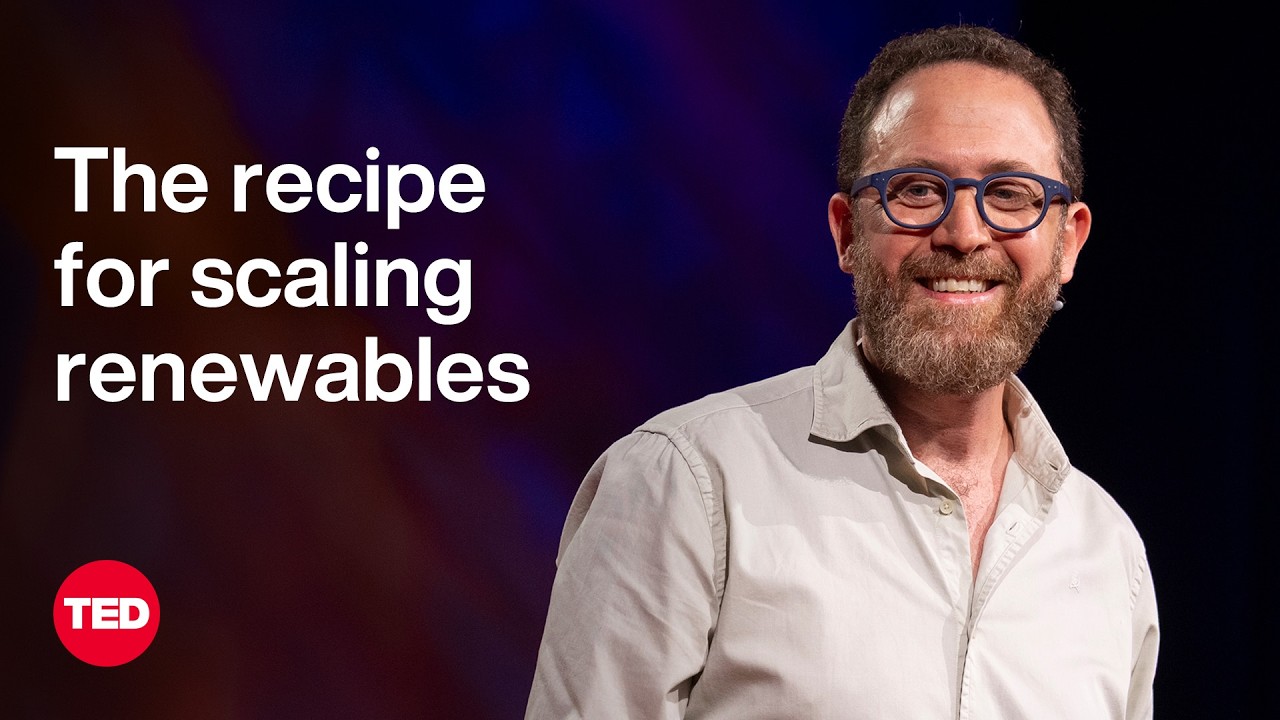
Most Countries Fail at Clean Energy. Here’s How Mine Succeeded | Sebastián Kind | TED
11:32

Most Countries Fail at Clean Energy. Here’s How Mine Succeeded | Sebastián Kind | TED

TED 06.10.2025 70 436 просмотров 919 лайков обн. 18.02.2026
Поделиться Telegram VK Бот
Транскрипт Скачать .md
Анализ с AI
Описание видео
Energy expert Sebastián Kind helped Argentina go from virtually no renewable energy to generating nearly 40 percent of its electricity from wind and solar in just six years, despite economic crises and skepticism. How did the country's transition off fossil fuels happen so quickly? He shows why the key breakthrough didn't hinge on technology or resources — and explains how other countries can follow the same path. (Recorded at TED Countdown Summit 2025 on June 17, 2025) Join us in person at a TED conference: https://tedtalks.social/events Become a TED Member to support our mission: https://ted.com/membership Subscribe to a TED newsletter: https://ted.com/newsletters Follow TED! X: https://www.twitter.com/TEDTalks Instagram: https://www.instagram.com/ted Facebook: https://facebook.com/TED LinkedIn: https://www.linkedin.com/company/ted-conferences TikTok: https://www.tiktok.com/@tedtoks The TED Talks channel features talks, performances and original series from the world's leading thinkers and doers. Subscribe to our channel for videos on Technology, Entertainment and Design — plus science, business, global issues, the arts and more. Visit https://TED.com to get our entire library of TED Talks, transcripts, translations, personalized talk recommendations and more. Watch more: https://go.ted.com/sebastiankind https://youtu.be/ACC5KCPRt_U TED's videos may be used for non-commercial purposes under a Creative Commons License, Attribution–Non Commercial–No Derivatives (or the CC BY – NC – ND 4.0 International) and in accordance with our TED Talks Usage Policy: https://www.ted.com/about/our-organization/our-policies-terms/ted-talks-usage-policy. For more information on using TED for commercial purposes (e.g. employee learning, in a film or online course), please submit a Media Request at https://media-requests.ted.com #TED #TEDTalks #ClimateChange
Оглавление (3 сегментов)

  1. 0:00 Segment 1 (00:00 - 05:00) 748 сл.
  2. 5:00 Segment 2 (05:00 - 10:00) 718 сл.
  3. 10:00 Segment 3 (10:00 - 11:00) 207 сл.
0:00

Segment 1 (00:00 - 05:00)

In just six years, Argentina, my beautiful home country, went from barely having renewable energy on its grid to one where on some days nearly 40 percent of its electricity comes from wind and solar. And this happened in a country globally recognized for its political and economic crisis. Home of a world-class oil and gas industry with the fourth-largest shale oil reserve and the second-largest shale gas reserve in the world. You might be wondering, how was that possible? And how can we replicate this all over the world? I'm going to tell you how. I spent my entire career making renewables a reality. I worked in the private energy sector, in government, in the third sector, and after many years, I learned that the key to making the energy transition work in emerging markets all comes down to helping investors protect their investments and building trust where there's not any. It's basic. It's a step one of real-world economics. But keep that framing in your mind for a while and let's look at Argentina as our case study. When I was starting out thinking about renewables, I was always asking myself two things. Why were we using fossil fuels instead of our incredible renewable resources? And why was my country experiencing recurrent economic crises? And I found that both questions were connected. Fossil fuels are easy, practical and for a long time has been the obvious choice. A lot of concentrated energy, just dirty. But who really cares, right? On the other side, renewables require significant upfront investment for them to produce clean energy for decades at almost zero operational cost, which makes them competitive against fossil fuels, but only in the long term. Long-term investments are really the challenge in risky markets like Argentina. As for the second question, the economic crisis, get this. I always knew that this was because of politics and what I call mismanagement. But there was something else there. Energy. Argentina is a country super rich in natural resources, but we've been importing fossil fuels for decades. And of course, fuels that had to be paid for with money that we never had. So it became clear to me that if we really want to make the energy transition work, we have to finally find a way to get private investment into the long term. And if we could do it, we can tackle both things at once. Climate change and the economic strain of spending hard currency we don't have in importing energy we don't actually need. Argentina has tried four times since 1990 to develop its renewable resources and failed each time because, of course, the transition from fossil fuels to renewables doesn’t happen because someone like me, here, on a TED Talk, says it should. It happens because it is convenient. And convenient, particularly in emerging markets, means economically viable for both the buyer and the seller. And here's where I found that my country was one of the hardest countries where to invest long term in the world. But why? Because historically, we had the habit of changing the rules halfway through. Can we imagine what it means to convince an investor to put their money into something that spans multiple administrations, four, five? Listen, we have five presidents in ten days in the early 2000s. (Laughter) It's just too risky. So the rule here is a short-term investment rule. And when you want to build your wind or solar farm and get your investment back in only a few years, the result is that the unit of energy is too expensive and is not competitive against fossil fuels. So here we go. Renewables are expensive. Of course not. But we need to build them in the long term, there's no other way to do it. So I decided to try to change that, and I started working from the civil society in creating a legal framework, a political umbrella, that would allow all the factions in my country to rally behind one single cause. We needed to develop our incredible renewable resources, consume less fossil fuels, and save on our energy balance. We needed a program that cannot be easily undone by a change in government control. We needed a national cross-party policy in which everyone agrees that renewables must happen, not because [they] are clean or green or fancy, but because [they] are convenient. It took me huge effort, frustration more than two years
5:00

Segment 2 (05:00 - 10:00)

but I did it. We managed to convince almost every member in Congress to support a national renewable energy law. (Applause) Something that, as you can imagine, felt nearly impossible in a country marked by deep political polarization and the oil and gas industry fighting us at every step. But we did it because the argument was clear, easy. It would be economically beneficial for the nation if we started by demonstrating to investors a true political consensus and a long-term unity. Long story short, the law was passed by with 94 percent of support in both chambers. Historic. (Applause) This is me. (Laughter) And with that in my hand, I moved to the next phase of the plan: implementation. I had the privilege of being invited to join the executive branch, the Ministry of Energy, to design a program that can really change the course of our energy future. And I knew where to start. We had to improve the credit rating of the energy program and shift it out of the credit rating of the country. Because by doing so, we would bring international capital to the game and prices would go down from A to B, making renewables competitive against fossil fuels. So we designed a unique scheme of investment guarantees, something that I love to call the worst-case scenario waterfall. It consists of three steps. The first one, what we call the energy payment guarantee. It is basically a fund, established in advance by the government to pay the seller of the energy, like the investors behind the wind or the solar farm, for any payment that the buyer, like the utility, cannot pay for whatever reason. Interesting. But we knew that this was not enough. Because we know that the government of Argentina has frequently halted currency conversions and restricted money transfers abroad in past economic crises. So we had to offer an extra layer of protection to the investors. We structured a second step, what we call the early termination payment guarantee. We structured treasury notes that we granted to investors in advance before they commit their investment. We told them that no matter what the government decides to do, they will get their investment back. That's beautiful. But still, something was missing here. Because we knew that we needed to bring international capital to the game. So far, we've been protecting the investors from problems within Argentina, but not from Argentina defaulting on its obligations as unfortunately had happened in the past. And if there's something money has, it's memory. So we decided to offer a third-step guarantee, what we call the international backstop, to backstop the obligations of the sovereign government. We negotiated a 750 million dollars with the World Bank, one of the least risky institutions in the world. In other words, we told investors that no matter what's going on, they will get their investment back in the currency of their choice, wherever in the world they would like. So now, it's a different thing, right? So the water of international finance could start flowing. But what does this really mean in practical terms? Before I took office, Argentina was negotiating contracts at the 350-dollar range in the solar business. Long-term contracts but short-term view. Super expensive. And of course, not competitive at all against fossil fuels. Not convenient. In less than six months, we brought prices down by a factor of seven, to the 50-dollar range. (Applause) We brought 11 billion dollars into the economy. In the wires, more than 200 projects all around the country are making today a place where on some days, nearly 40 percent of its electricity comes from wind and solar. And drum roll, please. The country -- (Applause) is saving today over two billion dollars in hard currency per year. This is more than 40 billion dollars in the life of the assets, equivalent to the entire debt that the country has with the IMF, the largest in the world by far. (Applause) More than 300 million tons of CO2 avoided. This is the real impact of what a well-structured and trustworthy program can offer. But I knew that this was not only a problem affecting Argentina. More than 70 percent of the countries in the world suffer about the same.
10:00

Segment 3 (10:00 - 11:00)

So I decided to leave the government a few years ago and with the support of Climate Breakthrough, I created a nonprofit organization to support governments in emerging markets with the design and implementation of renewables at scale. I wanted to offer others what I would have loved to have when I took office, and I didn't have. Someone, a real partner, that can help me design the path forward, craft the documents with me. Someone that can give me access to a world-class team of experts with real, hands-on experience in structuring projects all around the world, and particularly, renewable energy projects in emerging markets. Someone that can give me tools, concrete tools, like the iTrust, our guarantee fund, established and ready to use. It is called RELP, in short for real and possible. And we work across emerging markets in Southeast Asia, supporting governments in Africa, in Latin America and the Caribbean. And we won't stop until we see renewables in every single wire and beyond. (Cheers and applause) The key is to create stability, build trust and design programs that can really make renewables not just the right thing to do, but the most convenient thing to do everywhere. Thank you. (Cheers and applause)

Ещё от TED

Ctrl+V

Экстракт Знаний в Telegram

Транскрипты, идеи, методички — всё самое полезное из лучших YouTube-каналов.

Подписаться