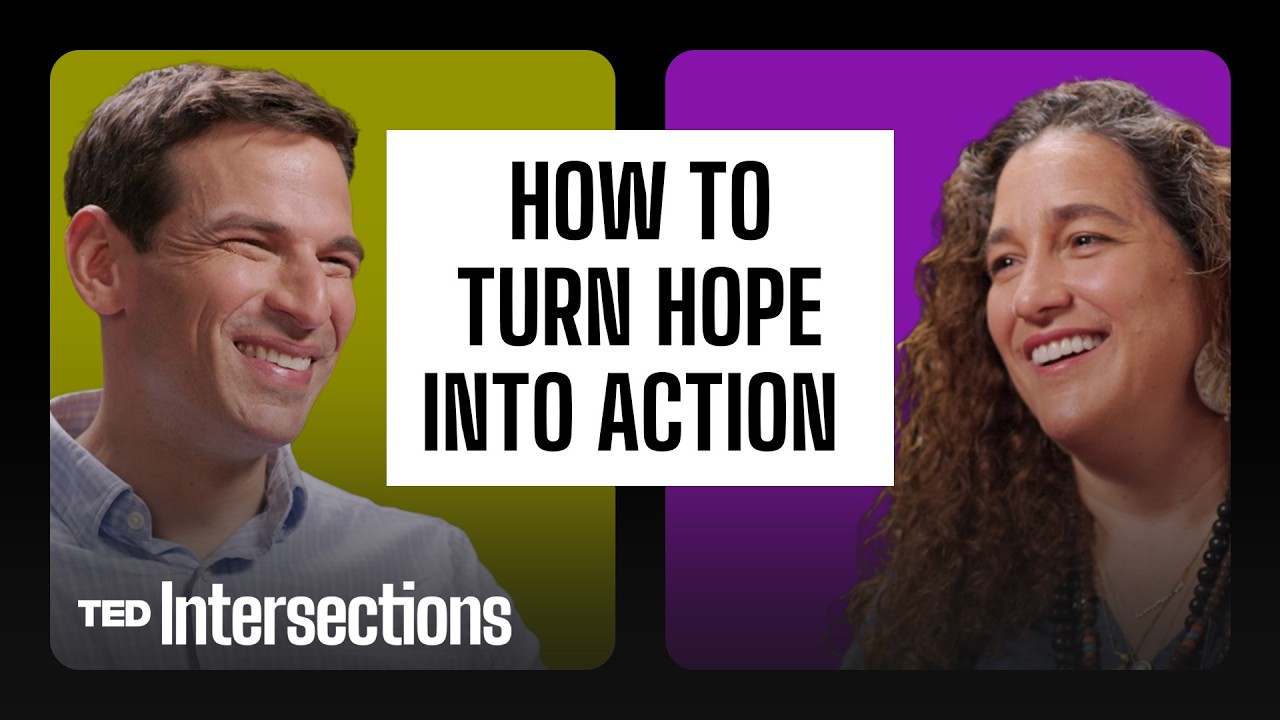
How do you hold on to hope while still being realistic about the work that needs to be done? Immunology researcher David Fajgenbaum and public health expert Celina de Sola discuss how they scaled personal missions into organizations making long-term impact on communities near and far. They explore how to stay motivated, discover your leadership style and uncover overlooked solutions hiding in plain sight. (This conversation is part of "TED Intersections," a series featuring thought-provoking conversations between experts navigating the ideas shaping our world.)
Join us in person at a TED conference: https://tedtalks.social/events
Become a TED Member to support our mission: https://ted.com/membership
Subscribe to a TED newsletter: https://ted.com/newsletters
Follow TED!
X: https://www.twitter.com/TEDTalks
Instagram: https://www.instagram.com/ted
Facebook: https://facebook.com/TED
LinkedIn: https://www.linkedin.com/company/ted-conferences
TikTok: https://www.tiktok.com/@tedtoks
The TED Talks channel features talks, performances and original series from the world's leading thinkers and doers. Subscribe to our channel for videos on Technology, Entertainment and Design — plus science, business, global issues, the arts and more. Visit https://TED.com to get our entire library of TED Talks, transcripts, translations, personalized talk recommendations and more.
Watch more: https://go.ted.com/tedintersections
https://youtu.be/FG0dYhiTGLI
TED's videos may be used for non-commercial purposes under a Creative Commons License, Attribution–Non Commercial–No Derivatives (or the CC BY – NC – ND 4.0 International) and in accordance with our TED Talks Usage Policy: https://www.ted.com/about/our-organization/our-policies-terms/ted-talks-usage-policy. For more information on using TED for commercial purposes (e.g. employee learning, in a film or online course), please submit a Media Request at https://media-requests.ted.com
#TED #TEDTalks #TEDIntersections
Оглавление (6 сегментов)
Segment 1 (00:00 - 05:00)
Celina de Sola: I feel like you can hold hope and despair at the same time, right? Like, it's OK to hold those things. Because if you're trying to be hopeful, you can't really always let go of the sadness and the despair and the frustration. So it's like, how do we hold those simultaneously in a way that enables us to keep working and keep learning and, you know, collaborating. [Intersections] [Presented by TED] [David Fajgenbaum, Immunology researcher] [Celina de Sola, Public health expert] I'd love to hear about your work. What are you working on? What are you doing? David Fajgenbaum: I’m on a mission to save and improve lives with the drugs that we already have. We use an AI platform to scan across the world's knowledge of every drug and every disease to find out new uses for the medicines that we already have. CD: That’s amazing. DF: And tell me about yourself. CD: So actually we were founded in El Salvador, an organization founded in El Salvador, we're trying to create systems that are more trauma-informed to make sure, especially in contexts of violence, but to make sure so kids and families can navigate the adversity they face and thrive, right, instead of just, you know, struggling with the impacts of stress and trauma on their lives. And we work in public schools, too, to make sure that those schools are safe spaces where they can learn and receive the support they need. DF: What is it about the system that made you really want to tackle this problem? CD: I think that we realized that we didn't really see, that most people, just society in general, but also teachers, nurses, doctors, the systems we were working with didn't have an understanding or the necessary understanding of the impacts of stress and trauma. So we wanted to figure out how we could provide, you know, that knowledge, those skills, so everyone that children and young people and families would interact with in these systems — education, health, law enforcement — would be able to do that, to provide, you know, to provide a service that is more trauma-informed and understands why people behave the way they do and how we can change the way we interact. DF: I was reading about your work. You've had such an incredible impact. It's just amazing. CD: Likewise, I'd love to hear about you, I read about your story, and I'd love for you to tell me a little bit more about it in person. DF: I went from being this healthy, third-year med student at Penn, where I know we both were students, to becoming critically ill. My organs started to shut down, my liver, kidneys, bone marrow, heart, lungs. And I went from being this totally healthy med student to being critically ill. Fifteen years ago was when I went into the hospital in the ICU and nearly died five times over the course of a three-year period from this horrible disease called Castleman disease before eventually getting a diagnosis, beginning to receive chemotherapy and then discovering a drug that wasn't made for my disease that could save my life. A drug that was made for organ transplant rejection, I thought could maybe treat my disease. And I started testing it on myself. And it's been 11.5 years that I've been in remission on this medicine. I mean, the moment that this drug started saving my life, all I've been able to think about is how many more drugs are out there that are made for one disease that could actually save way more lives. And that's just become my complete obsession. And now we've got this nonprofit working on it. CD: That's unbelievable. But how did you think of seeing if one medicine could work for something else? Obviously, you have a medical background, but how did that actually happen? What brought you to actually say, "I know there's something out there"? DF: Well, there's a couple of things. One was that I'd been getting seven different chemotherapy drugs with each of my relapses. Every time I was in the ICU, they'd give me seven chemotherapies, but they weren't made for my disease. And I kept thinking, everyone's telling me there's no drugs for Castleman's, but you keep giving me chemotherapy and they don't work long-term, but they're saving my life. Maybe there's another drug made for another disease. It was just that simple of a concept: these things work, maybe there's something else that could work. And the other was just the realization that I had no other option. I didn't have a billion and 15 years to create a brand new drug. If I wanted to survive, I would have to find something that existed. So it was the constraints of the system. And then what's been so crazy is how many drugs there are out there that can help more people that we've been neglecting for so long. CD: And so much funding has gone into developing those drugs, too. It's like, you already have all this R and D, what can you do to leverage that? DF: And so let's think about how this relates back to the work that you're doing. We've got systems that are broken that you guys are working to address. How do you try to leverage maybe what's already in place? Or maybe you just try to start from scratch. CD: You know, I think for us, I'm from El Salvador, we were working in some of the countries that had the highest rates of violence about 20 years ago when we started. And before that, I did humanitarian aid. So I worked mainly in countries affected by conflict and natural disasters. And we were just seeing that we weren't equipped, our systems aren't equipped to deal with so many of these things
Segment 2 (05:00 - 10:00)
and mental health and well being, which I think we understand a lot better now after the pandemic, are so foundational for other outcomes. You can't access learning, your physiological, what we consider traditional physiological health, weakens or worsens if you're not well emotionally. So we were seeing that and we also understood that the best way to address, we knew from science, that the best way to address the impacts of stress and trauma in children is a caring adult in their life. DF: And maybe share about an individual that has really been touched by your work, I'd love to hear a personal story. CD: Oh, my gosh, there's so many. But one of them comes to mind. You know, when you work with young people, most organizations that work with young people don't necessarily work with law enforcement. And when we were looking at what the ecosystem was that we wanted to convert into something more trauma-informed, we wanted to include law enforcement because we knew young people interact with police in, you know, sometimes great ways, sometimes not great ways, in different ways. So one police officer that we were working with, she was explaining how difficult it is to take calls. She was working in a really tough municipality, high rates of homicide and crime. And how it changes you to be exposed constantly to human suffering, which I'm sure it does in medicine, too. You're just exposed to human suffering. How do you get through that, how it changes you. So we started working after training a lot of officers, you know, and she became a trainer and an interventionist. She was explaining that now not only was she better able to manage her own, to self-regulate, to feel better and be well, but she was able to provide that for her peers. So it changed the way they interacted with communities. And interestingly, right, when you talk to young people, she was afraid. For example, "I don't know if I leave today if I'm going to come back alive." And a lot of young people would tell us the same thing in their community. So it was identifying these opportunities. And now, a few years later, we've been able to work with national police in three countries, and they're integrating mental health training as part of their cadet training. So we're really excited. Tell me about you. I know you've been working so much on systems and I'm really excited to hear about it. DF: As you said before, it's all about impact. That's why we do what we do. And for you, your impact is so broad-reaching and also so deep within these individuals, within communities. And for us similarly, we have a very bold and broad mission. And that's to save and improve lives with the drugs we already have by repurposing medicines. We're called Every Cure, which is a big, broad remit. But I'll share with you about one patient in particular, named Joseph. And actually, he was at the TED Talk that I gave just a few months ago and was able to be there in the audience, which was so special because I told his story during the talk. And his story is that he was critically ill with a horrible, rare cancer called POEMS syndrome, and his doctors had tried everything the doctors knew to try for this rare cancer. And his girlfriend, Tara, reached out to my team on a Friday. Joseph was getting ready to be transferred to hospice care that Monday, because nothing was working. And I was able to get in touch with his doctor on that Saturday and recommend three drugs that were made for multiple myeloma, which is a cancer that's similar to POEMS syndrome, but those drugs are not used for POEMS. And the doctor and I had a long discussion and there were a lot of debates about whether he could tolerate these medicines and whether we should sort of give this last Hail Mary effort. And the doctor decided to try the medicines. And amazingly, Joseph responded incredibly well. By that Thursday, he was out of the ICU. And now it's been over a year it's almost a year and a half now he's been in remission. These drugs were always there. They were just made for a different disease, a disease that actually is very similar to the disease that he has. And it's just been so special to see patients like Joseph get their lives back. Joseph and Tara, a year and a half ago were planning Joseph's funeral. Now they're planning their wedding together. And, you know, this idea that the medicine was there, but we humans hadn't done the work to match it together, it's just what drives us. We've got so many solutions out there, and we've got to help patients with them. CD: It's unbelievable. We have the solutions there, right? You have the medicines and the compounds there, and we have the human resources that are already there. It's like, how do we really capitalize on these resources that are sometimes latent with regards to other things they can do? But what do you do to stay optimistic? What do you do with the setbacks when you have a patient and you just can't find that cure? And how do you manage that? DF: Yeah, there are many cases where we aren't able to find a repurposed drug for a patient and they do pass away from their disease. It's just so heartbreaking. When you have a personal mission like the two of us have, where that's all we can think about, and it's what drives us.
Segment 3 (10:00 - 15:00)
And certainly when I've gone through similar experiences and to be on this other side, it's heartbreaking when you're not able to find the solution. It's also really motivating. It just, you know, pushes us to work harder and harder. And then there's patients like Joseph and others that we've been able to help and save that motivates us even further. It's the setbacks, the cases where we're not able to help patients and then also the [cases] where we are able to help patients, it's really created a circuit. And anytime I'm struggling, you know, with the challenges of this nonprofit, of Every Cure and the work that we do in research, I just think about what these patients are going through, what we're doing pales in comparison to the suffering that they're going through. And we're just trying to stay as motivated as we can to find solutions. How do you get through these challenges and setbacks? CD: I mean, it's hard, right? I mean, I just got a text yesterday from someone, a nurse at a clinic that we've been working in the schools -- We work in public schools in different parts of the countries we work in. And she called me and she was telling me about a girl who had survived violence and she was pregnant four months. It's just this horrible story in a really tough situation. And she was asking for intervention. And there's the worry around teen suicide and just support. And you hear these horrible stories and I agree with you. It's like, how do we focus on the successes, right? And then also in those successes, how do we try to support other people around us who are working on these same issues, you know, whether they're in government or nonprofit. And I think, you know, for me, there are days where you're just exhausted and you're like, oh, you feel like you're kind of running in place and everything's so urgent. I mean, you're saving lives, right? We're trying to keep people, also like, trying to save lives, trying to prevent the perpetuation of violence. And I think -- I also draw inspiration from the successes and from the people we work with, that determination. And then one thing I've come to terms with in the last few years is that I feel like you can hold hope and despair at the same time. Like, it's OK to hold those things, because if you're trying to be hopeful, you can't really always let go of the sadness and the despair and the frustration. So it's like, how do we hold those simultaneously in a way that enables us to keep working and keep learning and collaborating. DF: What you're saying is almost like sitting with the pain, sometimes. And I think that it's sitting with the pain, sitting, in our cases, with the loved ones of patients who didn't make it, patients who are suffering. It's, you know, understanding what the stakes are. And then to your point, celebrating and really leaning on the mentality and the positive outlook of the cases where you're able to help and it sounds like you're going through the same sort of thing. How do you think about scale? So obviously you started, you know, hyper local and you've really grown in scale. How have you thought about scaling the impact of your work? CD: I mean, we started volunteering in schools, right? Like, how can we be a caring adult for a kid, almost 20 years ago, when we started Glasswing. And I think we just, over time, started hearing from the students and from the teachers, aside from the work we were doing to meet basic needs, so to speak, infrastructure, provide after-school programs, learning opportunities. We just started seeing that there was this underlying issue and we were seeing kind of the negative impacts of the exposure to stress and trauma. So I think for us, we've always worked within systems with this idea, I guess the analogy for your sector would be almost like R and D for systems, right? So we're like, how can we learn from students, parents, teachers, if we're working deeply and long-term in communities? And that's what we've been doing. So with mental health, we knew that there was an opportunity to do non-clinical work by doing this psychoeducation, trauma education. And, you know, fast forward, we were able to get the funding through Audacious, we were able to get the resources. And now what's really exciting is that because there's such a demand and there's been such stigma around this, which has improved during the pandemic, but now there's a huge demand for it. So the exciting thing is these systems, they want this to be a part of what they do, not just from a human resource standpoint retention, performance, everything, quality of care, but also it's become like a priority. So now we're, you know, the curricula, mental health training is being integrated into teachers colleges that we're working with or medical schools, nursing, child protection, judges. So it's almost demand-driven, which is really exciting. And then also making sure we're constantly learning and adapting and responding and listening to those we work with to make sure that we're really achieving this whole vision of ecosystems and systems change. But in our case, there's no doubt we have to work with public sector
Segment 4 (15:00 - 20:00)
to reach as many people as we can. We also see them as a huge, frontline workers in particular, as a huge resource. DF: Wow, well, I see parallels in our work in that, you know, it started very, I guess I'd say hyperlocal with me in the sense that I was very sick and found a drug that I repurposed for myself, and then immediately, like you, started thinking, OK, if this drug worked for me, are there other drugs that could work for other patients? And at first it was just Castleman's patients, and then we started looking at diseases related to Castleman’s, other rare diseases. We've now repurposed 14 drugs for diseases they weren't intended for. And now thousands of patients are alive because of these drugs that weren't made for their disease. But about three years ago, we decided to really scale things. And that was with the creation of this nonprofit Every Cure. And it really coincided with the emergence of artificial intelligence. So, you know, I run a lab at the University of Pennsylvania and I'm very proud of our team, we can study, you know, a couple drugs for a couple diseases a year and make a lot of progress, and we were really proud of that. But then when you think about what artificial intelligence can do to scan across the world's knowledge of every drug and every disease -- CD: Quickly. DF: Almost instantly, right? To come up with predictions on how likely drugs are to work in new diseases, it's really mind boggling. And just to sort of put some numbers around it, when we built our first AI platform, about two and a half years ago and ran it for the first time, it took us 100 days to compute 75 million scores, because there's 4,000 drugs and there's 18,000 diseases. So if you tried every drug for every disease, it would be 75 million possibilities. It took 100 days. Now it takes about 17 hours to compute the same 75 million scores. The scores are really accurate, they're telling us that drugs like lidocaine can help potential patients with breast cancer. Things that, you know, our brains would have never gone to immediately. But what's so interesting also, is that a lot of these insights are based on research that we, humans, have already done. You know, we've studied this drug in the lab for this disease, and it maybe showed promise, but then we moved on to that drug for that disease because this wasn't a profitable opportunity. Or maybe this was a better opportunity for someone's career. And so there's all these breadcrumbs that have been spread all over the medical research system. And artificial intelligence is so good at picking up those breadcrumbs, making the connections. And then it's really up to us. And like you, we won an Audacious Project award this past year. And now it's up to us to leverage the power of artificial intelligence to look across 75 million possibilities. But then for us humans to say this drug, for this disease really needs to be studied in the lab, this one needs to be in clinical trials, and this one we have to get to patients. One of those diseases that I talked about in my TED Talk that I shared in the spring, it was a drug called leucovorin. It was developed for patients on a form of chemotherapy decades ago, and then used along with another form of chemotherapy decades ago. Turns out that a fraction of children have antibodies to prevent a vitamin from getting in their brain. But if you give them this old drug that was developed to be given to patients on chemotherapy, it can help to get that vitamin folate into their brain. And for a fraction of these kids, it can help them to speak, improve their verbal communication skills. And this sort of thing, where it's like, us humans, we made the connection, brilliant work was done, but the last mile wasn't taken. And that's because it's a cheap old drug, and it's not that anyone wants to suppress the information, it's just that no one's incentivized to get the word out. There's no drug company behind this. And so these are the kinds of systems problems that exist that you see, and I see every day, where it's like one little tweak here or there can really unlock a lot of value and potential. CD: So how did you transition from what you were doing, the deep work, into the systems work and what would you tell other people? Like, what would you advise other people who are trying to push forward there? DF: I think if you observe a major problem, like you did and like I did, I think it's really important when you start to solve it, to ask questions around what's already being done within the system. Let's not try to reinvent the wheel, like you mentioned. Let's see what already exists. So I started asking more questions. Physicians, researchers, pharmaceutical companies, government agencies, you know, there must be someone working in our system to try to find new uses for old medicines, there's got to be some entity that's responsible for making sure the drugs we have work for all the patients that can benefit. And the more I looked, the more I learned that there wasn't this system. Then I started trying to understand OK, what does exist? And you know, what gaps can we fill in? So I think the advice is really, get into the space, get going. I think a lot of times people want to sort of do a lot of fact-finding and a lot of learning, "I wonder what's going on here." Get into the space, start helping people, start doing the work, start trying to fix the problem, then start asking about the system. But don't stop asking questions until you figure out as much as you can about the system. And then I think maybe I'd say the third piece of advice would be to make sure that you've got an awesome team. For me, I know a lot about drug repurposing and a lot about immunology, and I can match drugs to diseases
Segment 5 (20:00 - 25:00)
but I really don't have strengths in systems and policy. And so I've got amazing colleagues who I can work with that can help us to make these sort of changes. CD: Yeah, I totally agree with you. I think the team is key because we all have different skills, right? Like, linear thinking, the more creative thinking. And I think you’re right, it’s like, what does exist? For us, that was always really important. It was important for us to be a local organization. Like, you know, founded and based in Latin America and really making sure that we were listening. I think what you said about asking questions and I think asking beforehand, but also continuing to ask, right, like, what else is there, continuing to understand the systems we're working in and their priorities. Because I feel like if we can, even if we don’t necessarily align with other things like politically or, you know, whatever it is, I think we can align what we can align on. And when we find those things that we can align on, you can really drive change together. And for us, working with public systems, there was no question. We know we can never reach everybody. And even though governments change, that's the other thing that for us was important when working with systems change. It's not just working with government officials that are appointed and in that administration, it's working at the operational level with people who are working every day, whether, you know, teachers, administrators, mid-level professionals, regional coordinators. So really thinking about the people within government systems that, you know, they outlive government changes because they're working there. And it's also they have this vocational drive, like, they have this vocation to be there, this desire to be in these systems. So I think for us, it was important to make sure that we continue to engage people who are part of these systems at all levels, not just going from the community to the ministers, but everywhere in between. And thinking big, right? Thinking big, but also maintaining that depth, that depth of work with individuals, with young people, communities. Because you can do both. You know, you can do both. And I think if you don't really understand deeply what challenges are, it's really hard to work on systems change and scale. DF: That's great. Yeah, I think about facing challenges. I think that you need at least three things to be able to overcome a big challenge. I think what we're doing could certainly be described as big challenges. One of them is, I think, you have to have a vision for what you're working towards, because when you're going through tough times, if you don't know what you're fighting for, you can't literally visualize it, at least for me, I can't keep the fight going. And I remember this back from when I was in the intensive care unit. Literally, as I said, today marks 15 years from when I was first hospitalized. And I just remember that I thought so much about, one day I'm going to be able to search for treatments in memory of my mom, one day I'm going to be able to maybe get married to this amazing person that I was with, Caitlin. But that vision, I think, is so important. The second is the people by your side, the team that you've got, you've got to have an amazing team supporting you. And for me, I was lucky when I was so sick to have such great support around me. And the third, I think, it's really this one step at a time that grind that you were describing, you know, meeting with these people and those people and doing this and that. I think you have to take it one step at a time because it's just too overwhelming. If someone had gone to you on the first day you were volunteering at the first school and said, we want you to create what you have now, you'd have been like, no way. Or at least I would have said it. I can't do that, I can do this one thing, but I can't do that other thing. But I think taking those little tiny, bite-sized pieces, at least for me, I think that helps me be able to do this sort of stuff. CD: Yeah, because it's always overwhelming. Those bite-sized, it's helpful, I think. And you know, when you were talking about visualizing, one of my favorite books is "Man's Search for Meaning" by Viktor Frankl. And I remember in that book, he does a lot of visualizing, and a lot of thinking about it. And I think having hope sometimes or often or perhaps always requires being able to envision, you know, you sitting in this hospital room and they told you they can't save you. I can't imagine what that must have been like. That must have been so heartbreaking, so young. And why, right, all these things. So I think that's a really good point. And something that I think we always have to do in this sector. To not fry, burn out. DF: I'm so glad you mentioned hope. Hope is, as you know, so powerful. It's like you have to have hope to overcome any challenge. And also, I found that in some contexts, hope can be, almost, not helpful in the sense that if you're overly hopeful, you sort of assume someone else is going to solve it and it sort of prevents you from taking action. But the type of hope that you're talking about and the type of hope that I love so much, is the hope that drives action. It's because I can see what I'm hoping for, because I want to help these young people in these communities like you do, or in our case, patients with these diseases like we try to help, that's going to drive action. And when there's this hope in action circuit, I find that you can get even more hopeful
Segment 6 (25:00 - 29:00)
then do even more action and then be more hopeful and drive even more change. CD: 100 percent, as you were saying, the hope in action. It's cyclical, right? Because as you do it, you're like, OK. And even if you have to take, like 12 steps back, you're like, OK, back to the grind. And I definitely have to draw on people around me a lot of times for that hope and the energy to do it. DF: What's your leadership philosophy, for how you lead your teams and make change? CD: Oh, my gosh. I mean, I feel like so much of leadership is about doing things together and knowing when to get out of the way. And I think -- And asking for help. I've always found it hard to ask for help generally, and I think, almost 20 years in to our organization, it's just really asking for help... And just being OK with stepping back on a lot of things. And I think that the other thing that's been really important is to build a really diverse team and understand, you know, what my weaknesses are, what different people's strengths are and find people that bring different skill sets, different knowledge, different approaches, different attitudes to the work to keep it dynamic and more -- I think more productive. DF: Yes, I love that. CD: How about you, what do you think? How big is your team? DF: We've got about 50 people that are part of Every Cure, and then about 20 people that are part of my lab at Penn. And so for me, similar to what you mentioned, I think one part of having a really effective team is just assembling the right people to be a part of this, effectively assembling mission-driven people where, like, they are here to help patients. That's why they're here. They're not here for a paycheck, they're here to help patients. I think that's number one. So recruiting is so important. I think you put a lot of time into finding the right people. And the second thing is really being able to set that vision of what we're working towards, and making sure just to constantly remind everyone of what that vision is: “We recruited you to save and improve lives. You are the best person in the world to help us do that. You're the best person in the world to build our AI platform to help us save and improve lives, but it’s always to save and improve lives.” And I think visualizing, as we talked about earlier, is so important. That's like literally showing patients that are here because of a repurposed drug and also those who are waiting for a drug. And I think that being able to really visualize, it's so powerful for me and I think it's helpful for our team. And then I think the third thing is maybe obvious, but I just think that over- communication is so important. I think that anytime you're facing big challenges, like you're facing and like we're facing, there's so many cases where you could get misaligned on one thing or another, but just keeping the conversation going, continue to communicate, just being present with one another, working together is so important. And that's challenging for my group, and I'm sure for yours as well, because we are located in a number of different locations. And so you aren't always able to, you know, bump into someone you know, over lunch. You have to really be intentional about communication. CD: Yeah, I mean, we're working different countries, different time zones, and we have a really big team of people. It is really hard, communication is hard. And I think you’re right about maintaining that fluidity. And I'd say not just with our teams, I also think leadership is about what interactions and partnerships we're developing, with who, outside of the institution. And I think also maintaining the humility as an organization, especially when you're working with systems to know that you're not within that system, so you can't necessarily understand everything that they're going through. So I think we've learned, as an organization and in our leadership, whoever it is in the organization, when we're working with people from other sectors, particularly from government sector, to maintain kind of that humility and curiosity about what it's -- you know, maintain the humility and curiosity about what it's like and what they need, what their priorities are and what they're interested in. DF: I love that you called out humility and curiosity because I just think those are two ingredients that you need in every single team and every single problem that you're trying to solve. Because if it was easy to solve, then someone else would have done it and we wouldn't be working so hard. So we've got to be humble because these are tough challenges. Well, this has been so awesome. I've so enjoyed spending this time with you.