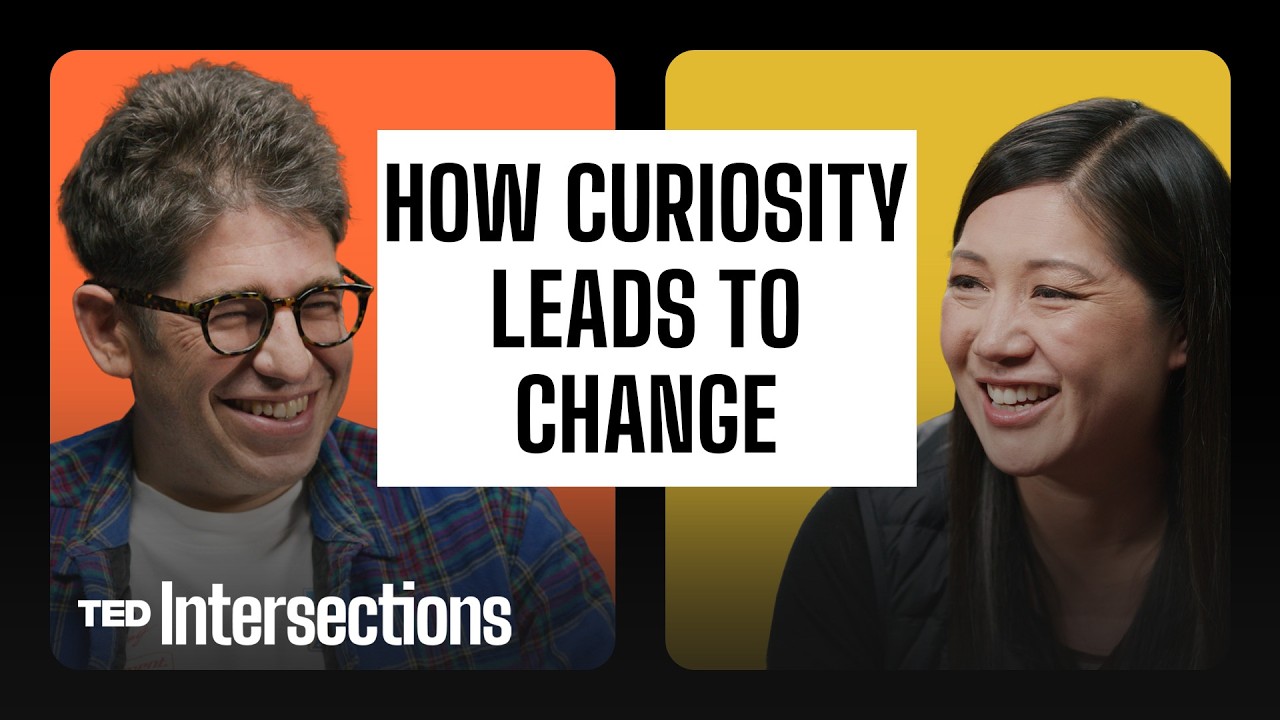
What happens when following the “right” path leads you to the “wrong” place? Kickstarter cofounder Yancey Strickler and scientist Jenny Du discuss how they’ve made careers out of rethinking old systems and imagining new ones. They dive into the spark that led to their success — and show why it’s important to love your own “weird ways” of being. (This conversation is part of "TED Intersections," a series featuring thought-provoking conversations between experts navigating the ideas shaping our world.)
Join us in person at a TED conference: https://tedtalks.social/events
Become a TED Member to support our mission: https://ted.com/membership
Subscribe to a TED newsletter: https://ted.com/newsletters
Follow TED!
X: https://www.twitter.com/TEDTalks
Instagram: https://www.instagram.com/ted
Facebook: https://facebook.com/TED
LinkedIn: https://www.linkedin.com/company/ted-conferences
TikTok: https://www.tiktok.com/@tedtoks
The TED Talks channel features talks, performances and original series from the world's leading thinkers and doers. Subscribe to our channel for videos on Technology, Entertainment and Design — plus science, business, global issues, the arts and more. Visit https://TED.com to get our entire library of TED Talks, transcripts, translations, personalized talk recommendations and more.
Watch more: https://go.ted.com/tedintersections
https://youtu.be/bGhSZLdGFEQ
TED's videos may be used for non-commercial purposes under a Creative Commons License, Attribution–Non Commercial–No Derivatives (or the CC BY – NC – ND 4.0 International) and in accordance with our TED Talks Usage Policy: https://www.ted.com/about/our-organization/our-policies-terms/ted-talks-usage-policy. For more information on using TED for commercial purposes (e.g. employee learning, in a film or online course), please submit a Media Request at https://media-requests.ted.com
#TED #TEDTalks
Оглавление (5 сегментов)
Segment 1 (00:00 - 05:00)
Jenny Du: In a way, it's not about, like, me or us and our beautiful ideas. It is about the why we want to do it and who else is it for? And knowing that there will be benefits to many other people if we can find a way to get it right. [Intersections] [Yancey Strickler, Writer, entrepreneur] [Jenny Du, Produce protector] Love how your career has been on, like, disrupting the status quo, kind of breaking those structures down. You did it at Kickstarter and now, with your new Artist Corporation structure. Like, let's just take it back, almost. Why has it been important to shake the institutions and normal ways of working? YS: My first thought was I've never felt like I've belonged anywhere. JD: Wow. OK, we've got to unpack that. YS: Yeah, yeah. Like, I grew up in the country, on a farm, I loved books, I didn't, you know, just -- It wasn't, what am I doing here? And that always created kind of a hyper awareness. Another word as anxiety. You know, but just a feeling of not totally fitting in. And I've never really been a part of any institution. I've never been really blessed by -- I mean, TED, this stage is certainly an amazing exception I'm very excited about. I've just never had the option to be a part of those things. I went to a high school in the middle of nowhere, very rural area. I have no connections. So just those things are not for me. And so anything I've done, it’s always been I have to figure out what’s my weird way. And I'm... Again, that not belonging causes me to be often very self-aware of what I'm doing. And so I'm, like, doing something while having some understanding of maybe why I'm doing it and through that, like a deepening -- I don't know, this is like, retrospectively, I'm saying this is what's happening. And so... So I would say it's because I don't have a choice. I would also say it's often annoying. (Laughter) Like as a kid, as a kid I just wanted to fit in. I remember one year before, like, seventh grade, my mom and I go in the mall, and I'm just like, let's only by the clothes that I know the other kids, who I'm not like, wear. And I went to school wearing these clothes, and it's like they still could tell. I'm like, what? What a rip off. And so, you know. But as you learn how to be yourself, you know, I think the things that are -- the things that hold you back when you're younger are your strengths when you're older. And so now it's just kind of it's like my, my gait, you know, it's how I walk. And it's often annoying. JD: Well I feel like, I mean, they say, like, let's say, in school. And you're really expected to conform to this pretty set framework of what like, a good student looks like. And then unfortunately, school's just sort of like, "Be a robot, repeat these things back to me." And then I think there's sort of a belief that the ones that are a little bit not the right fit, that don't fit, or stand out or even almost like, struggle in that environment, will be, you know, almost like, nurtured in the right way. The folks who will make the greatest change at some point later on. It's just more of that in this time and place that wasn't the right time and place. YS: I think any time you're having to like, whether you want to or not, confront some obstacle or overcome, you know, I'm left-handed and I'm having to learn guitar or whatever. There's like, all kinds, so many things. But that extra step way deepens your understanding of that thing. And ultimately I think, like, really accelerates the exceptional -- your ceiling, even. And in a way that again, if you're just like following, following the path, doing the right things, you will arrive at like, oh, you're a professional. But yet someone else might be the entrepreneur that like, yeah, you're the SVP at a big company, but they have made their own company. And... And I think a lot of it is like --
Segment 2 (05:00 - 10:00)
I mean, at the opposite of this way, but some people come out wrong. Like I came out wrong, you know. JD: Or different. YS: But like... But then you just force your way through the world and that process really teaches you, I think, ways that the world works, which is something you are dealing with these days. How did this thing you're doing start even? JD: Yeah. So it started with hearing a fact for the first time, that a third of the food that we produce worldwide is lost or wasted before it ever has a chance to be eaten. That was an FAO report. The UN Food and Agriculture Organization, in 2012. And our founder, James Rogers, heard that and was just sort of like, wait, what? And sometimes you hear something that you can't unhear and I think especially quite close to us, because where we are located in Santa Barbara, California, we're surrounded by these fruits and vegetable fields, especially if you're driving between where we are and you head up into Northern California. And it's pretty crazy suddenly to have it in front of you, to see this food that we're growing, and then just almost like, well, imagine just, especially for fruits and vegetables, like, take half of it off the plate. And you're sort of like, "This can't be possible. We're in the 21st century. This is the best we can do?" kind of. So I would just treat it as the thing you can't unhear. And then it sits with you and it sort of nags at you for a while. And then you feel compelled, like, what can we do about that? What do we... What can we uniquely contribute, even, to maybe try and figure that out? So then as material scientists, chemists, engineers, it was like, just then started to ask some really basic questions. Why is there food waste? Like, how do plants decay or spoil today? How do they protect themselves? So it was just like, really probably the benefit of a beginner's lens or mind on this because we don't come from food or agriculture. And so almost then hopefully not being trapped by or being blinded by the things that are immediately in front of us, but you lose track of and you just accept how they are. So anyways, that's how we got started and really kind of, grateful for that journey. It blends all these things that we talked about at the very beginning. It's like, I love science and engineering, so we have a technical problem. I want to put that towards something I would deem as like, meaningful and impactful use. And so helping, especially healthy foods last longer, which I wish all of us were eating more of for our own health and benefit. Like, all those things laddered up so well. And so it was sort of like, I don't know if this is going to work, but it sure seems like worth trying. YS: You're going to do it. JD: And how about for you then? Like, you know, call it the spark or fundamental core issue that you're trying to unpack? YS: I mean, I think basically all my work always starts with, like, "Why Yancey sad?" And just like a dumb self-interrogation. And for me, it was -- like, I'm a writer and I was building an audience, and I was running a community and doing a lot of stuff and having success with it. And I felt very lonely all the time. And tried to elevate people to be a part of it with me. And the dynamics were off. And... Yeah, I just felt unhappy. I was doing what I loved and I felt unhappy doing it. And I ended up just like, pausing for a bit, like, for a month. And I just read a lot. That's what I do. I just read and I read old and random. And I read two things in the same week, one about the history of hardcore and punk bands, which is my world, and how in all cases they made such weird music no record label would put them out, so they had to put themselves out. But to put themselves out, they just made up a fake record label name, a logo and a P. O. box. And you print it and then you self-legitimize. But what always happens is, by the time the first record would come out, four other people would come and be like, "We make music like you. Can we be part of it too?"
Segment 3 (10:00 - 15:00)
And it made me see that something like a punk label is not just putting out music, it's manifesting more punkness. It's teaching people the worldview, how to adopt it. And that same week, I was learning about the history of the Royal Society. Began in 1660, in London, Christopher Wren and other natural-law scientists start meeting in a pub on Thursday nights because they're annoyed that facts are determined by the church and the king. So they start a club with the motto of "Take nobody's word for it." And in 1664 they published the first zine, "Philosophical Transactions," which is people just trying experiments, experimenting with the idea of experiments, and those pages like, funded the Babbage machine, where Isaac Newton published, Benjamin Franklin's kite experiment, peer review, scientific method, all created through that process. And I came to feel like those two projects, a punk label and the Royal Society, are the same thing. JD: We brought it back to the beginning. Scientists, artists. YS: Yeah, it is an umbrella. It is some organization that stands for a purpose. It is open to anyone who reflects the criteria and promotes that same purpose. And there's some sort of economic, or rules that determine how it functions together. But I came to see that across history, that's been the most powerful form of culture creation ever. But I ended up -- Like, had that observation and wrote it up for myself, and I wasn't sure what to do about it. And I ended up sending it to five people who I'd thought about when writing it, who are people who run projects like this. Some of them I knew, some of them I didn't. And I reached out and I just attached a Google doc and I said, "Hey, I'm working on this thing. It's not public, but I wrote this while thinking of you and really curious to know what you think." And all five people wrote back. And all five had some reaction of like, "Wow, I've never thought of it this way. I've never seen this thing." And that feedback sort of fed that this is real and that process led ultimately to seeing, to building a tool for that sort of project to exist today, and then to imagine how those sorts of projects could legally become powerful, could become wealthy, could become bigger than how we think of an artist's role today. But like, it really did begin with just trying to understand my own unhappiness with the situation that was to my liking. I'd made the situation I wanted, but I did not enjoy it. And trying to figure that out for myself has just led to... Well, you know, in the talk I gave, I talk about how in starting Kickstarter, there have been a wall and we built a door. And that had been in the talk for a while, and about a month ago, I was reading "The Hero with a Thousand Faces," which is a book by Joseph Campbell, and this is where the hero's journey idea comes from. The hero's journey is, you know, you kind of get the shit kicked out of you. You're called to return, you deny it, you don't want it, you have to go deeper, you go deeper, and then you return. And the pivotal moment is that you find transcendence. And across every society, there's a similar sort of shape to the story. But the trick to transcendence, transcendence is a door. And the door of transcendence is all around us. There's like 12 right here between us right now. The doors of transcendence are everywhere. But there's a trick to doors of transcendence. Doors of transcendence are locked in very specific ways. And he writes that the doors of transcendence are always locked by opposites. Light and dark, life and death. Or as I saw when I read it, “artists,” “corporation.” Exact opposites. But opposites lead you to think that there is no space between them. But in the hero's journey, because you've gotten the shit kicked out of you, you just see it differently now, you perceive the crack. And the final stage of the hero's journey is to identify that and by identifying the doors and opening them and returning and telling people, you open the doors for everybody. And that is the point of the journey. But it's always locked by these opposites. And it's like... Yeah, like that's the deepest truths. The grandest things are in finding our way to that hidden door. And... Again, it's just like the glory of the universe, the trick of the whole -- It's all in chorus with itself. It's harmonizing with itself. And these things just give us a hint of what's actually at play. But there is a mix of like, it's an honor and a responsibility and it's a duty, and there's a lot of feelings that go into it
Segment 4 (15:00 - 20:00)
and, you know, learning about what you are doing. I'm thinking, oh, what a great -- Everybody's going to love this, like, what a great thing. And then to hear you have opposition. There are forces that oppose this. Maybe people don't care. You know, maybe the world you see is very hard for someone else to see. How do you carry that? JD: Maybe that goes back to a little bit your previous question, almost like, why... Like why do I identify as a scientist? Why do I love science? And it had always been I'm sure just positive influences from different places in my life. It was like, how do you do something that's like, doing good? Wanting to spend... We're all here on borrowed time, you know, our time is finite. And so how do you make the most of that? And that has been, at least for me, to find ways to serve or do good, to elevate almost our collective quality of life, if possible. So I guess in the face of opposition, it's like the conviction, I guess, that is tested as to whether or not you kind of, stay on the course, I guess, that you're on. And I think thinking about, like... Knowing that there's like, an entanglement of systems or incentives or whatever that's kind of got us all trapped and just don't accept those things as inevitable. And that it will take some kind of commitment to action. And you've also maybe got a willing, to be willing to do that and know that it may not even be solved in your lifetime, but that's the path that's worth walking. If that makes sense. And then I guess in that sense it's helpful because in a way, it's not about like, me or us and our beautiful ideas. It is about like, the why we want to do it and who else is it for? And knowing that there will be benefits to many other people, if we can find a way to get it right. So it's definitely, you know, a challenge of, like, resilience. But we also know that, I mean, I think you know, your own stories, encountering the same kinds of things. So it's also inspiring, though, to like, meet other people. Everyone's got their own version of the fight, I guess. And how do you not like, let the hard days win, kind of, is actually really tapping into others who are on a journey of their own, sharing their stories and just going like, man, like taking energy, I think from that. So, I mean, I think about like, you know, what you shared at this TED this year with regards to this Artist Corporation, I thought, like, to me, it's so impressive, because... When we work within certain bounds, like, as a common person, you work within legal bounds. You've gotten and you've created a whole new legal structure. And so I have a bazillion questions about like, where do you start? Who do you need to convince? What else needs to change in order to accommodate that? And so like, can somebody today go and actually register themselves or incorporate as an Artist Corporation? But like, that's such a perfect example of, at least for me, as a rule follower, like, but the laws are shaped in this way. And where's there really like room to carve this out? So I would love to take it from almost like, us trying to figure out what's the resilience that you need to sort of walk through this, but actually hear your direct example of what's the first two steps or something, you know, that you had to walk down? YS: Well, I think it always helps, even when people are opposing you, I think it helps to empathize. And because I think everyone, generally people are operating rationally within their local maximum. But can you change that? And it works best if you can crawl into someone's bubble with them and look into the world together. And by the time you're done talking, it's moved forward eight steps.
Segment 5 (20:00 - 24:00)
And people are open to that, I think, in certain circumstances. But we're all resistant to being wrong because that means changing -- You know, changing means that we were wrong. So like, those are gentle things to do. But... Yeah, I mean, the Artist Corporation idea is... Well, first it's just teaching me more about how the universe works. And I previously co-founded Kickstarter. And the last time a new corporate structure was made in the United States was 2012, and it was a public-benefit corporation structure. And Kickstarter was one of the first companies to become one of those. And so we closely followed as the process was happening, it was being passed as law and states and yeah, just had a bit of an inside view into that. And it just registered to me that it was very technical and very esoteric, but like, it happened. It happened, kind of because it is so technical and esoteric. It's just it operates at a very different frequency than other things we're aware of. JD: And like, who's really going to dive into that? YS: Who's going to care that much? And so I just happen to have seen that before. And then when I personally ran into a wall with something I wanted to do and felt like I wasn't clear, it wasn't clear what option to take, some part of my brain remembered, "Hey, there's that thing." And just, "Oh, could you do that thing on that thing?" You know, could you add that to that? And I have the blessing of experience that I feel grateful for every day. And the blessing of experience let's you know, let's you know how to roll with those things sometimes. And so this idea and feeling arrived at, like, my most capable moment as a human being until now. And arrived with me, being fortunate to know so many great people who could help with so many things of this I don't understand. Do you... I feel like the vibe, the mood in the world right now is quite doomy. JD: It's tough. YS: It's doom. Are you an optimistic person or are you just like, does that get you down? Do you like, see over it? JD: Mostly, yes. Probably depends a little bit on the day, and that's OK. It's almost learning to give myself some kind of, like, grace through that. If you can look over a long enough period of time, it's almost like the things that matter, they kind of bubble back up to the surface, even if there's a time of disruption. And maybe, again, maybe that's naive that in a way like what's good and right and really better for all of us like, prevails in the end. But I guess, fortunately, there's been so many examples in history where that pendulum, you know, does kind of navigate its way back and forth, but it's never sort of, at least to me, I don't feel like it's sort of, gone in one direction forever and ever and never been able to recalibrate or find its way back again. So, that's kind of, I think, why I maintain a bit more of an optimistic view, is just that, like, if we look on a long enough time scale, then enough of the right moments and drivers start to kind of click together to create a critical mass or a moment that allows change to come forward. I don't know how else to describe it, but it's like what's at the root of all of our malaise as a society that it can sometimes like, devolve to such a state. YS: There's a lot of noise. But how do you navigate according to truth? And it's a conscious mindset, I think, a little bit, of some intentionality and not allowing yourself to just be pulled by what you see. I think this is probably all of our time. JD: Thank you so much. That was such a treat.