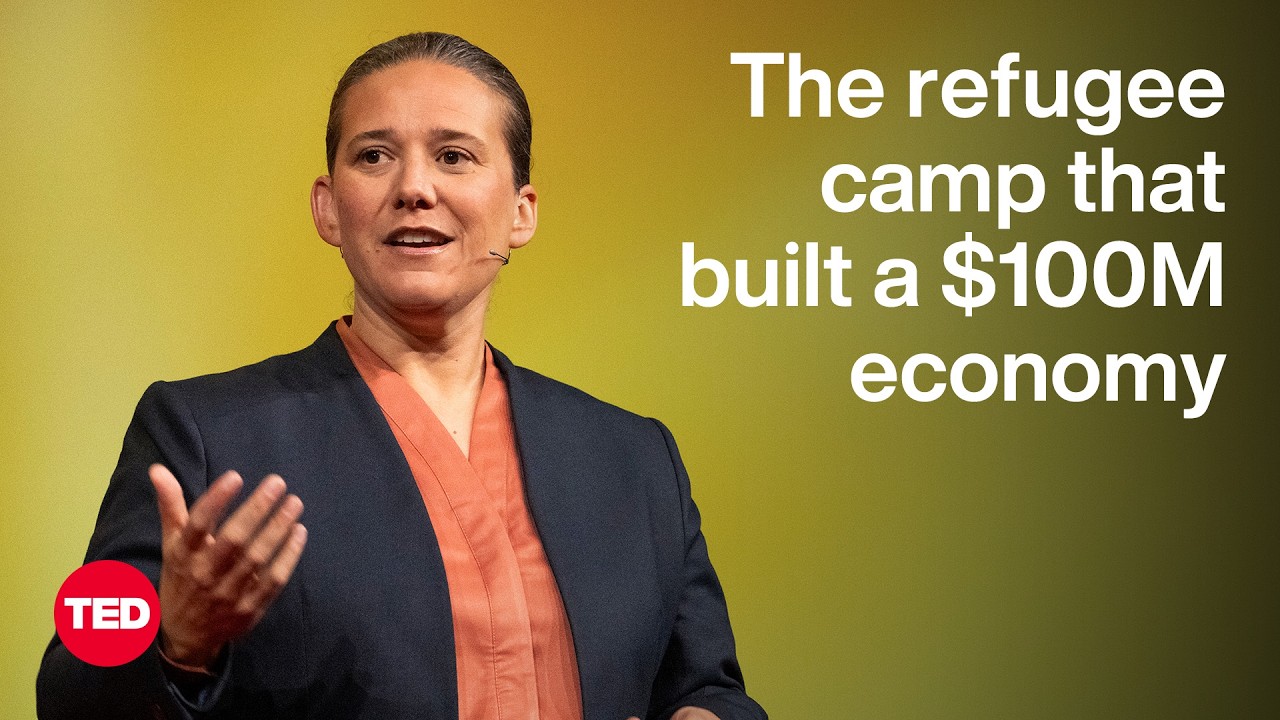
How Displaced People Are Driving Local Economies | Julienne Oyler | TED
8:38

How Displaced People Are Driving Local Economies | Julienne Oyler | TED

TED 15.09.2025 15 868 просмотров 391 лайков обн. 18.02.2026
Поделиться Telegram VK Бот
Транскрипт Скачать .md
Анализ с AI
Описание видео
The number of forcibly displaced people across the world is on the rise. While aid systems often focus on providing basic necessities like food and shelter, Julienne Oyler and her team at the nonprofit Inkomoko have a more ambitious plan: invest in refugee entrepreneurs in order to help them build their businesses, uplift their communities and gain access to financial services. She describes how displaced people are already driving local economies — and shows what it will take to bring their innovations to scale. (This ambitious idea is part of The Audacious Project, TED’s initiative to inspire and fund global change.) (Recorded at TED2025 on April 9, 2025) Join us in person at a TED conference: https://tedtalks.social/events Become a TED Member to support our mission: https://ted.com/membership Subscribe to a TED newsletter: https://ted.com/newsletters Follow TED! X: https://www.twitter.com/TEDTalks Instagram: https://www.instagram.com/ted Facebook: https://facebook.com/TED LinkedIn: https://www.linkedin.com/company/ted-conferences TikTok: https://www.tiktok.com/@tedtoks The TED Talks channel features talks, performances and original series from the world's leading thinkers and doers. Subscribe to our channel for videos on Technology, Entertainment and Design — plus science, business, global issues, the arts and more. Visit https://TED.com to get our entire library of TED Talks, transcripts, translations, personalized talk recommendations and more. Watch more: https://go.ted.com/julienneoyler https://youtu.be/BzUb5MOysLo TED's videos may be used for non-commercial purposes under a Creative Commons License, Attribution–Non Commercial–No Derivatives (or the CC BY – NC – ND 4.0 International) and in accordance with our TED Talks Usage Policy: https://www.ted.com/about/our-organization/our-policies-terms/ted-talks-usage-policy. For more information on using TED for commercial purposes (e.g. employee learning, in a film or online course), please submit a Media Request at https://media-requests.ted.com #TED #TEDTalks #GlobalIssues
Оглавление (2 сегментов)

  1. 0:00 Segment 1 (00:00 - 05:00) 640 сл.
  2. 5:00 Segment 2 (05:00 - 08:00) 462 сл.
0:00

Segment 1 (00:00 - 05:00)

Recently, after a long day of back-to-back meetings, I decided to treat myself to some ice cream. So, leaving the office, I crossed the busy road lined with solar panels, streetlights, ducked into a shop, walked right past the vegetables, and back to the cookies and cream. This was in Kakuma, a refugee camp in northern Kenya, home to 400,000 displaced persons, local Kenyans, solar-panel streetlights and ice cream. Few camps in Africa are as bustling as Kakuma, and it hasn't always been this way. Kakuma was never meant to be a place for human potential to thrive. In the local Turkana language, the word "kakuma" translates to "nowhere." When the camp was established, in the 1990s, it served as an important refuge for those fleeing war in Sudan. But it was isolated, with extreme heat and poor infrastructure. Today, with over 10,000 businesses, Kakuma serves as the economic hub for over a million people in the surrounding area. With a variety of shops, cafés, yoga classes and nearly 100 million dollars in market consumption each year, Kakuma is far from "nowhere." So what led to this remarkable transformation, from remote refugee camp to thriving community? Well, it's because of the ingenuity and determination of the people who live there. Displaced persons and their Kenyan hosts, together, building solutions to their community’s most pressing problems. Because forward-looking investors saw potential, private-sector companies took a chance, and the governments and UN agencies advocated for entrepreneurs. Entrepreneurs like Adela, who arrived in Kakuma with no formal business experience, but who today employs 26 people in her tailoring shop. And Mesfin, who runs the largest motorcycle dealership in the county, and who covers the school fees for 700 kids through his own philanthropy. These are just two examples among thousands in Kakuma, proving what's possible when investment unlocks human potential, a model that's sustainable and scalable for displaced people around the world. A model more important today than ever before, because tomorrow, we could wake up to the headline that reads: “All assistance for displaced people stopped.” A once-unthinkable scenario is now plausible. We have to prepare for a world in which the 125 million forcibly displaced people today have to fend for themselves. And we're witnessing accelerated crises, with wars in Europe and the Middle East forcing even more people to flee. And climate change is triggering floods in Brazil, fires in California, unlivable conditions across continents. As these trends continue, one in 10 of us will be displaced in 25 years. One in 10. Each of us is more likely to be displaced than ever before. The time for incremental change is over. We must do things differently. And yes, humanitarian aid remains essential in emergencies and for the most vulnerable. But the widespread system, as it is today, was never designed with dignity, or to be a long-term solution. Bold action requires us to change our perspectives, partners and policies. For too long, displaced people have been framed as burdens, and that thinking, that narrative, has led to missed opportunities. Over the last decade, I've worked alongside 100,000 businesses in five African countries, mostly in displacement- affected communities. And these entrepreneurs, they have the traits that case studies and business schools celebrate. They are resilient and resourceful. They innovate and adapt. They deeply understand their markets. They're the very leaders and problem-solvers investors around the world seek but are rarely seen as investment worthy. Inkomoko, the organization that I cofounded and lead, is Africa's largest lender to refugee entrepreneurs, unlocking accessible capital in communities too often overlooked by traditional finance. We've disbursed 25,000 loans, derisked by business advising and skills development. And with a 97 percent repayment rate, we’re demonstrating that displaced entrepreneurs are just as investible as any other. And we’re part of a growing private-sector movement in Kakuma
5:00

Segment 2 (05:00 - 08:00)

where, already, three commercial banks operate, the International Finance Corporation has committed 20 million dollars in investments in risk-sharing facilities, and Kenyan entrepreneurs are scaling hotels and supermarkets. And let's be clear, I don't think we should double down on the same unchecked capitalist practices that have led to today's global disparities. Capitalism and markets are flawed. But when we design for inclusion, they can be forces for change. When Uganda allowed refugees to work, the country's GDP increased by nearly a billion dollars. Ethiopia reformed its policies, and now thousands of refugees contribute in key sectors, like agriculture and manufacturing. When Rwanda, the country where I live, included refugees in its national ID program, they gained access to health care, financial services, and are growing an economy. Here's the truth. These examples, these African solutions, are what the rest of the world needs to learn from. These are solutions rooted in a shared experience, in hospitality, in humanity. A few weeks ago, I had dinner with my colleague Kuku. He was a refugee in Kakuma for nearly 20 years and the first person we hired there. He advised 1,000 businesses in Kakuma's vibrant markets, equipping entrepreneurs with financial skills, growth strategies and access to capital. But our dinner wasn't in Kakuma. It was in South Sudan, his home country. Like many displaced people, Kuku's path has been anything but linear. He’s had to navigate complex systems and is one of the few people able to return home. Leveraging his experience, he's part of our founding team in South Sudan, an expansion made possible by the audacious generosity of members of this community. He's still advising businesses owned by people who've had to flee war and the South-Sudanese diaspora like him, returning home to rebuild their nation. They all just want to contribute at their full potential. The data is clear -- the entrepreneurs are ready. So let's do what we know works. Investors, open your portfolios to businesses owned by displaced people. Philanthropists, prioritize funding economic inclusion, especially if you have a climate focus, as climate-driven displacement accelerates. And entrepreneurs, recognize this 125-million-and-growing population as viable customers. Academics and journalists, shift the narrative, highlight the resilience and opportunities in these communities. And policymakers, economic integration isn't charity. It drives regional peace and shared prosperity. From Kakuma to California, Syria to South Sudan, one truth remains: it's that humanity flourishes when people have the tools to succeed and the belief that they can. The future isn't just about preventing displacement, it's about seeing that the solution to one of the world's greatest challenges lies within the people most affected -- displaced people themselves. And it's on the rest of us to recognize this and invest in them. Thank you. (Cheers and applause)

Ещё от TED

Ctrl+V

Экстракт Знаний в Telegram

Транскрипты, идеи, методички — всё самое полезное из лучших YouTube-каналов.

Подписаться