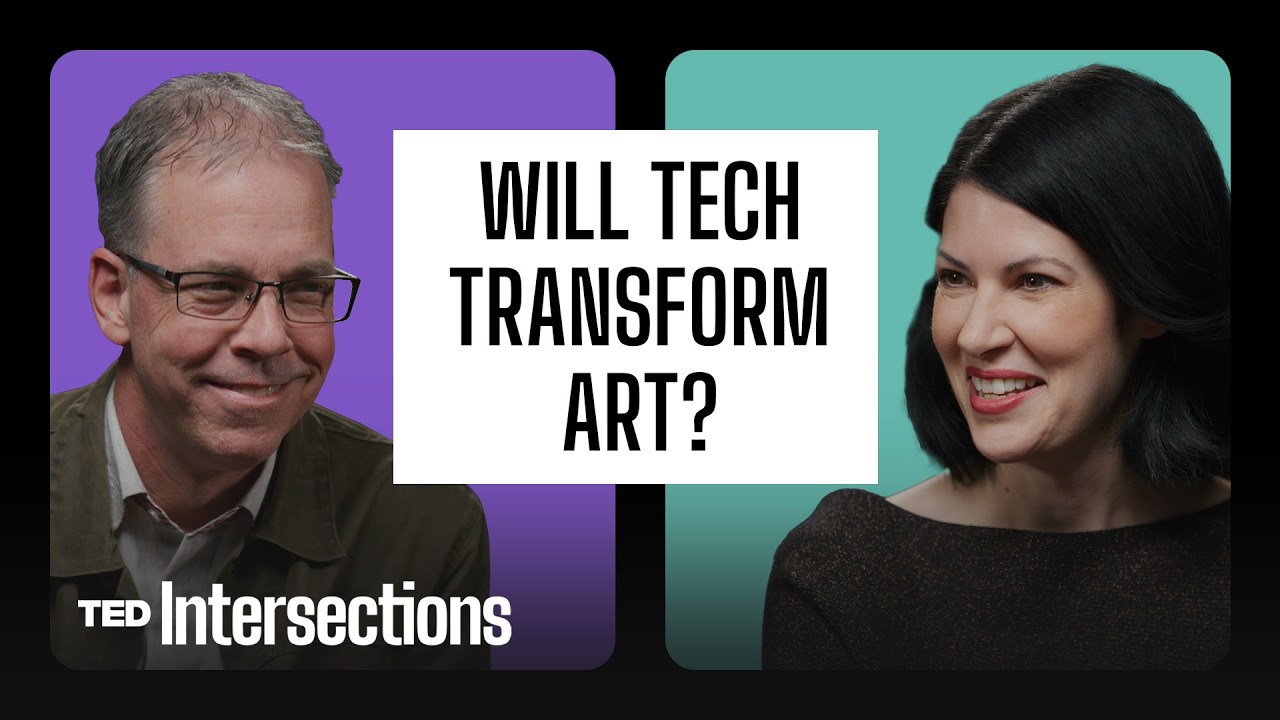
How will AI and new technology change art? Visual effects artist Rob Bredow, known for his work on Star Wars, and curator Nora Atkinson, who brought Burning Man to the Smithsonian, dive deep into the future of creativity, trading behind-the-scenes stories that show how to blend stop‑motion, LED walls and algorithms in art — while still keeping the soul in the work. (This conversation is part of “TED Intersections,” a series featuring thought-provoking conversations between experts navigating the ideas shaping our world.)
Join us in person at a TED conference: https://tedtalks.social/events
Become a TED Member to support our mission: https://ted.com/membership
Subscribe to a TED newsletter: https://ted.com/newsletters
Follow TED!
X: https://www.twitter.com/TEDTalks
Instagram: https://www.instagram.com/ted
Facebook: https://facebook.com/TED
LinkedIn: https://www.linkedin.com/company/ted-conferences
TikTok: https://www.tiktok.com/@tedtoks
The TED Talks channel features talks, performances and original series from the world's leading thinkers and doers. Subscribe to our channel for videos on Technology, Entertainment and Design — plus science, business, global issues, the arts and more. Visit https://TED.com to get our entire library of TED Talks, transcripts, translations, personalized talk recommendations and more.
Watch more: https://go.ted.com/tedintersections
https://youtu.be/moZMjD3imN8
TED's videos may be used for non-commercial purposes under a Creative Commons License, Attribution–Non Commercial–No Derivatives (or the CC BY – NC – ND 4.0 International) and in accordance with our TED Talks Usage Policy: https://www.ted.com/about/our-organization/our-policies-terms/ted-talks-usage-policy. For more information on using TED for commercial purposes (e.g. employee learning, in a film or online course), please submit a Media Request at https://media-requests.ted.com
#TED #TEDTalks #Art
Оглавление (5 сегментов)
Segment 1 (00:00 - 05:00)
Rob Bredow: Most artists, I think, our first reaction, my first reaction was like, that seems like a really bad idea. I don't want a machine taking over my job. And then when you start using it, you realize like, oh, OK, I'm very safe. The machine can't do what I can do. But actually it does help me with this one part here. And then you start finding little parts of the workflow that it helps you. Then it becomes a tool, like a better paintbrush. At that point, we've achieved something that actually can have a really nice benefit, I think. [Intersections] [Nora Atkinson, Craft curator] [Rob Bredow, Visual effects trailblazer] RB: How do you see like, in the space that you're in, in museums and curation, how do you see art that has AI used as one of the tools in it? Do you see it making its way in? Is it going to be 10 or 20 years down the line? Because it's going to be something that gets considered art much later in the scheme of things? NA: There's a lot of work being done that's using AI, either as the main focus of the work or at least as part of the production of the work. And I think it's unfortunate right now that there are very few people who've made it into the public eye in that realm. And I hope that a lot more of those barriers get broken down. I think in part, there's also the sort of gloss of the new technology, and people are using it the way it's supposed to be used. But all of my favorite work, typically, is when people get to the point with the technology that they start to try to break it. And that's what I'm really looking forward to seeing. RB: Yeah, that'll be really interesting. And that's you know, our uses of AI tend to be more about trying to get it to do what we need it to do, because our process is very artistic, but it's very commercial as well. We're doing a lot of work. We're doing a lot of shots in a row, we're telling a cohesive story, so we always need a lot of control. And that's one of the reasons our artists -- That's what artists are excellent at. It's getting what we're looking for, fine-tuning the results to get that high quality of craft. So it is interesting, we're trying to force these tools that can tend to have a mind of their own, especially if you're just using the stuff that everyone has available in their social media and things, trying to turn that into something that is more controllable is a whole operation unto itself. So when you're curating a new exhibit or thinking about the future of your museum in San Francisco, how do you consider all the different disciplines that can go into the craft? Is that an important factor for you? NA: I think it is. I think, you know, particularly with the Museum of Craft, which is what we are, craft was mostly defined by things that happened in the 20th century. And so we've been trying to break down the barriers of what that even means. But generally speaking, you know, you think differently through different media. And so the more media you can include, the more disciplines you can include, the more sort of inclusive an exhibition becomes. You bring in different audiences and I like to think about the idea that an exhibition largely can be about an idea more than it has to be about a specific discipline. RB: That's so interesting. It’s actually kind of similar in filmmaking, too. It tends to be a filmmaker, or sometimes a team, if it's a whole series, that have a very particular vision and you always know where to go when you have a question about what you're making, because they're the ultimate decision makers. But all the different crafts coming together, it's a collaborative process. And on a common day on the set, we'll always have more than 100 people. Sometimes if it's a complicated shooting day, there's 250 people working in their specialties, and it's down to lighting and the set dressing and the rest of the rigging and paint touch-ups and all these things happening simultaneously. It's one of the things that makes filmmaking so amazing is that all that can happen in a compressed period of time on the set, just to get that moment of acting in front of the camera. It's what makes movies kind of special, I think. NA: So what that reminds me of is this sort of idea of soul in art. And I know that there was another TED Talk from a few years ago, there was a composer who came, and he was showing off that he had created an algorithm that made infinite symphonic music. And it was a fascinating thing that you could create infinite symphonic music. And there's certainly application for that in video games and whatnot where you want to go on forever. But of course, it struck me that music then, what is it, essentially? Is it music? Because it isn't communicating anything. And I think that's really at the soul of a lot of this. How do you keep the soul in the work? RB: I think it's so important as we start using more and more AI tools, to have them driven by the people who are the artistic experts in their relative crafts. I think one of the tricky things about the existing commercially available tools right now is they tend to be designed for someone
Segment 2 (05:00 - 10:00)
who is not going to invest very much time and wants to get a lot of output. So a little bit of input, tons of output and it's impressive. It's technically impressive that it can happen, but it doesn't allow for someone who's a real expert in the craft to refine that, to get them something that is maybe a cut above. So you have to figure out. I think we'll be better off when the tools are being designed for these artists that have the experience. And that'll be interesting to see, because we have a bit of a hump to get over with the AI tools. NA: Right. I find when I'm experimenting with any kind of AI tool, that the first time, it's really, really cool. And after you've done it for a few sessions, you realize some of the same tropes come up again and again. And that's where you get kind of the more, you know, you start to become more adept at telling a story with it. So I don't think there's any danger that artists are going to go away. They're just going to transform. RB: Yeah, that's been our experience so far. I think in concept, most people, most artists, I think, our first reaction, my first reaction was like, well, that seems like a really bad idea. I don't want a machine taking over my job. And then when you start using it, you realize like, oh, OK, I'm very safe. The machine can't do what I can do. But actually it does help me with this one part here. And then you start finding little parts of the workflow that it helps you, and then it becomes a tool like, you know, a better paintbrush. And then I think at that point, we've achieved something that actually can have a really nice benefit, I think. NA: For sure. I like to remind people, for instance, that the Jacquard loom was part of the history of computing, and all these things are part of the same spectrum. RB: That's such a great example to really look back. Every time there's been a technical innovation, there's people wanting to hold it back for good reason, and then there's people who want to lean into it. The example we often refer to is photography versus painting, which of course, when photography came around, there were a lot of painters saying it took the painters' jobs, but then the painters became more expressionistic and did a whole new thing with that craft that, of course, there's still photorealistic painters today, but many more of them are able to express new kinds of things because the photos are doing the job of just documenting what happened. NA: How does curiosity play a role in what you do? RB: Well, there's so many different ways, actually. A lot of the things we invent at Industrial Light and Magic and inside of Lucasfilm are as a result of a person or a team getting curious about whether something will work. And our hunches in that area. I mean, of course they're informed hunches because this is coming from experts, but the areas to explore are almost always as a result of someone saying, I think there's either a better way or this person needs to do this impossible thing, and we've got to come up with some way of doing it. So having that intense curiosity to want to chase those things down because it's always inconvenient, right? There's never enough time. There's always risk that it's not going to work. But that's one of the things that I think people in general, who are attracted to this company to work, they come with a lot of curiosity and a little bit of dissatisfaction of the status quo. Like, status quo is not quite good enough, we can do this better. NA: That is why our jobs are fun. Because my job, as well, as a curator, is all about just running down whatever thing I'm super curious about, because someone else will be curious about that. And if it really gets you excited, and usually it's a risky proposition, like putting Burning Man in the Smithsonian, if it really starts to hit that spot in the back of your brain, you're like, "Why can't I just do this," then, you know, you get the opportunity to lead that charge. RB: So I'm so interested, I mean, that's an innovative move to do at the Smithsonian. Do you run into a lot of resistance, or do people who are pushing the state of the art in museums -- is there a lot of resistance to the status quo, or is there a lot of like, invitation? NA: So interestingly, again, I'm a curator of craft in basically an art world, and there aren't very many of us. And craft is kind of a sidelight, and I think it gives us permission to do things that you couldn't necessarily do in the art world at large. So Burning Man had been an aspect of art that had been pushed off to the sidelines, and I just started to draw the lines between what was going on in the craft world and what was going on out there, and seeing the value in something that wasn't valued. And that's, I think the most fun that I have in my job, is just trying to see something from a different perspective and then bring it full circle and bring other people along, which is probably very similar to what you have the opportunity to do. RB: Yeah, absolutely. Especially as we look at new tools, we look at AI, making sure first that we position it the right way, that it's not about replacing artists, it's about empowering artists and making our craft as efficient as possible, giving everybody the right tools. I think if everybody gets on board with that, then we're headed in a useful direction, which I think is really interesting.
Segment 3 (10:00 - 15:00)
NA: I think there's one thing, though, that I find interesting as well, which is that we're in this moment when everything is about now and we're progressing so fast towards the future, and then the sort of subversive act sometimes is that looking backwards, actually embracing lessons that we had from the past or amazing people. One of my favorite exhibitions that I ever curated was a show called "Murder Is Her Hobby: Frances Glessner Lee and The Nutshell Studies of Unexplained Death." And she was a woman who was creating miniature dioramas that trained forensic investigators how to approach a scene of the crime in the 19th century, breaking barriers. RB: That's amazing. NA: So it's those opportunities as well, to bring these sort of little-known things from the past up and have those conversations. Do you have the opportunity to kind of blend old and new in those kinds of ways? RB: I love that question. That's exactly what we do. And sometimes we look back at some of those original shots in the original “Star Wars,” and the craft that went into them is, well, first, things like shot composition and those kind of things, those are timeless. So there's lessons to be learned from the people who invented visual effects, some of whom we still get to work with, so we can ask them questions about how they approached it. But also, like when we started "Star Wars: Episode VII," so JJ Abrams’ film, this was about 12 years ago. We went back to all those miniature shots because we were going to do most of it with CG, almost all of it with computer graphics. We went back to those original shots and said, what about that AT-AT Walker is so charming in this original, and what are the things that we want to preserve from that era or emulate with the new tools? And what are the things that actually are just artifacts of the old way of doing it and actually they should just be improved with the new digital tools? So a great example of that is the ships that, when they were miniatures, the lights could only be so many feet away like the studio we're in now, they can only be 10 or 15 feet away, because at some point you run into the wall. You’re trying to simulate a sun, but you can only do so well with that. And it turns out, flying a ship that has mostly flat surfaces with a light that's relatively close and can only be so small, if you're simulating a sun, it's like infinitely far away. The computer can simulate it perfectly, but it's a little boring because it's just like an even illumination of light. But if you have a light that's relatively close, as the ship flies around, you get more interesting shading. And we wanted the hard shadows so you believed it was a sun, but we liked the more interesting shading, so we were able to keep the elements from the stage photography that we liked and drop the elements that made it feel a little bit artificial. So those are the kind of details we kind of obsess over. NA: So it's a really interesting question because at this moment, you know, I always think that the most interesting design and innovation comes from the constraints. And at this moment, we feel very unconstrained. AI is not maybe all the way there yet, but you can just do pretty much anything. So how do you create the necessary constraint to make something really interesting and meaningful? RB: Well, I love that question. I think it, especially for storytelling, the constraints make the story. I think we relate to it well because we understand the world, the constraints of the world. And you set up the rules in the first five minutes of a movie and you want to adhere to those. So that goes for, I think, the visual language, the storytelling, how the camera moves. I feel like it's upon us as creators to actually set the rule set for our show so the audience can then relax and go, somebody's thought this through. We know the tone, we know the feeling. I hear people a lot talk about tone of their favorite shows. And myself, when I see something that is well crafted, that has a consistency of style and design through it, I know I'm in good hands so I can relax and watch the movie. I imagine that's somewhat similar when you're talking about an exhibit, you're talking about a museum, laying that out and feeling that design. NA: That consistency. Yeah, I mean, I've been very fortunate at Smithsonian to work with some really wonderful exhibit designers, but always it has to be something conceptualized in your head from start to finish and really crafted room by room to make sure that people enter into the feeling of the space, as well as just appreciating the object. RB: Yes. Through the course of my work, I've become familiar with Refik Anadol's work, and I'm just so excited to see the kind of attention it's getting in museums where people sit there for half an hour and watch it on exhibit because it's very mesmerizing. It's kind of almost trance-inducing. Is this the kind of thing that, like, you would like to see, in general, in the museum community, the kind of exhibit that you would like to see continued to be explored and pushed forward? Or is it just like the right dose of it is what we need right now? NA: I think it's important to have it in the museums, and I'd like to see more of it, frankly, in the museums, because the faster that we can bring some of those aspects into museums
Segment 4 (15:00 - 20:00)
and allow all of the breadth of what's going on in that, the more we can document it, but also, the more you really get a sense for what's possible. RB: The variety of different kinds of expressions of that might be interesting to see next. NA: I think, just by and large, there hasn't been enough AI art that has made it into the museum yet. And I see a lot of the early ages of media art that was collected so much later in the game, and it's still fascinating because it's the opportunity to see an evolution in progress. RB: Yeah, and this stuff is so ephemeral, it requires a certain computer with a certain GPU, like, these are going to be harder pieces of art to keep and preserve than a painting on a canvas. NA: Well, there's another aspect to that as well, which is that I don't think that we need to be afraid of technology, and people who are doing it really well should be in a museum, and it should be sitting there right next to a marble sculpture or a crafted, you know, a painting or whatnot. Because you're seeing different types of true skill and value, and it actually lifts the value of those other things when you see them all in context. RB: I love that. This is the pitch I heard when George Lucas talked about opening his museum in LA, which is still under development, and I don't have any inside information about it. But what I heard early on was that it was going to be classic painting next to a movie poster that was also a fantastic painting, and I don't know if that's how they're going to end up curating it, but if they do, that sounds delightful to me. NA: A story is a story. And if it's a great object, it's going to survive that. I wish for TED that we would be able to see many more of those handcrafted things next to some of these AI things. Because I think it enriches both stories. RB: Yeah, they really do complement each other. Like, we have a shot in "The Mandalorian" that I talked about in my TED Talk, where we have stop-motion animation combined with real-time computer graphics combined with a real set, and it's it seamlessly blended between all three of those live on set, where 100 people can compose their shots and make a show inside this both high-tech and low-tech system, which I think, that kind of combination is really nice. NA: And I think it's that layering of information again, that now you're looking at this and the fact that it's seamless, the fact that you're sort of peering through these different lenses, you can sense it and you don't know where it happens. That makes it more magical. RB: Totally, that is 100 percent the right word for it. It is the magic trick when you could never guess how it would be done. Like, even people who've seen the behind-the-scenes are like, I know they used LED walls, I know they did digital extensions. They would have never guessed it was also some stop-motion in there. And as soon as you start mixing the media, it informs what it looks like. NA: So how much do you care whether people are coming to the films because they're romanced by the technology or that they're drawn to the story? RB: Oh, I mean, the story is king, 100 percent. The story has to be the driver and the characters. You know, when I first got into visual effects, especially when I first got to the point where I could help design sequences, because we do a lot of, let's say there's something like the Kessel Run or something like that in "Solo." The visual effects supervisor has a lot to do with the design of that sequence, trying to make sure we understand how we're going to approach all those shots. It would be too easy to lose track of the people when you're just designing spectacular ship shots. And even knowing that, it's still easy to design in too many ship shots and not enough shots where the action is going to take place on the actors' faces. As soon as you shoot the whole thing, you realize, oh, of course. Every time, I always get reminded, the story is on the actors' faces. It's not even just their lines. It's their lines, but it's more their reactions to other people's lines, to what's happening in the world. And you do need a few shots to keep yourself organized in the geography and to understand the story. But most of it's on actors' faces, which is lovely, because that's what we love to look at. NA: What do you see as the limitations now? RB: Oh, I think the opportunity to continue to give that moment on set, the most information as possible. So some of the reasons the LED walls are fun is because the actors get so much more information than acting in front of a blue screen. And I think there's a temptation to build less and to lean into the digital techniques more. For cost reasons, for efficiency, to move fast, all sorts of good reasons. But being able to make sure that set stays a magical space. You know, when we loaded the cast of “Solo” into the “Millennium Falcon” and there was a wraparound projection screen, and we didn't tell them in advance that it could do everything. It could do the whole Kessel Run. We just had stars up there. As far as they could tell, it was a painting. So they got in there. And this was Ron Howard's idea not to tell them, let them get up there and experience it. He's like, "Why don't we do a dry run?" They're still holding their script, half-ready for the shoot, so they sit down in their spots. And this is Donald Glover, Phoebe Waller-Bridge, Alden, I can't remember who else was in that particular shot. But they're first time in the cockpit, Alden was playing Solo.
Segment 5 (20:00 - 24:00)
So Ron does the countdown and he goes, "Rob, cue hyperspace." And so we cue hyperspace and the special effects guys shake the "Millennium Falcon," and they're just all freaking out in there because they pulled the lever and went into hyperspace. They didn't expect this to happen. Everybody was yelling and having fun. And then I heard Donald Glover say, after the take was all over, because I was listening on the headphones and he goes, "This is the coolest thing I have ever done." Which was just, I mean, to do that and have that be their first rehearsal, it changes what they're going to do on screen. NA: It must transform acting. You can really put people there. RB: Absolutely. Giant space monster appears on the screen, everybody knows right where to look, exactly when to react, you get a different performance than if you're just saying, "Look at that tennis ball, and ready one, two, three." And actors are great, they can do it. But how much better is it when you give them the real thing? When you're thinking about how a piece is going to resonate emotionally with people walking through the museum, or what story you're telling and what you want people to experience emotionally as they've gone through a whole part of an exhibit, what are the ways you try to use the art to kind of create certain emotional feelings? NA: I mean, that's what art is. You're walking through -- You wouldn't put the piece in the museum if there wasn't some kind of an emotional human resonance to it. So I think that's the glory of what a museum exhibition can be. I really love trying to create sort of hidden connections between things in the exhibitions as well, because your brain lights up as you're looking at all of these things, and you put this over here and all of a sudden it transforms what the piece is about. So I think it's just probably very similar to film. It's all about this sort of emotional storyline. And one of the beauties, of course, of a museum, similar to film, is that you’re bringing people through it typically all together. There's a group of people who were walking through this and having this, you know, multiplicity in that room that are sharing that experience, and the awe and the way one person will point to something and it brings others into that experience. One of the biggest joys I have putting together exhibitions is watching people walk through them. And something that touches this person might not be the same thing that touches someone else, but they bring each other along on that story. RB: Yeah, that is very similar in filmmaking, where our best heads of departments, the teams that run all the different departments that work on the show, they spend so much time with the script, understanding the story, the theme, and then using as many tools as possible to reinforce those themes, those emotions. And sometimes that can be technique, you know, the choices that are made in the craft. Sometimes that's just a feeling that everybody's going for. Like some of my favorite movies have these wonderful color scripts that even before we know what all the designs are, we know what the mood of the various scenes are going to be because of the colors that we're going to establish way early. So then you get back into that and you're like, how are we going to make that magenta feel in here? As you're adding in each of the designs so it gives the cohesive flow over the course of a movie. NA: And then that humanism is messy and people bring their own lives to it. There's a whole nother overlay that you never expected. My favorite thing, actually, is always opening an exhibition because after weeks and weeks of, you know, well, you know, years putting together a show, weeks of installing it in the gallery, you're kind of sick of looking at all of it, and it doesn't register any longer. And then the first people walk in and you get the wonder on their faces. RB: Dennis Muren, who is a visual effects supervisor who worked on the original "Star Wars," he said, on "Star Wars: Episode IV," that was our first big movie, right? They'd done all the shots. They could only see the mistakes that were left in the shots, all the things they wanted to make better. And then he went to the premiere down in Los Angeles, in Hollywood. And he watched the movie with the audience, and all he was seeing was those mistakes, but he could see everybody else was seeing the storytelling. And he said, that's when he became a filmmaker instead of a shot maker. Someone who could see the whole story instead of just all the different details, which I think is kind of beautiful. NA: Some of those mistakes end up being the kind of gems in the end product. RB: Absolutely, perfection isn't necessary. And Dennis would always be teaching us this. Dennis Muren and Ken Ralston and the teams that worked on those original films that inspired so many of us in our craft, they're really good at saying, well, that detail over there, it's imperfect, but it doesn't matter, people aren't looking there. I'd rather spend the time working on the thing that people are looking at. So there's lots and lots of great examples of films. NA: We're imperfect. RB: Yeah, exactly. Perfection is not always better. NA: Well, thank you so much, this has been so fun. RB: It has really been fun.