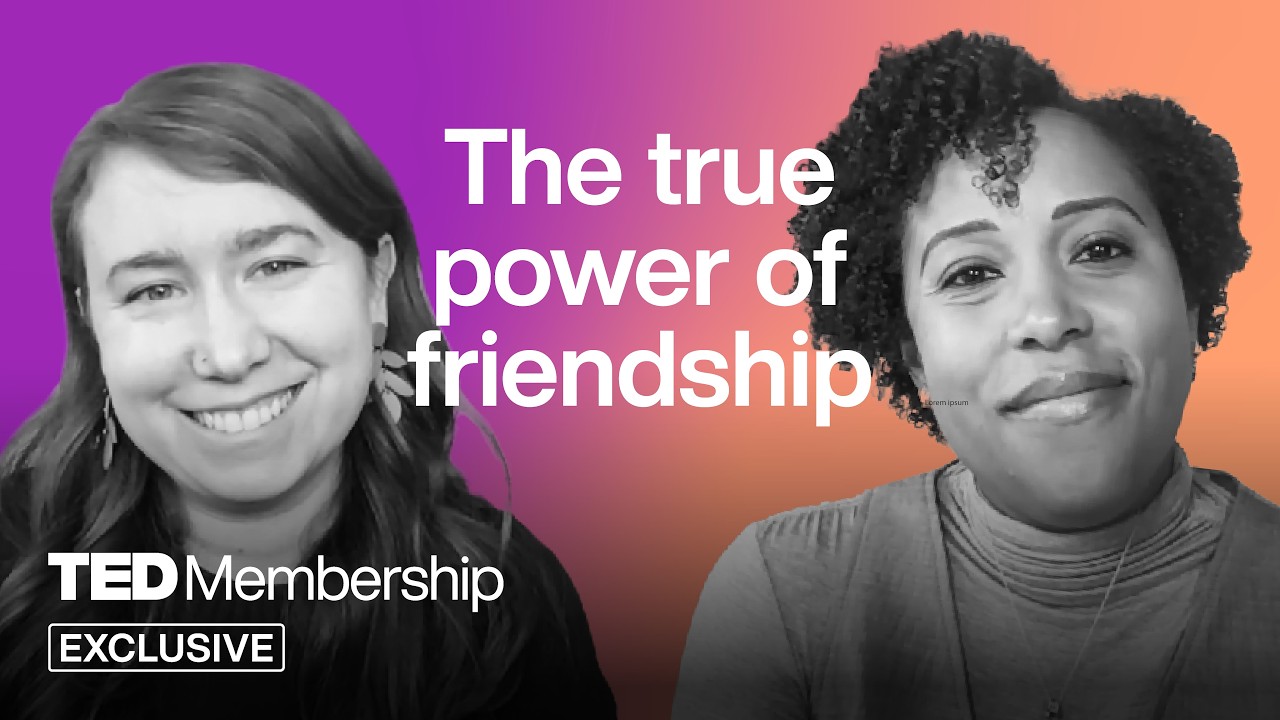
In a time when loneliness is becoming a public health crisis, author Rhaina Cohen says friendships aren't just nice to have — they’re essential to your health and happiness. She challenges the assumption that biological and romantic relationships matter most, exploring how close platonic bonds (when given real intention and commitment) can profoundly strengthen your life. (This conversation, hosted by TED's Whitney Pennington Rodgers, was part of an exclusive TED Membership event. TED Membership is the best way to support and engage with the big ideas you love from TED. To learn more, visit ted.com/membership.) (Recorded at TED Membership on November 19, 2025])
Join us in person at a TED conference: https://tedtalks.social/events
Become a TED Member to support our mission: https://ted.com/membership
Subscribe to a TED newsletter: https://ted.com/newsletters
Follow TED!
X: https://www.twitter.com/TEDTalks
Instagram: https://www.instagram.com/ted
Facebook: https://facebook.com/TED
LinkedIn: https://www.linkedin.com/company/ted-conferences
TikTok: https://www.tiktok.com/@tedtoks
The TED Talks channel features talks, performances and original series from the world's leading thinkers and doers. Subscribe to our channel for videos on Technology, Entertainment and Design — plus science, business, global issues, the arts and more. Visit https://TED.com to get our entire library of TED Talks, transcripts, translations, personalized talk recommendations and more.
Watch more: https://go.ted.com/rhainacohen25
https://youtu.be/d4vMetEtv0k
TED's videos may be used for non-commercial purposes under a Creative Commons License, Attribution–Non Commercial–No Derivatives (or the CC BY – NC – ND 4.0 International) and in accordance with our TED Talks Usage Policy: https://www.ted.com/about/our-organization/our-policies-terms/ted-talks-usage-policy. For more information on using TED for commercial purposes (e.g. employee learning, in a film or online course), please submit a Media Request at https://media-requests.ted.com
#TED #TEDTalks #Friendship
Оглавление (10 сегментов)
Segment 1 (00:00 - 05:00)
For a lot of us, this is a moment when questions of family come into sharper focus. Who do we gather with? Who supports us? Who do we choose? And who chooses us? And for some of us, those answers might feel wonderfully clear, but for others, there might be a tenderness around this or a sense that your answers aren't quite what tradition tells you they should be. And that's why our guest today feels especially essential right now. She's a journalist and author of the other significant others. And last year, she delivered a TED talk that pushed us to expand who we count as our people and to recognize the deep sustaining connections that don't always fit neatly onto holiday cards or family trees, but can shape our lives in very profound ways. I'm so grateful she's here to help us reflect on belonging, connection, and relationships that can carry us into this season and well beyond it. Please give a welcome to Raina Cohen. What a nice intro. Thanks, Whitney. — Well, I think just maybe to kick things off, your talk, the talk that you delivered on the TED stage is sort of a distillation of the big idea from your book, The Other Significant Others, that essentially argues for a more expansive approach to friendship and the role it can play for all of us. And to pull a quote uh from the book, you say, "If we don't limit friendship, it can be central to our lives. " So, for those of us who aren't familiar, as a primer, I think for our conversation, what do you mean by this? How are we limiting friendship? And how could we think about it more fully? — I think we limit friendship by thinking it can do less than it actually can. And one of the ways that feels really clear is by looking across time and across places and seeing what friendship looked like in those times and places. And it was different. Uh for one thing, I think the expectation now is that friendship uh is going to be a relationship that's private. It's just between you and someone else or maybe it's a small group of people and it is a nice addition to your life but it is not an essential part of your life. It's something that you can you know maybe uh put on the back burner and that was just not true in many other places. I mean you can uh see that there were rituals that were built around recognizing friendship uh potentially for the rest of your life. There uh an example of this ritual is called sworn brotherhood. Um and it was recognized as uh something that people would uh would witness like that commitment. We don't think about friendship as involving commitment let alone a commitment that you are going to formalize in front of other people. Um, so I think even the idea of commitment is something that would surprise a lot of people. And then I think the kinds of feelings that we think are possible to experience in friendship are also kind of limited. That we hold out romantic relationships as the relationship where you can experience excitement and infatuation. um and the you know the sort of fluttery feelings that actually friends can experience. I can you know can talk about my own experience with this. It's partly what led me to write the book. Um but again if you look across different times and places you will see that kind of affection where friends um would talk about loving each other and that's that was uh obvious that you would love your friends and I think um especially you know we're talking about certain subsets of society it's uh not that common to talk in that language of love or to snuggle up to your friend without that being a question of you know are you romantically involved. So I think between the idea that friendship is private, that it doesn't uh it should be easy, it shouldn't necessarily involve commitment, um and that there are there's kind of a cap on how intense the emotional experience might be. All of those are ways that we I think underestimate what friendship can be and do for our lives. — And you mentioned just now that you have sort of a personal connection to this. Can you tell us a little bit more about why you wrote the book and and then ultimately gave the talk? So, I found myself in a friendship that really broke the definition of friendship that I thought was, you know, what it was supposed to be. And, uh, this happened in my early 20s and I ended up meeting a friend who, it turned out lived 5 minutes uh, a five-minute walk away from me. And we became much more intertwined in each other's lives uh, than I had ex I had experienced maybe something somewhat comparable. um a couple of times, but we found ourselves struggling with even the language of best friend that felt inadequate that something more like partners maybe fit. And I found myself thinking about other people that I had known at different points in my life who had these really intense
Segment 2 (05:00 - 10:00)
devoted friendships that didn't kind of um couldn't be captured with the term friend or best friend. And then I looked to history, some of what I was just talking about before, and realized that we have a really specific idea about what friendship is now. And I wanted to find people today who had these kinds of friendships. And essentially over the course of those interviews, I realized that this wasn't just a project to lift up and help people recognize that there were these extremely close friendships that I called Platonic partnerships, but that because they challenged the definition of friendship by blending together kinds of elements of partnership and platonic friendship that they ended up asking all these bigger questions about how do we, you know, know that a that uh a romantic relationship is romantic? Why are romantic relationships held up higher than friendships by default? Like how do we define what family is? How does the state define what an important relationship is? So basically like it started from this personal place, but all these bigger questions came up for me that I wanted to tackle in a book. — And I think it's really important to note that this isn't an argument against romantic relationships. You're not suggesting that you have either or, right? — No. Absolutely not. I mean, I uh I try to be really careful in a number of ways to say that it's not either or. I think um that would be kind of using the same logic that I am trying to push against the idea that there's one right way to live. Um I think currently the message we get is that the right way to live is to find a romantic partner, maybe have kids, um you know, to not be alone. And I don't want to say that there's that that's that one right way is wrong, but I have found the other one right way. I think the bigger point is that there are a variety of ways to live deeply meaningful lives and that building your life around a friendship or many friendships or some other kind of combo of things um can be really important. Um and in fact there are people who I profile in the book who have both a romantic partner and this really close friendship. Um, and I explore the ways that those different types of relationships can actually complement each other. Like it can make a romantic relationship stronger to have a really close friendship like this in your life. So, I definitely don't see it as either or. — Hearing all of the things that you've researched and all the people you've encountered, it's it feels like you have just sort of this treasure trove of learnings and how you can think about friendship as sort of a primary maybe even foundational relationship. And I'm curious to hear what you've learned um about what can become possible for people when we do remove the limits from friendship and how it can function and how have you seen people's lives improve um as a result of doing this? A really big lesson I got um interviewing many dozens of people was that life takes you by surprise. And if you only have one way that you are told is possible to live your life and to be happy, it's just not that resilient to all of the things that can come up which range from wanting a romantic partner and not being able to find one to having a romantic partner and splitting up uh to having a kid with serious disabilities. Um, I mean there's sort of any number of things that I saw people struggle with and what made them be able to move into a life that felt really full to them was being open to the possibility that a friend could be there, could be the backs stop when things went wrong. Um, you know, one I mean I write about women a woman who was dying of ovarian cancer and her friend was really her primary caretaker. um and you know her husband was not kind of in the position to help especially with the kids. It's like having um a wider safety net when uh whether it's something that's acute or is just like your life didn't quite fit on the train tracks you expected. Uh it it's just this great way to um to still find a lot of meaning. And even for people whose lives don't take um a turn that maybe they wouldn't have chosen really benefit from having deep friendships um because they it means that they have more than one person in their life who can unlock a different side of them. I mean I think about one of my friends who I'm just constantly laughing around. Um, and I had her and another friend like hang out and I realized that one of my friends who brings out this really contemplative side of me had probably never seen me laugh as much I as I had then. So, I think also being open to the idea that you're going to have um more than one really significant relationship
Segment 3 (10:00 - 15:00)
in your life means that you have people who help you kind of figure out the like fuller well-rounded version of yourself. You know, I think there's been so much written these days about the challenges adults face and maintaining strong relationships, platonic relationships across different life events. You know, whether that's relocation or marriage or children and uh and I personally know that I've experienced some of these challenges as I've gotten older. What do you see as some of the biggest barriers to developing these types of relationships and how do you recommend people overcome them? Well, one way to answer that is to think about what are the ingredients of a thriving friendship or thrive I mean individual friendships and this probably also applies to community and a research I talked to from um the University of Utah said that the three magic ingredients of she was talking about attachment so like any kind of close relationship were time togetherness and touch — so if we work backwards from there it's like How um how much time are we able to spend with other people? Well, if we live far from our friends or potential friends, if the priority we have is having a house that, you know, we can keep to ourselves or there are problems with affordability, for instance, um when we're trying to figure out where to live, uh that's going to reduce the amount of time we have. Same thing for if we're working all the time. Um togetherness is um also about like just sharing life together. And if the way that we are maybe inclined to um spend time together because this is what's normal is to like go get coffee or do an activity and um and not just let people into our everyday lives because that would be uh you know like going and doing errands for instance um because that would be boring or not appropriate. that also can be a barrier. Um, and uh, and as well as if you think you're supposed to be kind of um, doing any activity of significance with your with a romantic partner um, as opposed to a friend, that can be difficult uh, for friendship. And then the third thing would be is touch. You know, there's certainly norms that we have around how close you can get to your friends. Um, as I, you know, mentioned before, I think, um, straight men really bear the brunt of this, that, uh, this is why you see the side hugs and, uh, as opposed to like a full-on hug or, you know, see handshakes or one, um, one man I interviewed said that his father won't even sit next to him right next to him on the couch. He has to leave space and all of his friends would do the same um, before he sort of had this other friendship. Um, so I think the kind of um those sorts of uh barriers around touch, norms of touch um can also get in the way. Um, and there are plenty of other things too that I think get at the idea that friendship is supposed to be easy. Um, that we shouldn't, you know, be inconvenienced or inconvenience others. Um, that those are a few of the I think the barriers that come into um getting closer. H. So, so then if someone were really interested in developing more intentional platonic relationships that are deeper than friendship as you're describing, what would be some of the steps you'd recommend people take to practice this in their lives with existing friends? Let's start there. — Yeah. I mean, one is how do you get more time together? And uh one thing that might sound simple but uh is really helpful is having recurring ways to see friends. So, I have a friend who has two young children and is really bound um to her house and like there's a day of the week when her husband is um has choir practice and uh every other week I come by after her kids are in bed and we hang out at the house um and it's like built into our calendars and even if one of us is unavailable, traveling, whatever, um we have this expectation of how much we're going to see each other uh that I think you can lose track of if you, you know, see somebody once, you don't make plans uh immediately and then a month or two or three passes. Um, another way that I've done this is to plan the next time you're going to see the person before you leave your like the existing interaction. So, if you're, you know, at dinner, um, get out your calendars and figure out the next time. Um, so that that's sort of like one thing that I would recommend. Uh I think on this the idea of like what is acceptable to ask of a friend or do for a friend I think trying to experiment with asking for help a little bit more or at least telling people when you're in a you're having you know a low mood being open
Segment 4 (15:00 - 20:00)
about the parts of your life that are not polished. Uh it invites other people to then share those things with you. Uh I've, you know, I've seen this um play out with people in my own life that uh sharing something that is vulnerable becomes an invitation and then that kind of uh is a flywheel that can bring you closer. — Uh and then the last suggestion I'll give is a more radical one. Um but maybe something to consider. Uh I on the one hand I really believe in the idea that we should take friendship more seriously. We shouldn't run away at the first difficulty. We should try to have um you know harder conversations um and make be intentional. But on the other hand, I think that there are ways that we make friendship harder than it needs to be because we have oriented so many of us our lives around a different set of priorities which might be as you know the idea that like you want to have everything to yourself. a home that you have control over or you make a decision about where to live so that it's as close to work as possible or um you know any number of other kinds of uh priorities and then we accept that uh we're just going to have some social deprivation as part of it. I don't think that's actually I say accept but I'm not sure that people are even conscious of it that there's this huge um loss that we incur when we um build our lives uh for some of these other values and I have found that um in my experience and in other people that I've interviewed if they situate their lives so that they it's built around friends physically close by their to their friends it makes it so much easier to maintain those friendships. And that is especially true for people who are really timestrapped um and like bound to the home like if they have young children or if they have to caretake for you know a relative in their life that having somebody next door um or down the block or you know just very close by it can um make or break the ability to get close to other people. So um I know that can take some work and we can talk about that. Um, but that's the more radical suggestion that I think you're doing work on the front end that makes friendship easier in the longer run. — Well, you know what you've shared is a lot around people that maybe are already in your life in some capacity and you see some opportunity to deepen the relationship. How what are some tips you would suggest for people who are interested in meeting people with the hopes that it could turn into something more? How do you approach those sorts of relationships? Yeah, I mean there are kind of a few steps there. So, one is like the search process. How do you find people who you might potentially want to become friends with? And then there's okay, you found somebody who you want to be friends with or a group of people. How do you make them how do you like end up becoming friends? And then it's once you become casual friends, how do you become really close? Um I recently uh went to a party that I felt like was a very interesting uh example of a way to solve that first search problem. So there were a few of my friends who were um had kind of realized that they wanted to widen their social circle because they would go to a party and like all their friends were friends with each other. So they were like locked in this circle together. And they held a party that they called three degrees like the six degrees of or whatever. six degrees of separation with the Kevin Bacon thing. And um the uh rules were if you were invited, you were asked to bring one friend that the hosts didn't know. So that was the second degree. And then that person was also supposed to bring a friend that the first guest didn't know. So that's the third degree. And it meant that twothirds of the party were people that the host didn't know. And also because everyone was kind of at a there were a lot of people at a remove um it made it uh more likely that you're going to meet new people. Uh so that's a way I thought was really interesting for um how you can encounter new people. Um or you could do a version of that I think at a dinner party with eight people in addition to like all the sort of standard things that people will um advise because they make sense like uh going to do some sort of activity that is oriented around community. Like for me that's swing dance. Um it could be a religious community, something where there is a place where people are going to be and you're going to keep seeing them and inevitably you'll strike up conversation because you keep seeing them. So that's kind of one way to deal with the search issue. And then in terms of how do you make friends from people that you find? Uh I would recommend trying to make the first move. Uh and this can be difficult in friendship because I don't think we have the expectation of rejection in the way that
Segment 5 (20:00 - 25:00)
it's really built into by contrast romantic relationships that we understand that there's some amount of risk-taking putting yourself out there and romantic relationships. But the same goes for platonic relationships and it sucks to make a bid and have it rejected um you know to invite someone to dinner or coffee or an activity. But um I think uh trying to embolden yourself to make the first move uh because otherwise there will be people who all maybe want to get to know each other but everybody's a little bit afraid. Um and then the third thing is like how do you escalate the friendship? And I think that doing the kind of recurring hangouts that I suggested is one way. Um I've sometimes been really explicit with people and told them I have a friend crush on them or that you know um earlier when I moved to DC where I live I had decide I like told a friend I'm you know deciding to focus on like making a few really close friends as opposed to a wider circle and that she was one of those people and that ended up I think pretty much transforming our friendship. um we don't live in the same place, but uh I you know officiated her wedding this past year. And I think that really articulating that I had that um I so thought so highly of her and I really wanted to get to know her um made it easier for us to get closer faster and like spend more time together than we might have otherwise. Mhm. It it strikes me how much of a role like just saying the thing really helps here in a way that maybe we do this in romantic relationships and not in others. Like I if someone were to say something like that to me, it would become immediately obvious how strongly you feel about that relationship and that feels like such a simple but profound way to think about this. Um well we have a lot of questions from members about the important role of physically being in in front of a person plays here. So Valerie C for instance asks um if you could tell us more about the research around how important authentic connection is um when you're an in-person having it be an in-person experience versus something that's virtual. — Um I you know I didn't end up focusing that much on the kind of virtual uh connection piece. So I don't um I don't have like specific people to site other than what I was mentioning before around you know one of the key um key ingredients of and a very close relationship and attachment relationship does involve physical touch. Um and obviously there's going to be variation across people. Um so I but you know I would say like there are ways that you can connect with people virtually as we are doing now. But there are things that you don't pick up when uh you are texting with someone. Um as an example, I uh had a friend who um I live with who um was going through something very difficult and some and someone in the house asked how she was doing and she could not fake it. she couldn't, you know, she couldn't decide to, if someone had asked her that by text, she might have not answered immediately or, you know, brushed it off. But when you are in person with people, there's body language, there are there expressions um that I think especially if there's something that's kind of more difficult going on uh that you pick up on as well as just getting to know people better. uh you know like I think of um a friend of mine who will just like she can get jittery and like shake her leg a lot and that is a signal to me that she's feeling particularly anxious and um by observe like observing that helped me understand other things about her. So, um, while I do think it's really great to be able to connect with, um, people all around the world through different kinds of, um, online platforms, um, and text and voice chat, um, I don't think that they are, uh, a total replacement for the, uh, the things that you learn about people and the ways you're able to care for them, like giving a hug or being really what it means to be physically present. um that it's uh you need at least some inerson uh interaction I think at some point to get really close. — And I'd love to dive into this a little bit more later in the conversation just sort of thinking about the future and sort of where we're headed but um sort of sticking in this space of how to cultivate these relationships. um thinking about support for this, how what can loved ones or family members do um to support people who have decided to deepen a platonic relationship? — I think one thing is to come in from a place of curiosity rather than judgment. One thing that I saw people who had platonic partnerships really struggle with was the constant misunderstanding that they were up against and often not
Segment 6 (25:00 - 30:00)
just sort of benign misunderstanding um but people who kind of stigma like treated their friendship in a way that was stigmatized. Um, and that could include gossiping. Um, or, you know, I write about a mother who is just like, I don't understand how you can be so close to somebody who you're not romantically involved in and was convinced that the friendship between two her son and her son's best friend was a romantic relationship. I mean, that's pretty common. Um, so I think coming in from not a place of like here's how I expect you to live your life. Why aren't you living your life that way? um the only way I can understand this friendship is if it is romantic. Um or telling them like your priorities are messed up, which is also something I've heard. Um yeah, those are not very helpful. And instead being like who matters to you? Why does this person matter to you? like coming from a place of these open-ended questions and trying to get to know the person. Um, treating them as you would treat someone's new romantic partner or um, somebody that they or maybe a relative that um, it's somebody who will uh, who really matters to a person you care about and therefore by extension you want to care about them too. Um, so I think that that's one way um, loved ones can be supportive. H and what about the structures around us? You talk about this um in the talk and a fair amount in the book. This idea of of friends um being supported in the workplace or um in their communities and government. Uh what sort of things do we need um to make room for more expansive and meaningful platonic bonds um outside of um of these relationships in our wider communities? Mhm. I mean, I think the kind of underlying principle of not coming from a rigid place of this is there's one or two kinds of relationships that matter, you know, romantic and familial and everything else is less important. Um, I think that translates to workplaces and to policy. So uh you know one way this tends to come up is when somebody uh when a friend is ill um or has passed away and the question is what will the workplace do to support them or not and also what does policy allow? So there was a woman who uh I mentioned earlier who took care of her best friend who was dying of cancer, was the main caregiver, and her workplace did not entitle her to family medical leave. Um nor when her friend died was she entitled to bereavement leave because those were uh benefits that were restricted to if it was a family member or a friend. Um, interestingly, if this had happened now, the state she lives in, Minnesota would, um, has expanded the definition of kind of who, uh, counts as somebody that you can take this kind of leave for. So, it's anybody that you, you know, you're close enough to consider family, which can be a platonic relationship. Um so that's something that both I think workplaces and policy um can do to uh be more expansive about how uh about providing benefits and rights to people who uh are outside of these the boxes of um kind of blood or adopted family um or uh marriage. And then the one other um kind of significant policy area that I explore uh has to do with the fact that we really only have marriage uh as a source of um rights and benefits in this country. uh whereas in other countries and also in other times in the US there have been um things like domestic partnerships um that would allow people who are not romantically involved to be able to sign rights to another person. Um and instead what ends up happening is that if you want to have your friend be your you know the heir to um uh the you know that the goods you have in your life or you want them to have medical or legal power of attorney rights. I mean, those are things that you have to do um by going to a lawyer, getting which can be expensive and going through a lot of paperwork um that u may or may not be recognized in the heat of the moment like in a hospital um because it's not something that uh people are used to. They they're used to this status that's associated with marriage or associated with being um a family member but not to uh the idea that a friend can be significant. So uh one thing that I saw from different legal scholars was the proposal to offer legal alternatives to marriage like that there you know when you go to the DMV you designate a person um who is the default person to handle medical and legal things in your life and that um and that would be especially helpful for people who aren't married but um you can also uh you know
Segment 7 (30:00 - 35:00)
in other cases you would be able to assign rights to different people which again is something that you can do if you spend a lot of money and have the wherewithal to go through a lawyer for different sorts of contracts, but that's not accessible to most people. It doesn't, you know, it's not like 20 or $30 in the way that a marriage license is. Um, so I it so having um a way that the state could uh recognize relationships that are not romantic or familial in nature would be a really big step. — Well, we have a question from Carlos O. uh which it's really interesting connected to this like so if we look at the opposite end of this do you think that there's a business case for organizations to do this to sort of pro to support uh these sorts of relationships and connections — um yeah it's interesting I mean I think that people are more content when uh they have a life that sort of holistically feels full. I know that there's research also, I mean, if you're thinking specifically about friendships in the workplace that can um be really uh sort of have effects on retention um if people feel close to others at work. But if it's, you know, if you're talking about close friendships outside of work, um, and let's say it's an occasion like someone is sick in their lives, um, I think people will feel, uh, a sense of, um, gratitude to the or, you know, organization that they are being seen as a whole person who, um, isn't just there to be a kind of cog um, in the machine and, um, where there are very narrow exceptions for when they're not allowed to work. Um I think people like respond to that really well and it feels in line with um you know different kinds of like affinity groups within organizations or the way that people um can be uh really committed to a workplace that gives them um high quality family benefits uh because they think that will better, you know, allow them to experience the entirety of their lives and um not feel like they're compromising um you know, getting promoted at work and that kind of thing. So, I can imagine that businesses would benefit um and have happier and more devoted employees um when these sorts of relationships are recognized — and I imagine that probably trickles out beyond organizations into the way communities sort of t tackle this and think about this too. Um well, one thing that really struck me in reading your book is really the diversity of people who have you you've encountered who have chosen to sort of pursue these types of relationships. It seems to really transcend everything from race, gender, age, sexuality, all types of of identifying factors. Although you do see that the different identifying factors people have impact the way that those involved navigate uh these sorts of relationships. So, I'm curious to know as we sort of look to the future, how you see um some of this changing as the demographic makeup of our world continues to evolve. — Yeah, it was really important. I mean, thank you for saying that. It was really important to me to show that uh the variety of people who have these sorts of friendships. It is not um just some I don't like I think young people um often uh believe that they're they've invented everything. And in fact, I think the most powerful stories were people in their, you know, 60s,7s, 80s who have really uh shown what it looks like to have um a real committed long-term friendship. Uh but you know, as we move forward, some there are demographic trends that I think point to people finding um or having the need to look more broadly for the kind of support and connection that they get. Um many of the people that I wrote about um something, you know, something didn't quite work out in their lives that they as they'd expected. They didn't they maybe didn't find a partner. Um or there's one person I wrote about who is um on the asexual spectrum and realized that uh sort of I don't know a standard or like conventional relationship was not going to be the kind of thing that they would pursue. And I think as we see um the rates of marriage declining and people getting married later um that is can be a form of encouragement to be more creative with um finding a life that you uh feel fulfilled by. Uh I think there's also increasing recognition that the ways that we have uh set expectations for a healthy relationship are um actually undermining um those relationships and that it really helps to have um a wider set of people. I mean Esther Pel, the psychologist has famously said that we uh now expect of one person what we used to expect of a whole village. So I think there are some kind of cultural forces
Segment 8 (35:00 - 40:00)
that might increasingly encourage people to look to the significance of their friendships and broadening um the kinds of people that they um want to have in their lives. And I think I've just seen such a blow up in interest um in chosen families um and also um particularly for caregivers having this idea of a village uh that they are they don't have to go it alone that um parenting has been so difficult for so many people and isolating and um there's just a lot more interest um that I have seen and I can point to sort of like organizations that of uh that are doing work on this in response to that um that growing interest in um looking to friends and re being creative about what it looks like to kind of like rebuild something that had existed more commonly in the past and exists in some kind of um some cultures um as all over the place to not just have a small nuclear family but maybe to have multigenerational homes or extended households where you have aunties and uncles who may or may not be related to uh to you, but really feel like those deep um connections. — Well, you mentioned um tech earlier and how that wasn't really a big part of how you approached this, but as we're thinking to the future, I'm interested to hear your perspective on how you think tech will impact the nature of I guess all relationships, but these sort of platonic partnerships as you say. Um, a lot of people say that they that tech might lead us to retreat from each other more and spend more time away from other humans interacting less with one another. How do you see this playing a role in the future of these relationships? — I mean, my best guess is that it will be a mixed bag as it currently is a mixed bag. So, I feel really grateful that I have a way um to be in touch with friends from all over the place. I mean, just the other day, I had a friend um text me uh you know, a photo from a place she say staying and that she was thinking of me. She lives on the other side of the country and we only get to see each other a few times a year in person. Um uh or you know, I left a voice memo on a walk yesterday for a friend of mine who lives in another city. Um, so I think those ways of being able to reach out um or coordinate so that you can go on a trip together or you know whatot um those are great part like ways that technology can um can enable or help us maintain friendships. I think the risk comes when technology becomes a replacement for the kinds of um interactions that you would might otherwise have with friends. um when you're you know watching YouTube video after YouTube video or you develop a parasocial relationship with someone that you haven't met and it feels um you know it might feel like you uh you are being known by whatever the uh I work in podcasting but you know I think this can happen with podcast hosts or with television with celebrities um but it's fundamentally one-sided so um I think tech can give us the illusion of having relationships when we owned and then the I think that with this newer technologies um that around um AI tools that uh are really you know skillful at mimicking certain aspects of um human uh relationships. Um I think one of the concerns there is that having relation is again about this one-sidedness. um that having relationships with real humans or even like pets um like any kind of living being is uh comes with like some difficulties and I'm recalling a story that um a journalist I um I know told where she was visiting some people uh who are working on these robots that will they think will kind of um become friends for young you know for kids uh and it's supposed to be a replacement for iPad interaction And uh this journalist was you know a little bit unnerved by this and she was kind of cracking a joke about like oh have you guys thought about um you know getting an AI girlfriend because she wouldn't have any needs. Um and this was they they'd also come up with like an AI dog that like the advantage that they said was you know you don't have to clean their pee or poop or train them or whatever. No needs. And these um the people at the startup were like didn't take it as a joke. they were like, "Oh, that's like an interesting idea. " Um, so I think the if people become used to interactions where there is nothing that they have to give up um and they're getting what they want when they want it all the time, that um not only becomes a problem because it it displaces time you would spend with
Segment 9 (40:00 - 45:00)
other people um but also because it becomes this comparison point that is impossible for any person to meet. um because a relationship is two-sided and it's just not always going to um be simple or easy all the time. So that that's um maybe my biggest concern around the um the future of technology and how it might shape our thinking about friendships — and so much that you've shared here in terms of tips for people developing these relationships has been around being vulnerable and really putting yourself out there. And um Renee A asked how you can attempt to connect with people without seeming needy. So what are I guess some of the ways you get over some of those feelings and in doing that um you know I think I still have I will hear myself apologize for things and then have to backtrack on the apology. Um I think also like giving to people is one. Uh so that might not feel vulnerable in the um in the same way as you know sharing that something difficult is going on in your life. But I'm thinking about a friend who uh hosted a small group of us at her house. I think letting people into your home um is a very uh kind of intimate revealing thing period. and she just fed us all and had like multiple courses and she, you know, her um expression of love and care is food. Um and also like had, you know, my housewarming had brought these like incredible Royos tea shortbread cookies. So, um I what there's there are ways that I think giving to other people and giving in a way that shows that you are um maybe thinking about what in particular they might enjoy. Um and giving them a little bit of exposure to your life, even if that's just like what's the art on your walls, what are the books on your shelf? Um that can be um a more um a smaller form of vulnerability. And I also think um it's useful to understand for yourself like what are the conditions that make it easier to um to be vulnerable. I think for me I'm probably more likely to open up um in someone's home than I am uh out in public. Uh so you can have these uh um the setting can be kind of a gateway to that kind of um intimacy. Uh so yeah I but you know um yeah but so those are ways to I think be a little bit vulnerable without feeling like you're immediately asking um for help and that by giving support to people you're also make giving um permission um to maybe later ask for help and also giving them permission to ask for help as well. Well, Rain, as we wind down this conversation and I sort of open by talking about the time of year that we're, you know, entering the holiday season and uh, you know, this is a time for a lot of people that can magnify connection and also loneliness. Um, so what are some ways you think we all can broaden our sense of family and the relationships that sustain us as we go into this period of the year? — Yeah, I totally understand that it is um, it is a complicated and sometimes like difficult time. Um I'll share you know one thing that uh had occurred uh that I'm doing with my friends this year. Um so my husband is Dutch and there is a very um important holiday called Cclass in the Netherlands and it involves uh essentially like a secret Santa and you write poems that go with the gift and it's kind of um you know supposed to be fun and we have want he and I have wanted to do this for each other. um we've been together for a long time and have not um have not often done it because with two people it's like not that exciting. um we now live with six other people and um it occurred to me that we could do what his family had done when he was a kid and um and celebrate this holiday that we're um essentially taking what had been a family tradition and letting friends uh be part of that. Um, and I think that this is probably relevant for a number of things this time of year where there is this sort of more the marrier feeling in that it can be hard if you're on your own um or maybe you just have like one other person that you don't want to have a full Thanksgiving meal or you know um what like whatever the kind of holiday is. So my suggestion would be is there some kind of uh sort of tradition or thing that feel would feel really nice to do this time of year that you that um maybe you have attached to family uh but could be something that you invite other people into. Uh I think the idea of I think friends giving which has become very popular in the last several years in the
Segment 10 (45:00 - 46:00)
US uh is one version of that and it can be um a really like lovely way for people to experience Thanksgiving but among people who are not necessarily their blood relatives. So um yeah that that's one suggestion that I have um for help having people be um to not feel like they are stuck with whatever the given family situation is and that they can um make their own version of um what they the things that they enjoy or might enjoy about this time of year. — Um so many great ideas here and Raina I feel like we could keep talking for ages. We've reached the end of our time unfortunately and thank you to the members who submitted questions that we didn't get to. Um this has been wonderful. Thank you so much for the gift of your time and your insight, Reena. — Oh well, thank you for your thoughtful questions and to everybody who submitted questions too. Um it's really uh it's exciting to me that people care about this topic so much and want to learn more about it.