The Tiny Organisms Transforming Farming | Karsten Temme | TED
10:26

The Tiny Organisms Transforming Farming | Karsten Temme | TED

TED 12.03.2026 15 223 просмотров 390 лайков

Machine-readable: Markdown · JSON API · Site index

Поделиться Telegram VK Бот
Транскрипт Скачать .md
Анализ с AI
Описание видео
What if the solution to feeding humanity has been hiding in the soil for millions of years? Bioengineer Karsten Temme discovered a remarkable answer to this question: for eons, crops relied on soil microbes to convert atmospheric nitrogen into food — until modern farming severed that ancient partnership. He shows how we can reawaken those dormant microbes using gene editing, creating “living fertilizer” that delivers nutrients to crops in real time and transforms farms around the world. (Recorded at TED Countdown Summit 2025 on June 18, 2025) Join us in person at a TED conference: https://tedtalks.social/events Become a TED Member to support our mission: https://ted.com/membership Subscribe to a TED newsletter: https://ted.com/newsletters Follow TED! X: https://www.twitter.com/TEDTalks Instagram: https://www.instagram.com/ted Facebook: https://facebook.com/TED LinkedIn: https://www.linkedin.com/company/ted-conferences TikTok: https://www.tiktok.com/@tedtoks The TED Talks channel features talks, performances and original series from the world's leading thinkers and doers. Subscribe to our channel for videos on Technology, Entertainment and Design — plus science, business, global issues, the arts and more. Visit https://TED.com to get our entire library of TED Talks, transcripts, translations, personalized talk recommendations and more. Watch more: https://go.ted.com/karstentemme https://youtu.be/ryca2RwoUQI TED's videos may be used for non-commercial purposes under a Creative Commons License, Attribution–Non Commercial–No Derivatives (or the CC BY – NC – ND 4.0 International) and in accordance with our TED Talks Usage Policy: https://www.ted.com/about/our-organization/our-policies-terms/ted-talks-usage-policy. For more information on using TED for commercial purposes (e.g. employee learning, in a film or online course), please submit a Media Request at https://media-requests.ted.com #TED #TEDTalks #Biotech

Оглавление (3 сегментов)

Segment 1 (00:00 - 05:00)

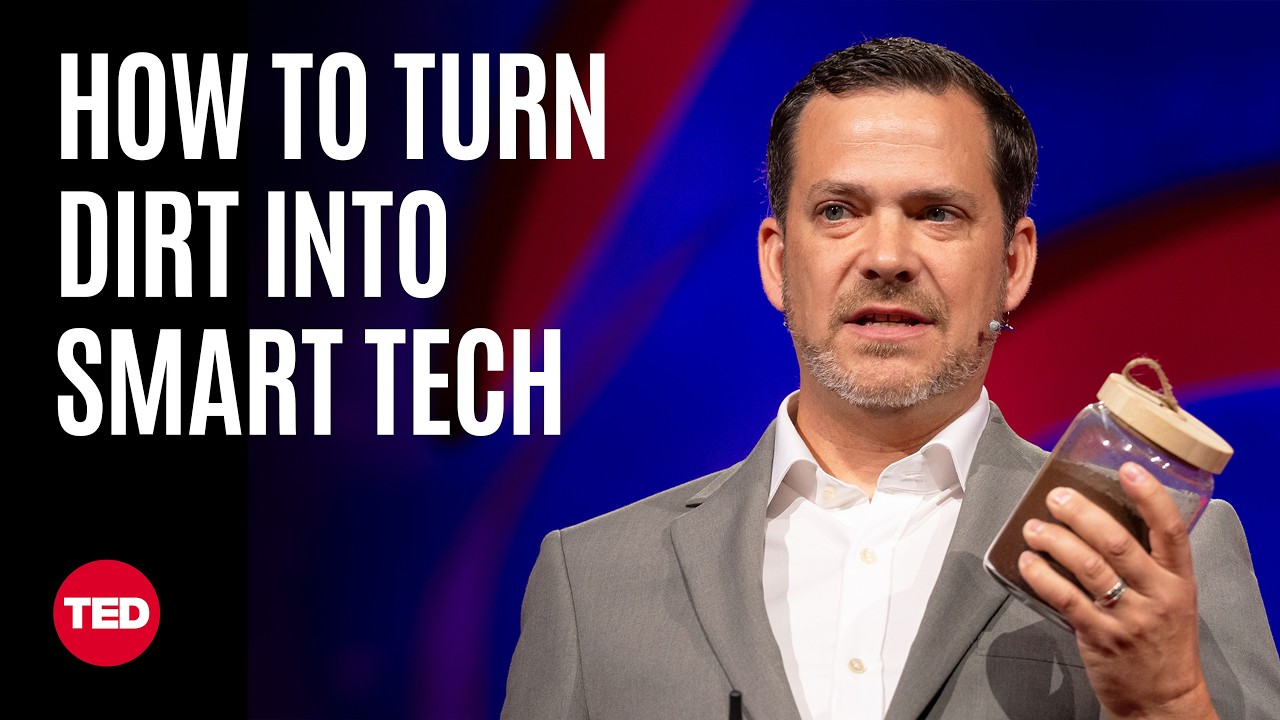
This jar contains a few ounces of soil. It looks pretty ordinary, doesn't it? But what you can't see is that it's teeming with life. The microbes inside are poised to become farmer's greatest tool and transform how we feed humanity. I'm Karsten Temme, founder of Pivot Bio, and I have dedicated my career to studying these microbes. They can and will revolutionize agriculture. Give me a sec while I set this down. So from the plow to the grain combine, humans have invented tools to grow more on the same amount of land. Fertilizer is the greatest of these. All those nutrients that a plant combines with sunlight to grow. Here's an example. In the 1950s, American farmers produced 2,600 kilos of corn per hectare. Today, there are yield competitions where the winners can generate more than 32,000 kilos on the same amount of land, in a large part because of the fertilizers they can use to fuel that crop. It's just amazing. But for all the good it does, fertilizer is an inelegant solution. Last year, farmers around the globe spent more than 200 billion dollars on nitrogen fertilizers alone. They spray it on their fields and then pray that roots can find it before it's lost. Because if that fertilizer is lost, the crop can end up starved of its nutrients and stunted in its yields. Those losses also translate to unintended consequences. Some becomes nitrous oxide, a greenhouse gas that's 265 times more potent than CO2. Some seeps into our groundwater. And some runs into our rivers and oceans, creating more than 500 dead zones around the planet. So there's got to be a better way. And I'm here today to tell you that there is. And it's rooted in biology. You see, 78 percent of the air around us is nitrogen gas. That's a form that plants can't use, and so they've partnered with microbes on a process called nitrogen fixation. The microbes can breathe in that nitrogen gas and turn it into a form that plants can metabolize. It's a symbiosis, a partnership that's worked for millions of years, right up until the point that humans started breeding crops to be more productive. Those bigger yields needed more nutrients, and fertilizer was invented to fill the gap. Well microbes in response shut down that nitrogen-fixing function, putting those genes into hibernation. What if we could wake them back up? use modern tools like gene editing to bring those microbes back to being specialized helpers for farmers? Then we could have a way for those microbes to live with the plant alongside the roots, sensing the crops nutrient needs and responding in real time. Well that’s a challenge that I set out to pursue two decades ago, along with my friend, lab mate and cofounder, Alvin. We made it our mission to get those genes working again. So here's how that went. We collected soil samples from farms across the United States. We extracted the microbes, we reprogrammed their DNA, and we cranked that nitrogen- fixing function to 11. Then one day in the lab, we saw that there was a test tube with a tiny corn seed germinating. Our microbes were living along the roots of that plant, producing nitrogen and sharing it with that tiny plant. That test tube represented a breakthrough. We had shown that we could create microbes that could sense and respond to the plant's nutrient needs in real time. We thought we had just solved agriculture. Well, spoiler alert, not quite. Across the last 15 years, we have been working to transform this breakthrough into a system that serves farmers on three continents today. I believe that across the next decade, we can help farmers reduce half of the fertilizer that they need. So what I wanted to do is take you on a quick little journey to meet three of the farmers that are using these microbes right now. So meet John. He's a corn farmer in Michigan who runs a 1,295-hectare farm. It's a complex operation, and he's got a lot of variables to manage so he doesn't need anymore. John’s turned to Pivot for the last five years to simplify his life. Each year we've sent him a little less than four kilograms of freeze-dried, powdered microbes, and he's coated the seeds with microbes, planted them as normal. Once in the ground, those microbes have gone to work. They eat sugars from the crop, they fix nitrogen and share it back with the plants. And then when the crops are harvested, those microbes die, ensuring they only do what we intend. Now they're operating at the cutting edge, alongside satellite mapping and soil monitoring

Segment 2 (05:00 - 10:00)

slow-release fertilizers and precision machinery. It means that yields at John's farm have boomed. His dad regularly applied more than 225 kilos of nitrogen fertilizer per hectare and generated about 8,500 kilos of corn. Today, John's able to apply less than 140 kilos of fertilizer, and yields have risen to 11,500 kilos. On that same land. It's amazing. And what gives me the most pride is that our microbes are helping make his job easier, while increasing his bottom-line profitability. And John's not alone. Our microbes have been used on as much as five percent of the US corn crop. So if you'll zoom with me about 7,000 kilometers south, I'd like to introduce you to Charles. Now Charles runs a large farm in Brazil. Brazil is an agricultural powerhouse. It's one of the world's top three corn producers. Yet, yields average just about 6,000 kilos per hectare. So there's a lot of room for upside improvement. One of the biggest limiting factors is nitrogen fertilizer. Brazil imported more than 80 percent of its nitrogen fertilizers last year. And that's something it's looking to reverse through microbes, both with us and others. So Pivot's been working with the Ministry of Agriculture to test and adapt our products ahead of commercial sales. And I'd like to give you a little bit of a look into Charles's farm, where he's counting on those microbes to supply about 30 kilos of nitrogen alongside the 120 kilos of nitrogen fertilizer he's applying every acre. That's about 25 percent less than he normally would use. Now the crop’s a couple weeks away from harvest, but what you'll see is the plants are larger, greener, they're healthier, they've got bigger root systems. All that sets up the crop to be more resilient in the face of an unpredictable climate. It also means that's a bigger factory for producing higher yields at better profitability. This is a boon for Charles's operation. It's also an opportunity for Brazil to have strategic independence, because these microbes can be brewed like beer close to the farm. That means no more reliance on foreign chemicals or global supply chains. We're also working in Kenya. And I'd like to introduce you to Margaret. Now every morning, Margaret wakes at 4 am and as she walks five kilometers to reach her small plot of land. For her, fertilizer isn't just an expense, it's a significant investment. 36 dollars for a 50-kilo bag. She applies it by hand and then prays that the rains don't wash it away, because all it takes is one rainstorm and that investment is washed away. And with it, her family's security is upended. So this is where the limits of fertilizer are most apparent, where there's no margin for safety. So what Pivot's done is we've teamed up with MIT and local partners to adapt our product and supply chain to work for smallholders like Margaret. We've shrunk our packaging. We've built a just-in-time network where farmers can text the day they're ready to plant, and we can motorbike them the freshest microbes possible. The results are astounding. Not only are the crops more resilient to those rainstorms, yields have improved 60 percent. (Applause) You know, the biggest complaint we've received is farmers say, "You haven't told me what the product is or where I can buy it. " So I started with this jar of soil. The microbes inside have already transformed how fertilizer works across millions of hectares, making it smart, dynamic, living. Since 2022, farmers have been able to prevent more than 1. 3 million metric tons of greenhouse gases. What's needed next is to be able to scale this system across hundreds of millions of hectares. And here's what that's going to require. It's going to require creating a global network for microbial manufacturing. But it's different than building fertilizer factories that cost billions of dollars. Biomanufacturing can scale at one two-hundredth the cost. It also gives us an opportunity to rethink supply chains to make them local and flexible. So in Michigan, that might mean FedEx is the best way to deliver those microbes, and a motorbike in Kenya might be the best last-mile solution. And what excites me the most is that we can spread a web of agronomic knowledge to connect farmers like Margaret, Charles and John together, helping them share knowledge with each other on the best way to put these microbes to work, to not just increase yields, but to improve efficiency and profitability. You see, when we build infrastructure on top of these microbes, we're not just deploying a new type of product.

Segment 3 (10:00 - 10:00)

We're building a better way of farming, one that works with nature and not against it, helping farmers grow more with less. Soil is our oldest agricultural technology, and it's the next frontier. With the microbes in here, we can empower farmers to grow the future from the ground up. Thank you. (Applause)

Другие видео автора — TED

Ctrl+V

Экстракт Знаний в Telegram

Экстракты и дистилляты из лучших YouTube-каналов — сразу после публикации.

Подписаться

Дайджест Экстрактов

Лучшие методички за неделю — каждый понедельник