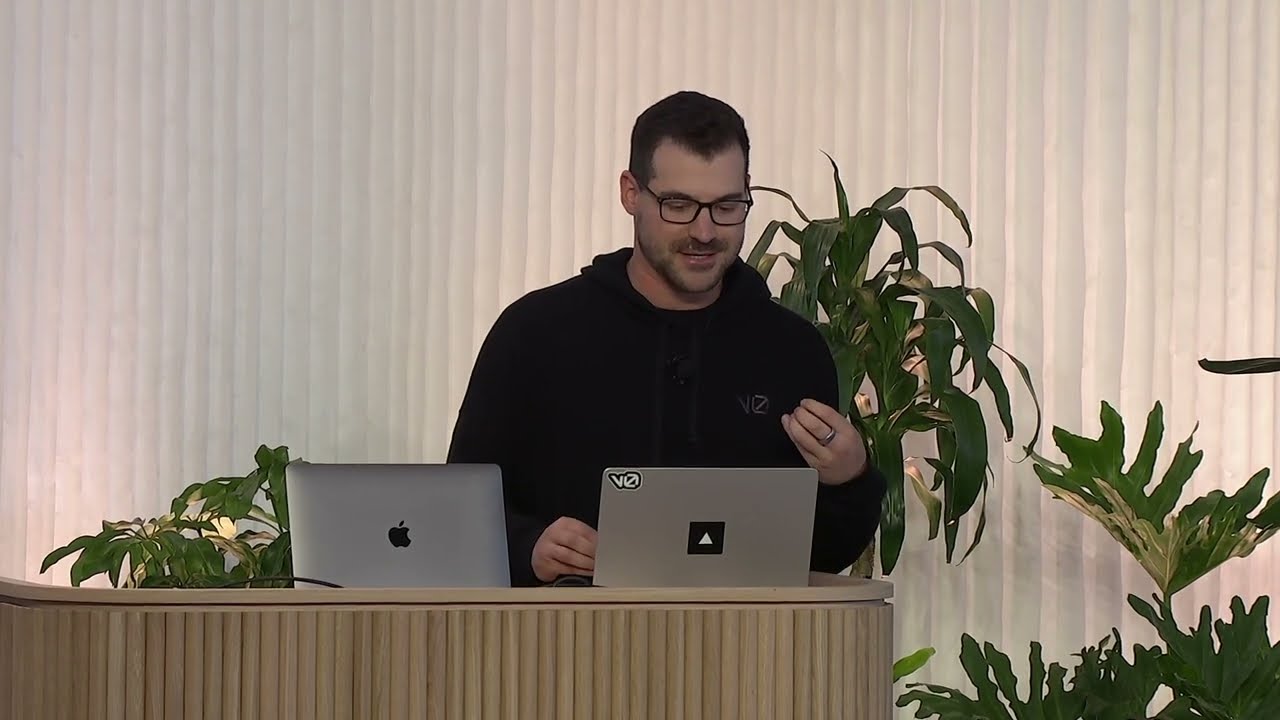
-I see a lot of friends here, so we'll keep this pretty casual. I'm Jared. I run the AI team at Vercel, which includes v0 and the AI SDK, which if you -- we're not going to talk about today, but you should check out. We started Vercel to -- with kind of a simple mission, which is to enable people to ship amazing products. And you'll note that the word developer actually isn't in that sentence anymore. And that's going to be one of the themes of today. So if you don't know what v0 is, it's a web development agent. I guess that's the hotter way of describing it. It is also a generative user interface AI. So the generative UI, if you will, system. And it sits somewhere in between a design tool, and a coding tool, and something that probably hasn't been built before. So today I want to basically show you how it works, but also talk about the sort of shifts that we're seeing in the current landscape, and how we are thinking about this tool and where it's going. So there's basically two themes that we're going to talk about today. And the first one is a term that I hope catches on, which is the era of personal software. And this is, kind of, an all-encompassing phrase. But when you have sophisticated enough code generation, at the same time combined with these new AI tools, this allows anyone to create anything just for them. And that's just brand new. And so it's kind of funny. It's sometimes easier to create software now than it is to, like, go Google it, right? You think about those favicon generator with all the ads, or JSON preview, or all these toy things that just suck. Like, right, like you don't want to use that. You want to build your own thing. Well, now you can actually do that. And v0 actually helps that. But it goes beyond just, like, little toys. You can imagine a situation where what often would require, let's say, tons and tons of business analysts in Excel, might be able to just like, have an app that gets generated instead. I used to work at Goldman Sachs. And so this rings -- this like, rings true for me. Instead of having to go build some like, crazy discounted cash flow model, just have v0 generate an app for it. And we'll see some of that today. But at a deeper level, personal software is going to let us solve higher level problems by creating -- allowing us to create Meta tools that we can use to solve them. And so what I want to show you today is how we can use v0 to show off some of that. And then take a sneak peek of like, some of the other -- the second theme, which we'll get to in a moment. So let's just hop into some demos. So I know realtime and text-to-speech is like, the big deal today, right, which is an amazing thing. An announcement that OpenAI came up with. So I'm super stoked about that. But let's just show what it would take to just do like, a simple text-to-speech app. Maybe I want to record a greeting or something like that. And v0 can help us there. So it doesn't take much to get started with v0. I'm literally going to like -- I'm not even going to copy it. I'm just going to take some screenshots of this. And this is, again, the OpenAI documentation. It doesn't really matter here. I'll use CleanShot here. And I can hop over to v0 and just say -- can we zoom in and see? I think we can see. Make a text-to-speech generator using OpenAI in the browser. And in this case, let the user input their OpenAI key directly. And let's attach some images of some docs. Whoops. Let's grab some docs there. I just grabbed the wrong doc. We'll take that there. Great. And yeah, let's see what happens there. So v0 is now going to basically generate an app for us. And it is going to do that as it streams. It's super fun. And when it's ready to render, it's actually going to render with real React code. It's based off shadcn and Tailwind. And if it does use external third-party libraries, those work too. Which is also really, really useful, as we'll see in a second. So I'm going to -- so not only does, like, v0 show me what it's building, it's also explaining how to use it, which is great. So I'll enter in my API key. And let's say, I love OpenAI, and let's generate this. And it looks like it's not working. Oh, well. Demo gods are being annoying. Let's see. Make it work properly.
Segment 2 (05:00 - 10:00)
I don't even know why it's not working. Let's see. So that's the right URL. Let's try this one more time, in which case we'll go back to the fallback. Ah! We screwed up, but it's okay. We had a working one. Same prompt. Let's see what the prompt was. Make it text-to-speech with OpenAI in the browser. Make it figurable. All right, it was clearly close. Probabilistic code. Still difficult. My API key was -- Oh, that was the whole thing the whole time? All right. Here we go. -I love OpenAI. -There we go. Sick. It worked. So yeah, it's a little toy app, but I'll show you some more realistic stuff that you can do. At Vercel, we're very like, v0-pilled. So we've done stuff like -- I don't know, if you ever need the Vercel logo, you can just grab it from this. What's also neat about v0 is when I'm ready to like, go live with this, if I want to, I can publish it directly and even get a URL. So that's super fun. And so now my site is live, which is great. And so now I have a shareable URL. So that's kind of great. I can also fork existing ones. But you can kind of go wild. Like one of our engineers has been like, cooking on this stuff and built a full image. Like, literally an entire image generator. So you can even -- all of this is built with v0 and prompts. So we can make memes here, like Moo Deng got accepted to YC by forking OpenAI. I don't know. Let's see. Did it do that? Add text. Great. Fire. What a sick meme. Amazing. So people can create, like, amazing stuff. And you can fork this yourself and even, like, keep going. And so there's sort of a TikTok-ification, if you will, of code, which has been fun and viral. And people have done some nuts -- pretty nutty stuff. So it takes you to the next point, which is that while this looks like a toy right now, we're actually betting that it's not going to be a toy forever. And so we think about this as like, we're about to launch these billboards in SF. Which sort of play on words about prompt engineering and professional engineering, and how these two things are going to fuse together. And so the rest of the demos I'm about to show you are actually pretty real world and more material. So we're about to have Next. js Conf in a couple of weeks. You should all come. You're all invited. And then one of the 3D artists that we hired built out this cool video animation. And of course, the v0 team, like, took that as a challenge. Okay, how do we do this in v0? And actually what is one of our -- somebody from the marketing department actually cooked this one up. And they did an amazing job. They actually were able to use React-three-fiber to generate a pretty good working clone prototype. And what was also really fun is that like, this is now forkable. So I can go back here. I can fork it -- if I wanted to. And I can keep prompting editing it. And in the essence of time, I'll show you what I did before I got on stage here. And I got -- let's see here. Whoops. My OpenAI. Where's my fork? Fork of CubeGenerator. So I took that. I forked it. And I made it for OpenAI demo day with just like, three prompts, which is pretty awesome. So I uploaded the OpenAI logos. I then just prompted it to say, like, make this for OpenAI. And boom, like, pretty much production grade React-three-fiber compatible code. And what's really useful is this code can be used in your application with just one command. So if I'm working on Next. js or any React application, I can just copy this. Pop open my editor, paste this in, and it will download all the third party dependencies and all of the React code that I need to like, ship this to production. And so we envision this world -- and you'll see here in components like, here's the DevDay cube. And we'd be ready to go here. And so you can imagine this world where software is not just personalized, but also, like, democratized, whereby every single person in the organization can work together. And through prompting, and code gen, and generative UI, you can imagine that the -- what it means to be an engineer or a developer is just like, vastly different than what it means to be a developer today. You're no longer going to have this like
Segment 3 (10:00 - 10:00)
gatekeeping of who can code and who can't code. Of course, those who can code will be God tier developers. And those who can't code, well, now they're going to be able to be empowered to ship and create amazing things. And so I'm really, really excited about the other billboard that we're about to launch too in SF. And that I'll read it to you now, which is that everybody can cook. And that's the second theme that we hope -- that I wanted to talk about today. Which was that, this idea that, through code gen, through generative AI and generative UI, we're hoping that we can bring and democratize creativity throughout entire organizations. So with that, I want to say thank you to OpenAI and thank you all for coming. And check out v0. Thanks so much.