Studying Scaling Laws for Transformer Architecture … | Shola Oyedele | OpenAI Scholars Demo Day 2021
16:22

Studying Scaling Laws for Transformer Architecture … | Shola Oyedele | OpenAI Scholars Demo Day 2021

OpenAI 10.05.2021 3 988 просмотров 70 лайков

Machine-readable: Markdown · JSON API · Site index

Поделиться Telegram VK Бот
Транскрипт Скачать .md
Анализ с AI
Описание видео
Learn more: https://openai.com/blog/openai-scholars-2021-final-projects#shola

Оглавление (9 сегментов)

Intro

um so i'll get started um hey everyone um my name is shola um i'm going to be talking about scaling laws for transformer architecture variants um and so today's talk is going to be broken down into three main sections first a discussion of the problem and context behind pursuing this research an overview of the research and any findings from the experiments as well as an overview of sort of future opportunities available for research on this topic um at first we're going to dive into the problem statement behind this research and project specifically um resources already been done in the space and to provide context on this research project i wanted to sorry about that specifically i want to chat about research that's already been done in the space to provide context on sort of this research project

Scaling Laws for language model performance show that loss scales as a power-law with model size, dataset size, and compute.

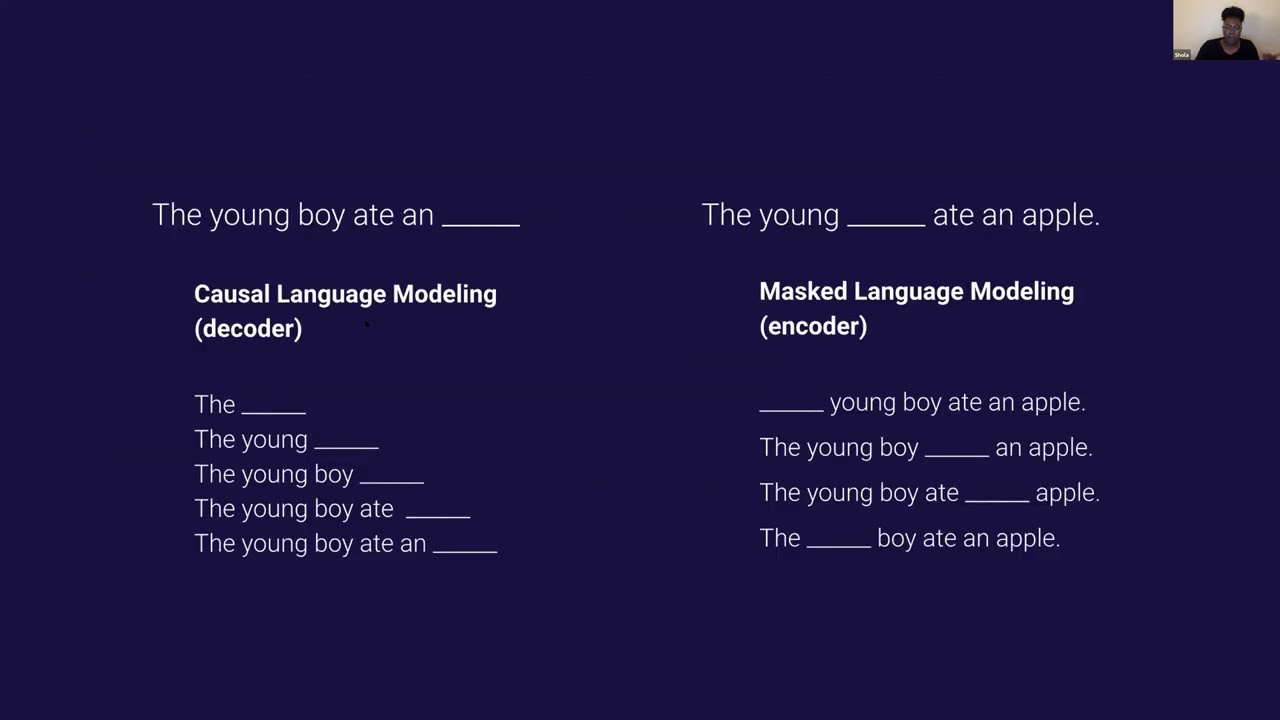
so scaling laws for neural language models was a recent paper that came out of open ai i imagine that most people in this room are familiar with this research so i'll try to keep my comments brief um this paper introduced empirical um scaling laws for the performance of machine learning models as a function of a number of key parameters or key attributes model size which is defined by the number of model parameters data set size and compute referring to the total compute budget used to train the model as defined in the paper compute is referred as the number of not embedding compute used during training can be estimated as c equals 6 nps where b is the batch size s is the number of parameter updates and the factor 6 accounts for the forward and backwards passes so the graph to the left is from the original paper and illustrates how language modeling performance increases so it improves smoothly as we increase model size and data set size and compute with optimal performance gained when all three are sort of scaled in tandem um and sort of given that lfc is its own function for every model um i consider lines that were within five percent of each other to be within a margin of uncertainty um so the further away lfc was sort of the more consistent significant i consider the results um and llc can be calculated with irreducible loss or without but in my experiments i exclusively calculated it without for simplicity um it should be noted that so this is lfc um the equation that sort of represents this power line here and this m term here is sort of the constant term that controls the trade-off between um loss and compute um if you see me looking off to my right i'm looking at my monitor to make sure i'm pointing at the right thing um so this is the existing research work that led to my research project while the original paper study scaling laws on decoder only transformers i wanted to understand how these laws trend among different transformer architectures so before we get into more background let's talk about motivation um so i was interested in working with transformers because of their impact on the nlp space when you add scaling laws which introduce the ability to forecast loss with respect to compute i was curious to know how these laws could generalize among the different types of transformer architectures i was also curious it's where the constraints of scaling laws and i thought trying to reproduce scaling laws um but on different types of architectures or different types of transformers could tell us more about what generalizes among the different algorithms versus being sort of a standalone feature of the original decoder only transformer so at best it would be an opportunity to understand the connection between transformer architecture components and model performance at worst it would be an opportunity to understand the constraints of scaling laws particularly when exploring more models so i'll sort of discuss next the types of architectures i experimented on why i chose them the differences and what i think we can expect from the resulting architectures so the transformer architectures i studied followed into two categories causal language modeling which is predicting the next token and sequence and mass language modeling which refers to predicting the mass word which may be any word within the sentence so the only difference between the two is the way that the model is trained so the same architecture can be used for both types of language modeling and you'll see later on in the presentation that i did this with bert although burt was originally released as a mass language model there is a causal implementation of it and i ran my experiments on both types

The variants were picked based on their architecture and access to an open sourced implementation of the algorithm.

so a little bit of background and i'll try to speed through this just because i know this is a lot of information but the architectures that i experiment with are shown here they were picked based on their architecture and ease of implementation so in the interest of time i'll try to be brief and maybe just highlight some of the more important characteristics um i think i mentioned earlier that in the original scaling loss paper it was studied only on the decoder only transformer um since the data set size and machine that i use are all different from the original paper i decided to experiment on a transformer that was similar to what was used in the original paper and for that i used gbt2 for that as it was the closest to what was in the original paper and i thought it would be a good reference point to put the others in context as you'll see the other two causal language models that i experiment with or transformer excel and reformer um you'll also see that bert like i mentioned was experimented on using his mass implementation but then also its causal implementation as well and so you know bur is a mass language model that uses random masking and um next sentence prediction um the only difference sort of between the two as far as the causal and the mass implementation is the way the model is trained uh meaning that the same architecture can be used for both types of modeling so i really want to point that out just because it will become important later in the presentation but um just wanted to call that out and then of course these last two mass language models which are both um sort of based off of or both sort of similar and inspired by bert um i'll sort of skip that in the interest of time

The impact of architecture on scaling laws depends on how significantly it impacts compute.

so my hypothesis is that the impact of transformer architectural scaling laws depends on how significantly that architecture impacts model size data set size and most likely compute so given reformers focus on reducing its memory and compute during training that's embedded in its architecture my prediction was that you would see that the reformer architecture particularly outperformed the other models given the insight on the original paper on how weekly performance trends with model shape i predicted that bird scaling laws would have little to no change between the causal and the mass version and that you would see the all of the mass language models sort of have scaling laws that are within a sort of a margin of uncertainty or sort of um have only the difference of a constant pre-factor within them um so next i want to talk about experiments um methodology preliminary findings and research implementations i'm going to try and speak a little bit faster because i think i'm running a little bit slower on time

Experiments were done using model size scans to calculate and compare L(C)* among the variants.

um so for methamp methodology um one of the key tasks of my research project was calculating um the compute efficient frontier fit that's lfc and on transformer architectures doing language modeling and essentially trying to understand how lfc changes with respect to algorithmic changes within an architectural family um so once i decided which models to study i proposed several model sizes and then produced a learning curve for each run ideally training at least four to five sizes for every model and sort of the number of parameters ranging between 2 million and 350 million um with some variation between the different um the different architecture um this graph highlights sort of uh one of the typical loss versus estimated compute and here i just want to point out that we sort of see this front formation of a pareto frontier and this sort of i would say line that's adjacent to this curve is the scaling law um that i'm going to be looking for and then sort of evaluating between the models

The same architecture using a different method of training can produce different L(C)s. BERT MLM

models um so these are some of the preliminary findings um that i had i think the numbers are less important but more so just the relationship between one another um so on this slide we can see that the same architecture using a different method of training can produce different llc's um so this result was initially surprising because i had assumed that the same that we'd see the same lfc um because they have the same architecture but it actually makes sense conceptually once you consider the same architecture when trained differently processes data differently so in the case of bert when it's trained as a mass language model the context is encoded bidirectionally so you have sort of semantic information on the left and the right as such is the case when you are sort of decoding mass words both um anywhere sort of within a sentence versus in the causal implementation um you only ever see words to the left of the word that you're predicting um and so that was pretty surprising in terms of um the results um another one that was pretty

Reformer formed a tiered pareto frontier, meaning that some of the larger models don't perform better than the smallest within the same tier but use more compute.

interesting was sort of um reform reformed a sort of like tiered pareto frontier meaning that some of the larger models don't perform any better than the smallest within the same tier but they do use more compute so essentially these models would be sort of needlessly more expensive um when you could just use this one so that i thought was um pretty interesting reformer did have sort of one of the best locs of the models i tested um i think particularly with reformer i would want to sort of see how this pattern persists with some of the other architectures and to sort of see if this is a pattern that you can find with all of the transformers that all the transformers whose architecture directly impacts compute um so that may be like the evolved transformer um versus just reformer um so some of the limitations i had um i did limited hyper parameter sweeps um some of the problems that i found could have been solved with that um really calculating scaling laws with irreducible loss um could have made the fits more precise which could have revealed additional information um the other piece is that like the nature of this research in general is that some of the comparisons are just simply apples to oranges and that there are way too sort of variations within the two different architectures um and so i think the next time i would really want to figure out a way to isolate um as much of the differences as possible so you know what in particular is driving the changes in lfc um and last sort of why it matters um

The architecture that scales best is the most cost effective model to use.

so the architecture that scales best is the most cost effective model to use this is why this research matters because it allows us to find the architecture to find that architecture and potentially use our findings to understand what future architectures could look like that continue to optimize cost as we can see over time the gap widens in terms of the gown model perform the model performance you receive for the same amount of compute um and if the slope is steep enough and architecture can consistently begin to outpace other architectures within the expected range of compute um so this sort of matters because currently we're seeing ever increasing amounts of acute uh compute being used in the industry um these scaling laws um allow for up to allow for us to optimize large computer regimes and choose the best architecture and model size that helps reach this aim in my experiments the reformer model was that architecture that produced the best power laws in comparison to the others the reformer model was designed to be an efficient transformer and utilizes several techniques to reduce memory footprint and compute time i think this directly i think this direct impact on compute time is likely why we see such improved performance with it was the only transformer architecture i experimented with that had this property but in my next experiments i'd like to explain expand the architectures i consider to

Continuing the study of the model performance of different transformer architectures at scale.

similar styles of transformers and so what's next for me is really just continuing this study doing more hyper parameting to expanding the list of models that i'm using and really just expanding the experiment suite to be able to more exhaustively draw correlations and draw insights as far as the connection between model performance and compute with respect to transformer architecture um and last but not least lastly i just wanted to say thank you um i think it's been amazing time at open ai it's been an incredible opportunity um i really wanted to say a special thank you to my mentors aaray and nick and really thankful that i've been able to have two um everyone else at openai mariah christina pamela kathy alithea i also wanted to say special thanks to the tools that helped made my research possible um it would not have been possible to do this without open source tools like hugging face deep speed and azure and i think i might be out of time so we'll see what um what francis says but if anyone has any questions feel free to ask um if not we'll see what happens with respect to time yeah you can take one question okay um do we have any questions um okay so i see a question here that said any intuition as to the tier structure of the reformer um i don't think so i think that so i think my only hypothesis would be that um because sort of the reformers differences because the performance differences are sort of related to using tricks to specifically reduce memory and compute um my thought is that the hyper parameters matter a bit more with reformers specifically that might not necessarily be the case with burt and transform excel in any of the others um so i couldn't isolate which one specifically that was sort of driving that change but that's sort of my thoughts behind it

Другие видео автора — OpenAI

Ctrl+V

Экстракт Знаний в Telegram

Экстракты и дистилляты из лучших YouTube-каналов — сразу после публикации.

Подписаться

Дайджест Экстрактов

Лучшие методички за неделю — каждый понедельник