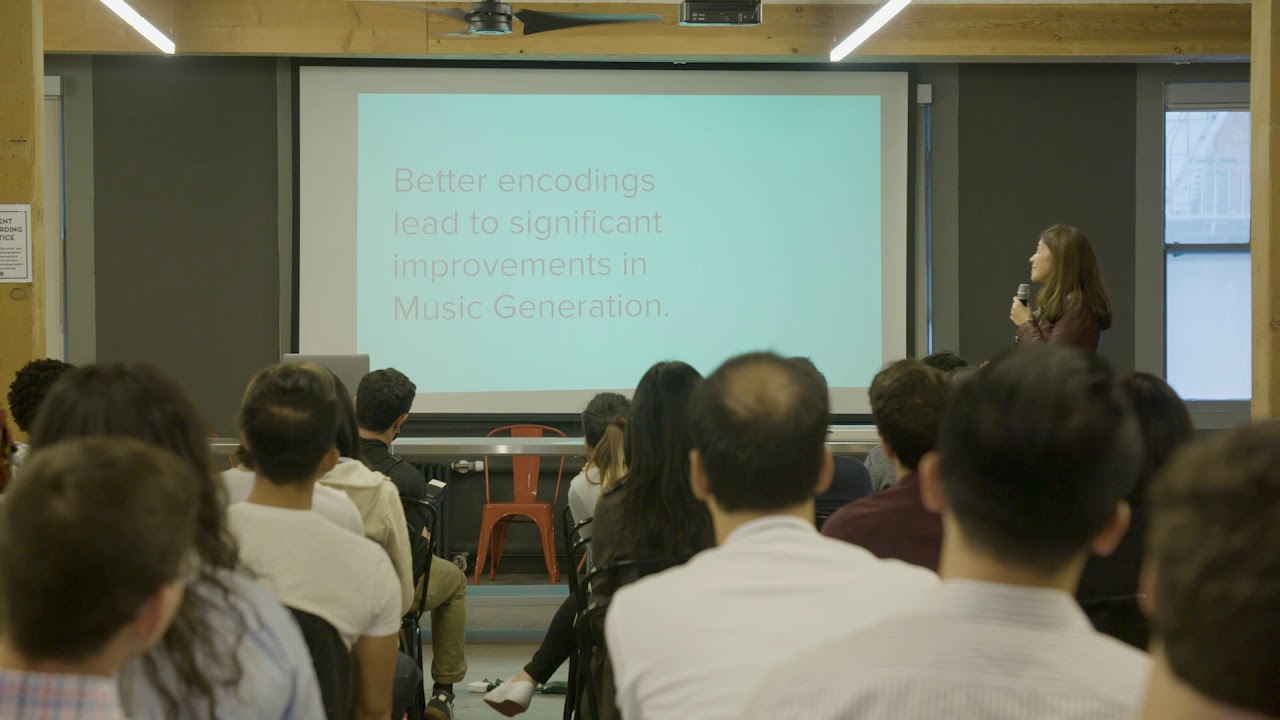
Music Generation | Christine Payne | OpenAI Scholars Demo Day 2018
11:34

Music Generation | Christine Payne | OpenAI Scholars Demo Day 2018

OpenAI 02.07.2020 3 918 просмотров 104 лайков

Machine-readable: Markdown · JSON API · Site index

Поделиться Telegram VK Бот
Транскрипт Скачать .md
Анализ с AI
Описание видео
Christine Payne talks about Music Generation on OpenAI Scholars Demo Day on September 20, 2018. Learn more: https://openai.com/blog/openai-scholars-2018-final-projects#christine
Оглавление (10 сегментов)

Intro

thank you hi I'm Christine Payne I'm really excited to be here and want to thank you all for being here as well and I want to say thank you especially to opening I for sponsoring us this summer it really has been an incredible program so I thought I would dive right in presentation that's not clicking sorry with some sample generations so

Sample generations

this summer I was working on training an lsdm to generate music so this first one is a sample when I train my LFE M on classical piano music okay and then when I took the same neural net and instead of training out in classical music I trained it on jazz music and then asked it to generate new pieces all right so a nice way to think about

Language modeling

music generation is to think about it as a language model problem so I won't get into the details now but for language modeling we usually use an architecture maybe something like an LST or a transformer and we treat it on the task we give it a prompt sentence and then our sequence of words and then we ask it what should the next word be and once you have a model that's really good at this it's actually pretty convenient to turn it into a generator you just take this word that's predicted feed it back into the model and then ask it to predict the next word and so forth and you can create a text or a piece of music as long as we'd want the trouble of course is what we need to do would be able to translate music into tokens that we could then feed sequentially into a model like this so people have tried to

Limitations

do this in the past but often times because it's a difficult problem we have some pretty strong limitations on what you can do with music so it's kind of clear how if you had one note at a time you could ask the machine at the model to predict the next note and maybe you come ajan and say like every time step will have exactly four nodes and then predict the next set of four nodes so if you're doing Bach Corral's that could work really well we're another limit you might have is like how many notes you could have so the lowest note to the highest note but might be a pretty small range but I was really curious about could we extend this and make it more general the

Musical Timesteps

problem is when you start looking at general music it's really complicated so you know effectively you can have any number of notes at any time it could be any combination of that so I'm defining here what I call a musical time step and so ideally we want to tell the model that at this moment in time we're playing a D and a B and then you move forward into a G then you afford an you clean up and so forth you go and you do a genus E but here we've run into a problem right because here we notice we're gonna try to fit in an extra D but it's faster than where we were sampling things and so this causes a problem so we can imagine sampling more often but then you know this also causes other issues because I'm will end up with lots of moments where nothing's happening at all and Ella stamps don't really love it we have basically species word you know it's not ideal otherwise we might build have a method that's more flexible and has some sort of more complicated notion of time like how long to wait until the next time set so we have here both our sampling frequency problem and then the problem saying noted before how I dunno range we want and if we want to be flexible about how many notes we play it once so to solve these problems I'm

Chordwise

proposing two different kinds of encodings and I'm calling these the court bytes encoding and then note wise encoding and I like to think about these in sort of parallel to the language models so chord wise is very similar to like a word based language model and know why it is much more the way you do character by character prediction so for chord wise is what I'm doing here and literally I've only found some of them here but literally for every 88 of the piano keys I'm putting 0 or 1 for if a note is being played at that high step so at the very first moment you can say they're just the TC simply so we have the two ones you know you can imagine this could exploit pretty quickly we could have you know two to the 88 popsicle possible combinations fortunately piano music is a lot more predictable than that we're limited by how many fingers we have and what sounds good so I found that in across most of classical music we had a vocab range around 55,000 so 55,000 different combinations of notes the other system

Note Y

I'm proposing is this note Y system where here I literally say first it's going to be C then another C and we're gonna weight the weight sort marks at the end of this time weight force except then you end that first C that's down in the bottom you play G and then you wait again so it's sort of it's very much like a character system might be this is the men's of being pretty nice it has a much smaller vocab size because you only hate number of notes you have the ends and the weights and it also has a really nice feature that you can pretty easily encode notes that last longer which I also tried playing around with violin modeling and there you really need to be able to have notes that last for a long time so I took the results of these and

Quiz

I made a quiz which I invite people to come across to the table later and try it out but I have pairs of songs and one song at the human concludes piece and one is an AI composed piece and the task is to guess which is which and encouragingly enough people are really bad at this it's you know I was getting most people around twos threes ones do you people got Poor's although often people would email me and be like I'm a professional musician so in general people are finding this hard so they take home from this is that these better encodings can actually lead to some really interesting music generation and i'm just suggesting to encoding here i think there's probably possibility for even more interesting combinations I'm suggesting you know maybe we can look at ways of including some known music theory things thirds scales things like that I tinkered with this a little bit but I think there's still a lot that can be done another interesting possibility

Suggestions

is right now I'm training my model on pretty much all composers at once and then asking that to generate it would be really fun to train that and then fine-tune it on kind of neat quirky combinations I'm suggesting like what if you smashed Chopin and jazz together or something like that I think there could be some fun artistic possibilities and lastly I think the big problem both for this and then in the language model generation world is how you kind of get a longer-term structure so the pieces that are was creating more often really good for the first 30 seconds and even like a minute sounded good and then we started being you know you realize that there's really no long when going on here and so ideally you'd love to have some sort of sense of the big picture where you are and then that's sort of immediate index notes that'll sound good and in the interest

Questions

of time I skipped a lot of detail so I'll open it up to questions now feel free to hit any of these or whatever you'd like thank you or you can just let me up so the question is did I hit any dead ends things that I tried but just were not working at all um I would say that I feel that way a little bit about the chord wise system like I feel intuitively that it should work and it actually turns out to be very good at memorizing theses so I can prompt it with a little bit of Mozart and then it'll continue to generate like 45 seconds or a minute of Mozart perfectly but it has a really hard time moving away from training set and getting into kind of interesting new patterns and so I feel like there should be a way to get around that but I feel like it's a little bit of a dead end right now so that's part of why I moved over to know Weiss go ahead oh the question is how many minutes of training data did I put into it and I knew someone was gonna ask me it is it's actually a very large amount I don't know why in minutes but it's I so I took data from there's a classical archives where everyone has just submitted MIDI recording so they're pieces so it'll have like the entire set of show penny to Beethoven sonatas but it's really a pretty broad range of like all of the famous classical music pieces so in the piano said I wasn't finding I was limited by data when I tried to do violin and piano duo's then I was more because there's a much smaller set for that there's a super interesting question it's have we done models like this on birth songs or like whale songs I imagine I do not know that answer so it sounds like it could be really fascinating but I don't know but Thank You Sadie one more shake on okay yeah so the so one thing that I would really love to see in these pieces but that I don't see right now is any music we have an idea of like one and then go so you have a theme or like a short idea and then you repeat the the third time you do it starts that way but then it goes off into a longer idea and occasionally I say here but not regularly enough that I could say like oh it's really learned this and I kind of would expect a good music model to get that and that's one of those longer-term structure things but I'd love to be able to get all right thank you I'm gonna pass it up

Другие видео автора — OpenAI

Ctrl+V

Экстракт Знаний в Telegram

Экстракты и дистилляты из лучших YouTube-каналов — сразу после публикации.

Подписаться

Дайджест Экстрактов

Лучшие методички за неделю — каждый понедельник