🔥 Join Maker School & get customer #1 guaranteed: https://skool.com/makerschool/about
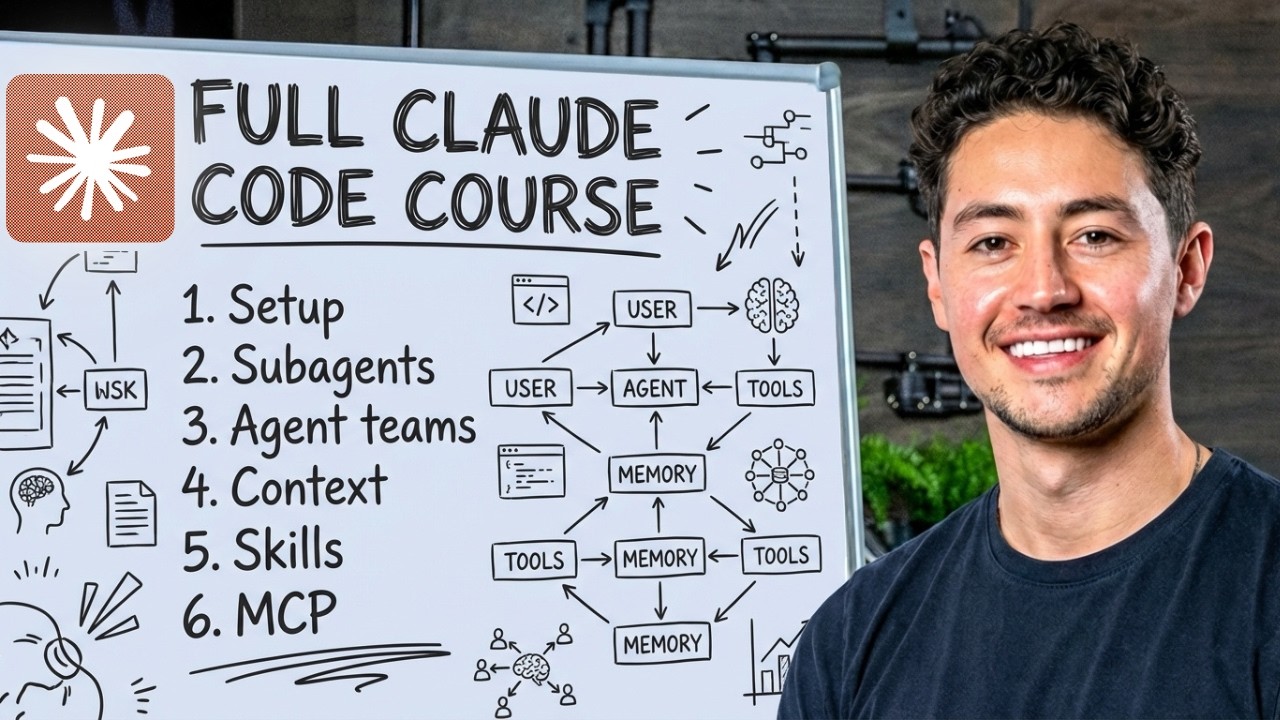
📚 Watch my NEW 2026 Claude Code course: https://www.youtube.com/watch?v=QoQBzR1NIqI
🎙️ Listen to my silly podcast: www.youtube.com/@stackedpod
📚 Free multi-hour courses
→ Claude Code (4hr full course): https://www.youtube.com/watch?v=QoQBzR1NIqI
→ Vibe Coding w/ Antigravity (6hr full course): https://www.youtube.com/watch?v=gcuR_-rzlDw
→ Agentic Workflows (6hr full course): https://www.youtube.com/watch?v=MxyRjL7NG18
→ N8N (6hr full course, 890K+ views): https://www.youtube.com/watch?v=2GZ2SNXWK-c
Summary ⤵️
This video shows how to sell the exact same AI system for 5–10x more by repositioning and packaging it differently. You’ll learn three strategies: focus on high-value revenue problems, stack perceived value with simple add-ons, and confidently raise your prices. The result is fewer clients, better clients, and a lot more money for the same amount of work.
My software, tools, & deals (some give me kickbacks—thank you!)
🚀 Instantly: https://link.nicksaraev.com/instantly-short
📧 Anymailfinder: https://link.nicksaraev.com/amf-short
🤖 Apify: https://console.apify.com/sign-up (30% off with code 30NICKSARAEV)
🧑🏽💻 n8n: https://n8n.partnerlinks.io/h372ujv8cw80
📈 Rize: https://link.nicksaraev.com/rize-short (25% off with promo code NICK)
Follow me on other platforms 😈
📸 Instagram: https://www.instagram.com/nick_saraev
🕊️ Twitter/X: https://twitter.com/nicksaraev
🤙 Blog: https://nicksaraev.com
Why watch?
If this is your first view—hi, I’m Nick! TLDR: I spent six years building automated businesses with Make.com (most notably 1SecondCopy, a content company that hit 7 figures). Today a lot of people talk about automation, but I’ve noticed that very few have practical, real world success making money with it. So this channel is me chiming in and showing you what *real* systems that make *real* revenue look like.
Hopefully I can help you improve your business, and in doing so, the rest of your life 🙏
Like, subscribe, and leave me a comment if you have a specific request! Thanks.
Chapters
00:00 Introduction
00:38 Solve hot problems & reposition niche
4:24 Increase perceived value
11:32 Just price more
15:11 Outro
Оглавление (5 сегментов)
Introduction
I've sold the exact same system for $500 that I've then sold for $5,000. And it was literally identical. Same workflow, same integration, exact same result. The difference was not then in my system. It was in my ability to deliver value. And that's what I want to talk about today. So, I sell consulting through Leftclick. We built systems for everything from small to mid-size local shops doing 10K a month to multi-billion dollar portfolios. And our average ticket price actually used to be less than 1,500 bucks a pop until I learned how to position and frame my service. In this video, I want to show you guys how to do that as well. And we're going to cover three things. repositioning your niche, adding perceived value to a service without actually materially changing that service, and then stacking results. So, let's start with the first, which is
Solve hot problems & reposition niche
repositioning your niche. Okay, so the easiest way to charge more for the exact same service is not actually to change the service or to spend more time delivering it. It's actually just to take your service and then change the people that you're selling it to. In short, you find problems that cost you more money and then you just use your service to solve those instead. In general, the closer your solution is to revenue generation, the more money people will be willing to pay for it. Why? Because, as it turns out, a lot of the same business problems require the exact same amount of effort to solve. But one of those problems will be worth $100, then another one of those problems might be worth $10,000. So, if problem X costs your client $100, then problem Y cost them $10,000. Like, which one are they willing to pay more for? Obviously, if you solve problem Y, people will understandably be happy to pay a premium price. So, let's walk through a hypothetical. You know, I'm on a call with a marketing agency that charges on average $10,000 a month for their service. And during the call, you know, I'm asking them all the right questions. I discover they have two main needs. The first need has to do with tracking and then reporting their expenses. So, right now, their admin staff are manually submitting receipts via email and then maybe their accounting team spends three or four hours a week just categorizing them. So, the average team member costs 60 bucks an hour. If we think about this in terms of total expense of that problem, then it's 60 bucks an hour or so times 20 or so hours a month. That's maybe $1,000 a month that they're spending on that process. Now, the second need that we uncovered was their lead response time or their speed to lead. Uh basically, they have a funnel where people will submit a request to work together through their website. Very standard. A lot of people do it, myself included. And then they're currently running some sort of ad to that website. The way it works is when somebody fills that out, they get an email and then their office manager looks at the email and then eventually gets back to the lead. Again, very standard stuff. How much is that problem worth? Well, let's say they get 60 leads a month or two per day. And because they don't respond as quickly as they would like or as they should be, maybe instead of responding in 5 minutes, they respond in like 3 hours, uh maybe five leads per month leak through their funnel, which is actually something that you see a lot of people suffer from. So, on average, they convert 20% of the inquiries to a price of $10,000. And their average turn, the number of months people stay with them is 3 months. So, putting all these numbers together, what this means is that customer is losing $30,000 every single month. They're losing five leads that are converting at a rate of 1 in5 for a $10,000 a month product that lasts 3 months, $30,000 off their topline. Well, here's the kicker. Both of these services are very, very similar to provide, but one costs a lot more to the client. Now, if you don't believe me in terms of delivery, you know, if I were doing this, I would build both of these systems out in make. com. Both of the systems would involve some sort of web hook trigger which would watch either expenses or maybe new leads added to a service. Both of them would also involve some sort of intermediate data storage, maybe a Google sheet or something. And then both of them would involve transforming that data that comes in to some degree. So if I solve the first problem of expense reporting, it might take me 3 or 4 hours and then I would earn $1,000 a month for the client by doing so. Now, if I solve the second problem, it would also take me 3 to four hours except I would now be earning them $30,000 a month by doing so. Which problem should you solve? Obviously, the second one. This seems really black and white. In reality, most business problems are like this. When the average customer comes to you, they will have many issues in their pipeline. They don't just have one. Now, in general, what you want to do is you want to stick to the ones that are closer to revenue generation, which tends to be stuff like lead genen, uh, sales, onboarding, basically things that are further up in the stack. You'll be able to demand way more money by doing this than if you focus on things that are at the bottom of the stack, which is stuff like expense reporting or dashboards or visualization. So focus on the problems that actually cost them money. And if you have the option to choose between problems or at least propose solutions to problems, always propose solutions to revenue generating ones. Okay. So let's say you are now solving the right problem and you're providing basically the same service and doing so. Well, you could still charge two to three times more literally just by increasing the
Increase perceived value
perceived value of what you are selling. Let me explain. Think about coffee. You know, you can make a cup of coffee at home for like 30 or you can buy the exact same cup of coffee at a fancy cafe for $6. What is the difference? If we're talking about the product itself, which is the coffee, very little. You have similar beans, probably have similar water. You know, you probably have more crema and the espresso from the cafe, but that's about it. Certainly not worth 20 times the amount that you pay for the actual materials. So then what is the actual difference? Well, for the most part, it's not actually the product. It's everything around that product. When you go to a coffee shop, you are inundated by smells and sights and sounds the second you walk in. Probably smells like baked goods and spices and cinnamon. It is probably warm. Or maybe it's cool if you're in a warmer place. I'm definitely not. I'm in Calgary. It's freezing out here. So hopefully my coffee shops are warm. In any case, it is perfectly temperature controlled. You walk in, the barista at the front desk is nice. They're pretty. They make you feel heard and listened to. You get some socializing in. The cafe interior is high-end. It's probably very sexy. You know, there's some cool music playing in the background. Sometimes they even have live bands. You know, it's noisy. It's loud. It's in a good way. Basically, you feel surrounded by people and energy and life. very different from the dull, quiet, drabness of your home. And also, maybe you have some fast Wi-Fi. Maybe there's some perceived social benefits to being at that cool cafe. Ton more stuff. Basically, what that cafe has done is it has added a significant amount of perceived value to consuming coffee there. And while I don't think you as somebody who has purchased the product would be able to consciously point out all these things in your average cafe visit, that is what is going on. Instead of just perceiving this product as a cup of coffee, what you are doing it now is you are perceiving it as an experience. Now you have had a bunch of psychological techniques employed upon you. Most of them without your knowledge and in doing so that cafe has increased the perceived value of that coffee by over 20 times by basically changing everything about the coffee except for the coffee itself. So the good news is you can do the exact same thing with AI. any service. Instead of just giving the person the product in our case, you know, AI consulting, we're doing templates or systems or workflows. The idea is you give them that but then you also give them a bunch of stuff around that workflow. So let's use an example here. Uh let's use the speed to lead one that I talked about earlier. So salesperson A will sell the speedtole system. Okay. They will say hey I'm going to build you a speed to lead system that does XY andZ. That's it. So what they have done is they've delivered a deliverable which is just one price point. Salesperson B who we can just pretend is me in this instance won't just sell the speedtole system. I will sell you a speedtole system, a fullmake. com environment configuration, a weekly strategy call that leads up to the deployment of the system, a Slack availability which leads up to the deployment, a complete end-to-end documentation over Loom, and then I'll also send you tech stocks. I'll sell you hands-on training sessions. Uh, I'll sell you an additional automation library with seven other systems. I'll sell you one-click integrations with your CRM. You know, I'll even sell you like a 90-day SOP optimization plan. What I am doing versus salesperson A is I am taking the thing and then I am adding 10 related things that aren't the thing itself but improving the consumption of that thing. Kind of like the coffee experience that we talked about earlier. This is a managed service. Okay. So let's think about the actual difference between salesperson A and then salesperson B which is me. If the system requires actually 10 hours of my time to build and let's say you know we spread that out over the course of about 2 weeks or so. If I offered a weekly 30-minute call that's one extra hour. If I offer Slack availability over the course of that time period, it probably take me about an hour to reply to those messages. If I build them some documentation, maybe that would take me an additional hour. And if I provide a hands-on training session, maybe that's another hour. So, collectively, let's just add them all up. Maybe it's something like I'm now spending 15 hours instead of 10 hours to deliver the same thing. But what is the perceived difference in value? You have 10 times the number of line items on the scope. So, I'm not just going to charge 1. 5x, which is the ratio between the sum total of the new work versus the old work. What I'm going to charge is three to four times, which is completely asymmetrical. The client thinks they're getting a whole agency relationship instead of just a system. And that's what I am now selling them on. And because of that, I get to charge three to four times more. So, in practice, instead of just selling a lead qualification system for $3,000, you should sell a complete revenue acceleration package that includes the automation system itself, weekly strategy sessions, tool integrations, a documentation library, uh, additional automations at no cost, 90-day optimization plan, and so on and so forth. And if you do this, you're not just going to sell for $3,000. You can get away with selling this for $9,000, which is three times the amount for 1. 5 times the work, a net result of 2x. In terms of actionable ways to do this, because I always have people say stuff like, "No way. It's not that easy. Let me break down exactly how to add this stuff without, you know, wanting to jump off a bridge. " For documentation packages, once you're done with the system, just sit down and record yourself testing it one module at a time and then testing it end to end. That'll take you something like 20 minutes, unless you're building uh, I don't know, a freaking pyramid. This is your documentation video, okay? That's your Loom or your Komodo decks or whatever the heck. Then what you do is you take the video and you pass it through AI and then you just have AI generate you an SOP. Gemini now does video for instance or you could just take some screenshots and then add it to a transcript for that template library. Just go through all your other systems, find seven that are somewhat related and then just give it to them. Bonus points if they're stuff that you think that they are probably going to want or related to their needs cuz odds are, you know, if you provide them a system template or blueprint or video, they're not actually going to be able to implement it themselves. They're going to want to hire you to do those implementations for them, which is literally a free added upsell. for tool integrations, you know, connecting to their CRM or Slack. That looks really complicated to them. In reality, it's usually just one more module at the end of any workflow, whether it's Make. com, NAND, or Zapier. You're just adding something into their database, which is straightforward. Strategy sessions, uh, 30-minute weekly calls. All you do is you build a very short call structure. You spend half the time literally just ask them how they're doing. It's a mini therapy, mini catchup. And then that also allows you to collect more information so that you can use it to sell them on an upsell later. And then in exchange, the client feels like they have direct access to you, that they have some facetime. And I'll be honest, you know, if you offer this as optional, a lot of the time client doesn't actually fully utilize you. Anyway, Slack access, just add them to a channel, which feels premium, but honestly, most clients will message you like once every couple of days. And most of the time, their questions are something you can answer very quickly and very easily. For optimization SOPs, you know, it's like an SOP that you build once, then you just send it and you recoup that cost every single time you send it to a new client. It's like a standalone resource that just gets more and more valuable. And really the psychology here is that people perceive the outcome, which is what they're getting, differently from the actual effort. To them, it looks like you're building them a custom, crazy big, very hands-on managed solution. But to you, it's basically the same system that you already know how to sell, plus some templates, and then an additional sprinkle of time for a call here or there. So, when I was starting LeftC, I would routinely see people sell the same systems that I was selling for $700 for 10 grand. And I would think to myself, well, this is you know, how the hell can they sell such a simple dumb system like that for that much money while I'm here slaving away for 115th. This is how you don't actually give them the system. You try justifying the price later. What you do is you actually build your own market of one by creating your own custom deliverable and focusing more on the experience than the actual template or the system itself. Okay? And that takes me to my third point for charging more. And this one is my favorite because it's literally the simplest to implement. And that's just
Just price more
price more. Even if the problem is the same and the perceived value is the same, literally just charge more for the same thing and you will make more money. If you raise your prices by 200%, supply and demand economics dictate that you will now convert half as many customers. First of all, that's not true. You will almost certainly convert way more than half of that customer base. Even if you charge twice as much just because people's budgets and their willingness to say yes are not linearly distributed. They're normally distributed and they also follow a power law in my experience. But second of all, even if it was true, and again, it isn't, working with half as many people at twice the price is actually significantly better than working with twice the people at half the price each. Let me explain. There's a project management reason why, and then there's a psychological reason why. The project management reason is that any project has both fixed costs and variable costs. Fixed costs are ones that you must incur every time you take on a new client. So, this is going to be your stuff like your onboarding, uh, setting up their project management environment, uh, I don't know, initial email, initial kickoff call, so on and so forth. Variable costs are costs that scale with the size of the opportunity. And so, the bigger the client, the more money they pay you, and the more intense their project is, typically, the more the variable costs will be. Well, when you work with half as many people, your variable costs don't change because they're a product of how big the client is, right? So, they're the same. But because you're working with half as many people, that means you incur half the fixed costs. The equation here is something like F, which is fixed cost, plus V, which is variable cost, equals T, which is total cost. Assuming variable cost is the same in both scenarios, we can just get rid of that. If you have 10 clients at 10K a month, that's 10 F. And if you have five clients at 20K a month, that's 5F. Despite the fact that in both the situations, you make literally the same amount of money. In the latter situation, you incur half the fixed cost. So, that's the project management reason. Uh, the second reason is psychological. When I first started my automation business, I was charging something like 1,500 bucks a pop or sometimes way less for my systems. And the clients at that level are small. They're nitpicky. They constantly change requirements. And to be honest, they're pretty poor. The reason why is they just don't have enough money. So, when you don't have money, you kind of need to make sure that your dollar goes as far as humanly possible, right? Incentives insist that these clients need to be hands-on with their project to make a better ROI. So, at some point I figured this out and I literally just took my $1,500 projects and I'd made them 4,000 bucks. So, I charge 4 grand for literally the same systems I was selling for 1,500 bucks. And I promise I did not change a single thing about the actual service implementation cuz I did not know the other stuff that I've told you about so far. The result was I got a completely different base of clients. These guys had money. Uh they also had to do. So, incentives insisted that they trust my process and give me as much control over it as humanly possible. And what I ended up getting was way fewer fixed costs. They were also way less of a pain in the ass to deal with. And then because they had more money, there was significantly more upsell opportunity later. So higher paying clients are usually easier to work with because they understand the value of your time. You're also solving bigger problems. When you work with larger businesses, the stakes are higher. When the stakes are higher, they take your solutions more seriously. You get bigger case studies. Uh when you deliver a $10 million improvement versus a $100,000 improvement, right? The dollar impact of your outcomes are huge. And that actually ends up becoming your marketing which helps you get more clients. All this is basically a virtuous feedback loop. So how do you actually do this? Well, hopefully I've convinced you at this point that is not very hard. You literally double your prices. So just take your current price, multiply it by two. If you're charging $2,000, start charging $4,000. Now you will obviously have a lot more people say no to you, but it's not going to be twice as many people. And the ones who say yes will be an order of magnitude better to work with. So yeah, that's literally it. You just charge twice as much. And this relationship will continue working up until the point that it doesn't. The issue that most people have is they never actually stress test it for themselves. You can get away with charging a lot more than you probably think. Okay, these are my three
Outro
strategies to charge more for the same work. So, to wrap it all up, first you solve hot problems by focusing on systems that impact revenue instead of some nice to have admin stuff. So, always try and figure out the problem cost that your prospect is incurring. If you can do it on a monthly basis, that's even better. Then, position your solution to solve the largest cost need. Second, master the psychology of perceived value. Basically, build value first and then just stack a bunch of things that are tangentially related to that value together into a managed service or an experience. By doing so, you get to charge significantly more money than you were before. Finally, just price higher. Take your current rates, multiply them by two. You're going to lose some prospects, of course, but the ones who say yes will be better clients, and you're also going to incur a lower fixed cost of operations. Hopefully, this helped. Time for my shameless plug. uh I am interested in starting to invest and helping scale companies. My goal is to provide immediate liquidity in exchange for a portion of your business, maybe 20% or so. And then in doing so, I want to also act as an adviser to help you scale by implementing processes just like the ones that I'm talking about in this video. So, if you guys are interested, if you guys want some liquidity, if you guys have some good fundamentals and you need some cash to grow the business, just send me over an email and chat with my team. We've worked with everything from SMBs to multi-billion dollar portfolio companies, and we'd love to help you solve your own business bottlenecks, both through advising and through direct investment. You can just book a call below using the link. On the other hand, if you guys want more tactical breakdowns like I just did for you, Maker School is over 2,500 members that share their exact wins and their losses with these strategies, link is also in the description. Hopefully, this was helpful to somebody. I don't know, maybe just me. Uh, have a lovely rest of the day and I'll catch all y'all on the next one. Thanks.