I Tested 900 AI Offers: Here's What Actually Worked
9:53

I Tested 900 AI Offers: Here's What Actually Worked

Nick Saraev 04.09.2025 28 298 просмотров 1 308 лайков

Machine-readable: Markdown · JSON API · Site index

Поделиться Telegram VK Бот
Транскрипт Скачать .md
Анализ с AI
Описание видео
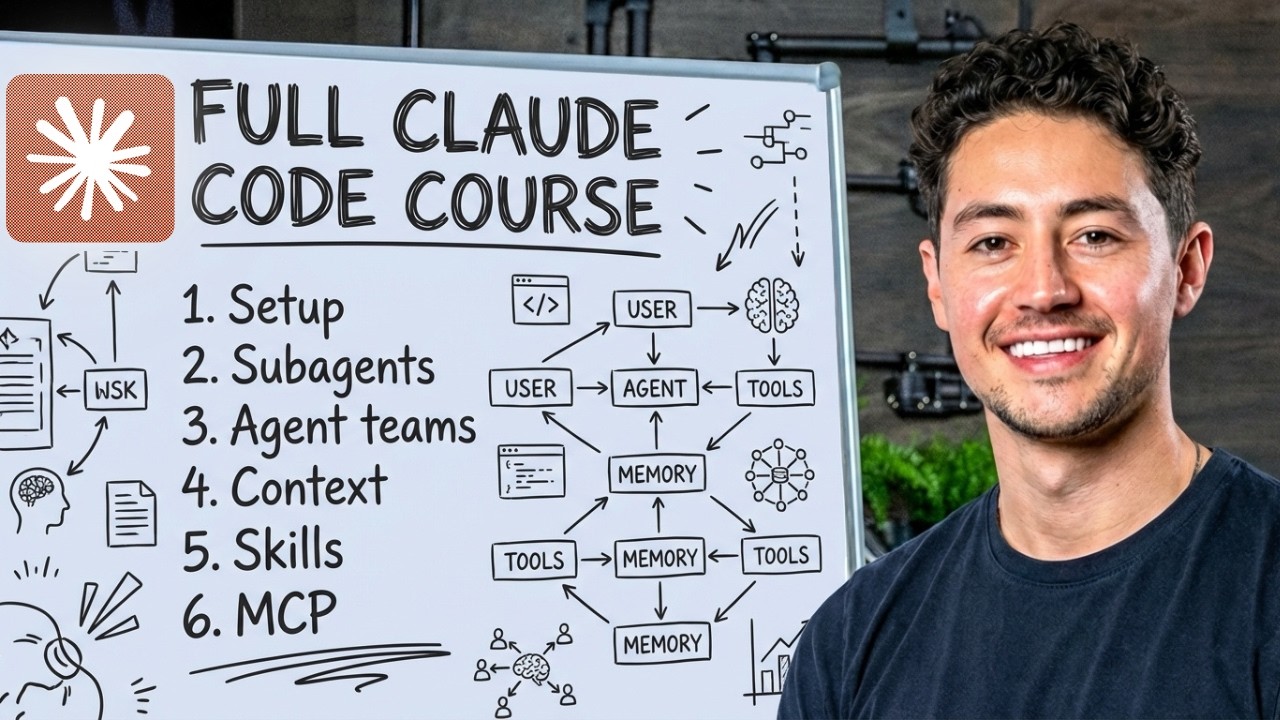
🔥 Join Maker School & get customer #1 guaranteed: https://skool.com/makerschool/about 📚 Watch my NEW 2026 Claude Code course: https://www.youtube.com/watch?v=QoQBzR1NIqI 🎙️ Listen to my silly podcast: www.youtube.com/@stackedpod 📚 Free multi-hour courses → Claude Code (4hr full course): https://www.youtube.com/watch?v=QoQBzR1NIqI → Vibe Coding w/ Antigravity (6hr full course): https://www.youtube.com/watch?v=gcuR_-rzlDw → Agentic Workflows (6hr full course): https://www.youtube.com/watch?v=MxyRjL7NG18 → N8N (6hr full course, 890K+ views): https://www.youtube.com/watch?v=2GZ2SNXWK-c Summary ⤵️ I analyzed 900+ closed AI deals and found three key patterns behind high-value projects: 1. Focus on front-end systems that have impact on revenue generation, 2. Include related monthly recurring offers to generate recurring revenue, 3. Do small, daily, actionable steps to build skill, trust and momentum. These 3 things create a huge gap in results, and make the difference between some people being stuck on $500 projects while others close $60K+ deals. My software, tools, & deals (some give me kickbacks—thank you!) 🚀 Instantly: https://link.nicksaraev.com/instantly-short 📧 Anymailfinder: https://link.nicksaraev.com/amf-short 🤖 Apify: https://console.apify.com/sign-up (30% off with code 30NICKSARAEV) 🧑🏽‍💻 n8n: https://n8n.partnerlinks.io/h372ujv8cw80 📈 Rize: https://link.nicksaraev.com/rize-short (25% off with promo code NICK) Follow me on other platforms 😈 📸 Instagram: https://www.instagram.com/nick_saraev 🕊️ Twitter/X: https://twitter.com/nicksaraev 🤙 Blog: https://nicksaraev.com Why watch? If this is your first view—hi, I’m Nick! TLDR: I spent six years building automated businesses with Make.com (most notably 1SecondCopy, a content company that hit 7 figures). Today a lot of people talk about automation, but I’ve noticed that very few have practical, real world success making money with it. So this channel is me chiming in and showing you what *real* systems that make *real* revenue look like. Hopefully I can help you improve your business, and in doing so, the rest of your life 🙏 Like, subscribe, and leave me a comment if you have a specific request! Thanks. Chapters 00:00 Introduction 00:33 Learnings from 900 AI deals 04:27 Recurring revenue multiplier 06:03 Dominance of foot in the door 08:37 Action Plan 09:28 Outro

Оглавление (6 сегментов)

Introduction

So, I just finished going through and analyzing over 900 posted and closed deals for AI services inside of Maker School. And what I want to do in this video is show you three patterns that separate people that are stuck at $500 projects from those that close deals that are worth over $60,000. And I'm not just throwing around random numbers here. This community is the largest AI automation community by revenue currently on school. We got over 2,500 members. The entire group is singularly focused on customer acquisition. And I personally review every single breakdown that comes through the system. what I discovered is probably going to piss a ton of people off because a lot of what you think about selling AI and no code is actually backwards. Uh so, three

Learnings from 900 AI deals

things. First, there's a specific pattern to all of the major wins that the majority of consultants miss, and that's what I'm going to cover. Uh second, I also want to talk about a counterintuitive strategy that increases your average order value a ton. And third, there are a few obvious AI services that make a lot more money than others. So, I want to cover which ones they are, too. Let me show you. So, to be clear, I have access to something nobody else in the automation space has. It is real data from more than 900 breakdowns of sales. These are actual AI systems that people have sold to real clients, including everything from small $200 kind of disasters to full enterprise systems that have sold for more than $60,000. It's not speculation or theory. It is probably about as close to the ground truth data as you can get in terms of the current state of the industry. And when you look at this data and you put it in front of you, there are three major patterns that emerge. The first is what I'm going to call the revenue proximity principle. It is by far the biggest factor that determines whether or not you sell a system for $2,000 or $20,000. So after looking at all these businesses, we found that the systems that touch the front end, which means lead generation, sales, and customer acquisition, average 350% higher project values than systems that solely touch the back end, which typically refers to admin, automation, HR, payment systems, documents, just stuff that's not as connected to money. The reason this happens is probably because it is much easier to justify a higher cost when that cost is more closely tied to revenue versus savings. The reason why because you can only save 100% of the money that you make, whereas you can theoretically make thousands of percentage points on a revenue investment. Now, Leftclick, which if you don't know is our AI consulting agency, we found the same thing. We worked with everything from small to mid-size businesses to multi-billion dollar investment portfolios. And literally all companies, whether they are small or in the higher end of the scale, spend much more money for systems that improve at the front end than they do the back end. We found this out pretty quickly. And as a result, we now almost exclusively focus on revenue generating systems simply because why would I do the same work for $10,000 that I could do and make $50,000 instead? If you build systems that help customers make even one more sale per month and your customers generate let's say $10,000 from that sale, your services are now generating $10,000 to $15,000 a month in value. Uh so it is very easy for you to charge a sizable percentage of that in terms of revenue. Let's say $3,000. If your client looks at the $3,000 a month that you are charging and then the $15,000 generating, they see a 5x ROI. And there are very few things in life that are going to deliver a return on investment like that. So, in general, the front-end promises we saw that did well in Maker School were specific and tied to money. They were things like, "I'll generate you 40 qualified leads per month," or, "This system will get you a 30% improvement to your conversion rate. " Whereas, the back-end promises that did not do so well tended to be quite vague and tied mostly to time or some other small savings. You can think of that as stuff like 10 hours saved per week or maybe uh 80% reduction in errors. The worst one is always like improved efficiency. It's like, what the hell does that mean? So here's what some front-end systems look like in practice. For lead genen, you have cold email systems, speedtole systems, ad and UGC automation systems, uh lead scraping and go to market automation systems, AI content generation systems. For sales, we have CRM automations that route hot leads instantly. You have proposal generators to close deals faster, AI lead qualifying systems, asset generators, and so on and so forth. And then for conversion optimization, you have personalized follow-up and nurture systems, automatic lead scoring systems. Uh all of these systems are ones that when you sell, you can justify direct return on investment, which makes them easier to sell and then also allows you to charge more for that. If you compare that to back-end systems, stuff like inventory management or employee scheduling or maybe document processing, these might still save time or cut costs, but they don't generate new revenue, which means it's harder to justify, it's harder to price, and ultimately it's harder to sell. Business owners at the end of the day are going to pay anything as long as they have guaranteed revenue growth. They'll negotiate everything else. But if you can put revenue in front of them because, you know, any business has margins. Revenue tends to be multiples on the margin. They're more than happy

Recurring revenue multiplier

to pay it. The second is what I'm calling the recurring revenue multiplier. One of the biggest case studies in the group made over 62,000 bucks in 3 months, which sounds absolutely bonkers, especially given that they were new to selling AI. But the main reason they won was they understood recurring revenue. Now, recurring revenue is insane. If you land a onetime $5,000 client, that equals $5,000, right? But if you land a recurring $2,500 per month client, you would make 30,000 bucks in year one, and that is assuming zero upselles or anything, which is a pretty crazy assumption to make. So yeah, pretty much every major win over 20,000 bucks involves some form of recurring revenue. The guy that closed 62,000, Michael, had more than $11,000 per month in recurring, which means over 3 months that is 33 grand. Meaning after that client, he only had to actually close 29K or a little over $9,000 a month in new revenue, which is obviously a lot more achievable than $20,000 every single month. Could talk all day about why, but recurring services are what makes the majority of your money in any agency or service-based business over the long term. And also a key thing in consulting and especially in building systems is that once you have installed a bunch of systems in a business aka you are managing their legion uh their sales you know their customer coms and so on and so forth you have essentially become infrastructure which is very sticky. You know in general infrastructure does not get replaced for a minor cost saving like most other things would which gives you way more leverage for future sales and upsells and crossells and so on. You know when a client needs something new they're not going to shop around their network. they're just going to ask you because you understand their business better than many other people and in many cases you actually understand it probably better than they do themselves. The last major finding was the dominance of foot in the door. Pretty much all of the biggest wins were from people who started fast with very imperfect $200 to

Dominance of foot in the door

$500 projects. The first couple of posts they'd make about their wins were typically not very impressive at all and sometimes involved clunky ass scopes for relatively little pay. Uh but these people consistently outperformed people that spent months negotiating some perfect $5,500 deal. something like three times over. So they made over 300% more than people that spend a lot of time trying to figure out high-quality deals to actually get paid what they are feeling that they are worth. So I'm now taken to calling this a paradox. Uh it is the paradox of speed. And I've personally seen this in leftclick many a time. It's a big chunk of why I always just tell people in maker school and on YouTube just get going. Cuz there's so much you don't know that trying to plan for everything, trying to scope out every single project to its fullest extent is silly and kind of impractical. It is way better instead to start and then worry about where you land after you launch, even if that is a little scary to you right now. One of our first clients is actually a project I won for somewhere between 500 to 600 bucks on Upwork and I later upsold them to a monthly recurring service and made over $16,000. Okay, so lots of similar stories and a lot of the time initial projects, especially those ones that are posted on jobs platforms like Upwork or Fiverr, are literally there just to feel you out. You'll quickly realize is the majority of the competition blows. So when you demonstrate high value, when you demonstrate that you do not blow, clients that you work with tend to want to hold on to you. And it becomes very simple to upsell to some bigger service later on. Also, my final point is that by doing this, you will not only learn important skills that you can use to bundle a bigger package later on. You'll learn things like how clients uh communicate requirements. You'll learn how to handle scope creep without destroying a relationship, which happens all the time. Uh or what happens when an integration fails and maybe a client's pissed off at you. Also, you learn how to deliver under pressure and you put yourself in situations where clients might question the quality of your work, which is very humbling. Uh, people that close their first project within 30 days, even if those deals were small, we literally had a few for 50 bucks, average over five times the posted revenue on Maker School versus those that did not. Okay, so these three principles don't just add, they multiply together. When you use revenue proximity, you get to charge way more. When you use recurring revenue, you obviously get to build long-term income and cash flow. And when you use foot in the door, you build experience rapidly and also improve your confidence, which lets you charge more. The math after all is said and done is something like a 15 times performance gap. Which means if you understand and implement these, instead of making $1,000 per unit time of your work, like a lot of people you probably see on Reddit that are bitching about how hard life is and how this niche sucks, you could make $15,000. That's real money. So, I thought I'd leave you with an actionable plan. So, this wasn't just a fluffy, you know, YouTube think piece. Uh, here's what you can do immediately to improve your AI offers. In week one, you should audit your current offer against the revenue proximity principle. Are you building back-end systems? You can still do that.

Action Plan

Just tie them to front-end results. Are you already building front end? Then your job is mostly about quantifying the revenue impact, which you can guesstimate if you have to. Just bundle in a money back guarantee or something and then put together, you know, a high quality front-end offer. In week two, you should design a recurring service component around your existing skill set and offer. Don't just build a new skill set from scratch. Try monetizing your current skill and then just attach a monthly price tag to it. I have lots of videos on retainers if you guys just want to check out other ones on this channel. In week three, you should start some sort of daily actionable outreach and feel free to take on whatever you can, even if the rates lower than you might be comfortable with right now. Uh don't wait for perfection. And then in week four, you should iterate based off that real client feedback and make your offer better and then just increase your prices. My rule of thumb is 30%. Okay, if you like this and want actual analysis of these wins, check out Maker School. You can find them all down below. I'm tracking what actually makes

Outro

you money for tons of different services, whether it's AI or automation or consulting or operations. Maker School nowadays is not even about selling a particular thing. Is mostly about how to build the shape of a successful business. And if you guys run a company and want help employing the same sorts of front-end offers that I talked about in this video, book a call with my team. We've worked with multi-billion dollar companies to help drive growth. We'd be happy to chat. With that said, I hope you guys all got some value from this video. Have a lovely rest of the day, and I'll catch all y'all in the next one. Back.

Другие видео автора — Nick Saraev

Ctrl+V

Экстракт Знаний в Telegram

Экстракты и дистилляты из лучших YouTube-каналов — сразу после публикации.

Подписаться

Дайджест Экстрактов

Лучшие методички за неделю — каждый понедельник