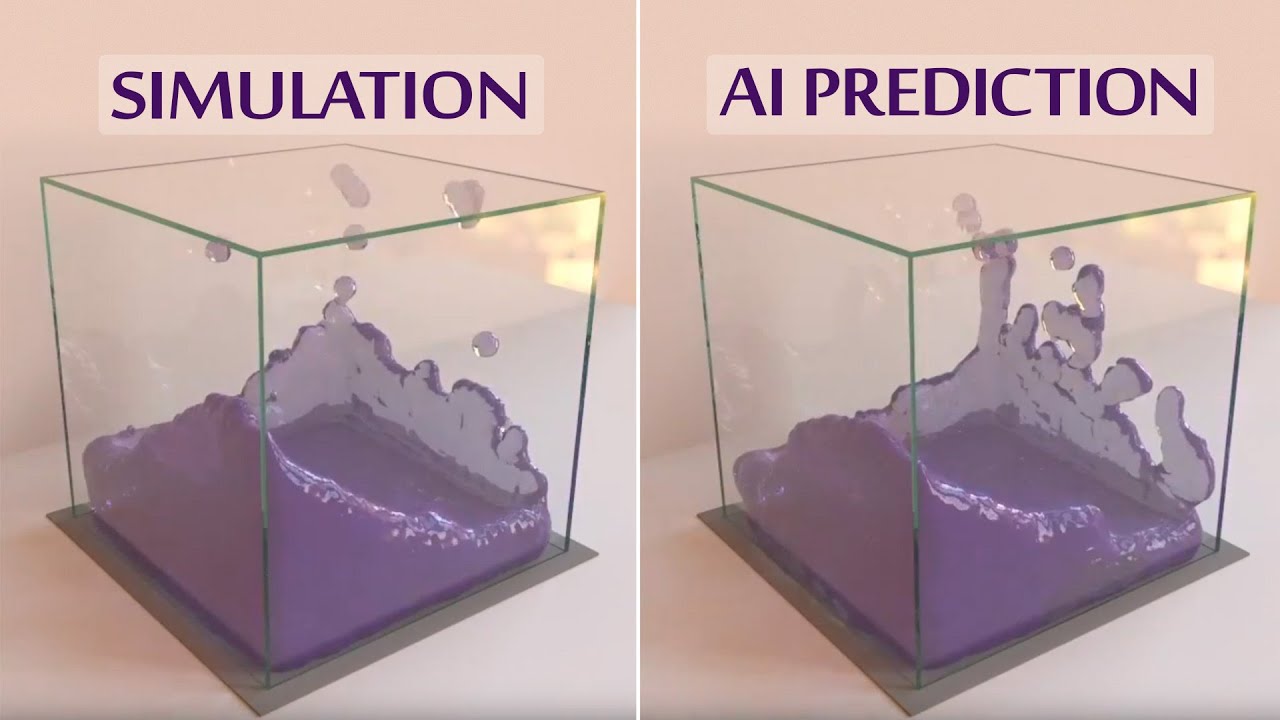
This Fluid Simulation Should Not Be Possible
7:58

This Fluid Simulation Should Not Be Possible

Two Minute Papers 18.01.2026 131 434 просмотров 6 570 лайков

Machine-readable: Markdown · JSON API · Site index

Поделиться Telegram VK Бот
Транскрипт Скачать .md
Анализ с AI
Описание видео
❤️ Check out Weights & Biases and sign up for a free demo here: https://wandb.me/papers 📝 The paper "Fast Octree Neighborhood Search for SPH Simulations" is available here: https://andreaslongva.com/pdf/2022-SA-NeighborhoodSearch-compressed.pdf https://animation.rwth-aachen.de/media/papers/79/2022-SA-NeighborhoodSearch.pdf Our Patreon if you wish to support us: https://www.patreon.com/TwoMinutePapers 🙏 We would like to thank our generous Patreon supporters who make Two Minute Papers possible: Adam Bridges, Benji Rabhan, B Shang, Cameron Navor, Christian Ahlin, Eric T, Fred R, Gordon Child, Juan Benet, Michael Tedder, Owen Skarpness, Richard Sundvall, Ryan Stankye, Steef, Taras Bobrovytsky, Tazaur Sagenclaw, Tybie Fitzhugh, Ueli Gallizzi My research: https://cg.tuwien.ac.at/~zsolnai/
Оглавление (2 сегментов)

Segment 1 (00:00 - 05:00)

Look at what is possible today. This is a massive wave generator pushing water towards a sloped beach with obstacles. Not real, of course. This is a computer simulation, but it is so accurate. It is absolutely breathtaking. Now, check this out. Yep, that is a view that shows us this simulation is done as a collection of particles. How many particles? Well, this is 9 million particles moving at the same time. Absolutely incredible that it is now possible. I'll tell you in a bit how. Now, this is supposed to be borderline impossible. It's borderline impossible because traditional methods just can't keep up. Look at this fountain scene. As the simulation runs, more and more particles are emitted over time, reaching up to three and a half million particles. First, for each particle, we got to find some neighbors to be able to compute density or pressure forces. To do that, we can put a uniform grid on the scene and check the grid points to find which particles are neighbors. Yes, up until a point. Now, as we add more water, it spreads out and finding neighbors just gets more and more expensive. But it gets worse because the grid is uniform. We either waste time checking empty space or get bogged down by having too many particles in one cell. In these scenarios, regular grids simply can't keep up with the complexity. Not a chance. Now, hold on to your papers, fellow scholars, because here is the solution to our troubles. Instead of a rigid grid, researchers proposed a specialized structure that gives us multiple resolutions at the same time. Look at how beautifully this grid adapts to the scene. It is designed in a way so that each of these little grid cells has not too few or too many particles just the right amount to work with. They call these arct trees. Now wait a trees are nothing new. They were invented more than 50 years ago now. So what is new here? Well, usually an act tree is like a map that helps you find things, but you have to stop and ask for directions at every intersection. Computer scientists call this branching. Now, this incredible work just supercharged that. I mean, of course they did. If you have a lot of stuff and you want them to be in order, what do you need? Of course you want a bunch of German scientists write an algorithm for it. Okay. So, what did they do? Well, hold on to your papers, fellow scholars, because they supercharged the way we read this map. I'll tell you how. Dear fellow scholars, this is two minute papers with Dr. Koa Eher. Think of the old methods like a driver who has to pull over at every single intersection. Unfold a giant paper map and see whether to turn left or right. Oh, wait. Now we have a new intersection. Stopping again, checking the map. Got it. Proceed. All that constant stopping and secondguing is what we call branching. This totally slows you down. No good. Now, get this. This new technique is like driving a car where you never have to look at the map because the lanes are so perfectly designed that they guide you exactly where you need to go. Instead of stopping to check your location, you just keep your hands on the wheel and the pedal [clears throat] to the floor. And the lanes just guide you to your destination. In computer science, we call this property branchless. And computer hardware loves that. It loves that because normally it does not work like that. Normally it takes a small batch and asks a ton of questions before processing it. Then another small batch. Another bunch of questions. Terrible. Now this new technique helps it to process data in big clean batches. So it gets way faster. It's incredible because this is not impossible anymore. But they did a lot more than that. And they also challenged an older golden rule of fluid simulations. For decades, the golden rule was that your grid cells must be the same size as the particles neighborhood. Imagine a little bubble of space where one particle can feel its neighbors. That should be the grid cell size, too. Well, this paper proves that's wrong. They found that using larger cells about one and a half times the support radius actually makes the simulation faster. Hm. It's like using a slightly larger scoop to move coffee beans. You might get a few extra beans

Segment 2 (05:00 - 07:00)

you don't need, but you finish the job way faster because you aren't carefully counting every single bean as you scoop. Huh. Absolutely genius. But it gets better. Check out this double damre scene. Here we see two variants of fluid particles interacting. We have fine particles. You see these with yellowish colors. These are for highdetail motions on the surface. And then coarse particles with the blue for the bulk of fluid underneath. This allows the simulation to capture beautiful splashing details on the surface while saving massive amounts of computing power by using simple particles for the deep water where you can't see the movement. Anyway, now here's my favorite. Check this out. Here we mix thick gooey slime with splashing water. At first, you'll notice those three orange armadillos are actually made of high viscosity goo that moves much slower than the surrounding blue water. H. And as the water pours in, the slime deforms slowly. And finally, at the end, they start slowly mixing. And look, we get a cheeky little splash. Bloop. Loving it. And this whole thing is actually genius. Why? Because previously if you had a low resolution simulation, it looked very coarse. Or if you went high resolution, it took up to weeks to compute. But now this is genius because we can have our paper and eat it too or cake or something. We get the incredible visual detail of millions of tiny particles where it matters most. And this technique even works for complex fluid solid interactions like these deformable bunnies being tossed around by 5. 6 million fluid particles. This makes me so happy. But something else does not. It is truly heart-wrenching that this groundbreaking work was published about 3 years ago, yet it sat quietly in the archives almost forgotten. Look, man. So, I thought I have to make a video about this and let you know because if we don't, nobody else will. So, save a paper today. Subscribe, hit the bell, and leave a kind comment to get more like this. We need new tools for the era of LLMs and Weights and Biases now has Weave, a lightweight toolkit to confidently iterate on LLM applications. Use traces to debug how data flows through each step of your app and use evaluations to measure your progress. It is the best. Try it out now at wnb. me/papers me/papers or click the link in the description below.

Другие видео автора — Two Minute Papers

Ctrl+V

Экстракт Знаний в Telegram

Экстракты и дистилляты из лучших YouTube-каналов — сразу после публикации.

Подписаться

Дайджест Экстрактов

Лучшие методички за неделю — каждый понедельник