🎓 Learn AI In 10 Minutes A Day - https://www.skool.com/theaigridacademy
Get your Free AGI Preparedness Guide - https://theaigrid.kit.com/agi
🐤 Follow Me on Twitter https://twitter.com/TheAiGrid
🌐 Learn AI Business For Free AI https://www.youtube.com/@TheAIGRIDAcademy
Links From Todays Video:
https://www.theinformation.com/articles/inside-openai-team-developing-ai-devices?utm_campaign=Editorial&utm_content=Dealmaker%2CNewsletter&utm_medium=organic_social&utm_source=bluesky%2Cfacebook%2Clinkedin%2Cthreads%2Ctwitter&rc=0g0zvw
Welcome to my channel where i bring you the latest breakthroughs in AI. From deep learning to robotics, i cover it all. My videos offer valuable insights and perspectives that will expand your knowledge and understanding of this rapidly evolving field. Be sure to subscribe and stay updated on my latest videos.
Was there anything i missed?
(For Business Enquiries) contact@theaigrid.com
Music Used
LEMMiNO - Cipher
https://www.youtube.com/watch?v=b0q5PR1xpA0
CC BY-SA 4.0
LEMMiNO - Encounters
https://www.youtube.com/watch?v=xdwWCl_5x2s
#LLM #Largelanguagemodel #chatgpt
#AI
#ArtificialIntelligence
#MachineLearning
#DeepLearning
#NeuralNetworks
#Robotics
#DataScience
Оглавление (5 сегментов)
Segment 1 (00:00 - 05:00)
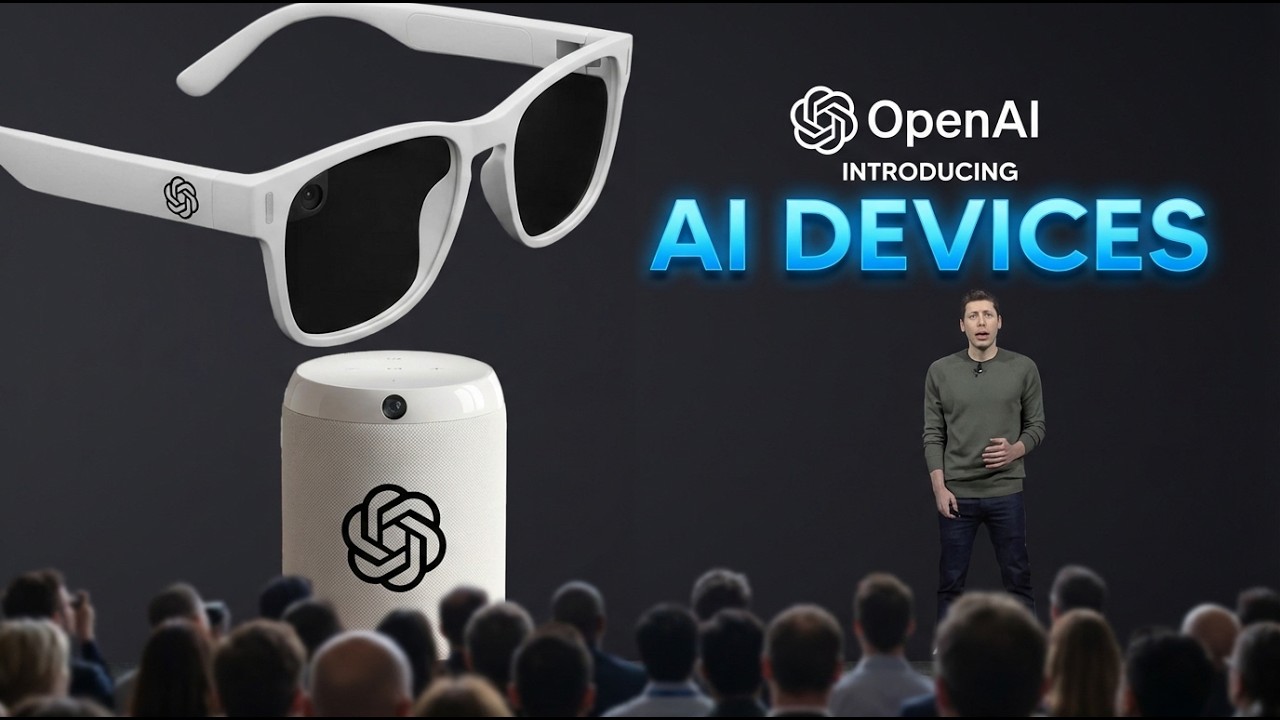
So, OpenAI is working on a family of three different AI powered devices. So, let's talk about it. So, we got this information from the information and it talks about OpenAI's new devices and I think this is one of the most interesting things because AI hardware is going to be a real part of the 2030s as we move offline into integrated AI systems that work in our daily lives in a more natural way. So essentially this talks about the fact that OpenAI has more than 200 people working on a family of AI powered devices that will include a smart speaker and possibly smart glasses and a smart lamp. And that's according to a person with knowledge of the plans. And it says that new details are starting to emerge about the group and its development strategy. Now, it does talk about the fact that the speaker, which is the first device that OpenAI is going to release, is going to be priced between $200 and $300 according to people with the knowledge of it. And the speaker will have a camera enabling it to take in information about their users and surroundings, such as items on a nearby table or conversations about, you know, people having in the vicinity. And it's going to allow people to buy things with a facial recognition feature similar to Apple's ID. Now, this is all pretty crazy and I'm going to dive into why this product, and I'm not hating on OpenAI here, there are just so many issues with this that I think OpenAI will need to face before even starting to really bring this to market because the entire hardware market right now is in a kind of fragmented space with a lot of different social interactions going on. Meaning that if OpenAI doesn't play their cards right, this could be one of their worst moves ever. Now, if you're wondering when is this all going to happen, apparently it's going to happen in next February. So, this time next year, so in around 2027, it's quite likely that OpenAI will be shipping those devices to customers. Now, even though that means they're going to be shipping the customers, you know, in 2027, it's quite likely that we'll probably get some kind of video demo earlier this year. So maybe halfway through this year, we'll get a demo and then you're probably going to be able to place a pre-order for that product. And so remember how this article talks about the fact that the speaker will have a camera enabling it to take in information about its users and surroundings. This is going to be a really big issue because right now, like I said, the AI world is very fragmented. On one hand, you have people that absolutely love AI and will use every day. And on the other hand, you have people that just absolutely hate AI and want nothing to do with it. Let's dive into why this product is going to face so many issues and the key details that most people did miss. So, when I was doing research for this video, I found out that other AI hardware attempts have struggled to gain traction even with significant resources. And you can see here it talks about the fact that Amazon's AI powered Alexa, which was launched in barely a half working state last year, hasn't really moved the needle. So, Amazon essentially, as you guys may know, have a product which is of course their Alexa AI device. But the problem is that many people don't like it because of many different issues that they are currently facing. And the problem I'm trying to illustrate here is that if Amazon with all their billions of dollars and billions of dollars in cash flow and all the resources and years of development that they have had to develop Alexa into a very good product, how are OpenAI going to be able to beat them? I'm not saying it can't be done. I'm just saying it's pretty bleak at this moment in time. OpenAI would need to completely surpass Amazon's AI efforts and make a product that is actually good because there are some fundamental limitations to having an AI speaker device that most people don't realize there is. So before we even get into the actual hardware issues that Amazon was facing, let's get into some of the social issues that OpenAI are going to face. Besides the technical hiccups, you can see here that OpenAI will have to tread extremely carefully when it comes to user privacy. Marketing a device designed to ingest and analyze vast amounts of potentially intimate data isn't exactly straightforward. And the key here, and I'm sure you guys have realized that this is a common theme in AI right now with everyone being split. The problem is that consumers are already growing wary of AI, fearing that it's ushering in a new era of surveillance. And it talks about the fact that their subsidiary, Ring, completely missed the mark with its Super Bowl ad earlier this month, which showed off a new function that lets camera feed scan the entire neighborhood. Now, if you haven't seen this ad before, I'm going to show you guys this ad right now. And I think this is why, like I said, AI devices at this moment in time when consumer sentiment isn't great is going to be a really difficult challenge. Remember, they're trying to sell this product to the masses. And in doing so, you have to get them on board. And right now, it doesn't seem like people are, you know, enjoying what these companies have to offer. So, here was the ad where you essentially have a girl who lost her dog. And then of course she puts up a poster saying they've lost a dog. It's pretty sad. Pretty, you know, sad story of losing a dog. And then it's like, okay, in the app, what we're going to do is launch this search party feature where every
Segment 2 (05:00 - 10:00)
single, you know, device around there can just be activated and search for the dog. And in theory, this sounds like a good idea. You've got more people searching for your pet. This is, you know, a wholesome thing. But people didn't take it that way. And this is why I say people are not trusting current tech companies to do the best with their user data. You can see that some people criticized the ad as being Orwellian, leading some customers to apparently disconnect and destroy their Ring cameras. And it says here, "How will users react to an OpenAI smart speaker? " That remains to be seen. But considering the many missed attempts we've come across so far, the company has a lot to prove. And this is why I say titles like this, you know, videos like this have to ensure that they're on the side of the consumer because rings or will an ad was apparently the worst Super Bowl disaster since Kindall Jenner handed the cops a Pepsi. So you have to understand the Super Bowl is something that everyone sees. It's got billions and billions of eyes on it. And this kind of PR at the moment where you're seeing multiple individuals say that look we don't want to you know have these kind of devices that are intrusive into our home. It's not going to bold well for open AAI provided they don't market it in a way that actually makes it seem like a helpful device. So I think they're going to be struggling really to get people on board here. And that's going to be one of the main issues because the problem is and this is why I say like if you look at the tweets I should have shown you guys the tweets that were just like oh my god there's no way I'm having this in my house yada yada for the speaker specific problem is the fact that the speaker is meant to sit in your home and always be on and contextually aware and that constant processing recognizing faces monitoring surroundings answering questions throughout the day. All of that, if you didn't realize, when you compare that to what standard smart home devices do, that actually requires heavy model usage. Unlike when, you know, you go on to chat GPT and you input a query and you ask it one question, a home speaker is probably going to make hundreds of small AI calls per day just passively observing. And OpenAI needs to actually cover that cost of compute somehow. And the realistic options are either a high device price, which as they said is probably going to be $200 to $300, or a mandatory subscription or throttling the AI capabilities, which is going to defeat the entire purpose. So, OpenAI are kind of stuck here because unlike Amazon, Amazon can afford to subsidize Echo because it sells you products. But OpenAI doesn't have that revenue flywheel to lean on and they need to be able to bring this device in a way that's as consumerfriendly as possible. So having the speaker problem which is you know always aware is going to be an issue because if they're going to run it on ondevice AI it's quite likely that that's not going to be as powerful as the ones up in the cloud. And even if they do have ones up in the cloud it's probably going to be a very lightweight and a quick model. And we know that those lightweight and quick models problem is take a look at this. They hallucinate a lot. So that's going to be a major issue that they're going to need to fix. You can see here it says another problem that hallucinations remain a major problem plaguing the current crop of AI powered tools. Translating woefully incorrect information into the real world could have all sorts of unpredictable consequences in a smart home. In spite of all the high-tech features, for instance, Patterson Tuoy couldn't get Alexa to properly control her bathroom fan. And this is a key issue. If you have something that costs $2 to $300 and it's being powered by an AI system, if it doesn't do things correctly, you are going to face severe frustration. Doesn't matter how nice it is. It doesn't matter how minimalistic the packaging is or the branding is. If it doesn't work, okay, you will be extremely frustrated. And you the thing is as well, you already know how much people are going to jump on the OpenAI bandwagon of their project failing. and AI products failing already gets completely viral PR. You've already got, you know, Mark MKBHD when he did a video on the Humane AI pin, he gave it pretty negative PR. You had so many other tech YouTubers, they're all going to review these products. And if they see that, okay, all of these AI products, well, not all of them, but you know, this smart speaker from OpenAI, if it doesn't perform how it's meant to, that is going to be terrible PR and people are going to be like, okay, that's just a terrible cash grab. I want this company to die anyways. I'm not going to be the one buying it. Now, maybe it's going to be, you know, a high portion of tech users that actually do adopt this, but you have to understand they're going to have to iron out those solutions as quickly as possible. And remember, the problem is that hallucinations are actually a part of AI in its current form. So, I'm not sure how Open going to solve that. You can see here that, you know, some users on Reddit that I found in this thread talking about their Amazon products that they just weren't happy with. and they said, "I'm convinced they are designing it for a mythical customer that does not exist. They seem to think that we want a chatty companion to sell us stuff when most of us just want is a
Segment 3 (10:00 - 15:00)
device that does what it is supposed to do quickly, succinctly, and reliably. " And so, like I said, you have to understand that AI backlash is going pretty crazy. And you need to understand that releasing a product in this climate whilst the CEO of this company is facing tremendous hate comments online just saying, "I can't believe you would say a comment like that. " And if you're wondering what I'm talking about, check out my previous video. This is going to be something that will have to be done with the consumer first. And I'm not sure OpenAI are going to get that right because they haven't got that right in the past. Now, the thing is though is that OpenAI could actually take market share here because Amazon Echo's customers are frustrated. They haven't been listened to and the product doesn't seem to be advancing as quickly as it could. So, when you think about this, the core issue is that they're basically trying to bolt a modern LLM onto the old technology from 2012. And they need to, you know, do what Apple is apparently doing with Siri and is scrap the hybrid approach and build everything on a pure LM foundation, even if it means a painful transition. And you know, right now, apparently, Echo takes around 15 seconds for simple questions, and that's just awful for a voice assistant. If you've ever used Gemini Live, Chat TPT Live, Claude Live, those are practically instant. So, they're going to need to solve those issues. But think about it, okay? If Amazon isn't able to solve all of these issues that it currently has and OpenAI, they're able to come in and say, "Look, look guys, we've actually got a product that works. " Okay, that is going to be significant market share that OpenAI can take and users may actually pay for if it does work. Now, here's the question, big question. How is this going to be priced? Because I wonder, the breaking point for Open AI? When you look at the Amazon Echo, which starts at $30 or $40, and Alexa is actually free, and the Google Nest is pretty similar. When you think about this, all of these devices, they work out of the box. Even if you're looking at the meta rayband glasses, all of those AI native devices work out of the box. And Apple devices are expensive, but remember Siri is free and it's baked into the ecosystem you already pay for. So OpenAI, they're going to have to figure out how they can merge the subscription in a way that doesn't, you know, cost people a lot because every other tech competitor has a pricing advantage over them already. I think what they'll have to do is figure out how they're going to price this effectively so that they can actually discount it. So, it's probably going to be like Amazon Prime where the hardware and the service feel like one product rather than two separate costs. And Apple does similar things with Apple one bundles. It changes the psychological framing from device plus subscription to one premium AI membership that comes with hardware. So, basically one subscription for everything. And I think that option is probably the best because a lot of people wouldn't want to be having, you know, multiple different subscriptions, but they might need to in some cases have just a $10 a month that's optimized just for that device rather than just optimized for the web as well, which allows them to keep the plus pricing or power users while making hardware accessible for mainstream consumers. The point is that it will be pretty difficult to price this for OpenAI because they haven't done this before. They haven't done a hardware product before and of course they don't want to price it too cheaply to not lose money and brand status, but they don't want it to be too expensive so that people don't want to buy the product and think it's just a complete ripoff. Now, one thing that most people don't know as well is that they're probably going to release smart glasses, but they won't be released until 2028. And that is apparently, you know, according to someone involved in the AI glasses development. Now, I think this is probably one of the smartest moves because one thing that we know about the AI glasses in the moment is that the market is proven. People already buy AI glasses. They're already used on a day-to-day basis. When we look at Meta, Meta Ray-B bands already proof of concept, okay? They're already sold out well because they look normal and the AI is almost invisible. You're not walking around with a screen strapped to your face like the Google glasses. And that is the key lesson here. that form factor that Open Eye chooses, it will have to be not only as good as Metas, but even better. So, you know, with Joanie IV designing them, hopefully they have the best shot at doing so. Now, the biggest problem, okay, is that the date, okay, they said 2028, and we know that the tech industry moves notoriously quick, okay, remember 2028 is going to be a rough year for AI glasses because that is when the market is going to start to mature. When you think about OpenAI glasses entering that market, the problem is that you know Meta is not going to stand still. Meta has already sold around 2. 6 million units since 2023 and other companies have started to invest in their own infrastructure to do that. When you think about the fact that Meta has already got millions of loyal users, people already know what they are. They're seeing them in videos. OpenAI has none of that. And the brand partnership question alone is massive. Meta got away with glasses because Ray-B bands are already genuinely cool. OpenAI's glasses designed by Joanie IV
Segment 4 (15:00 - 20:00)
might look good, but without an, you know, a recognizable eyewear brand, they're basically selling an unknown frame to people who deeply care about how glasses look on their face. That is going to be a real big problem that they're going to have to face. come into a market two years from now where Meta already going to be leading with innovative technology, even better design, and even more market awareness. Not only that, we're going to have to look into how Apple are going to come into the game, too. Apple is expected to release its full AR glasses in 2028, probably going to be launching a few months before OpenAI using OLED OS, micro OLED display technology. And so OpenAI won't even be the premium alternative to Meta. Apple will basically occupy that space first with a much stronger ecosystem. Existing customer loyalty, and they already have the iPhone integration advantage. Apple's glasses will probably connect to the iPhone, support Siri with visual context, recognize text, create contextware reminders, and offer premium materials and build quality. And remember that is exactly what OpenAI is trying to do from a company with or you know that already has two billion devices already in people's pockets around the world. How will OpenAI manage to fit into that ecosystem. Are they going to be underneath Meta? over them? Competing with Apple is a very tough thing to do. Not only are you competing with Apple and Meta, Open Eyes Glasses are going to have to compete with Google and Samsung. Remember, Google is backing Android XR as an open platform, meaning any manufacturer can build on it, which creates a flood of cheaper options. By 2028, you're probably going to have Meta, Apple, Samsung, Google back devices, plus Chinese competitors from Huawei, and Xiaomi all competing simultaneously. And when OpenAI enters that market without hardware heritage, without an eyeear partner, without an existing device ecosystem, that is a genuinely difficult position. Now, I'm not saying they can't get it done. I'm just saying when we look at things across the board, this is going to be one of those tricky things. So, how does OpenAI win? Because clearly they're trying to win in this race. And I think that, you know, they could still win here because when you think about the actual market size, the data is encouraging because the smart glasses market is expected to grow by 20% compound annual growth rate from 2023 to 2028 driven by healthcare, logistics, retail, and consumer adoption. So, it's quite likely that by 2028, it's probably going to be a more mainstream category. So, it's likely that they're going to be able to get market share, just it's going to be incredibly competitive. Now, like I said, OpenAI's advantage here is that they're not going to be able to just compete on hardware alone. The real advantage has to be the AI layer. If chatbt in the glasses is meaningfully smarter, more conversational, more agentic, and more useful than whatever Meta or Siri is doing, that will have to be the key differentiator. The glasses essentially becomes a vessel for the model rather than a hardware project for competing on specs. That's the credible angle, but it requires the AI gap between OpenAI and its competitors to still be significant in 2028, which is far from guaranteed. you know, when you consider the fact that claudentropic is, you know, many people's daily driver. Google has started to take market share and Apple is still in the AI race. So, when you think about it, the glasses is probably going to be where the real market is. I know that the speaker sounds cool. It's probably just a first iteration product, but I can see the glasses being where most market share is had. And the reason I wanted to include this is that the reason that this matters so much for OpenAI is because OpenAI is essentially a company that needs to make money. When you understand that OpenAI is burning money every single year, you have to understand that at a certain point investors start to wonder where is the revenue going to come from. If OpenAI are going to target a trillion dollar valuation IPO and if they're looking to have trillion dollars, you know, in terms of, you know, the future valuations of the company, when we really think about this, are those, you know, hardware products as well as those, you know, chatbt subscriptions going to equate to enough revenue to justify the valuations? If we actually think about it and do some napkin math, if you, you know, let's say we take, for example, Meta's, you know, sales, they actually sold 2. 6 6 million Ray-B bands roughly over two years as a firstg product from a brand with no hardware history and Amazon sold around $30 million units a year at its peak, but that was $30 to $50 devices. When you think about a product that's $250, a premium AI speaker is much harder to sell to the mass market. And when we look at the rough scenarios in year one, let's say they do really well, which is uh 5 million units, that's a billion dollars in revenue. That kind of sounds like a big number, but those hardware margins are typically 20 to 40% after manufacturing, logistics, and retail cuts. And Apple makes exceptional margins, but everyone else kind of struggles. So, OpenAI with no manufacturing experiences like these other companies, they're probably going to look at the lower end, close to 25%.
Segment 5 (20:00 - 21:00)
And then when you think about that, of the billion dollars that they just made or $1. 25 billion, roughly $250 to $300 million of that is going to be profit. But remember, this is a company that is burning billions of dollars every single year. That's why I say this is going to need to work. Okay? If this doesn't work, it puts OpenI in a dire position. So the glasses, you know, there's there's no confirmed price yet. But when you think about the fact that Meta's Ray-B bands are $300, so $350 is probably going to be realistic. But when you think about, you know, hardware revenue, subscription conversions, and potential revenue, I mean, it could be a billion a year in annual revenue from the hardware ecosystem alone. But of course, they're going to need a lot more to justify their insane evaluation. The big situation here with OpenAI devices, okay, and this is the thing I want to leave you guys with is that if the speaker underperforms just like the Humane AI pin did, which sold around 10,000 units before it was considered a failure, then the damage isn't just lost revenue. It's PR that, you know, won't go away. It's going to be the narrative that OpenAI hardware isn't good, and that's going to be a bad return for the glasses investments. If you have one bad hardware launch, it's going to poison the well for everything that follows. So that's what happened with Google Glass and that's why it took them nearly a decade to try again. And so when you think about it, the best thing for them is to ensure that this first product is genuinely amazing.