You’ll Never Look At Chocolate TV Ads The Same Way Again
7:25

You’ll Never Look At Chocolate TV Ads The Same Way Again

Two Minute Papers 14.11.2025 59 347 просмотров 3 199 лайков

Machine-readable: Markdown · JSON API · Site index

Поделиться Telegram VK Бот
Транскрипт Скачать .md
Анализ с AI
Описание видео
❤️ Check out Weights & Biases and sign up for a free demo here: https://wandb.me/papers 📝 The paper "A practical octree liquid simulator with adaptive surface resolution" is available here: https://cs.uwaterloo.ca/~c2batty/papers/Ando2020/Ando2020.pdf Sources: https://www.youtube.com/watch?v=kdt5Cs1VYJA https://www.youtube.com/watch?v=YmmSDZ6dBdY https://www.youtube.com/shorts/FVIDRU9-FW8 https://www.youtube.com/watch?v=gNZtx3ijjpo&pp=ygUHb2N0cmVlcw%3D%3D https://www.youtube.com/shorts/1Euba1QvhW0 https://www.youtube.com/shorts/k2P9yWSMaXE https://www.youtube.com/watch?v=Z5qbxQI6dgw https://www.youtube.com/watch?v=laoGmqNtUMI 📝 My paper on simulations that look almost like reality is available for free here: https://rdcu.be/cWPfD Or this is the orig. Nature Physics link with clickable citations: https://www.nature.com/articles/s41567-022-01788-5 🙏 We would like to thank our generous Patreon supporters who make Two Minute Papers possible: Benji Rabhan, B Shang, Christian Ahlin, Gordon Child, Juan Benet, Michael Tedder, Owen Skarpness, Richard Sundvall, Steef, Taras Bobrovytsky, Tybie Fitzhugh, Ueli Gallizzi If you wish to appear here or pick up other perks, click here: https://www.patreon.com/TwoMinutePapers My research: https://cg.tuwien.ac.at/~zsolnai/ X/Twitter: https://twitter.com/twominutepapers Thumbnail design: Felícia Zsolnai-Fehér - http://felicia.hu
Оглавление (2 сегментов)

Segment 1 (00:00 - 05:00)

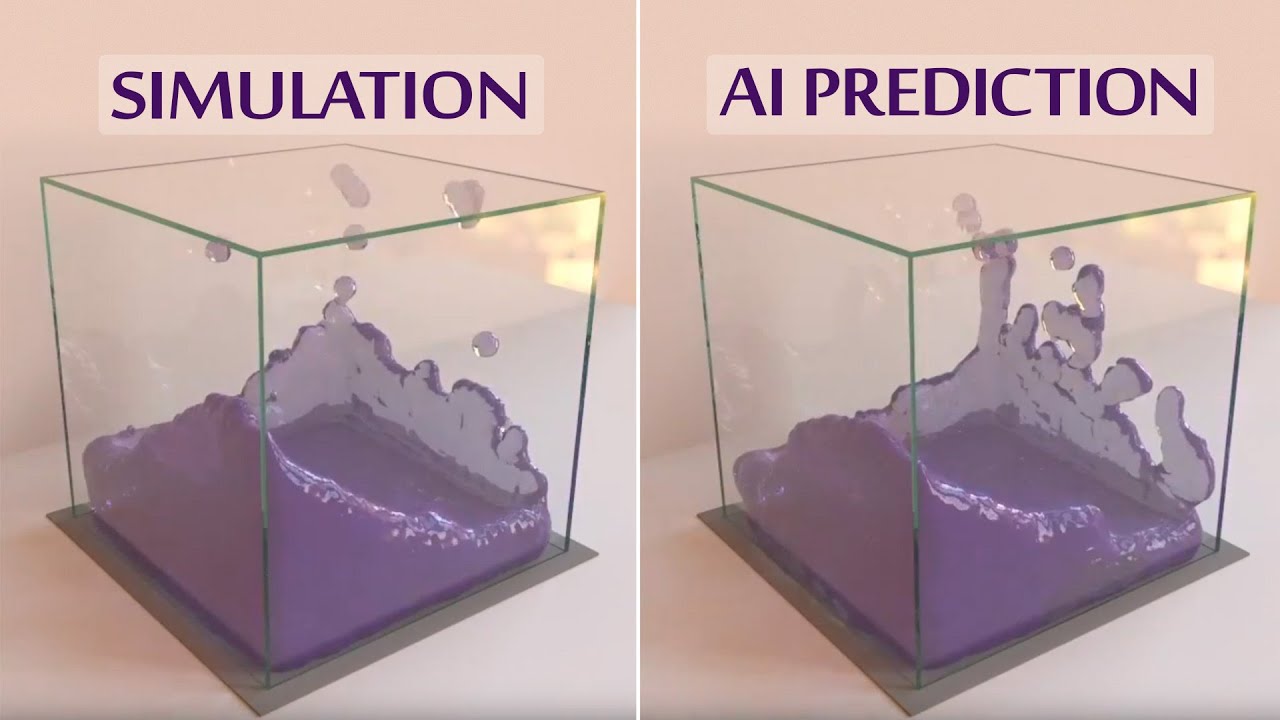
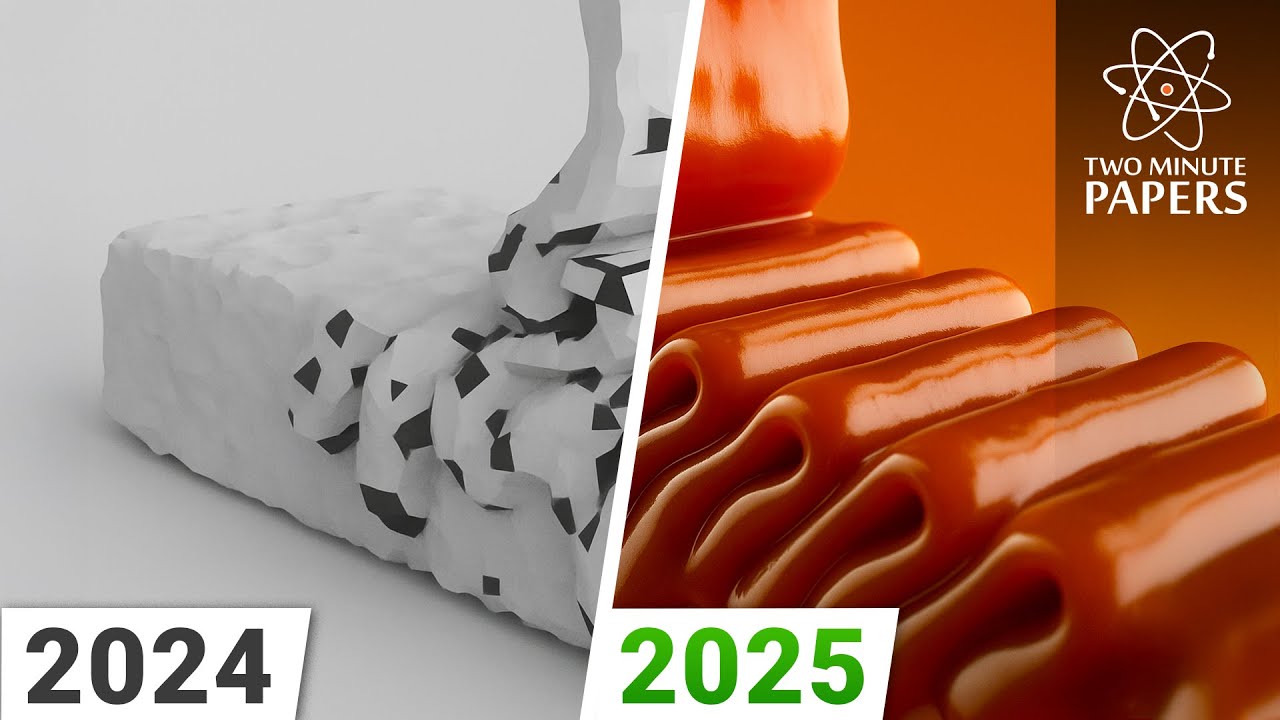
Ever see those TV ads where caramel always lands perfectly on that chocolate bar? Yummy. Or those ice cream commercials. Oh my. Let's not even talk about that. So delicious. But also, if you look closer, they all seem kind of impossible, right? In reality, staging something like this is often impossible. You see, liquids don't listen to technical directors. So what they often do instead is they create a digital simulation of the scene which is a little virtual world. And in this world we do whatever we want. But [clears throat] there is a problem. You still rarely get the splash you want. Things are either too smooth or they break physics or even worse they take a stupendously large amount of time to compute. The problem is that we have to create a little grid in these simulations and compute quantities like velocity and pressure within these grid points. Now, of course, fewer grid points, fewer computation, faster program. Are we done? Not quite. Because then you get these really coarse simulations that will not fool anyone. Of course, let's get a really fine grid then. More grid points. Okay. But then you need to have a grid that is at least 1,000 points in 3D, which is 1 billion points in total. And then you would have to compute all that for every single frame and time step. This is completely hopeless. But what if I told you that this was solved 5 years ago and nobody knows about it? But it gets better. It doesn't even need any AI, just human ingenuity. The key is to make this simulation adaptive. Have a grid that is more detailed around more splashy regions, but regions where not much is happening. No point in wasting too much computation on that. Okay, how do we do that? Well, we take a box and cut it into smaller boxes. Looks good. Not yet. Okay, then cut some more. Now, more cuts mean more grid points, more detail, and just continue until we have the desired resolution. Now, wait a second. Adaptive fluid simulations date back until maybe even 20 years or more. We even have a name for them. Octries. People know about this. So, what's really new here? Well, this work was done by Oh, we know him well around here. Yoichi Ando. He is a master of adaptive simulations. Also advised by Chris Barry, one of the best in the business. So if you see that, you know it's going to be good. And they finally made these kinds of simulations more practical. Now I'll try to explain what this means, but I mean listen, this is coming from the paper. Don't get frightened. We develop a novel staggered octry pson discretization for free surfaces that is second order in pressure and gives smooth surface motions even across octry tjunctions without power/voronoi diagram construction and it goes on and you may be thinking h maybe it is not too late to close this video in horror but wait I'll try to explain it in simple words look this promise es a nice and detailed liquid simulation. Let's have a look. Wowzers, that looks amazing. The wireframe view reveals the underlying geometry. And now you go. Aha. That's why Dr. Carol keeps talking about adaptivity. Look, some parts don't need any detail at all, while others require an insane amount of detail. That is super hard to achieve. And now hold on to your papers fellow scholars for the octry view. And here is where the magic happens. Dear fellow scholars, this is two minute papers with Dr. Carola. Dr. Carol. Now the explanation. We have our stack of boxes and at some parts nothing happens and at others we have these wild splashes. Now, where a smaller box touches a bigger one, we have a little step, a little seam. That is an octry T junction. Previous methods create ugly little waves and artifacts here. To fix it, you need to build hidden super secret meshes between these boxes. No good. You can do that using these Voronoid diagrams. And now we are just adding fixes upon fixes which take a long time. And it's also just more calculations that can break. Don't do that. So remember this step between the

Segment 2 (05:00 - 07:00)

boxes. H instead use this new thing that they call a staggered octry paw discretization which smooths out this step between the boxes. The result is that water can flow cleanly from one box into another while it keeps the math simpler and accurate. Huh. Genius. So, does it work on larger scale scenes? I want to see that. Oh, boy. Let's look at this one. And now the fish. Okay. We are computer graphics researchers here, not artists. Okay. And it shows. But the algorithm is absolutely incredible. I mean, look at that extreme adaptivity. And it's like my Toyota. It just refuses to break. I'll tell you in a moment how long it takes to run. But all this was invented already 5 years ago and hardly anyone saw it or knows about it. These research papers are like endangered species and we have to save them. So save a paper today, leave a like, subscribe, hit the bell icon and leave a really kind comment. This also helps the YouTube algorithm get you the good stuff in the future. Okay, runtime. Now, let me be clear. Fast this is not okay. We are not in frames per second region. No sir. And we are not even in seconds per frame region. We are firmly in minutes per frame. You will have to wait about 1 and a half to 3 minutes for each frame that you see. That's a lot, but for me that barely matters because finally it made the impossible possible. What a time to be alive. And I am thinking that two more papers down the line and we'll surely get something like this running in real time. Why not? We need new tools for the era of LLMs. And Weights and Biases now has Weave, a lightweight toolkit to confidently iterate on LLM applications. Use traces to debug how data flows through each step of your app and use evaluations to measure your progress. It is the best. Try it out now at wnb. me/papers

Другие видео автора — Two Minute Papers

Ctrl+V

Экстракт Знаний в Telegram

Экстракты и дистилляты из лучших YouTube-каналов — сразу после публикации.

Подписаться

Дайджест Экстрактов

Лучшие методички за неделю — каждый понедельник