❤️ Check out Weights & Biases and sign up for a free demo here: https://wandb.me/papers
📝 The paper "Multi-Material Mesh-Based Surface Tracking with Implicit Topology Changes" is available here under one of these links hopefully:
https://pub.ista.ac.at/group_wojtan/projects/2024_MultimatMeshing/SuperDuperTopoFixer.pdf
https://dl.acm.org/doi/10.1145/3658223
📝 My paper on simulations that look almost like reality is available for free here:
https://rdcu.be/cWPfD
Or this is the orig. Nature Physics link with clickable citations:
https://www.nature.com/articles/s41567-022-01788-5
Sources:
https://www.youtube.com/watch?v=dtBqv-qIFLo
https://www.youtube.com/watch?v=EZul6DR-fHc
https://www.youtube.com/watch?v=F6t8LR2mX1I
https://www.youtube.com/watch?v=d3a5OquQ4kU
🙏 We would like to thank our generous Patreon supporters who make Two Minute Papers possible:
Benji Rabhan, B Shang, Christian Ahlin, Gordon Child, Juan Benet, Michael Tedder, Owen Skarpness, Richard Sundvall, Steef, Taras Bobrovytsky, Tybie Fitzhugh, Ueli Gallizzi
If you wish to appear here or pick up other perks, click here: https://www.patreon.com/TwoMinutePapers
My research: https://cg.tuwien.ac.at/~zsolnai/
X/Twitter: https://twitter.com/twominutepapers
Thumbnail design: Felícia Zsolnai-Fehér - http://felicia.hu
Оглавление (2 сегментов)
Segment 1 (00:00 - 05:00)
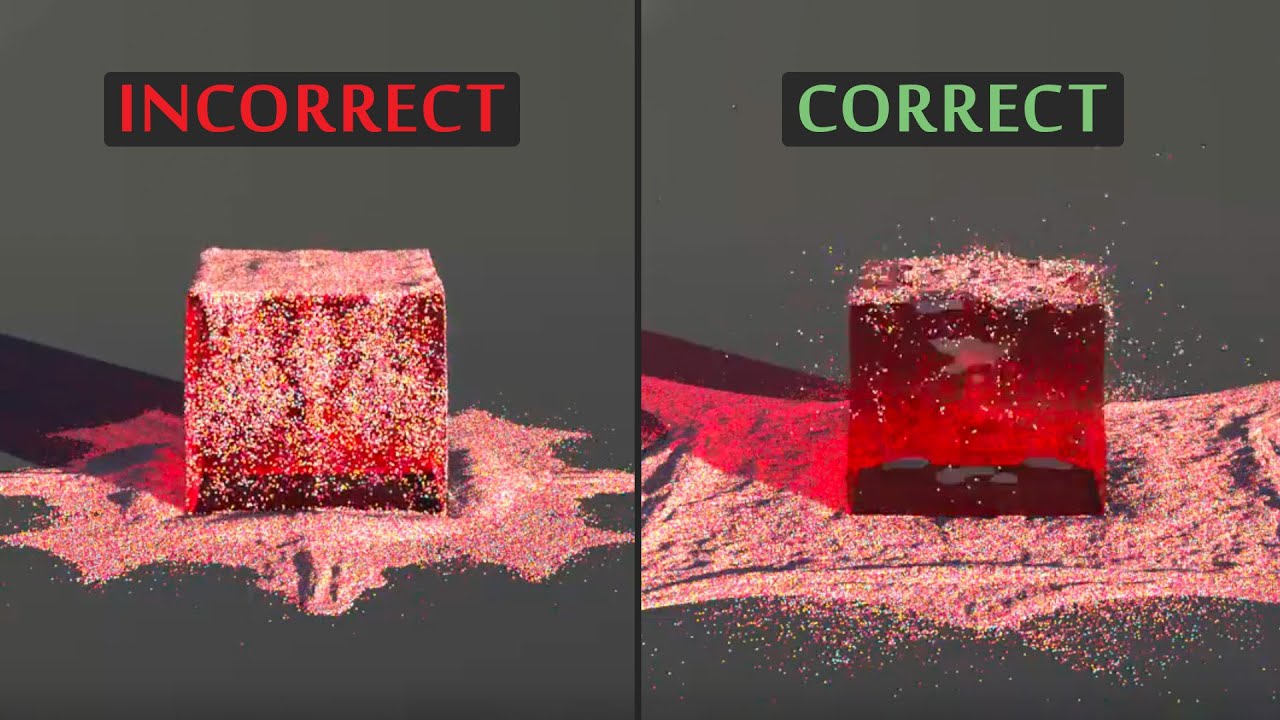
The problem with games and often even movie visual effects is that they are digital, so they use simplified geometry that’s often not quite good enough. It is reality, but simplified. For instance, if you zoom in on real bread dough, you see small bubbles forming. Uh-oh, that means you would need to have bubble physics, which is incredibly difficult, if not impossible to get right. Yes, real life is messy, and capturing that seems completely hopeless. Until scientists tried to write a computer simulation to do this 11 years ago, and this was the result. Wow, this is incredible. Beautiful water droplets merging and splitting. But it got better. Multi-material simulation of…a bunch of melting bunnies was also possible. So, why doesn’t everyone just use this instead? Amazing quality games and movies await! Well, not quite. It has a big problem: when we give it larger-scale scenes, it takes…forever. Literally forever, because the algorithm can hang, and never finish. So, amazing research, but not quite there yet. However, it was so difficult to beat, we’ve been waiting for 11 years now for a research paper that could get the job done. It seemed like it would never happen, but now, hold on to your papers Fellow Scholars, because it is finally here. Let’s see what it can do. Holy mother of papers! Look at that. A huge bunch of bubbles with a 1,000 different materials. Yes! Each bubble is treated as a distinct material, not just some colored texture slapped onto it. And they merge and pop beautifully. But it gets better, because this is Two Minute Papers, and it always gets better. Look! This is a simulation, so they also produced an opaque view of what is happening inside. And it is beautiful beyond words. Wow. It looks a bit like a molecular simulation. Loving it. Now, here’s a crab, but you know what is better than a crab? Of course, 5 crabs! Let’s throw them together, now this is 5. 3 million triangles and 72 different materials. Absolutely impossible to do. Now, we are going to cut through them, and look inside, and see if we see garbled up geometry, or nice separation. And…go! Wow. Look at that. Look at that! Goodness! This is cleaner than a freshly washed window in a Pixar movie. You know what? Now let’s use this knowledge, and observe this what they call normal flow, where we blow things up. The spheres fill up the space beautifully, the wireframe view reveals how difficult and complex this piece of geometry is. And now, let’s do this slicing operation as with the crabs. And…whoa! The key part here is that the volume is under extreme pressure, it expands until it perfectly fills the space. And when we look into it, I see watertight geometry. No overlaps, no missing faces, no tears. And all this under extreme deformation. So, how on Earth is all this possible? This looks like black magic! Well, this work is coming from Chris Wojtan’s research group in Austria, and he is a master of fluids and topology. And the research paper explains it, but it is written for experts. I’ll try to explain it in simple words. But first, listen, you’ll love this one: to summarize, it replaces explicit collision-driven mesh surgery with a local implicit reconstruction step that converts self-intersections into topological changes. Okay, what the heck does all this mean? Dear Fellow Scholars, this is Two Minute Papers with Dr. Károly Zsolnai-Fehér. Dr. Carroll. So, previous work. Imagine that you are making a movie where every time two bubbles touch, you stop everything, take a pair of scissors, cut and glue everything together until it looks good. Then, advance one pitiful frame, and do it again. This is the collision-driven mesh surgery part. No wonder it hangs when you give it a big scene! Okay, so what the new one does instead is it creates a simulation that does not need
Segment 2 (05:00 - 07:00)
cutting and gluing, because…drumroll…it heals itself. Automatically and on the fly! Crazy! That means that you can even give it defective geometry, and it can not only deal with it, but heal it too! For instance, if you give it these poor little bunnies, their little rumps are going to get healed too. But it gets better. Look! It finally runs in finite time. So yes, it will be done within our lifetime, how cool is that? I’ll tell you exactly how long it takes in a moment. Now please drop a like, subscribe, hit the bell icon and leave a really kind comment to help save these papers, because they are amazing, and absolutely nobody is talking about them. We have to save them. Ok, so in practical terms, it is 7-10 times faster than the previous technique. So previously, an all-nighter render runs in a lunch break. Glorious! And it always finishes. Or otherwise this would have to be an infinitely long lunch break. And scales to huge scenes and broken geometries as well. It can handle bubbles bigger than the one inflating the AI stock market right now! Hooray! This is absolutely incredible and it is going to change everything. You saw it here first on Two Minute Papers. Now, not even this technique is perfect, it works with a sparse background grid, this grid has a certain resolution, like pixels in an image, but in 3D. And if we have a hole that is smaller than our pixels, that is, one grid cell, it will miss it. If you catch it doing that, you can counteract it with higher grid resolution. And just one more paper down the line, I bet this will also be solved. A really advanced paper explained in really simple words. What a time to be alive! So, this heals your meshes, no more craters - subscribe to Two Minute Papers.