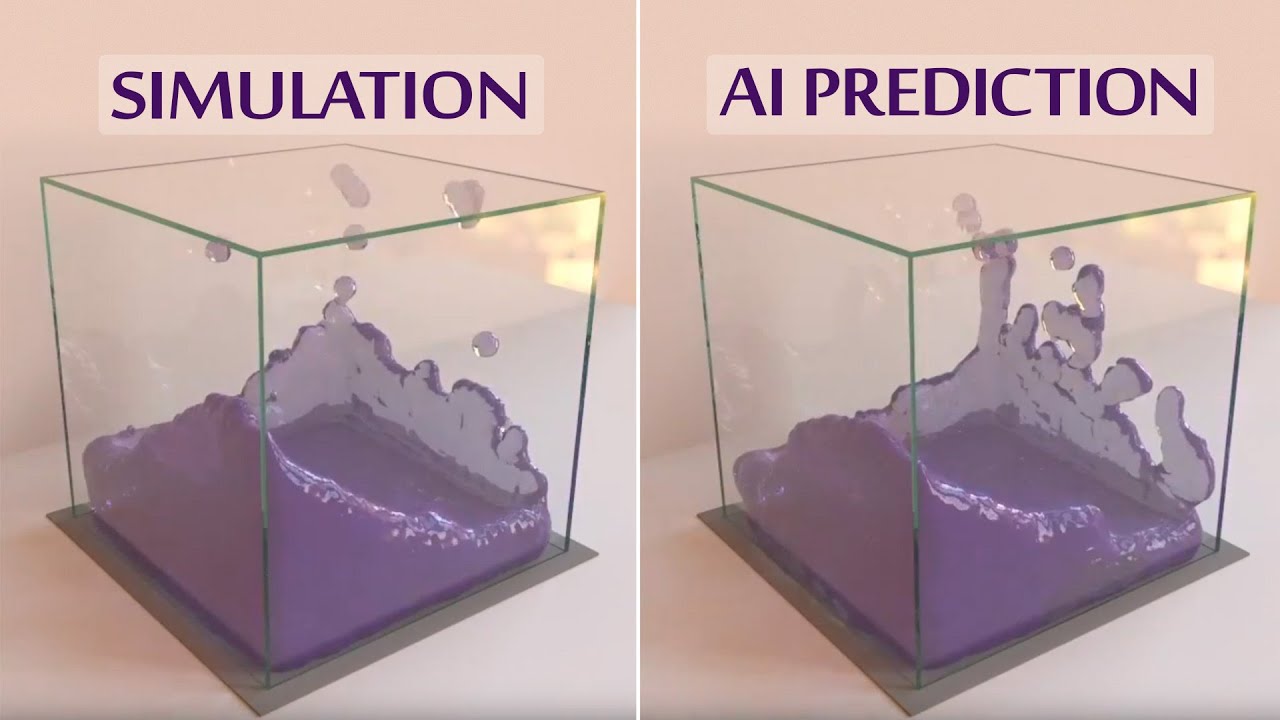
NVIDIA Just Solved The Hardest Problem in Physics Simulation!
7:49

NVIDIA Just Solved The Hardest Problem in Physics Simulation!

Two Minute Papers 27.09.2025 1 608 428 просмотров 64 193 лайков

Machine-readable: Markdown · JSON API · Site index

Поделиться Telegram VK Бот
Транскрипт Скачать .md
Анализ с AI
Описание видео
❤️ Check out Lambda here and sign up for their GPU Cloud: https://lambda.ai/papers Guide: Rent one of their GPUs with over 16GB of VRAM Open a terminal Just get Ollama with this command - https://ollama.com/download/linux Then run ollama run gpt-oss:120b - https://ollama.com/library/gpt-oss:120b 📝 The paper is available here: https://graphics.cs.utah.edu/research/projects/ogc/ Sources: https://www.youtube.com/watch?v=CfEg7fucVYg Our Patreon if you wish to support us: https://www.patreon.com/TwoMinutePapers Note that just watching the series and leaving a kind comment every now and then is as much support as any of us could ever ask for! 🙏 We would like to thank our generous Patreon supporters who make Two Minute Papers possible: Benji Rabhan, B Shang, Christian Ahlin, Gordon Child, John Le, Juan Benet, Kyle Davis, Loyal Alchemist, Lukas Biewald, Michael Tedder, Owen Skarpness, Richard Sundvall, Steef, Sven Pfiffner, Taras Bobrovytsky, Thomas Krcmar, Tybie Fitzhugh, Ueli Gallizzi My research: https://cg.tuwien.ac.at/~zsolnai/ X/Twitter: https://twitter.com/twominutepapers Thumbnail design: Felícia Zsolnai-Fehér - http://felicia.hu #NVIDIA
Оглавление (2 сегментов)

Segment 1 (00:00 - 05:00)

This work is just unbelievable. I cannot believe what I am seeing here. An incredible human achievement. You see, this is not reality. This is a computer simulation written by scientists. It shows what happens to me after a long winter when summer finally comes again. Oh yes. And this scene is built from almost 2 million, yes, 2 million triangles. And this technique can do this calculation 10 times per second on average. That is absolutely amazing. Wow. And it creates a penetrationfree simulation that was previously nearly impossible. So what does penetrationfree simulation actually mean? Well, imagine you're playing a video game and your character's hand goes right through a closed door. That is called penetration. and it instantly breaks the illusion. Not acceptable. We want our virtual objects to act like real world objects. If you push your hand against a table, it stops. You don't phase through it like a ghost. I hope. If it does, I have some bad news for you. Okay. So, penetrationfree simulation is all about teaching the computer this basic rule of reality, giving digital objects solidity so they can't pass through one another. But surprisingly, it's almost impossible to pull off correctly. This has been a surprisingly tough problem for a long time now. Why? A brilliant earlier technique called incremental potential contact or IPC made huge progress here. However, it had its own challenges. Imagine you're a traffic controller for an entire city. The rule is if even a single car is about to cause just the tiniest collision, you must stop every single car in the entire city. Yes, even cars miles away on an empty highway have to slam their brakes. Previous methods work a bit like this. A small local problem could force the whole simulation to a grinding halt, making it incredibly slow and expensive to run. On top of that, these methods sometimes applied forces at strange angles which could cause objects like cloth to look unnaturally stretched and distorted. And yes, this is where the magic of the new technique offset geometric contact comes in. Or if you want to sound cool, just call it OGC. here. Instead of one citywide traffic controller, imagine every car now has its own personal super smart sensor. It knows exactly how far it can move before it gets close to anything else. My goodness. But this way, each part of the simulation can move freely and only slow down when things are actually about to collide with something. Only those. The rest of the simulation can keep moving at full speed. Whoa, how is that even possible? Well, the way this technique does this is absolutely beautiful. You are going to love it. Dear fellow scholars, this is two minute papers with Dr. Carola. Dr. Carol, the paper is full of beautiful mathematics and lots of formalism. So, I'll try my best to explain it here. So you see the algorithm creates an invisible force field around every object. It's like a perfectly fitted suit of armor. And this armor has a special property. It can only push directly outwards perfectly perpendicular to the surface. So when two objects get close, their force fields interact and push them apart cleanly, which finally prevents those weird stretching artifacts we saw before. It's like putting everyone in a hamster ball. And thanks to these local bounds and clean forces, the OGC method finally gives us truly penetrationfree simulations for movies, computer games, and virtual worlds, but in a way that is massively parallel. So, it runs crazy fast on the GPU. I'll tell you how fast in a moment. I love firing up simulations like this on a Lambda instance. Super fun. Also, when clothing is moving in a game, the underlying character will not show through. And just think about it, this simulator was initialized with an incorrect state and it is able to recover from it. Absolutely amazing. So, if we have this piece of yarn built from 65,000 little elements and we start pulling goodness, look at that. If you start tightening these crazy knots, while previous methods would unravel, OGC keeps everything intact. Look at that.

Segment 2 (05:00 - 07:00)

Holy mother of papers. Did you see that? Amazing. So, when I opened this research paper, I saw that what? Wow. This was written by a group of allstar scientists. This is like the Avengers of Computer Graphics. An insane roster of brilliant people. I then instantly knew that this is going to be good. So, how good exactly? Well, now hold on to your papers, fellow scholars, because this technique is not only way better, but also more than 300 times faster than the previous method. From just one research paper to the next one, more than 300x faster. I can't believe what I'm seeing here. What a time to be alive. Now, not even this technique is perfect for me. Some of these simulations with clothing feel a bit too rubbery. The authors themselves point out that the contact forces aren't always perfect. It's a bit like walking on a floor that has tiny invisible speed bumps. It's a similar idea. Also, in some very specific cases with few collisions, but very high speeds, this method can actually be slower than the old techniques. So, still not perfect, but an incredible step forward. I mean, goodness, they absolutely nailed it. And you know the drill. The first law of papers says that research is a process. Do not look at where we are. will be two more papers down the line. And line, I am sure this will be solved too. And this is the place where you hear about these amazing techniques before they go mainstream. And when they do, you can tell your friends, "Oh yes, I saw it years ago on Two Minute Papers. " So, make sure to subscribe, hit the bell icon, and leave a kind comment because these papers are a bit like endangered species. Almost nobody is talking about them, and I'm trying to save them so you can help our cause, too. Save the snails. Save the beavers. Subscribe to Two Minute Papers. And I got to say, I can't stop playing with OpenAI's Open GPT model through Lambda GPU cloud. And as you see, I am doing very useful things with it for science. Yes, this is actual speed. I can't believe that I can have more than 100 billion parameters running super fast here. Many of you fellow scholars are using it and if you don't, make sure to check it out. It costs only a couple dollars per hour. Insanity. You can rent an Nvidia GPU through lambda. ai/papers

Другие видео автора — Two Minute Papers

Ctrl+V

Экстракт Знаний в Telegram

Экстракты и дистилляты из лучших YouTube-каналов — сразу после публикации.

Подписаться

Дайджест Экстрактов

Лучшие методички за неделю — каждый понедельник