❤️ Try Macro for free and supercharge your learning: https://macro.com/papers
📝 The papers are available here:
https://physics-iq.github.io/
https://physbench.github.io/
📝 My paper on simulations that look almost like reality is available for free here:
https://rdcu.be/cWPfD
Or this is the orig. Nature Physics link with clickable citations:
https://www.nature.com/articles/s41567-022-01788-5
🙏 We would like to thank our generous Patreon supporters who make Two Minute Papers possible:
Benji Rabhan, B Shang, Christian Ahlin, Gordon Child, John Le, Juan Benet, Kyle Davis, Loyal Alchemist, Lukas Biewald, Michael Tedder, Owen Skarpness, Richard Sundvall, Steef, Taras Bobrovytsky, Thomas Krcmar, Tybie Fitzhugh, Ueli GallizziIf you wish to appear here or pick up other perks, click here: https://www.patreon.com/TwoMinutePapers
My research: https://cg.tuwien.ac.at/~zsolnai/
X/Twitter: https://twitter.com/twominutepapers
Thumbnail design: Felícia Zsolnai-Fehér - http://felicia.hu
Оглавление (2 сегментов)
Segment 1 (00:00 - 05:00)
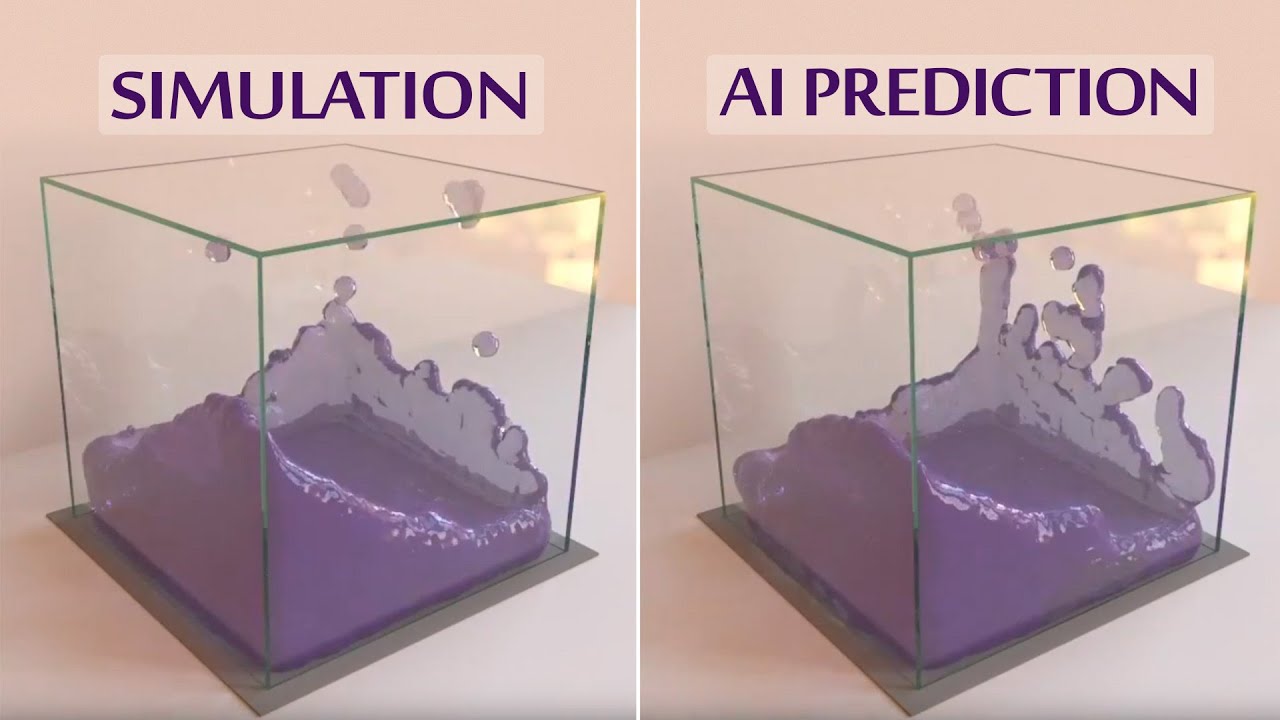
Today we are going to see AI techniques fail in ways that are ridiculous, it’s going to be an absolute disaster. Why? Now we know that AI techniques can generate videos from a piece of text, I always think, okay, but do they really understand what they are looking at? Do they really know the physics of these objects? Oh! I like this question a lot, because it sounds very philosophical, and sounds pretty much impossible to answer. But wait a minute, according to this amazing new paper, there is an actual answer to this question. Incredible. We can ask questions to test whether these AIs actually understand what they are seeing, but not this way. If you visualize what is inside of a neural network, you don’t get a lot of useful information, only a bunch of numbers. Remember, this is not human intelligence, this is artificial intelligence. So, how do we ask them? Well, scientists at Google DeepMind say, let’s show them the start of the video, and if the AI understands it, it will be able to tell us what will happen in the next 5 seconds. We humans know what is about to happen, but do they? Let’s have a look through 4 experiments, where each gets more challenging than the last one. First, let’s start simple. A rotating teapot. Pika 1. 0 says yes, stand aside everyone, I got this, it will not rotate, but grow a pedestal. Oh my, that is a complete disaster, and this is just the simplest question. Now then, Lumiere says no-no-no, this is a rotating teapot, and I shall do exactly that. Wait…where were the handles exactly? Object permanence is not my strong suit. But, OpenAI’s Sora and Runway’s Gen3 kind of gets it. Not perfect, but not bad. Now, two, let’s paint something. There is a bit of rotation and it is clear as day what is about to happen. Yes, now let’s show the start this with OpenAI’s Sora because it was right last time, and…oh my goodness. That is not even close. Then, Pika 1. 0 says yes, I know what’s going on here. Zooming in and then something happens. Also wrong. And if we ask Lumiere…come on man, are you even trying? Now if we ask VideoPoet, now this is quite reasonable. Not perfect, but better. Now, three, light versus heavy. A classic. We expect that the heavy kettlebell object will leave a larger imprint on the pillow than a light scrap of paper. Easy, right? Well, let’s see together. VideoPoet says choose me, I know, I know… the evil pillow eats the paper, and as a revenge, we then stab it. Yes, that is what will happen. Pika 1. 0 says, nothing to see here, we just zoomin’. Just keep zoomin’. Then OpenAI’s Sora says…I do not know what it says. Wow, all of them were absolute disasters. So what do we do now? Do we make it easier for them? Nope, we make it even harder! Dear Fellow Scholars, this is Two Minute Papers with Dr. Károly Zsolnai-Fehér. Four, we start with a match on fire, which we put into water. What happens then? Runway Gen3 says, of course, it floats. Lumiere says nope, you’re dead wrong, fires clearly exist underwater, and VideoPoet says that’s also wrong, of course, an explosion happens. And the best of them all in this case is Sora, which kind of gets it, wait a minute…then it gets lit on fire by the water again. Oh my. And this was just the start. Scientists tested these AIs on a heck of a lot more. Solid dynamics, fluid dynamics, optics, thermodynamics, magnetism, you name it. So, what is the result? Man, I am so curious. Wow, look at that. Sora came in dead last, while the multiframe version of VideoPoet aced it. However, look. This is still below 30%, so it only aced it compared to its competition. But overall, that result is that they mostly have no idea about physics. Another interesting thing is that they understood fluid mechanics better than solid dynamics, which is really interesting, because if you study the basics of both, I think fluids are way harder. Not even close. But not for the AI, this is not human intelligence, this is a different kind of intelligence. And these results are really surprising to me - these techniques can generate lots and lots of photorealistic footage, but apparently, visual realism and physical understanding
Segment 2 (05:00 - 06:00)
do not go hand in hand. In other words, the best, most photorealistic looking systems don’t necessarily understand the world around us too well. Now there is another study that shows pictures to these GPT-like AI assistants and asks questions about them. Think of this like a visual IQ test where we ask about temperature, air pressure, or smash a watermelon and ask about that. And the results are…each of them know different areas a bit better, but all of them are surprisingly poor. But why? I mean, everyone says that many of these are PhD level AI systems, so what happened? What went wrong here? Well, two things. One. Physical understanding differs significantly from the tasks that these systems are trained for. So, just teach them more about that, right? Nope, two, shockingly, as we teach these algorithms more, they don’t start scoring better on tests like these. So yes, AIs can do amazing things today, but they are not human intelligence. They are a fundamentally different kind of intelligence that still has a long way to go. I hope you had as much fun with this as I had. I loved this one. If you wish to see more, subscribe and hit the bell icon. And what do you Fellow Scholars think? Let me know in the comments below.