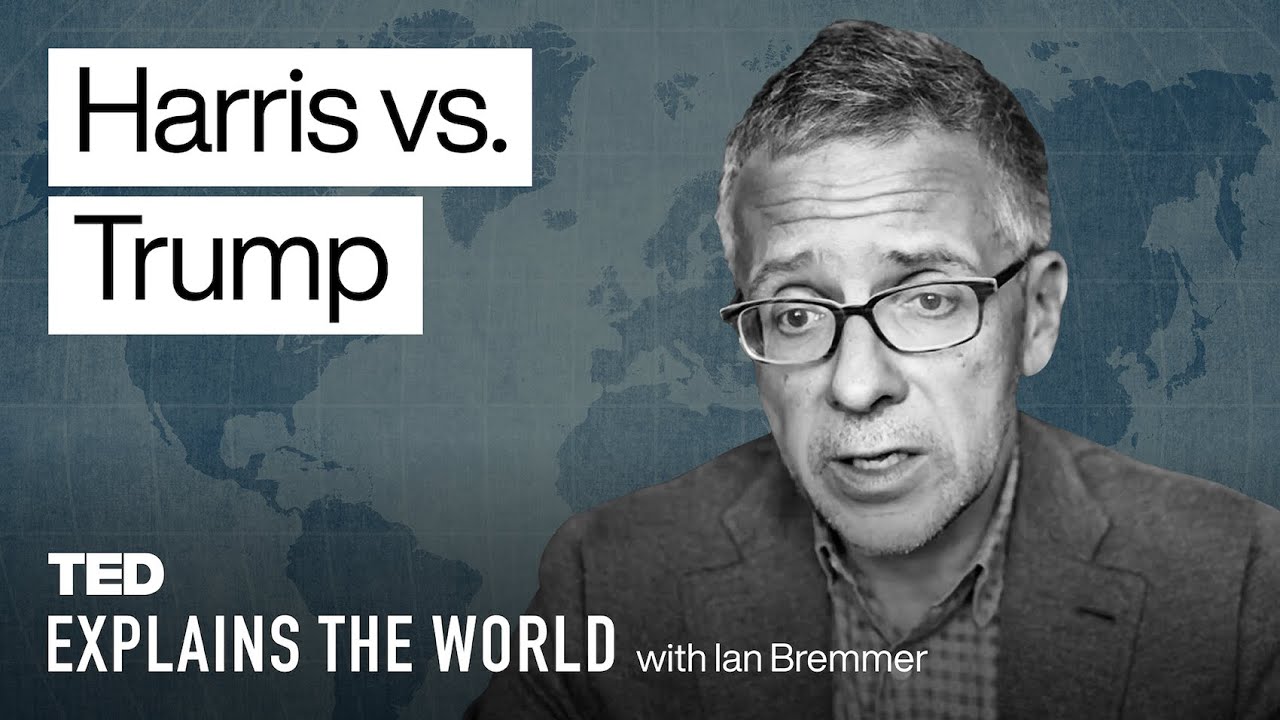
The result of the 2024 US presidential election will be critical for Americans and the world. In a fascinating conversation, geopolitical expert Ian Bremmer digs into proposed policies from Kamala Harris and Donald Trump and explores how they think about everything from foreign policy to immigration and the economy. Discover unexpected similarities and crucial differences between the candidates — and get ready for what's to come. (This live conversation, recorded October 10, 2024, was hosted by TED’s Helen Walters. Visit https://ted.com/membership to support TED today and join more exclusive events like this one.)
This video is part of the series “TED Explains the World with Ian Bremmer.” Watch more: https://go.ted.com/tedexplainstheworldwithianbremmer
Follow TED!
X: https://twitter.com/TEDTalks
Instagram: https://www.instagram.com/ted
Facebook: https://facebook.com/TED
LinkedIn: https://www.linkedin.com/company/ted-conferences
TikTok: https://www.tiktok.com/@tedtoks
The TED Talks channel features talks, performances and original series from the world's leading thinkers and doers. Subscribe to our channel for videos on Technology, Entertainment and Design — plus science, business, global issues, the arts and more. Visit https://TED.com to get our entire library of TED Talks, transcripts, translations, personalized talk recommendations and more.
https://youtu.be/_cPj3b9BDPI
TED's videos may be used for non-commercial purposes under a Creative Commons License, Attribution–Non Commercial–No Derivatives (or the CC BY – NC – ND 4.0 International) and in accordance with our TED Talks Usage Policy: https://www.ted.com/about/our-organization/our-policies-terms/ted-talks-usage-policy. For more information on using TED for commercial purposes (e.g. employee learning, in a film or online course), please submit a Media Request at https://media-requests.ted.com
#TED #TEDTalks #politics
Оглавление (12 сегментов)
Introduction
Helen Walters: Hello, everybody. It's lovely to be here with you today. I am Helen Walters, I am the head of media and curation at TED, and I am thrilled to be your host for this episode of TED Explains the World with Ian Bremmer. Ian, of course, is not only the president and founder of the geopolitical risk advisory firm Eurasia Group, he is also a scion of the media industry. He is the head of GZERO Media. And today, I wanted to say hi to all of the TED members who are here watching this, and thank you for sending in your questions. We are going to get right to them. Hi, Ian. Ian Bremmer: Hi, good to see you. HW: OK, so we are here to talk about the US election, a giant moment not just for America but also for the entire world. On the docket, we have former President Donald Trump and Vice President Kamala Harris. Today is October 10, people have already started to vote. But as we count down to the official election day of November 5, what do you think, what thoughts are people taking into the ballot box with them? IB: I think the most important thought, and this is a global conversation, it’s a global audience that’s dialed in to us today. We’ve had a lot of elections happening this year, and most of them have been change elections. They are a backdrop of people that are not particularly happy with where they believe their country is going. And that has led to a lot of voting against incumbents who traditionally have some advantages. Doesn't mean all the incumbents have been voted out, but they've all had a tough time. And that is as true in countries with enormously popular leaders like Modi, for example, in India, as it is in countries that have had leaders that have faced real difficulties, like Macron in France. You’ve seen in South Africa, Ramaphosa and the ANC. A number of conservative PMs seeing the end of their rule in the UK with Labour. That's the backdrop. And this backdrop comes in part because inflation is really high on the back of the pandemic, and people are upset about their economic prospects. Also, because migration is high, in part on the back of the pandemic, when people weren’t moving and suddenly they could. And also, in part, broader structural trends around the world, bigger gaps between rich and poor, climate challenges, geopolitical challenges and war. All of those things, repressive regimes, have led to environments where people that are going to the ballot box are not happy with who they’re voting for. And the United States is no exception. The difference in the US, I would say a couple of big ones. One is that the disinformation environment and the political division and dysfunction around that division is much higher today than it has been in any of the other advanced industrial democracies. And secondly, the visceral unpopularity among opponents of these candidates is much higher than we have seen either in these other countries or historically in recent times in the United States. Which means not only is this a very, very close election, and I don't have a strong view at this point, even one month out, of who’s going to win. It’s going to be determined by a small number of voters in a small number of districts in a small number of swing states, you've all seen that, I have nothing more to tell you than what you've seen from all the pollsters and all the media on that. But also that so many Americans are not prepared to accept the outcome. So many Americans are prepared to see that this is rigged. And let's also remember, we've just gotten through, and no one asked me about this in the past few weeks, but it's important, we've just had two assassination attempts, quite serious ones, one that was very close from succeeding, against former President Trump. In case people were worried, you know, not thinking about just how serious the passions, the tensions, the conflict is as the backdrop for this election. The stakes are very serious indeed.
Foreign policy
HW: All right, let's dive headlong into your world. Let's talk foreign policy. What do you see as the major differences between the candidates and their worldview, and what might be the difference in how they approach international relations if they're elected? IB: Well, one, I mean, this might be a boring way to start, but it's important, is the way that they will govern will be very different. Very different from Biden and very different from each other. Biden is and has been the most experienced foreign policy hand we've had as a president in decades. He was vice president, of course, and served that completely. Before that, he had served in the Senate for his entire career, including running the Foreign Relations Committee. So when you see Biden, or back before his age really started to show, when you have seen Biden on stages globally, you see him meeting with leaders that he has known personally, he has had long relationships with for a very long time. That is also true of his inner circle in the White House. These are people that have worked with Biden for decades, that he knows, that he trusts. And therefore, Biden's foreign policy decision-making style is made in the White House, right? And they make decisions, the president makes a surprising number of those decisions himself, and then they expect the cabinet to execute on those decisions, implement on them. That's very different than what we would see under Kamala Harris. She's had a lot of foreign policy exposure from being vice president, made a lot of trips, met with a lot of leaders, that’s very useful, for four years. That's very different from a lot of direct foreign policy making experience as a principal. That she has not had. And she would rely on a much more traditional cabinet. So how a Harris foreign policy manifests would have much more to do with the people she decides to appoint in state as NSA, in defense, in treasury, in commerce, than it has for the Biden administration. And they'll have regular cabinet meetings, which Biden has not been doing. And when they do, and they have differences that need to be hashed out, they'll be hashed out in front of her, and she'll play a very active role in steering that conversation. But it's very different from Biden. Where for a Trump administration, there would be a small number of high-level issues that he will make decisions on in a untransparent and frequently instinctive way. And he won't take a lot of advice from other people around those decisions. And then there'll be a whole other host of policy-making decisions that he will not be interested in almost at all. And those will be decisions that will be made by others that happen to be trusted around him and afforded the responsibility for those issues, which might be the cabinet secretaries, but might also be informal people that are in or around the White House. For example, as Jared Kushner ended up with the Middle East portfolio last time around. So, I mean, I know you want to ask me about policy, but I don't want to sleep on the fact that a lot of the way policy gets implemented in a really big organization like the US government depends on what kind of leadership and structure you have. And these would be two very, very different structures.
Trumps inner circle
HW: That's really interesting. I think that the question of personnel, the question of who's in those inner circles does really matter. What is your sense of who's going to be surrounding the president in the next four years? IB: Well, I want to say, one, that for Trump, those decisions are almost always made at the last minute. And Trump responds a lot to recency. The person that he just met that just impressed him, that looked like, sounded like the person that should be in that role. Even if he has never met that person before, he'll be very excited and say, "I want that person in that job." Look at the way Rex Tillerson became secretary of state. I mean, didn't know Trump from Adam and came out of that meeting, “Well, I’m going to guess I get the job.” And that could have been Jim Stavridis, that could have been Dave Petraeus. They would have been very different. So definitely, the fact that Trump has been president for four years means that there is a constellation of people around him that have worked with him, that are trusted, that he will go back to. I think Robert O'Brien, who had been national security advisor, will certainly play a senior role again in a Trump administration. I think that certainly Robert Lighthizer, who was US trade rep, will probably be running trade in some form, in some position. He'd like to be secretary of treasury. I don't think he's going to get that job, but he'll do something. But there'll also be a bunch of people that, you know, will be complete surprises, even shocks to the system. And I can tell you, like, you know, people that look good right now, Tom Cotton, the senator, certainly looks like he's, you know, got a very good chance of either running Defense or CIA. Pompeo always throws himself in the mix, though he didn't endorse Trump until very late, and it's not clear whether he'd get a nod or not. There’s always a question of what Jared and/or Ivanka might do, even though they've said they don't want to be around this time around. Trump keeps going back to them every time he sees them and says, "Of course you're saying that, but you're going to be in, and I want you in." And you'll see what that means. So I think there's an enormous amount of uncertainty. Now for Kamala Harris, she has told the people that want the positions around her that, you know, definitely her staff is collecting all that information. She is not prepared to start that decision-making process until after an election, assuming she wins. So still very early in that process, too. But you have a lot of people around Kamala, certainly, that you would expect to have significant positions. In my world, her lead foreign policy advisor has been Phil Gordon, serving in the National Security Council in the White House. Very capable. I would expect he'd have a good shot at being national security advisor, assuming he wants that job. I think for secretary of state Bill Burns, a lot of people say he’s older, he's in his mid 70s, but he’s done a very solid job not only running the CIA but also running point on the Middle East. If he wanted the job at state, I think he'd have a very good shot at it. I think my good friend Chris Coons, the senator from Delaware, who's been a lead foreign policy voice in the Senate, probably the most capable on Senate co-chair of the campaign, would certainly be in the running for that post. I could see others. Susan Rice, former national security advisor, I think is certainly interested in it. So a lot of people that I think you would consider to be fairly center to center-left, fairly establishment-type figures in key foreign policy and economic related roles. I don't think there'd be a huge shift from Biden to that group. I'm not expecting the Biden people would stay. But in terms of their orientation towards the world, I don't think it would be dramatically different.
Changes in the Middle East
HW: I mean, whatever happens, foreign policy is going to be front and center for whoever is in those positions. We are all watching what's happening in the Middle East, what's unfolding there, with increasing horror as Lebanon has been drawn in, increasingly Iran is connected. What changes do you see in the Middle East come January 25? IB: Well, let's first talk about the changes we're seeing before January 25, because this war, you and I, Helen, have talked about it a few times since October 7, and it continues to change pretty dramatically on almost a daily basis. One of the biggest things that changed is, of course, you're right that the war has escalated. It's escalated on several different occasions since October 7. But in addition to the fact that the war has escalated, you know, in Gaza to a ground invasion, now into the northern front, into Lebanon with Hezbollah and of course more broadly across the Middle East with the so-called axis of resistance led by Iran. And even with shots fired between the Iranians and Israel now on a couple of occasions. The fact is that some of the organizations that have been involved in this war are no longer experiencing the capacity to escalate. So, I mean, Hamas, you may have seen that Sinwar, who is running Hamas on the ground, has just recently, in the last 24 hours, announced that they're going to start suicide bombings again, which they had said that they weren't going to use as operational policy. The reason they're announcing that is because they can't do much of anything else. Their tunnels have been sealed, their weapons caches have been destroyed. Their leadership has been obliterated. I mean, they just don't have the ability to mount a credible, organized fighting force. And so it's definitely still a threat. Because, you know, suicide bombers are not to be slept on. But it is nowhere near the threat it was on October 7. Hezbollah has now said that they would like a cease fire with Israel, and they're not linking it to ending the fighting in Gaza anymore. That was utterly fundamental to what they were saying for the last entire year. They started launching rockets at Israel on October 8, the day after October 7. And they said they're not going to stop until Israel stops bombing Gaza. Well, what changed? What changed is that Nasrallah, the leader of Hezbollah, was assassinated. His entire leadership team has been systematically assassinated. Thousands and thousands of their fighters have been killed and maimed, and their war-fighting capability and their communications capability is being systematically torn apart. So Israel's military asymmetries have stopped their enemies from being capable of escalating with the potential untested exception of Iran. And the big debate right now, of course, is how will the Israelis respond to the Iranian attacks, the 180 ballistic missiles, and what might the Iranians do in response? I think the concerns of escalation here are overwhelmingly about the Israeli decision-making process, because the Iranians actually understand that they, too, are quickly running out of ways to effectively escalate against a far, far stronger Israel with a completely committed ally of the United States. So that's where we have been, that's where we are now. I'm happy to move to, you know, who would do what and what to expect going forward, if you like, Helen, but please, frame it as you wish.
Israeli decisionmaking process
HW: I think the question that a lot of members actually have sent in before we convened here, and I think a question on a lot of people's minds is what influence -- you talk about the Israeli decision-making process. What influence can either candidate actually have on that decision-making process, and how does either candidate actually have a hope of making any kind of difference in what actually is transpiring over in the Middle East? I think that's the framing. IB: Well, let's first of all recognize that even if the United States wanted to have a lot of influence and was prepared to use leverage to get it, which President Biden has not been willing to do, but even if they were, that does not mean that the Israelis, and this Israeli government in particular, would be falling in lockstep behind the United States's preferences. I mean, in Ukraine, you have a country that is much more reliant on American largesse to continue fighting than the Israelis are, and at the end of the day, the Ukrainians have taken a number of decisions in this war, in their war, that the Americans weren't aware of and would not have supported, right? I mean, for example, the sending of 40,000 troops into Russia, into Kursk. The US didn't know that and certainly didn't think it was a good idea afterwards. Taiwan is much more reliant on the United States for its continued ability to survive in some sovereign fashion, governing its own territory. And yet we see frequently decisions by the Taiwanese government statements they make that are clearly seen as escalatory by Beijing, that the Americans would not want them to make. So I think that American influence over allies is frequently overstated. I think we should start with that. But it is clear that however much influence the Americans might have on Israel, President Biden has been unwilling to test that theory. He's been unwilling to potentially mete out any consequences to the Israeli government whatsoever if they choose to ignore American private warnings, which have been repeated and fairly sharp, and public concerns, which have been aired more infrequently and much more softly. If the United States was prepared to take off the table, the military support that they provide Israel, or at least the offensive military support, continue to provide the ability for Israel to defend itself against attacks from its enemies around the region, something that, you know, Macron, for example, is now talking about, the French president, something that the UK has flirted with the new Keir Starmer administration. I think you would probably see at the margins more willingness of the Israelis to consult with the Americans as they're making decisions about, for example, how far to go into Lebanon. I think there would be more decision-making that was made, at least with the Americans in awareness of it in advance. I'm not sure it would have changed the way the Israelis are pursuing and fighting the war. In part because it is so overwhelmingly popular in Israel, because the Israelis don't support a two-state solution anymore, because the Israelis want to do everything possible to get their hostages out and to get their 60,000 civilians back into the north. And that means, you know, fighting Hamas to the last leader and fighter that they can and destroying Hezbollah as well. So I'm not sure that the United States would have much effect on Israel. But there's another question, which is, would the United States have more support from other countries around the world? The US has lost a lot of influence with the global South, particularly Southeast Asia, for example, Indonesia, Malaysia, even Singapore, because they are perceived as complicit in the Israeli strikes into Gaza and the lack of humanitarian assistance getting in for the people of Gaza. I think a policy by the US, which was more aligned with allies in Europe and the Gulf, would be more broadly supported by other countries that have gone sour on the US as a consequence of that. And here there's a big difference between Harris and Trump. Harris would certainly want to be seen as the president of the most important ally of Israel in the world. I don't think she would change that at all. But I also think she would do a lot more to help ensure that the Palestinians got regular humanitarian aid in, as opposed to the roughly 10 percent of what they had at pre-October 7 right now. I think she'd push harder on that directly and publicly with Israel. I think she'd be working more closely with the United Nations. And I also think she'd be working more closely, multilaterally with American allies. I think that Trump, on the other hand, has already made clear he does not support a two-state solution anymore. He did when he was president the first time around. In fact, that was behind the Bahrain conference and behind the Abraham Accords, was a nominal map, a road map for a two-state solution with what that would look like in the West Bank in particular. He has also said that he would support Israel directly striking Iran's nuclear facilities. Jared Kushner has circulated what he thinks is a unique opportunity for Israel to take care of, as he describes it, the Iranian problem. There's no question in my mind that Kamala Harris would not support that. So frankly, I think that Harris and Trump differ perhaps the most on the Middle East, specifically on Israel-Palestine, than they do on any other major foreign policy issue out there. And I think that is likely to manifest after January.
Ukraine and Russia
HW: So that's interesting, because the next question that I wanted to ask you about was Ukraine and Russia. And we're reading right now about Bob Woodward's reporting on maybe giving COVID tests to Putin or calling Putin when he hasn't been in office, claims which Trump denies. But I think it's clear to outsiders, at least, that it seems like the approach to Russia would be pretty different between the two candidates. But what do you think would change in the US's dealings with Russia when either one of them is elected?
Covid Vaccines
IB: So the Trump team has denied that they've had those phone calls. We don't have any evidence of them from Woodward, so we don't know yet. The Putin and the Kremlin has confirmed the COVID tests. The COVID tests are interesting -- the COVID vaccines, excuse me. And I think that's -- excuse me, am I right, was it tests or vaccines? I've seen both actually. HW: Actually I think it was tests. IB: Was it tests? So to me that's interesting because it's not like Trump -- I mean Trump talked a good game with Putin. And you remember the Helsinki summit in particular where it seemed like, you know, he was trying to make nice-nice with Putin as his best buddy as opposed to the ways he's been much tougher with some US allies in NATO. But the reality of US policy under Trump was not that. The reality is that the Javelin missiles, anti-tank missiles that Biden refused to provide to Ukraine, were provided in the Trump administration. The reality is that a series of high-level sanctions against Russia were actually tightened and toughened up under Trump, that were not under Obama. And also Trump was pushing much stronger against the Germans on the Nord Stream pipeline and aligning their energy security to Russia, which Obama didn't care very much about. So that is you know, it's a little counter to what the narrative in the media actually discusses around Trump. And providing machines that do COVID testing, you know, in an environment where you have a really bad relationship with someone, but you know you need to communicate with them and you are prepared to work with them in areas that are not hurting your national security. That actually strikes me as a fairly sensible thing to do and reflects leadership. So I would not be critical of that. If we find out that it is indeed true that Trump has been in regular contact with Putin since leaving the presidency, while refusing to talk to Zelenskyy until Zelenskyy begged for a meeting at the UN and didn't want to take it and finally did, that would be, I think, an issue of significant concern, and we would want information if we could get it around what was actually in those conversations. But I think that if Trump were to become president now, you've heard from many people now about how stupid it sounds that Trump is going to end the war in a day. And, you know, I think you and I can agree, Helen, that Trump is occasionally prone to, you know, slightly exaggerating things. And that might be true with the 24 hours. It might take 36 hours, for example, for him to come to peace between Russia and Ukraine, maybe even 48. I mean, if he had to golf in between. But I mean, more seriously, he wants to end the war. One of the things that he considers to be a feature of his administration is new wars did not start under his administration. He was very loath to use force, even against the Iranians when the Emiratis, the Saudis were begging him and the Iranians were engaging in all sorts of strikes in the region, against, you know, oil facilities, against ships, against American bases. And he didn't do anything. And then finally when he finally did, he finally took a big whack and killed Qasem Soleimani. And then the Iranians didn't do much at all because they saw that this was not to be trifled with. But he was very reluctant to use military force. And I think that clearly he wants to be the guy that says he ended the war between Russia and Ukraine. And the way he intends to do it is to call Putin and to call Zelenskyy and say, "You've got to freeze the conflict where it is or else." So what's the "or else"? Well, if the Ukrainians don't accept a ceasefire and freezing the conflict where it is, and then there'll be negotiations of some undetermined form, then he would cut the Ukrainians off from any further support from the US. So, in other words, that's a pretty big stick if Zelenskyy doesn’t accept it. And it would also divide Europe. Some Europeans would support Trump, certainly Hungary's Orban, and then there would be some very difficult decision-making made by other countries that aren't on the front lines, like Poland, the Baltics and the Nordics, who would definitely oppose Trump, but others would have a harder time making up their mind. And then he'd go to the Russians and he would say, "You've got to accept this ceasefire or else." Or else what? "Or else I'm going to put much tougher sanctions on you. You're not going to grow at four percent. I'm going to stop you from exporting oil to India. I'm going to end that deal. I am going to put sanctions on the banks in China that are allowing you to engage in financial transactions. I'm going to put sanctions on your central bank." So, I mean, that would have massive costs for the world and for the Europeans. Again, it would divide the Europeans from the United States, but it would certainly be a pretty big stick that Putin would be hit by. I mean, the question, of course, is how do you game this out? Like, I mean, does Zelenskyy say yes, knowing that Putin is going to say no? If Zelenskyy says no, can Putin then say yes and he doesn't have anything to worry about? I mean, clearly, not that these guys are going to be gaming it out together, but it's a serious question. Now the one thing that Trump is unlikely to do, he's very unlikely to call the Europeans and coordinate with them, which has been the most successful part of Biden's policy. The fact that it has been unlike Biden's Middle East policy, Biden's Russia-Ukraine policy has been a multilateral policy led by the US in NATO. And so at every step of the way, economic sanctions, freezing of Russia's assets, provision of intelligence, provision of military support and training, all of that is being done collectively by the entire alliance, even the Japanese and the South Koreans, the Australians have been on board with all of this. It is highly unlikely that Trump will do that. Trump is much more likely to make those phone calls to the Russians and Ukrainians himself, and a lot of allies are going to find out about it when they're briefed by Trump's people or when they watch it on TV. And that, of course, is a much more challenging way to run policy. Now Harris would be very different. Harris would have a multilateral policy, not only in lockstep with the Europeans, but she would not be prepared to do anything with Russia unless the Ukrainians were on board. So it's a very different approach. Again, the structural approach, not the intention of the policy, the structural approach would be very, very different. The intention of the policy would be to end the war. And end the war, even accepting that the Ukrainians are not going to get all their land back. Now I think that the orientation that Harris has on all of this, which is pretty interesting, is that the Ukrainians, in order to be enticed to accept a freezing of the conflict, which de facto means that they lose a fifth of their territory, even though they don’t, you know, accept that politically, they need to be given hard security guarantees. And the hard security guarantees that they are given is NATO membership, which has never been actually extended. They say, yes, you're going to be allowed in, but when, we have no idea. And I think that if the US says, "If you accept a freezing of the conflict, we give you NATO membership, and that means the conflict is frozen, you lose 20 percent of your territory. But if Russia tries to take any more, they're fighting everybody." They're fighting NATO. That’s acceptable to Zelenskyy. Zelenskyy, I think, can get there in a way that it would be much, much harder for Zelenskyy to accept what Trump would be arguing for on their erstwhile phone call. The point, of course, is that Putin won't accept that because Putin isn't prepared to accept Ukraine being a part of NATO. But if Putin says no and he won't have negotiations, but the Ukrainians say yes and NATO says yes, you are now in a better position globally because you can now go to other countries with influence over Russia, like China, and say, "Look, we've got a peace plan. Here it is. And we're all on board." And a lot of the countries in the global South that just desperately want this war to be over would, I think, be sympathetic to that in a way that right now they're not sympathetic to the US position, which is we defer to Ukraine. And the Ukrainians are saying "We want all of our land back," and everyone knows they're not going to get it back. So it's endless war. Endless war that the Ukrainians are increasingly not going to be capable of fighting. So the reality, I think, is that the ultimate policy outcomes that Trump and Harris would find acceptable, are closer than you would think. But the mechanisms that they would use to try to achieve those outcomes are radically different. And as a consequence, the potential for success, the consequences of failure would also be very, very different. HW: Whew, that is so interesting.
Climate change
I will be chewing on that for some time. But now I'm going to change the subject completely because I think that we should talk about climate change. Milton just flattened Florida. Helene decimated North Carolina. We know, you know, I know, we know that climate change is not a theoretical threat. It is ever present, it is increasingly dangerous. What do you think the candidates are going to say about climate? And I guess in the back of my mind, I have the voices of the young people I've heard who are increasingly nihilistic about the idea that anyone is ever going to take any meaningful kind of change on climate. So where are the candidates, and are the young people actually right? IB: Oh, yeah, the young people are right. And the young people are the ones that are ultimately going to make the change on climate. They're the ones that are going to demand that companies change their behavior or they'll stop buying their goods. They’re the ones who demand that governments change or they're going to vote for much more radical outcomes, and they're going to increasingly do that as they have a larger share of the voting population, and they have a larger share of wallet and consumer spend. And, of course, as the implications of climate change become much more real for all of us internationally. Of course, we know it's getting worse because so much of it is already baked in, irrespective of what we do going forward. And we see the manifestations of that in massive storms and massive droughts, climate change, climate weirding as they call it, climate escalation on both sides. We see that all the time, and everyone accepts it. Even though there's disinformation online, you've got 193 countries around the world that are all signatories for the Intergovernmental Panel on Climate Change, and they all accept that what we see and what the scientists tell us in front of our eyes. And I certainly understand that a Harris administration is going to talk a much bigger game about green energy and about a transition to sustainable energy. I also know that Trump is going to talk a lot more about drill, baby drill, and oil and gas and even coal, and he will give much more personal access to his administration from the CEOs of those companies, who will be more frequent guests. And they almost never have a chance to see Biden. But, but. You saw that Harris walked back her "I oppose fracking." She walked it back de facto when she became vice president. She walked it back in dure when she was asked about it on the trail. The United States is now producing more oil than ever before and far more oil than anyone else in the world. Far more than the Saudis, far more than the Russians. That is under a Harris- Biden administration. And I expect that would be extended under a Harris presidency. Under Trump, there's no question that he is going to make it easier to have permitting for additional drilling in Alaska and other places, and he’s going to make the regulatory environment easier to navigate for more infrastructure build, the rest of it. But I don't think he's going to suddenly eviscerate the Inflation Reduction Act, because so many of the jobs that come from that legislation are red-state jobs. So much of the investment is red-state investment. And I mean, the highest level of post-carbon energy production in the United States was California a couple of years ago. It's now Texas, right? Texas, which has become an energy superpower in its own right for oil, for gas and also for solar and wind, right? And I also think that both administrations would be moving faster to permit nuclear. So for the United States, it is really an all of above, all of the above policy, which, by the way, is also China's policy. The only thing is that China is 20 years ahead of the United States. China's been investing at scale for a long time in wind and solar and geothermal and nuclear and electric vehicles and batteries and supply chain all over the world, while the Americans have been ignoring it. And so now the Chinese have world leaders at scale in all the global renewable energy. And the Americans aren't there yet. But Americans recognize that's the policy they need. So you're going to have two superpowers of energy, the United States, the superpower of carbon energy, trying to transition and increasingly transitioning. And you're going to have the Chinese, the superpowers of post-carbon energy, right? And the rest of the world saying, what the hell are you going to do for us, as the climate is getting warmer and we're not capable of paying for it? And I think the gap between the US and China and the global South is going to grow on this issue, because what the American solution is, well, just invest in new technology, make it cheap enough that eventually these countries are going to be able to take advantage of it. That's great, But what they want are reparations, because the Americans are the ones, and the Chinese, are responsible for getting us to where we are. The Europeans and these countries won't be able to emit carbon in the atmosphere the way we have. And yet, they're going to be facing all the costs of the lack of biodiversity, of the lack of ability to produce effective agriculture, all the rest. And the hope, the hope -- and you see, for example, Eric Schmidt talking about this in the last few weeks, is that you're going to make bigger AI bets that will allow these countries to meet their sustainable development goals and allow these countries to deal with climate change. That's a great bet, but it is an unproven bet as of now. I'm a believer, but my God, we have to get lucky to not have this be far, far more devastating for people all over the world. HW: Now either candidate taking the idea of reparations seriously, is that really being talked through, talked about? IB: No, in fact, even AOC, when she was talking about a Green New Deal, she wasn't talking about a Green Marshall Plan. It was American exceptionalism. I mean, you know, the funny thing about American policy is that, you know, you go from left to right and the entire political spectrum is still pretty narrow from a global perspective, right? That is something that I think people in the United States need to be more aware of.
Immigration
HW: Alright. So there are so many other things that we should and could talk about, but we have limited time. So I'm going to chuck very large topics at you and ask you to very pithily define exactly where we are and what we need to think about. Immigration. You mentioned it earlier. It's been a huge issue for both candidates. But who’s thinking smartly about this, and what should we look for? IB: You're seeing more alignment between Harris and Trump on immigration. Not as fast as you've seen in Europe, but in Europe you're now seeing EU-wide efforts to coordinate immigration policy driven by Ursula von der Leyen, aligned with, you know, people as diverse as Schultz and Maloney and Macron. I mean, even Orban, who just met with von der Leyen and certainly it was a fairly acrimonious meeting. But, you know, Orban's point was, when you look at Hungary's Viktor Orban, when you look at, you know, the EU policy on migration, this is stuff he was talking about years ago. So in the United States, you have a lot of, you know, relatively blue cities that have been very, very comfortable talking about being sanctuary cities and being open for lots of illegal immigration, which they are very happy to trumpet when it's a theoretical issue. And then as soon as those immigrants start coming over in large number, because these are not border cities, right? Some of them are Canadian border cities. They're not border cities which they see as a problem. And then suddenly, they realize, wait a second. We don't want to pay for all this. We don't want to have all these people in our city. And they become much more cautious and hard-line on illegal immigration. So I do think that if Harris were to become president, you would see a continuation of a much tougher set of policies that Biden has implemented in the election period to try to bring immigration numbers down and which, frankly, are closer to the immigration policies that you saw under Trump. I don't think that there's an enormous gap. The rhetorical gap is what's much bigger, the willingness of Trump to use immigrant populations, to demonize them, to say that they are somehow genetically at fault when they are, you know, committing violent crimes, even though the violent crime rate overall is nowhere close to what it was in the '90s. And immigrants are some of the least likely to commit them, because that means they get tossed out of the country, as opposed to people that actually have a legal right to be in the US. But, I mean, there's been so much really disturbing language that I think has increased hatred and leads to more violence and hate crimes against illegal immigrants and frequently against immigrants that aren't illegal. I think Trump's much more willing. That's a feature of Trump, of Vance, of the MAGA America First-ism, in part because it's a grievance-based, more nativist ideology. But the actual policies on immigration are not so radically different. The big difference in policy implementation that Trump has talked about is wanting to send back some 11 million illegal migrants in the US. There is absolutely no way he would be able to implement that policy. The infrastructure doesn't exist. It would not be created. But I would say that even if he did 10 percent of it, which is plausible, the inflationary impact that would have on labor in the United States would be significant. And I think that the market participants that are looking at the difference between Harris and Trump are looking at tariffs but they're also looking specifically at labor rates and immigration.
Economy
HW: That's interesting. I mean, inflation has also been a huge topic of conversation, but I don't know that people are necessarily connecting immigration and inflationary rates. What else should people be thinking about in terms of the economy from these two candidates? IB: The fact that the great deficit hawks are near extinction. That either Trump or Harris would be strongly expansionary in terms of fiscal spend. There would be slightly different focus, I think, that Trump would look to extend the entire tax cut package that would be coming to a conclusion. It was, you know, put in as temporary kicking the can to somebody else. And if that can is kicked to the same person, he's going to expand it all. So he wouldn't get as much money in, and he would also try to reduce corporate tax rates further. The intention would be to juice growth, but I don't think that would meet the expenditure and, especially in a still comparatively slightly higher interest rate environment, where you're doing a lot more debt servicing as a part of your budget. And also, I think Trump would lean more heavily into higher spending in defense, Kamala Harris, her policies would be less growth-oriented for the private sector. Though she is trying to lean into small and medium enterprises and entrepreneurship, again, something that you would see, you know, green shoots of that are useful long term, but you wouldn't see that benefit for the four years of her presidency. She would certainly increase tax rates on the wealthy and probably the corporate, the baseline corporate tax rate. So that would bring more money in. But the significant expansion of social programs would more than make up for that. And so both of these presidents would be significantly expansionary on the fiscal side. I don't think it would affect the interest in the strength of the dollar globally, I think that's a much longer-term issue, especially given how weak the comparative other stores of value and economies are around the world, Japan, the Eurozone, China, which isn't convertible. But certainly this is a very big can that is being kicked. And when you talk about US politics frequently, that's what you're talking about. You're talking about short-term, tactical refusal to accept long-term strategic challenges. The climate change challenge is the biggest example of that. But the fiscal challenge is a certain second.
Misinformation
HW: So many cans, so little time. OK, here's a really great question that we had in from one of our lovely TED members. "What can be done about the pandemic of misinformation making a mockery of informed voting?" IB: I think as long as we have algorithms that are driving the information that we get and that are being driven by a profit motive as opposed to a civic motive, a community motive, or just an accuracy and information motive, all of those things would be very different. You're going to have this become a much bigger problem. I remember when weathermen and women weren't objects of politicization. That is no longer true. There's weather control, apparently, from God knows who, from "them." They're doing weather control. You know, hurricanes do not differentiate between Trump voters and Harris voters, and you desperately need to listen to the scientists, on what is likely to come from an imminent, massive storm and tornadoes and storm surge. And, you know, more people are dead today because of that disinformation. So if you think that this is unprecedented and bad when we talk about a hurricane, and never mind when we talk about a pandemic, then what do you think is going to happen with our democracy? So I think there are a lot of things that can be done. One of them is that bots do not have free speech. They don't have the right of free speech. I'm a big advocate of free speech. I think it's an important thing we have in our country. It applies to human beings. So I think that human beings, at least in America, and I understand there are problems in more repressive societies, and for now, the US is not such a society, though there are trends, should be verified. In other words, you have to be a real human being to be able to exist on a social media platform, as a human being, to be verified, to be promoted algorithmically. And if you're not, I mean, there's a place for AI-related content, but that content needs to be not verified, and it cannot be promoted algorithmically. It has to be promoted by a human being who knows it's AI-driven content. I think that would make a difference. I also think that we need more responsibility for civic relations and democracy from our corporate leadership. We just do. And I think that we have seen an unfortunate, you know, lionization of a whole class of people that are making an incredible amount of money, they're the richest people in the world, and they show zero concern for the well-being of their fellow citizens. And that has to change. More people have to lead by example. But we are going to need more regulation as well that helps ensure that if a business model is actively eroding democracy, that they have to pay for the costs of that. They have to be responsible for the negative externalities. You and I talked about climate change. It's fairly clear that if you're a company that emits pollution, you should have to pay for that pollution, because if you don't, the animals will pay, the kids will pay. You know, the society will pay. Someone always pays. And that is equally true when we talk about disinformation. If there are costs to a platform -- a platform has every right to make money -- but if there are direct costs to society that are measurable, that come from the existence and the furtherance of that product, those are costs that also have to be borne by that corporation, and we have not yet been willing to have that conversation. Reparations are one thing. I mean, you know, the idea that you have to pay for the countries that you've already -- But I'm talking about things that are happening right now, companies that are making money right now, that are making benefits, that are actively not paying for costs on the back of our citizens and our young people. That is not acceptable, and that has to change.
Violence after the election
HW: Well said, Ian Bremmer. What are the chances -- and this is a horrible question, but I have to ask it -- what do you think are the chances that we’re going to experience violence after the election? IB: Well, violence, sure. I mean, we experience violence every day in this country, so I don't think you mean that. I'm not sure you mean January 6 type violence, because I think that's very unlikely. I think Washington, DC will be locked down. It's the same thing that, like, you know, you had to take your shoes off. Why? Because it was a shoe bomber on a plane, so damned if you're going to put them in your shoes going forward. I mean, we make sure that we can’t do the same thing a second time. But I do think there’s going to be violence. Look, you haven't asked me about two assassination attempts on former President Trump. At least one of which was incredibly close from happening. I mean, if this kid had been at all remotely capable as a shooter, Trump's dead. And I think that Trump's supporters, who believe that "they" have tried to impeach and convict him twice then they're trying to throw him in jail for crimes he didn't commit, and we're going to vote for him anyway. And then they try to kill him, and they killed him. I think they do not accept that. And I think that would have led to serious riots across the country, violent riots with people with guns and not just citizens, but I think also Trump supporters in the military, you know, recruits, you know, enlisted men and women, I think Trump supporters in police forces. I think this would have been certainly far more violent than anything we would have seen since the Vietnam days, and maybe worse than that. And no one asked me about it. In the last several weeks, I don't think I've gotten one question from anyone, from a meeting with a leader, during the UN General Assembly week, all the leaders I met with, or in a media interview or a speech, nothing. And yet we were this close to that. And so I do think that we are, you know, kind of normalizing this process, even though this process is anything but normal. There will be districts that don't certify the winner of the election because the elected officials don't like the outcome. There will be massive numbers of court cases. I think there will be intimidation in certain areas that will try to stop certain people from voting. And I think that after the vote is done, there will be huge numbers of people that don't believe that it's true, that believe it's rigged. And that's a dangerous place to be. So I'm not that worried about the weeks running up to the election, the next four. I'm very worried about the days and weeks after the election. I'm not talking about a civil war. I’m not talking about the US becoming a dictatorship. But I am talking about a period of profound unrest that people alive in the US right now aren't really prepared for and they're certainly not used to. HW: That is a very miserable note on which to end, but end we must. So I suppose the conclusion is that we should all go vote. I'm just going to share that this is the first election that I will be voting in as an American citizen, I'm really very excited, and I'm very excited that I get to talk to you on these occasions. Ian, thank you so much for your wisdom and for your insight. Thank you to all the TED members for being here and we will see you again soon. IB: Thank you, Helen.