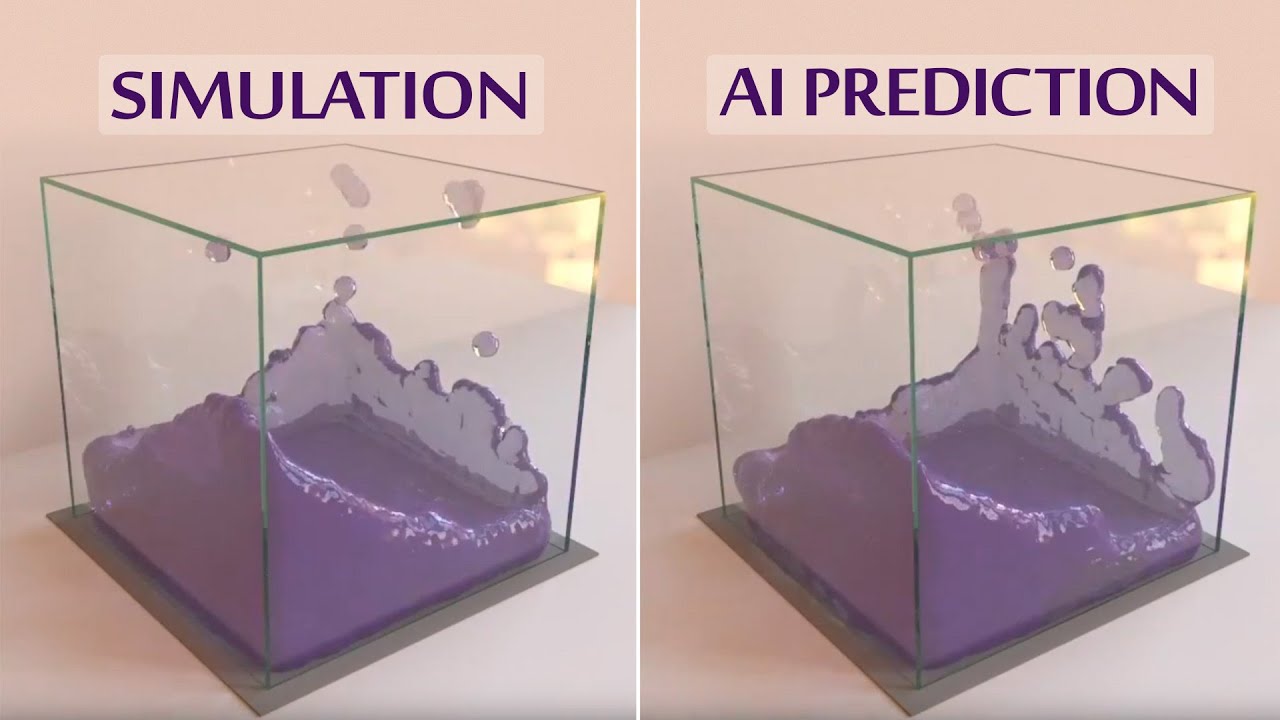
Surface-Only Liquids. Legendary work. Here, we lean on the observation that most of the interesting detail in a fluid simulation is visible on the surface of the liquids, so why not concentrate on that. Now, of course, this is easier said than done, and this work really pulled it off. But, we are not stopping here. We can also use this amazing paper to add realistic bubbles to a simulation. And you will see in a moment that it greatly enhances the realism of these videos. Look at that. I absolutely love it. If the video ends here, it is because I cannot stop looking at and running these simulations. Okay, it took a while, but I am back, I have recovered. So, the key to this work is that it does not do the full surface-tension calculations that are typically required for simulating bubbles, no-no. That would be prohibitively expensive. It just says that look, bubbles typically appear in regions where air gets trapped by the fluid. And it also proposes an algorithm to find these regions. And the algorithm is so simple, I could not believe my eyes. I thought that this was some kind of a prank. It turns out, we only need to look at the curvature of the fluid, and only nearby, which is really cheap, simple and fast. And it really works! I can’t believe it. Once again, this is an approximate solution, not the real deal, but it is extremely simple and fast, and it can even be added as a post-processing step to a simulation that is already finished without the bubbles. How cool is that? Loving it! Now wait, we just said that surface-tension computations are out of reach. That just costs too much. Or, does it? Here is an incredible graphics paper from last year that does just that. So what is all this surface-tension thing good for? Well, for instance, it can simulate this paperclip floating on water. That is quite remarkable because the density of the paperclip is 8 times as much as the water itself, and yet, it still sits on top of the water. We can also drop a bunch of cherries into water and milk and get these beautiful simulations. Yes, these are not real videos, these are all simulated on a computer. Can you tell the difference? I’d love to know, let me know in the comments below! And get this, for simpler scenes, we only need to wait for a few seconds for each frame. That is insanity. I told you that there are some magical works within computer graphics. I am so happy for the opportunity to share them with you! However, wait a second. Remember, we said that these graphics works are fast and approximate. But is this really true? Can they really hold the candle to these rigorous computational fluid dynamics simulations that are super accurate, but take so long? That is impossible, right? A quick simulation on our home computer cannot possibly tell us anything new about aircraft designs, can it? Well, hold on to your papers, because it can! And it not only can, but you are already looking at it! This is a devilishly difficult test, a real aerodynamic simulation in a wind tunnel. In these cases, getting really accurate results is critical. For instance, here we would like to see that if we were to add a spoiler to this car, how much of an aerodynamic advantage we would get in return. Here are the results from the real wind tunnel test, and now, let’s see how the new method compares. Wow. Goodness! It is not perfect by any means, but seems accurate enough that we can see the wake flow of the car clearly enough so that we can make an informed decision on that spoiler. Yes, this, and even more is possible with computer graphics algorithms. These approximate solutions became so accurate and so fast, that we are seeing these two seemingly completely different branches, computational fluid dynamics, and computer graphics getting closer and closer to each other. Even just a couple years ago, I did not dare to think that this would ever be possible. And yet, these fast and predictive simulations are within arm’s reach, and just a couple more papers down the line, and we might be able to enter a world where an engineer is able to test new ideas in aircraft design every few minutes. What a time to be alive! So, all this came about because I am worried that as the field of computer graphics is so small,