❤️ Check out Weights & Biases and sign up for a free demo here: https://wandb.com/papers
❤️ Their mentioned post is available here: http://wandb.me/prompt2prompt
📝 The paper "Prompt-to-Prompt Image Editing with Cross Attention Control" is available here:
https://arxiv.org/abs/2208.01626
Unofficial open source implementation:
https://github.com/bloc97/CrossAttentionControl
❤️ Watch these videos in early access on our Patreon page or join us here on YouTube:
- https://www.patreon.com/TwoMinutePapers
- https://www.youtube.com/channel/UCbfYPyITQ-7l4upoX8nvctg/join
Stable Diffusion frame interpolation: https://twitter.com/xsteenbrugge/status/1558508866463219712
Full video of interpolation: https://www.youtube.com/watch?v=Bo3VZCjDhGI
🙏 We would like to thank our generous Patreon supporters who make Two Minute Papers possible:
Aleksandr Mashrabov, Alex Balfanz, Alex Haro, Andrew Melnychuk, Benji Rabhan, Bryan Learn, B Shang, Christian Ahlin, Eric Martel, Geronimo Moralez, Gordon Child, Jace O'Brien, Jack Lukic, John Le, Jonas, Jonathan, Kenneth Davis, Klaus Busse, Kyle Davis, Lorin Atzberger, Lukas Biewald, Luke Dominique Warner, Matthew Allen Fisher, Michael Albrecht, Michael Tedder, Nevin Spoljaric, Nikhil Velpanur, Owen Campbell-Moore, Owen Skarpness, Rajarshi Nigam, Ramsey Elbasheer, Steef, Taras Bobrovytsky, Ted Johnson, Thomas Krcmar, Timothy Sum Hon Mun, Torsten Reil, Tybie Fitzhugh, Ueli Gallizzi.
If you wish to appear here or pick up other perks, click here: https://www.patreon.com/TwoMinutePapers
Thumbnail background design: Felícia Zsolnai-Fehér - http://felicia.hu
Károly Zsolnai-Fehér's links:
Instagram: https://www.instagram.com/twominutepapers/
Twitter: https://twitter.com/twominutepapers
Web: https://cg.tuwien.ac.at/~zsolnai/
Оглавление (2 сегментов)
Segment 1 (00:00 - 05:00)
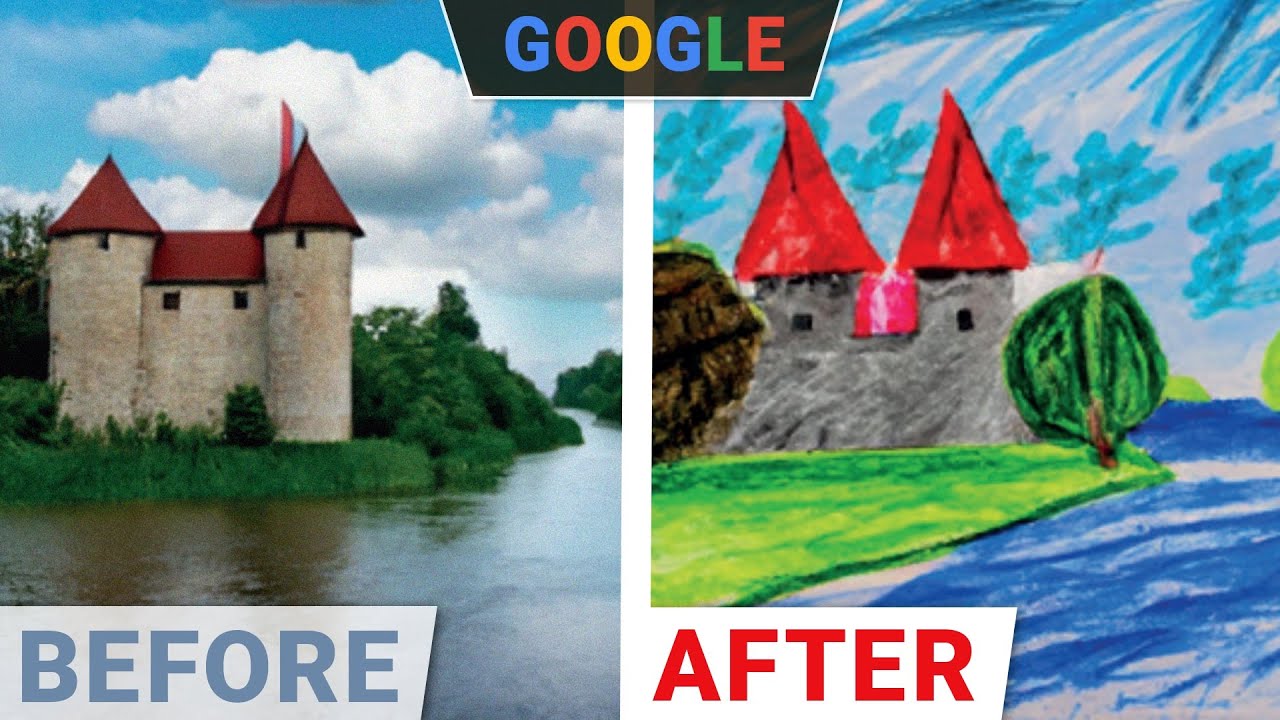
Dear Fellow Scholars, this is Two Minute Papers with Dr. Károly Zsolnai-Fehér. Today we are going to have a look at how this new paper just supercharged AI-driven image generation. For instance, you will see that it can do this, and even this. And today, it also seems clearer and clearer that we are entering the age of AI-driven image generation. You see, these new learning-based methods can do something that previously was only possible in science-fiction movies. And that is, we enter what we wish to see, and the AI paints an image for us. Last year, this image was possible, this year this image is possible. That is incredible progress in just one year. So, I wonder what is the next step? Beyond the regular quality increases, how else could we improve these systems? Well, scientists at Google had a fantastic idea. In this paper, they promise prompt to prompt editing. What is that? What problem does this solve? Well, whenever we create an image, and we feel mostly satisfied with it, but we would need to add just a little change to it, we cannot easily do that. But now, have a look at 5 of my favorites examples of doing exactly this with this new method. One, if we create this imaginary cat riding a bike, and we are happy with this concept, but after taking some driving lessons, our little imaginary cat wishes to get a car now, well, now it is possible. Just change the prompt, and get the same image with minimal modifications to satisfy the changes we have made. I love it. Interestingly, it has also become a bit of a chonker in the process. A testament to how healthy it is to ride the bike instead! And two, if we are yearning for bigger changes, we can use a photo, and change its style as if it were painted by a child. And I have to say this one is very convincing. Three, and now, hold on to your papers and behold the Cake Generator AI. Previously, if we created this lemon cake, and wished to create other variants of it, for instance, a cheese cake, or apple cake, we got a completely different result. These variants don’t have a great deal to do with the original photo. And, I wonder would it be possible with the new technique that? Oh my goodness. Yes! Look at that. These cakes are not only delicious, but, they are also real variants of the original slice. Yum! This is fantastic. So, AI-generated cuisine, huh? Sign me up right now! Four, after generating a car at the side of the street, we can even say how we wish to change the car itself. For instance, let’s make it a sports car instead. Great. Or, if we are happy with the original car, we can also ask the new AI to leave the car intact, and change it surroundings instead. Let’s put it on a flooded street, or, quickly, before water damage happens, put it in Manhattan instead. Excellent. Loving it. Now, of course, you see that not even this technique is perfect, the car still has changed a little, but that is something that will surely be addressed a couple more papers down the line. Five, we can even engage in mask-based editing. If we feel that this beautiful cat also deserves a beautiful shirt, we can delete this part of the screen, then, the AI will start from a piece of noise and morph it until it becomes a shirt. How cool is that? So good! It works for many different kinds of apparel too. And while we marvel at some more of these amazing examples, I would like to tell you one more thing that I loved about this paper. And that is, it describes a general concept. Why is this super cool? Well, it is super cool because it can be applied to different image generators. If you look carefully here, you see that this concept was applied to Google’s own closed solution, Imagen here. And I hope you know what’s coming now. Oh yes, a free and open-source text to image synthesizer is also available and it goes by the name Stable Diffusion. We celebrated it coming into existence a few episodes ago. But, why am I so excited about this? Well,
Segment 2 (05:00 - 07:00)
with Stable Diffusion, we can finally take out our digital wrench and tinker with it. For instance, we can now adjust the internal parameters in ways that we cannot do with the closed solutions like DALL-E 2 and Imagen. So let’s have a look at why that matters. Do you see the prompts here? Of course you do. Now, what else do you see? Parameters! Yes, this means that the hood is popped open, we can not only look into the inner workings of the AI, but we can also play with them, and thus, these results become reproducible at home. So much so that there is already an unofficial, open-source implementation of this new technique applied to Stable Diffusion. Both of these are free for everyone to run. I am loving this. What a time to be alive! And once again, this showcases the power of the papers, and the power of the community. The links are available in the video description, and for now, let the experiments begin! Thanks for watching and for your generous support, and I'll see you next time!