Is Simulating A Jelly Sandwich Possible? 🦑
6:01

Is Simulating A Jelly Sandwich Possible? 🦑

Two Minute Papers 06.03.2022 150 412 просмотров 5 849 лайков

Machine-readable: Markdown · JSON API · Site index

Поделиться Telegram VK Бот
Транскрипт Скачать .md
Анализ с AI
Описание видео
❤️ Check out Perceptilabs and sign up for a free demo here: https://www.perceptilabs.com/papers 📝 The paper "Accelerated complex-step finite difference for expedient deformable simulation" is available here: http://www.cad.zju.edu.cn/home/weiweixu/wwxu2019.files/acf.pdf https://dl.acm.org/doi/10.1145/3355089.3356493 ❤️ Watch these videos in early access on our Patreon page or join us here on YouTube: - https://www.patreon.com/TwoMinutePapers - https://www.youtube.com/channel/UCbfYPyITQ-7l4upoX8nvctg/join 🙏 We would like to thank our generous Patreon supporters who make Two Minute Papers possible: Aleksandr Mashrabov, Alex Balfanz, Alex Haro, Andrew Melnychuk, Angelos Evripiotis, Benji Rabhan, Bryan Learn, Christian Ahlin, Eric Martel, Gordon Child, Ivo Galic, Jace O'Brien, Javier Bustamante, John Le, Jonas, Jonathan, Kenneth Davis, Klaus Busse, Lorin Atzberger, Lukas Biewald, Matthew Allen Fisher, Michael Albrecht, Michael Tedder, Nikhil Velpanur, Owen Campbell-Moore, Owen Skarpness, Rajarshi Nigam, Ramsey Elbasheer, Steef, Taras Bobrovytsky, Thomas Krcmar, Timothy Sum Hon Mun, Torsten Reil, Tybie Fitzhugh, Ueli Gallizzi. If you wish to appear here or pick up other perks, click here: https://www.patreon.com/TwoMinutePapers Thumbnail background design: Felícia Zsolnai-Fehér - http://felicia.hu Meet and discuss your ideas with other Fellow Scholars on the Two Minute Papers Discord: https://discordapp.com/invite/hbcTJu2 Károly Zsolnai-Fehér's links: Instagram: https://www.instagram.com/twominutepapers/ Twitter: https://twitter.com/twominutepapers Web: https://cg.tuwien.ac.at/~zsolnai/
Оглавление (20 сегментов)

Intro

Dear Fellow Scholars, this is Two Minute  Papers with Dr. Károly Zsolnai-Fehér. Today we are going to torment a virtual  armadillo, become happy, or sad depending on   which way we are bending, create a ton of jelly  sandwiches, design a crazy bridge, and more.

Intro

Dear Fellow Scholars, this is Two Minute  Papers with Dr. Károly Zsolnai-Fehér. Today we are going to torment a virtual  armadillo, become happy, or sad depending on   which way we are bending, create a ton of jelly  sandwiches, design a crazy bridge, and more.

What is this

So, what is going on here? Well, this new paper  helps us enhance our physics simulation programs   by improving how we evaluate derivatives.   Derivatives describe how things change.    Now, of course, evaluating derivatives is not new.   It’s not even old. It is ancient. Here you see   an ancient technique for this, and it works well  most of the time…but whoa! Well, this simulation

What is this

So, what is going on here? Well, this new paper  helps us enhance our physics simulation programs   by improving how we evaluate derivatives.   Derivatives describe how things change.    Now, of course, evaluating derivatives is not new.   It’s not even old. It is ancient. Here you see   an ancient technique for this, and it works well  most of the time…but whoa! Well, this simulation

Reference simulation

blew up in our face, so, yes, it may work well  most of the time, but unfortunately, not here. Now, if you are wondering what should  be happening in this scene. Here is the   reference simulation that showcases  what should have happened. Yes,   this is the famous pastime of the computer  graphics researcher, tormenting virtual   objects basically all day long. So, I hope  you are enjoying this reference simulation.    Because this is a great reference simulation.   It is as reference as a simulation can get.    Now, I hope you know what’s coming. Hold on to  your papers, because this is not the reference   simulation. What you see here is the new technique  described in this paper. Absolutely amazing. Actually, let’s compare the two. This is the  reference simulation, for real this time,   and this is the new, complex  step finite difference method.    The two are so close that they are  essentially the same. I love it. So good. Now, if the comparison made you hungry, of course,  we can proceed to the jelly sandwiches. Here is

Reference simulation

blew up in our face, so, yes, it may work well  most of the time, but unfortunately, not here. Now, if you are wondering what should  be happening in this scene. Here is the   reference simulation that showcases  what should have happened. Yes,   this is the famous pastime of the computer  graphics researcher, tormenting virtual   objects basically all day long. So, I hope  you are enjoying this reference simulation.    Because this is a great reference simulation.   It is as reference as a simulation can get.    Now, I hope you know what’s coming. Hold on to  your papers, because this is not the reference   simulation. What you see here is the new technique  described in this paper. Absolutely amazing. Actually, let’s compare the two. This is the  reference simulation, for real this time,   and this is the new, complex  step finite difference method.    The two are so close that they are  essentially the same. I love it. So good. Now, if the comparison made you hungry, of course,  we can proceed to the jelly sandwiches. Here is

Jelly sandwich simulation

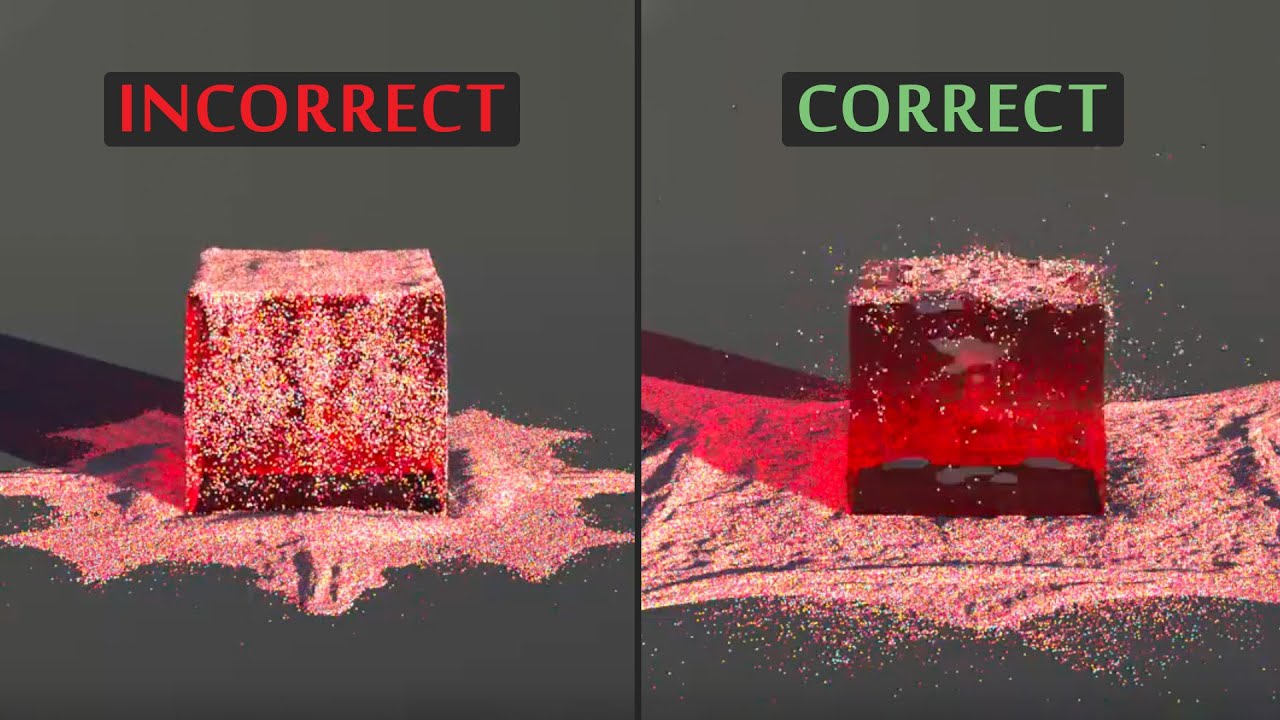
the same scene simulated with a bunch of previous  techniques, and…my goodness! All of them look   different! So, which of these jelly sandwiches  is better? Well, the new technique is better,   because this is the only one that preserves volume  properly. This is the one that gets us the most   jelly. With each of the other methods, the jelly  either reacts incorrectly, or at the end of the   simulation, there is less jelly than the amount  we started with. Now, you are probably asking,   is this really possible? Yes, yes it is! What’s  more, this is not only possible, but this is a

Jelly sandwich simulation

the same scene simulated with a bunch of previous  techniques, and…my goodness! All of them look   different! So, which of these jelly sandwiches  is better? Well, the new technique is better,   because this is the only one that preserves volume  properly. This is the one that gets us the most   jelly. With each of the other methods, the jelly  either reacts incorrectly, or at the end of the   simulation, there is less jelly than the amount  we started with. Now, you are probably asking,   is this really possible? Yes, yes it is! What’s  more, this is not only possible, but this is a

Is this really possible

widespread problem in physics simulation. Our  seasoned Fellow Scholars had seen this problem   in many previous episodes, for instance, here is  one with the tragedy of the disappearing bunnies. And, preserving the volume of the simulated  materials is not only useful for jelly sandwiches.    It is also useful for doing extreme yoga. Look -  here are a bunch of previous techniques trying to   simulate this, and, what do we see? Extreme  bending, extreme bending… and more extreme   bending. Good I guess? Well, not quite! This yoga  shouldn’t be nearly as extreme as we see here. The   new technique reveals that this kind of bending  shouldn’t happen given these material properties. And wait, here comes one of my favorites.   The new technique can also deal with this

Is this really possible

widespread problem in physics simulation. Our  seasoned Fellow Scholars had seen this problem   in many previous episodes, for instance, here is  one with the tragedy of the disappearing bunnies. And, preserving the volume of the simulated  materials is not only useful for jelly sandwiches.    It is also useful for doing extreme yoga. Look -  here are a bunch of previous techniques trying to   simulate this, and, what do we see? Extreme  bending, extreme bending… and more extreme   bending. Good I guess? Well, not quite! This yoga  shouldn’t be nearly as extreme as we see here. The   new technique reveals that this kind of bending  shouldn’t happen given these material properties. And wait, here comes one of my favorites.   The new technique can also deal with this

Hyperelastic Material

crazy example. Look, a nice little virtual  hyperelastic material, where the bending energy   changes depending on the bending orientation,  revealing a secret. Or, two secrets, as you see,   it does not like bending to the right so much,  but bending towards the left, now we’re talking! And, it can also help us perform  inverse design problems. For instance,

Hyperelastic Material

crazy example. Look, a nice little virtual  hyperelastic material, where the bending energy   changes depending on the bending orientation,  revealing a secret. Or, two secrets, as you see,   it does not like bending to the right so much,  but bending towards the left, now we’re talking! And, it can also help us perform  inverse design problems. For instance,

Inverse Design

here we have a hyperelastic bridge built from  over 20 thousand parts. And here, we can design   what vibration frequencies should be  present when the wind blows at our bridge.    And here comes the coolest part - we can choose  this in advance, and then, the new technique   quickly finds the suitable geometry that  will showcase the prescribed vibration types. It pretty much converges after 4 to 6  Newton iterations. What does that mean?

Inverse Design

here we have a hyperelastic bridge built from  over 20 thousand parts. And here, we can design   what vibration frequencies should be  present when the wind blows at our bridge.    And here comes the coolest part - we can choose  this in advance, and then, the new technique   quickly finds the suitable geometry that  will showcase the prescribed vibration types. It pretty much converges after 4 to 6  Newton iterations. What does that mean?

Newton iterations

Yes, it means that the new technique  comes up with an initial guess,   and it needs to refine it only 4 to 6 times  until it comes up with an excellent solution.

Newton iterations

Yes, it means that the new technique  comes up with an initial guess,   and it needs to refine it only 4 to 6 times  until it comes up with an excellent solution.

Summary

So, better hyperelastic simulations,  quickly and conveniently? Yes please,   sign me up right now! And, what would you use  this for? Let me know in the comments below!

Summary

So, better hyperelastic simulations,  quickly and conveniently? Yes please,   sign me up right now! And, what would you use  this for? Let me know in the comments below!

Outro

Thanks for watching and for your generous  support, and I'll see you next time!

Outro

Thanks for watching and for your generous  support, and I'll see you next time!

Другие видео автора — Two Minute Papers

Ctrl+V

Экстракт Знаний в Telegram

Экстракты и дистилляты из лучших YouTube-каналов — сразу после публикации.

Подписаться

Дайджест Экстрактов

Лучшие методички за неделю — каждый понедельник