❤️ Check out Perceptilabs and sign up for a free demo here: https://www.perceptilabs.com/papers
📝 The paper "Predicting High-Resolution Turbulence Details in Space and Time" is available here:
http://www.geometry.caltech.edu/pubs/BWDL21.pdf
📝 Wavelet Turbulence - one of the best papers ever written (in my opinion):
https://www.cs.cornell.edu/~tedkim/WTURB/
❤️ Watch these videos in early access on our Patreon page or join us here on YouTube:
- https://www.patreon.com/TwoMinutePapers
- https://www.youtube.com/channel/UCbfYPyITQ-7l4upoX8nvctg/join
🙏 We would like to thank our generous Patreon supporters who make Two Minute Papers possible:
Aleksandr Mashrabov, Alex Balfanz, Alex Haro, Andrew Melnychuk, Angelos Evripiotis, Benji Rabhan, Bryan Learn, Christian Ahlin, Eric Martel, Gordon Child, Ivo Galic, Jace O'Brien, Javier Bustamante, John Le, Jonas, Jonathan, Kenneth Davis, Klaus Busse, Lorin Atzberger, Lukas Biewald, Matthew Allen Fisher, Michael Albrecht, Michael Tedder, Nikhil Velpanur, Owen Campbell-Moore, Owen Skarpness, Rajarshi Nigam, Ramsey Elbasheer, Steef, Taras Bobrovytsky, Thomas Krcmar, Timothy Sum Hon Mun, Torsten Reil, Tybie Fitzhugh, Ueli Gallizzi.
If you wish to appear here or pick up other perks, click here: https://www.patreon.com/TwoMinutePapers
Thumbnail background design: Felícia Zsolnai-Fehér - http://felicia.hu
Meet and discuss your ideas with other Fellow Scholars on the Two Minute Papers Discord: https://discordapp.com/invite/hbcTJu2
Károly Zsolnai-Fehér's links:
Instagram: https://www.instagram.com/twominutepapers/
Twitter: https://twitter.com/twominutepapers
Web: https://cg.tuwien.ac.at/~zsolnai/
Оглавление (2 сегментов)
Segment 1 (00:00 - 05:00)
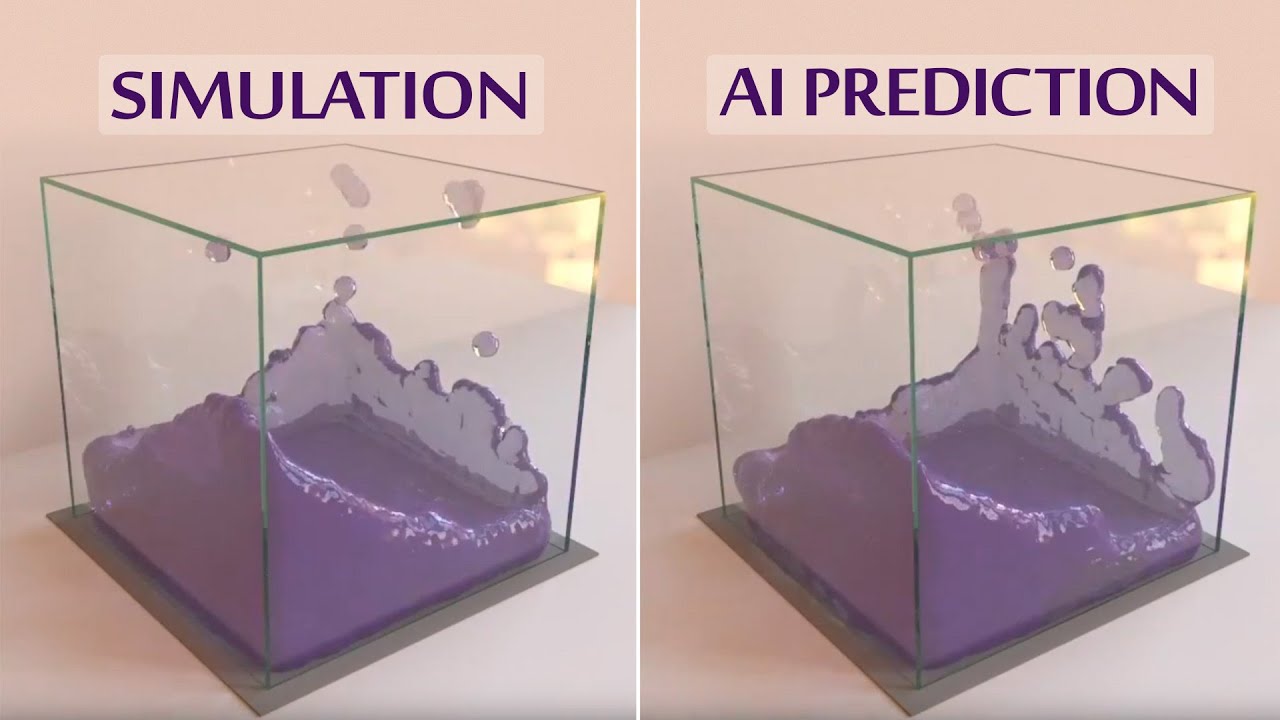
Dear Fellow Scholars, this is Two Minute Papers with Dr. Károly Zsolnai-Fehér. Today is going to be all about turbulence! And we are going to do this, and this and…this. To understand what this new paper has to offer, we have to look at an earlier work named Wavelet Turbulence. Apart from the fact that it in my opinion, it is one of the best papers ever written, it could do one thing extremely well. In goes a coarse, low-resolution smoke or fluid simulation, and out comes a proper simulation with a lot more details. And, it is typically accurate enough to fool us. And all this was possible in 2008. Kind of boggles the mind, so much so, that this work even won a technical Oscar award. Please remember this accuracy statement as it will matter a great deal. Once again, accurate enough to fool us. Now, more than a decade later, here we are, this new method is leaps and bounds better, and can do 5 amazing things that the previous methods couldn’t do. One, it can do spatiotemporal upsampling. Upsampling both in space and in time. What does this mean? It means that in goes a choppy, low resolution simulation, and out comes a smooth, detailed simulation. Wow, now that is incredible. It is really able to fill in the information not only in space, but in time too. So good. Now, two, previous methods typically try to take this coarse input simulation and add something to it. But not this new one. This new method creates a fundamentally new simulation from it. Just look here. It didn’t just add a few more details to the input simulation, this is a completely new work. That is quite a difference. Three, I mentioned that Wavelet Turbulence was accurate enough to fool us. So I wonder how accurate this new method is? Well, that’s what we are here for, so…let’s see together! Here comes the choppy input simulation, and here is an upsampling technique from a bit more than a year ago. Well, better, yes, but the output is not smooth, I could characterize it more as less choppy. And, let’s see the new method. Can it do any better? My goodness. Look at that! That is a smooth and creamy animation with tons of details. Now, let’s pop the question - how does it compare to the reference simulation - reality if you will? What? I cannot believe my eyes. I can’t tell the difference at all! So this new technique is not just accurate enough to fool the human eye, this is accurate enough to stand up to the real, high-resolution simulation. And all this improvement in just one year. What a time to be alive! But wait a second. Does this even make sense? If we have the real reference simulation here, why do we need the upsampling technique? Why not just use the reference? Well, it makes sense - the plan is that we only need to compute the cheap coarse simulation, upsample it quickly, and hope that it is as good as the reference simulation, which takes a great deal longer. Well, okay, but how much longer? Now, hold on to your papers, and let’s see the results, and…. yes! This is about 5 to 8 times faster than creating the high-resolution simulation we compared to, which is absolutely amazing, especially that it was created with a modern, blazing fast reference simulator that runs on your graphics card. But, remember, I promised you five advantages, not three. So, what are the remaining two? Well, four, it can perform compression! Meaning that the output simulation will take up to 600 times less data on our disk, that is insanity. So, how much worse is the simulation stored this way? My goodness, look at that! It looks nearly the same as the original one. Wow. And, we are still not done yet. Not even close! Five. It also works on super high Reynolds numbers. In other words, if we have some of the more difficult cases where there is tons of turbulence,
Segment 2 (05:00 - 06:00)
it will works really well. This typically gives a lot of troubles to previous techniques. Now, one more important thing. Views are, of course, not everything. However, I couldn’t not notice that this work was only seen by 127 people. Yes. I am not kidding. 127 people. This is why I am worried that if we don’t talk about it here on Two Minute Papers, almost no one will talk about it. And these works are so good, people have to know! Thank you very much for watching this, and let’s spread the word together! Thanks for watching and for your generous support, and I'll see you next time!