❤️ Check out the Gradient Dissent podcast by Weights & Biases: http://wandb.me/gd
📝 The paper "Practical Pigment Mixing for Digital Painting" is available here:
https://scrtwpns.com/mixbox/
Tweet at me if you used this to paint something cool! - https://twitter.com/twominutepapers
❤️ Watch these videos in early access on our Patreon page or join us here on YouTube:
- https://www.patreon.com/TwoMinutePapers
- https://www.youtube.com/channel/UCbfYPyITQ-7l4upoX8nvctg/join
🙏 We would like to thank our generous Patreon supporters who make Two Minute Papers possible:
Aleksandr Mashrabov, Alex Balfanz, Alex Haro, Andrew Melnychuk, Angelos Evripiotis, Benji Rabhan, Bryan Learn, Christian Ahlin, Eric Martel, Gordon Child, Ivo Galic, Jace O'Brien, Javier Bustamante, John Le, Jonas, Jonathan, Kenneth Davis, Klaus Busse, Lorin Atzberger, Lukas Biewald, Matthew Allen Fisher, Mark Oates, Michael Albrecht, Michael Tedder, Nikhil Velpanur, Owen Campbell-Moore, Owen Skarpness, Peter Edwards, Rajarshi Nigam, Ramsey Elbasheer, Steef, Taras Bobrovytsky, Thomas Krcmar, Timothy Sum Hon Mun, Torsten Reil, Tybie Fitzhugh, Ueli Gallizzi.
If you wish to appear here or pick up other perks, click here: https://www.patreon.com/TwoMinutePapers
Thumbnail background design: Felícia Zsolnai-Fehér - http://felicia.hu
Meet and discuss your ideas with other Fellow Scholars on the Two Minute Papers Discord: https://discordapp.com/invite/hbcTJu2
Károly Zsolnai-Fehér's links:
Instagram: https://www.instagram.com/twominutepapers/
Twitter: https://twitter.com/twominutepapers
Web: https://cg.tuwien.ac.at/~zsolnai/
Оглавление (2 сегментов)
Segment 1 (00:00 - 05:00)
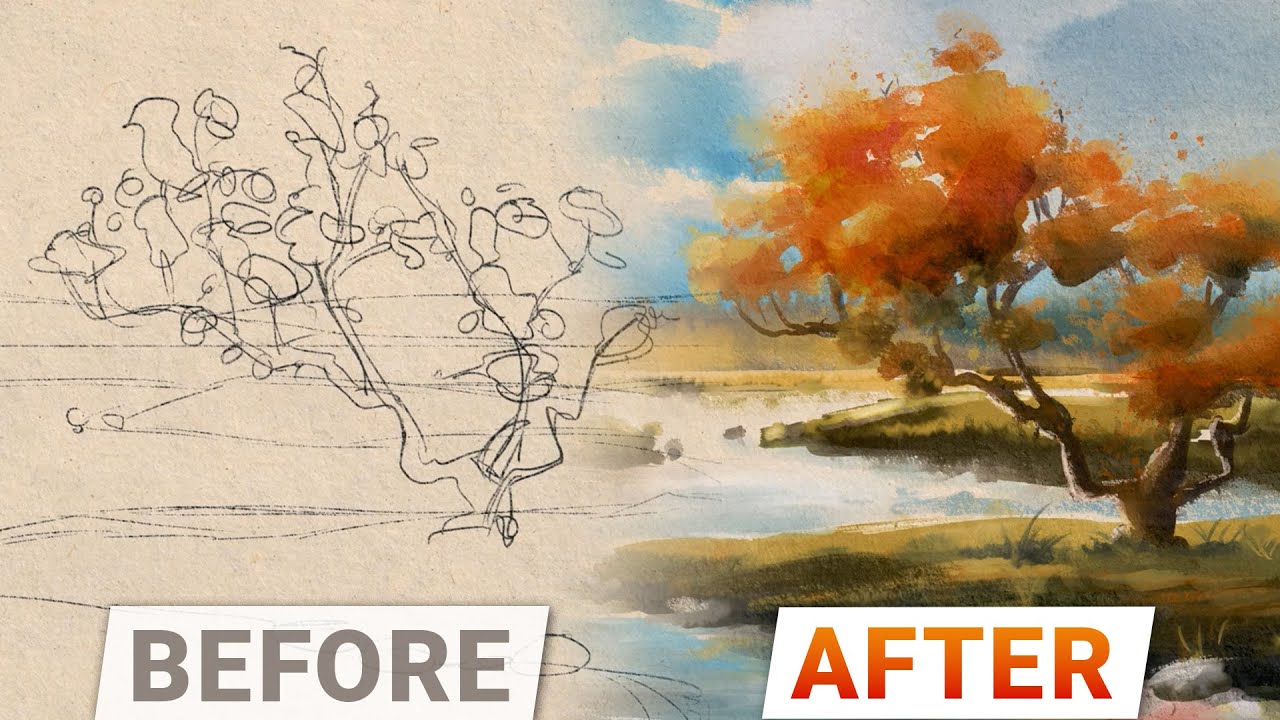
Dear Fellow Scholars, this is Two Minute Papers with Dr. Károly Zsolnai-Fehér. As you see, this is not our usual intro. Why is that? Because today we are going simulate the process of real painting on a computer, and we’ll find out that all previous techniques mix paint incorrectly, and finally, and create this beautiful image. Now, there are plenty of previous techniques that help us paint digitally, so, why do we need a new paper for this? Well, believe it or not, these previous methods think differently about the shape that the paint has to take, the more sophisticated ones even simulate the diffusion of paint, which is fantastic. They all do these things a little differently, but they agree on one thing. And, here comes the problem. The one thing they agree on is that blue plus yellow equals a creamy color. But, wait a second… let’s actually try this. Many of you know already what is coming…of course. In real life, blue plus yellow is not a creamy color, it is green. Does the new method know this? Yes it does! But only this one. And we can try the similar experiments over and over and over again. The results are the same. So, how is this even possible? Does no one know that blue plus yellow equals green? Well, of course they know, but a proper simulation of pigments mixing is very challenging. For instance, it requires keeping track of pigment concentrations, and we also have to simulate subsurface scattering, which is the absorption and scattering of light within a volume of these pigments. In some critical applications, just this part can take several hours to days to compute for a challenging case. And now, hold on to your papers, because this new technique can do all this correctly, and in real time. I loved this visualization as it is really dense in information, and super easy to read at the same time. That is quite a challenge, and in my opinion, just this one figure could win an award by itself. As you see, most of the time, it runs easily with 60, or higher frames per second, and even in the craziest cases, it can compute all this about 30 times per second. That is insanity. So, what do we get for all this effort? A more realistic digital painting experience. For instance, with the new method, color mixing now feels absolutely amazing, and if we feel like applying a ton of paint and let it stain the paper, we get something much more lifelike too. Artists who try this will appreciate these a great deal I am sure. Especially that the authors also made this paint color mixing technique available for everyone, free of charge. As we noted, computing this kind of paint mixing simulation is not easy, however, using the final technique is, on the other hand, extremely easy. As easy as it gets. If you feel like coding up a simulation and include this method in it, this is all you need to do. Very few paper implementations are this simple to use. It conceals all the mathematical difficulties away from you. Extra point for elegance, and, huge congratulations to the authors! Now, after nearly every Two Minute Papers episode where we showcase such an amazing paper, I get a question saying something like “okay, but when do I get to see or use this in the real world? ”. And rightfully so, that is a good question. For instance, this previous GauGAN paper was published in 2019, and here we are, just a bit more than 2 years later, and it has been transferred into a real product. Some machine learning papers also made it to Tesla’s self driving cars in one or two years, so tech transfer from research to real products is real. But, is it real with this technique? Yes it is! So much so that it is already available in an app name Rebelle 5, which offers a next level digital painting experience. It even simulates different kinds of papers and how they absorb paint. A paper simulation you say? Yes, here, at Two Minute Papers, we appreciate that a great deal. If you use this to paint something, please make sure to leave a comment or tweet at me. I would love to see your scholarly paintings! What a time to be alive!
Segment 2 (05:00 - 05:00)
Thanks for watching and for your generous support, and I'll see you next time!