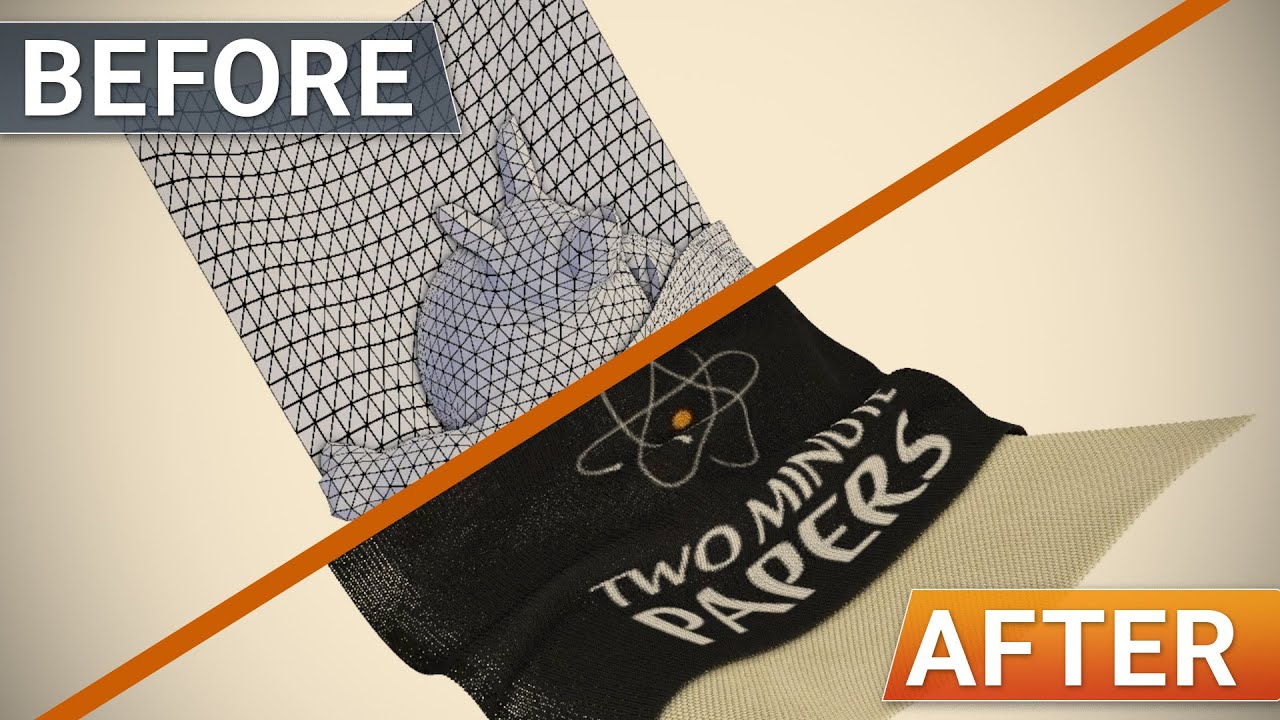
From Mesh To Yarn... In Real Time! 🧶
5:54

From Mesh To Yarn... In Real Time! 🧶

Two Minute Papers 11.12.2021 87 974 просмотров 6 415 лайков

Machine-readable: Markdown · JSON API · Site index

Поделиться Telegram VK Бот
Транскрипт Скачать .md
Анализ с AI
Описание видео
❤️ Check out the Gradient Dissent podcast by Weights & Biases: http://wandb.me/gd  📝 The paper "Mechanics-Aware Deformation of Yarn Pattern Geometry" is available here: https://visualcomputing.ist.ac.at/publications/2021/MADYPG/ 🙏 We would like to thank our generous Patreon supporters who make Two Minute Papers possible: Aleksandr Mashrabov, Alex Balfanz, Alex Haro, Andrew Melnychuk, Angelos Evripiotis, Benji Rabhan, Bryan Learn, Christian Ahlin, Eric Martel, Gordon Child, Ivo Galic, Jace O'Brien, Javier Bustamante, John Le, Jonas, Kenneth Davis, Klaus Busse, Lorin Atzberger, Lukas Biewald, Matthew Allen Fisher, Mark Oates, Michael Albrecht, Michael Tedder, Nikhil Velpanur, Owen Campbell-Moore, Owen Skarpness, Peter Edwards, Rajarshi Nigam, Ramsey Elbasheer, Steef, Taras Bobrovytsky, Thomas Krcmar, Timothy Sum Hon Mun, Torsten Reil, Tybie Fitzhugh, Ueli Gallizzi. If you wish to appear here or pick up other perks, click here: https://www.patreon.com/TwoMinutePapers Wish to watch these videos in early access? Join us here: https://www.youtube.com/channel/UCbfYPyITQ-7l4upoX8nvctg/join Thumbnail background design: Felícia Zsolnai-Fehér - http://felicia.hu Meet and discuss your ideas with other Fellow Scholars on the Two Minute Papers Discord: https://discordapp.com/invite/hbcTJu2 Károly Zsolnai-Fehér's links: Instagram: https://www.instagram.com/twominutepapers/ Twitter: https://twitter.com/twominutepapers Web: https://cg.tuwien.ac.at/~zsolnai/

Оглавление (6 сегментов)

<Untitled Chapter 1>

Dear Fellow Scholars, this is Two Minute Papers with Dr. Károly Zsolnai-Fehér. This is not some hot new Two Minute Papers merchandise - this is what a new cloth simulation paper is capable of doing today. So good! And today, we are also going to see how to put back the holes into holey geometry, and do it quickly! But wait a second, that is impossible. We know that yarn-based cloth simulations take forever to compute. Here is an example, we showcased this previous work approximately 60 episodes ago. And curiously, get this, some of the simulations here were nearly 60 times faster than the

cartridge belt rib

yarn-based reference simulation. That is amazing. However, we noted that even though this technique was a great leap forward, but of course, it

slip stitch honeycomb

wasn’t perfect, there was a price to be paid for this amazing speed, which was, look

stockinette

that pulling effects on individual yarns were neglected. That amazing holey geometry is lost. I noted that I’d love to get that back. You will see in a moment that maybe, my wish comes true today. Hmm! So, quick rundown. We either go for a mesh-based cloth simulation.

Fast, mesh-based simulation

These are really fast, but, no holey geometry. Or, we choose the yarn-level simulations, these are the real deal, however, they take forever. Unfortunately, still, there seems to be no way out here. Now, let’s have a look at this new technique. It promises to try to marry these two concepts, or in other words, use a fast mesh simulator, and add the yarn-level cloth details on top of it. Now of course, that is easier said than done, so let’s see how this new method can deal with this challenging problem. So, this is the fast mesh simulation to start with, and now, hold on to your papers, and let’s add those yarns. Oh my, that is beautiful. I absolutely love how at different points, you can even see through these garments. Beautiful. So, how does it do all this magic? Well, look at this naive method. This neglects the proper tension between the yarns, and, look at how beautifully they tighten as we add the new method on top of it. This technique can do it properly. And not only that, but it also simulates how the garment interacts with a virtual body in a simulated world. Once again, note how the previous, naive method neglects the tightening of the yarns. So, I am super excited, let’s see how long we have to wait for this. Are we talking fast mesh simulation timings, or slow yarn simulation timings? My goodness. Look at that! The mesh part runs on your processor, while the yarn part of the simulation is implemented on the graphics card. And, whoa, the whole thing runs in the order of milliseconds, easily in real time. Even if we have a super detailed garment with tens of millions of vertices in the simulation, the timings are in the order of tens of milliseconds at worst. That’s also super fast. Wow. So, yes, part of this runs on our graphics card and in real time. Here, we have nearly a million vertices, not a problem. Here, nearly two million vertices, two million points if you will, it runs like a dream. And it only starts to slow down when we go all the way to a super detailed piece of garment with 42 million vertices. And here, there is so much detail that finally, not the simulation technique is the bottleneck, but the light simulation algorithm is. Look, there are so many high-frequency details that we would need a higher-resolution video, or more advanced antialiasing techniques to resolve all this detail. All this means that the simulation technique did its job really well. So, finally, yarn-level simulations in real time. What a time to be alive! Huge congratulations to the entire team, and the first author, Georg Sperl, who is still a PhD student, making important contributions like this. And, get this - Georg’s short presentation was seen by… oh my…61 people. Views are not everything. Not even close! But, once again, if we don’t talk about this work here, I am worried that almost no one will. And this is why Two Minute Papers exists. Subscribe if you wish to see more of these miracle papers, we have some great ones coming up.

Gradient Dissent

Thanks for watching and for your generous support, and I'll see you next time!

Другие видео автора — Two Minute Papers

Ctrl+V

Экстракт Знаний в Telegram

Экстракты и дистилляты из лучших YouTube-каналов — сразу после публикации.

Подписаться

Дайджест Экстрактов

Лучшие методички за неделю — каждый понедельник