Simulating A Virtual World…For A Thousand Years! 🤯
5:21

Simulating A Virtual World…For A Thousand Years! 🤯

Two Minute Papers 01.12.2021 754 572 просмотров 43 473 лайков

Machine-readable: Markdown · JSON API · Site index

Поделиться Telegram VK Бот
Транскрипт Скачать .md
Анализ с AI
Описание видео
❤️ Check out Perceptilabs and sign up for a free demo here: https://www.perceptilabs.com/papers 📝 The paper "Synthetic Silviculture: Multi-scale Modeling of Plant Ecosystems" is available here: https://storage.googleapis.com/pirk.io/projects/synthetic_silviculture/index.html 🙏 We would like to thank our generous Patreon supporters who make Two Minute Papers possible: Aleksandr Mashrabov, Alex Haro, Andrew Melnychuk, Angelos Evripiotis, Benji Rabhan, Bryan Learn, Christian Ahlin, Eric Martel, Gordon Child, Ivo Galic, Jace O'Brien, Javier Bustamante, John Le, Jonas, Kenneth Davis, Klaus Busse, Lorin Atzberger, Lukas Biewald, Matthew Allen Fisher, Mark Oates, Michael Albrecht, Michael Tedder, Nikhil Velpanur, Owen Campbell-Moore, Owen Skarpness, Rajarshi Nigam, Ramsey Elbasheer, Steef, Taras Bobrovytsky, Thomas Krcmar, Timothy Sum Hon Mun, Torsten Reil, Tybie Fitzhugh, Ueli Gallizzi. If you wish to appear here or pick up other perks, click here: https://www.patreon.com/TwoMinutePapers Thumbnail background design: Felícia Zsolnai-Fehér - http://felicia.hu Meet and discuss your ideas with other Fellow Scholars on the Two Minute Papers Discord: https://discordapp.com/invite/hbcTJu2 Károly Zsolnai-Fehér's links: Instagram: https://www.instagram.com/twominutepapers/ Twitter: https://twitter.com/twominutepapers Web: https://cg.tuwien.ac.at/~zsolnai/
Оглавление (6 сегментов)

<Untitled Chapter 1>

Dear Fellow Scholars, this is Two Minute Papers with Dr. Károly Zsolnai-Fehér. Today we are going to simulate thousands of years of vegetation in a virtual world. And I am telling you, this paper is unbelievable. Now, normally, if we are building a virtual world, we don’t really think about simulating a physics and biology-based ecosystem. Let’s be honest, it’s more like “Yeah, just throw in some trees and we are done here”.

Parameter Space

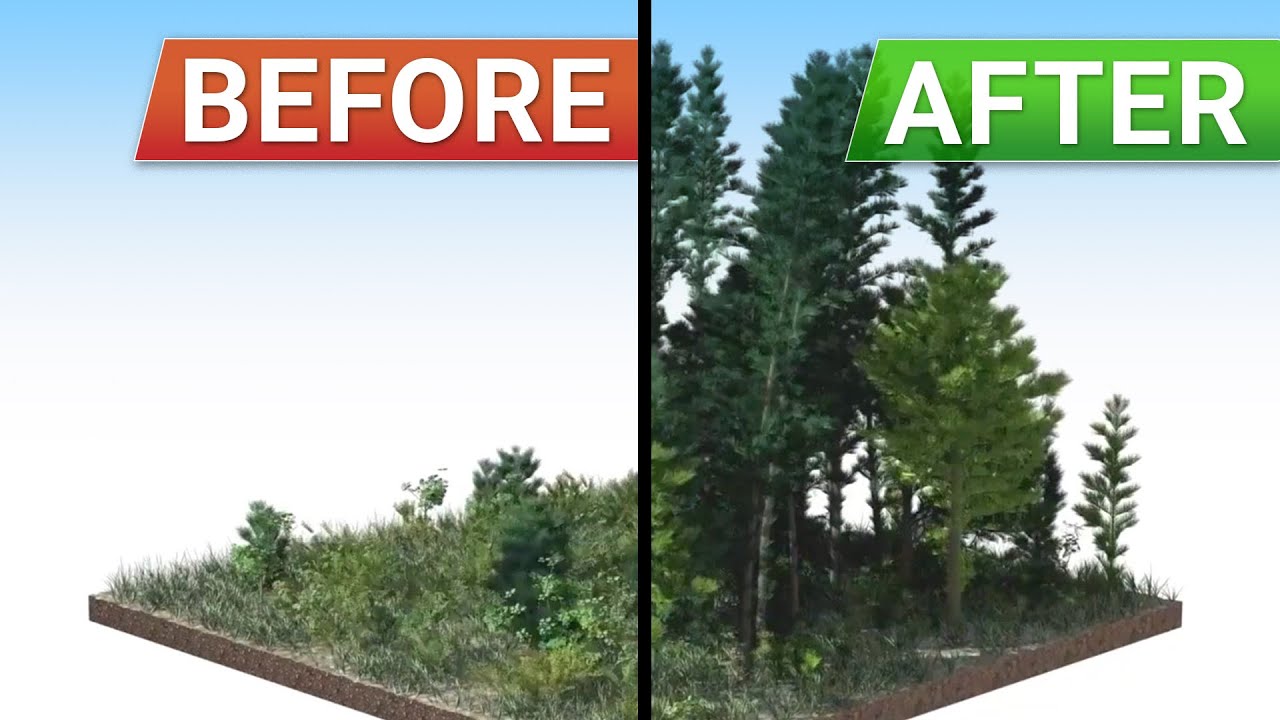
But, in reality, the kinds of vegetation we have in a virtual world should be at the very least a function of precipitation and temperature. And here at this point, we know that this paper means business. You see, if there is no rain and it’s super cold, we get a tundra. With no rain and high temperature we get a desert. If we keep the temperature high, and add a ton of precipitation, we get a tropical rainforest, and this technique promises to be able to simulate these, and everything inbetween. See these beautiful little worlds here? These are not illustrations. No-no! These are already the result of the simulation program. Nice! Now, let’s run a tiny simulation with 400 years and a few hundred plants.

Boreal Forest Growth

Step number one. The first few decades are dominated by these shrubs, blocking away the sunlight from everyone else, but, over time, step two, watch these resilient pine trees slowly overtake them and deny them their precious sunlight. And, what happens as a result? Look! Their downfall brings forth a complete ecosystem change. And then, step three, spruce trees start to appear. This changes the game. Why? Well, these are more shade-tolerant, and let’s see…yes, they take over the ecosystem from the pine trees. A beautifully done story, in such a little simulation. I absolutely love it. Of course, any self-respecting virtual world will also contain other objects, not just

Obstacles

the vegetation, and, the simulator says, no problem. Just chuck ‘em in there, and we’ll just react accordingly and grow around it. Now, let’s see a mid-sized simulation.

Large Ecosystems

Look at that. Imagine the previous story with the pine trees, but, with not a few hundred, but, a hundred thousand plants. This can simulate that too. And now comes the final boss. A large simulation. Half a million plants, more than a thousand years. Yes, really. Let’s see the story here in images first, and then, you will see the full simulation. Yes, over the first hundred years, fast-growing shrubs dominate and start growing everywhere, and after a few hundred more years, the slower-growing trees catch up, and start overshadowing the shrubs at lower elevation levels. Then, more kinds of trees appear at lower elevations, and slowly over 1400 years, a beautiful, mixed-age forest emerges. I shiver just thinking about the fact that through the power of computer graphics research works, we can simulate all this on a computer.

Complex Landscapes

What a time to be alive! And, while we look at the full simulation, please note that there is more happening here, make sure to have a look at the paper in the video description if you wish to know more details. Now, about the paper. And here comes an additional interesting part. As of the making of this video, this paper has been referred to 20 times. Yes, but this paper is from 2019, so it had years to soak up some citations, which didn’t really happen. Now note that one, citations are not everything, and two, 20 citations for a paper in the field of computer graphics is not bad at all. But every time I see an amazing paper, I really wish that more people would hear about it, and always I find that almost nobody knows about them. And once again, this is why I started to make Two Minute Papers. Thank you so much for coming on this amazing journey with me. Thanks for watching and for your generous support, and I'll see you next time!

Другие видео автора — Two Minute Papers

Ctrl+V

Экстракт Знаний в Telegram

Экстракты и дистилляты из лучших YouTube-каналов — сразу после публикации.

Подписаться

Дайджест Экстрактов

Лучшие методички за неделю — каждый понедельник