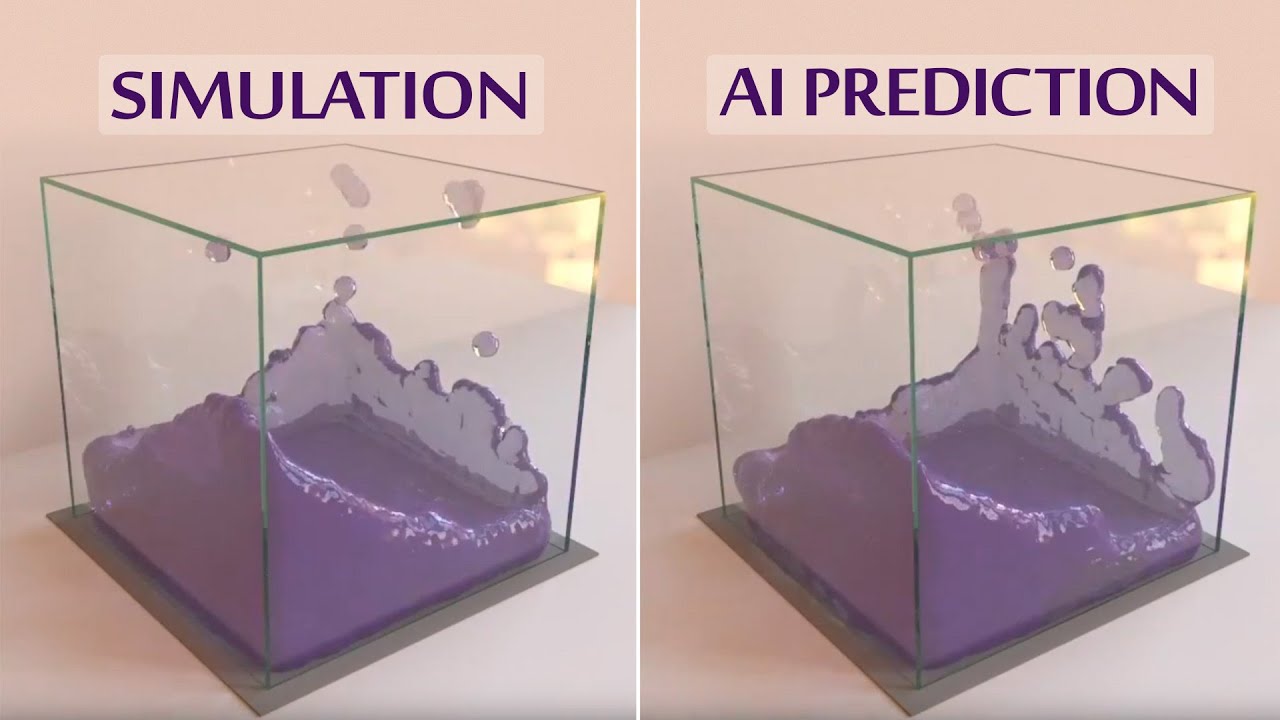
Can A Virtual Sponge Sink? 🧽
5:51

Can A Virtual Sponge Sink? 🧽

Two Minute Papers 25.11.2021 45 944 просмотров 2 933 лайков

Machine-readable: Markdown · JSON API · Site index

Поделиться Telegram VK Бот
Транскрипт Скачать .md
Анализ с AI
Описание видео
❤️ Check out Weights & Biases and say hi in their community forum here: https://wandb.me/paperforum 📝 The paper "Unified particle system for multiple-fluid flow and porous material" is available here: https://cronfa.swansea.ac.uk/Record/cronfa57521 https://dl.acm.org/doi/10.1145/3450626.3459764 Meet and discuss your ideas with other Fellow Scholars on the Two Minute Papers Discord: https://discordapp.com/invite/hbcTJu2 🙏 We would like to thank our generous Patreon supporters who make Two Minute Papers possible: Aleksandr Mashrabov, Alex Haro, Andrew Melnychuk, Angelos Evripiotis, Benji Rabhan, Bryan Learn, Christian Ahlin, Eric Martel, Gordon Child, Ivo Galic, Jace O'Brien, Javier Bustamante, John Le, Jonas, Kenneth Davis, Klaus Busse, Lorin Atzberger, Lukas Biewald, Matthew Allen Fisher, Mark Oates, Michael Albrecht, Michael Tedder, Nikhil Velpanur, Owen Campbell-Moore, Owen Skarpness, Rajarshi Nigam, Ramsey Elbasheer, Steef, Taras Bobrovytsky, Thomas Krcmar, Timothy Sum Hon Mun, Torsten Reil, Tybie Fitzhugh, Ueli Gallizzi. If you wish to appear here or pick up other perks, click here: https://www.patreon.com/TwoMinutePapers Thumbnail background design: Felícia Zsolnai-Fehér - http://felicia.hu Károly Zsolnai-Fehér's links: Instagram: https://www.instagram.com/twominutepapers/ Twitter: https://twitter.com/twominutepapers Web: https://cg.tuwien.ac.at/~zsolnai/
Оглавление (9 сегментов)

Introduction

Dear Fellow Scholars, this is Two Minute  Papers with Dr. Károly Zsolnai-Fehér. Today we are going to not only simulate fluids,   but even better, we're going to absorb  them with sponge-like porous materials too.

Overview

This paper does not have the usual super high  resolution results that you see with many other   simulation papers. However, I really wanted  to show you what it can do through four lovely   experiments. And, at the end of the episode,  you will see how slowly or quickly it runs!

Experiment 1 spongy dumbbells

Experiment number one. Spongy dumbbells. One side  is made of a spongy material, and if it starts   absorbing the water, let’s see if it sinks. Well,  it slowly starts to descend as it gets heavier,   and then, it gets so heavy that eventually, it  sinks the other half too. That is a good start. Now, experiment number two. Absorption.   Here, the green liquid is hard to absorb,

Experiment 2 absorption

therefore we expect it to pass through.   While the red liquid is easier to absorb,   and should get stuck in this perforated material.   Let’s see if that is indeed what happens…the green   is coming through, and where is all the red  goo? Well, most of it is getting absorbed here.    But wait, the paper promises to ensure that  mass and momentum still gets transferred   through the interactions properly. So, if  the fluid volumes are simulated correctly,   we expect a lot more green down there than  red. Did we get it? Oh yes, checkmark! And if you think this was a  great absorption simulation,   wait until you see this. Experiment  number three. Absorption on steroids.

Experiment 3 absorption on steroids

This is a liquid mixture, and these are porous  materials. Each of which will absorb exactly one   component of the liquid and let through  the rest. Let’s see…the first obstacle   absorbs the blue component quickly, the second  retains all the green component, and the red   flows through. And, look at how gracefully  the red fluid fills the last sponge. Lovely. Onwards to experiment number four. Artistic  control. Since we are building our own little   virtual world, we make all the rules.   So let’s see the first absorption case.    Nothing too crazy here. But, if this is  not in line with our artistic vision,   do not despair, because this is our world, so  we can play with these physical parameters.    For instance, let’s increase the absorption  rate, so that the fluid enters the solid faster.    Or, we can increase the permeability, this is the  ease of passage of the fluid through the material.    Does it transfer quicker into the sponge?    Yes it does! And finally, we can speed up  both how quickly the fluid enters the solid,   how quickly it travels within, and we have  also increased the amount of absorption.    Let’s see if we end up with a smaller remaining  volume. Indeed we do! The beauty of building these

How long does it take

virtual worlds is that we can have these  simulations under our artistic control. So, how long do we wait for the sponges? Well,  hold on to your papers, because we not only   don’t have to sit down and watch an episode of  Spongebob to get these done, but… get this. The   crazy three-sponge experiment used about quarter  of a million particles for the fluid, and another   quarter-ish solids,  and runs at approximately a second per frame.    Yes, it runs interactively, and all  this on a consumer graphics card. And, yes, so that’s why the resolution of the  simulations is not that high. The authors could   have posted a much higher resolution simulation  and kept the execution time in the minutes per   frame domain, but no. They wanted to show us  what this can do interactively. And in this case,

Interactively

it is important that you apply the First Law Of  Papers, which says that research is a process.    Do not look at where we are, will  be two more papers down the line. So, there we go,

Conclusion

I really wanted to show you this paper, because  unfortunately, if we don’t talk about it, almost   no one will see it. This is why Two Minute Papers  exists. And, if you wish to discuss this paper,   make sure to drop by on our Discord server.   The link is available in the video description.

Outro

Thanks for watching and for your generous  support, and I'll see you next time!

Другие видео автора — Two Minute Papers

Ctrl+V

Экстракт Знаний в Telegram

Экстракты и дистилляты из лучших YouTube-каналов — сразу после публикации.

Подписаться

Дайджест Экстрактов

Лучшие методички за неделю — каждый понедельник