NVIDIA’s Stretchy Simulation: Super Quick! 🐘
5:58

NVIDIA’s Stretchy Simulation: Super Quick! 🐘

Two Minute Papers 05.11.2021 112 105 просмотров 5 897 лайков

Machine-readable: Markdown · JSON API · Site index

Поделиться Telegram VK Бот
Транскрипт Скачать .md
Анализ с AI
Описание видео
❤️ Train a neural network and track your experiments with Weights & Biases here: http://wandb.me/paperintro 📝 The paper "A Constraint-based Formulation of Stable Neo-Hookean Materials" is available here: - Paper: https://mmacklin.com/neohookean.pdf - Online demo: https://matthias-research.github.io/pages/challenges/softBody.html 📝 The paper "Gaussian Material Synthesis" (with the pseudocode) is available here: https://users.cg.tuwien.ac.at/zsolnai/gfx/gaussian-material-synthesis/ 🙏 We would like to thank our generous Patreon supporters who make Two Minute Papers possible: Aleksandr Mashrabov, Alex Haro, Andrew Melnychuk, Angelos Evripiotis, Benji Rabhan, Bryan Learn, Christian Ahlin, Eric Martel, Gordon Child, Ivo Galic, Jace O'Brien, Javier Bustamante, John Le, Jonas, Kenneth Davis, Klaus Busse, Lorin Atzberger, Lukas Biewald, Matthew Allen Fisher, Mark Oates, Michael Albrecht, Michael Tedder, Nikhil Velpanur, Owen Campbell-Moore, Owen Skarpness, Rajarshi Nigam, Ramsey Elbasheer, Steef, Taras Bobrovytsky, Thomas Krcmar, Timothy Sum Hon Mun, Torsten Reil, Tybie Fitzhugh, Ueli Gallizzi. If you wish to appear here or pick up other perks, click here: https://www.patreon.com/TwoMinutePapers Thumbnail background design: Felícia Zsolnai-Fehér - http://felicia.hu Meet and discuss your ideas with other Fellow Scholars on the Two Minute Papers Discord: https://discordapp.com/invite/hbcTJu2 Károly Zsolnai-Fehér's links: Instagram: https://www.instagram.com/twominutepapers/ Twitter: https://twitter.com/twominutepapers Web: https://cg.tuwien.ac.at/~zsolnai/ #nvidia #gamedev
Оглавление (4 сегментов)

<Untitled Chapter 1>

Dear Fellow Scholars, this is Two Minute  Papers with Dr. Károly Zsolnai-Fehér. Today we are going to have a look at beautiful  simulations from a quick paper. But wait,   how can a research paper be quick?   Well, it is quick for two key reasons. Reason number one. Look at this complex soft body  simulation. This is not a jumpsuit, this showcases   the geometry of the outer tissue of this elephant,  and is made of 80 thousand elements. And now,   hold on to your papers, away with the geometry…and  feast your eyes upon this beautiful simulation!    My goodness, tons of stretching,  moving and deformation. Wow! So, how long do we have to wait for a  result like this? All-nighters, right? Well,   about that quick part I just mentioned…it runs  very, very quickly. 8 milliseconds per frame.    Yes, that means that it runs easily in  real time on a modern graphics card. And this work has some other aspect that is  also quick, which we will discuss in a moment.    But first, let’s see some of the additional  advantages it has compared to previous methods.

Additional Advantages

For instance, if you think this was a stretchy  simulation, no-no! This is a stretchy simulation.    Look, this is a dragon. Well, it doesn’t  look like a dragon, does it. Why is that?    Well, it has been compressed  and scrambled into a tiny plane,   but if we let go of the forces. Ah, there it  is. It was able to regain its original shape.    And the algorithm can withstand even this sort  of torture test, which is absolutely amazing. One more key advantage is the lack of  volume dissipation. Yes. Believe it or not,

Volume Dissipation

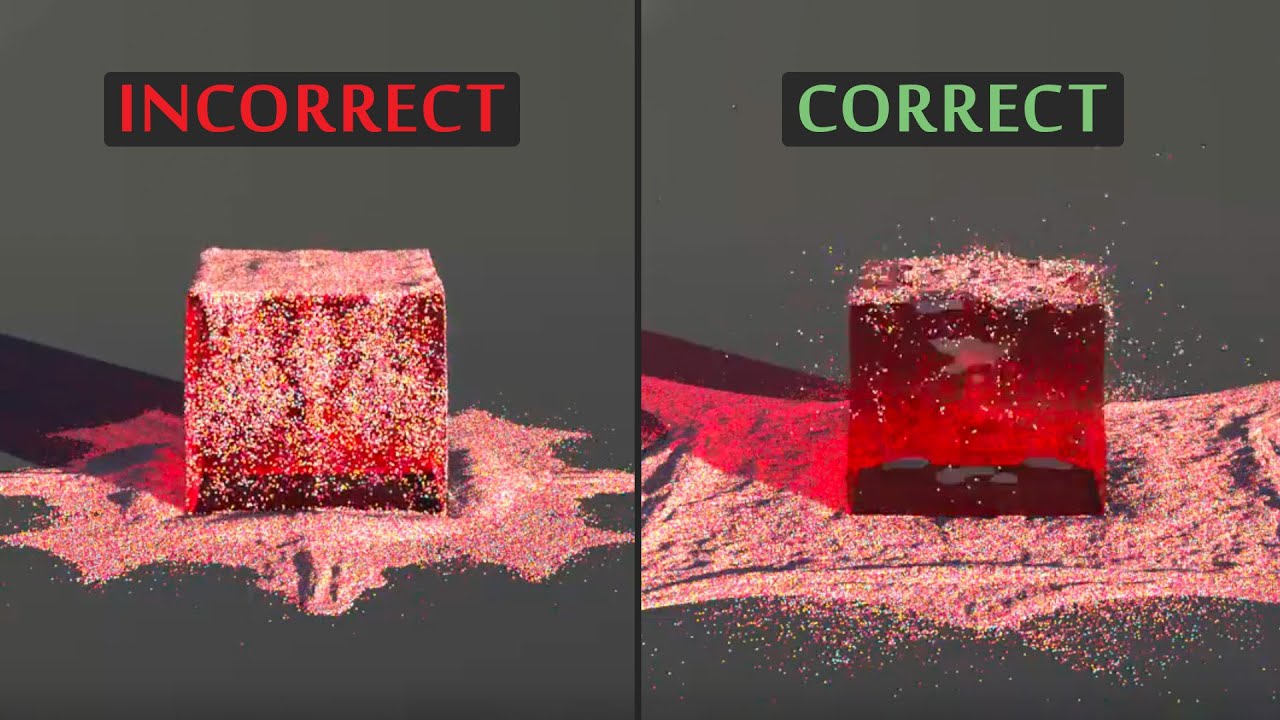
many previous simulation methods struggle  with things disappearing over time.    Don’t believe it? Let me show you this experiment   with gooey dragons and bowls. When using a  traditional technique, whoa, this guy is GONE. So, let’s see what a previous method would do  in this case. We start out with this block,   and after a fair bit of stretching... wait a  second. Are you trying to tell me that this   has the same amount of volume as this? No sir.   This is volume dissipation at its finest. So,   can the new method be so quick, and still retain  the entirety of the volume? Yes sir! Loving it. Let’s see another example  of volume preservation…okay,

Volume Preservation

I am loving this…these transformations are not  reasonable, this is indeed a very challenging   test. Can it withstand all this? Keep your eyes  on the volume of the cubes, which change a little,   it’s not perfect, but considering the crazy things  we are doing to it, this is very respectable. And   in the end, when we let go, we get most of it  back. I’ll freeze the appropriate frame for you. So, second quick aspect. What is it? Yes,  it is quick to run, but that’s not all.    It is also quick to implement. For reference, if  you wish to implement one of our earlier papers   on material synthesis, this is the  number of variables you have to remember,   and this is the pseudocode for the algorithm  itself. What is that? Well, this shows what   steps we need to take to implement our technique  in a computer program. I don’t consider this to   be too complex, but now, compare it to  this simulation algorithm’s pseudocode.    Whoa, much simpler. I would wager  that if everything goes well,   a competent computer graphics research  scientist could implement this   in a day. And that is a rare sight for a modern  simulation algorithm, and that is excellent. I think you are going to hear from this  technique a great deal more. Who wrote it?    Of course, Miles Macklin and Matthias Müller,   two excellent research scientists at NVIDIA.   Congratulations, and with this kind of progress,   just imagine what we will be able to do two more  papers down the line! What a time to be alive! Thanks for watching and for your generous  support, and I'll see you next time!

Другие видео автора — Two Minute Papers

Ctrl+V

Экстракт Знаний в Telegram

Экстракты и дистилляты из лучших YouTube-каналов — сразу после публикации.

Подписаться

Дайджест Экстрактов

Лучшие методички за неделю — каждый понедельник