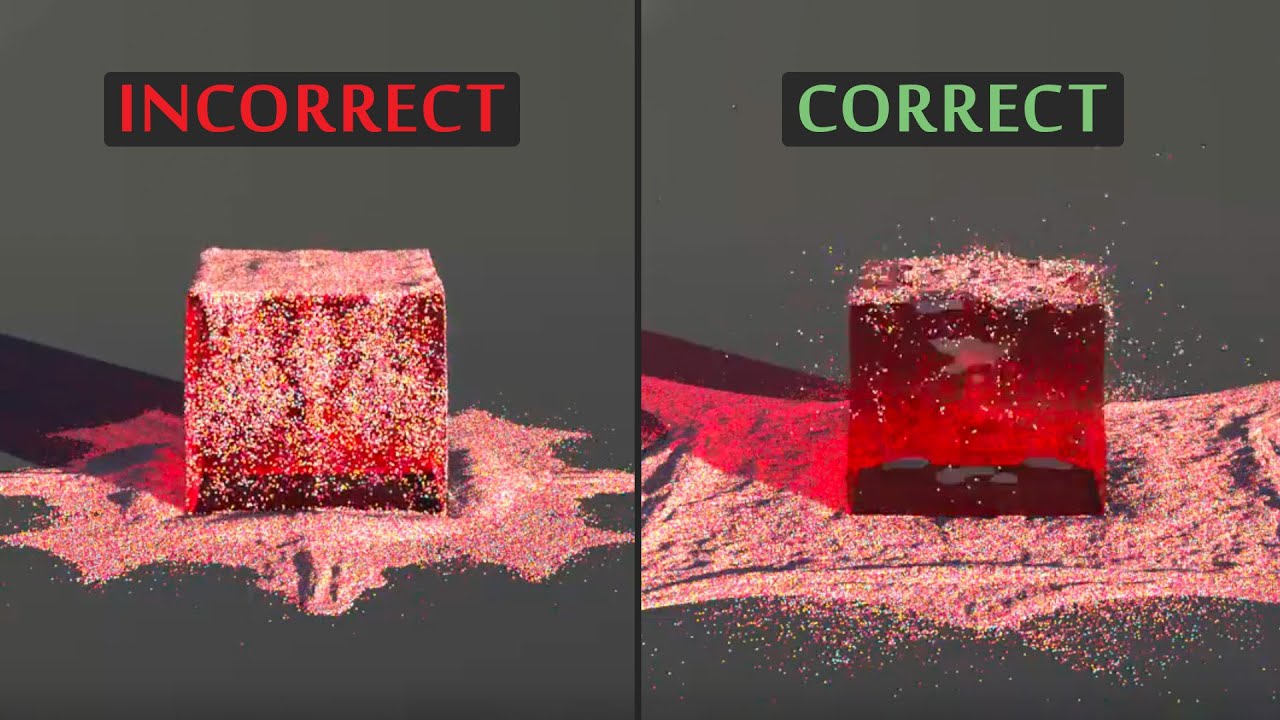
Penetrations. Now, let’s increase the time step size. What do we expect to happen? Well, now, we advance the simulation in bigger chunks, so we should expect to miss even more interactions in between these bigger steps. And…whoa! Sure enough. Even more instability, even more penetration. So, what is the solution? Well, let’s have a look at this new method and see if it can deal with this difficult scene. Now, hold on to your papers, and…wow, I am loving this. Issue number one, things coming to rest is solved, and, issue number two, no penetrations. That is amazing. Now, what is so interesting here? Well, what you see here should not be possible at all, because this new technique computes a reduced simulation instead. This is a simulation on a budget. And not only that, but let’s increase the time step size a little. This means that we can advance the time when in bigger chunks when computing the simulation, at the cost of potentially missing important interactions between these steps. Expect a bad simulation now, like with the previous one, and…wow, this is amazing. It still looks fine. But we don’t know that for sure, because we haven’t seen the reference simulation yet. So, you know what’s coming. Oh yes! Let’s compare it to the reference simulation that takes forever to compute. This looks great. And, let’s see… this looks great too. They don’t look the same, but if I were asked which one reference is, and which is the cheaper, reduced simulation, I am not sure if I would be able to tell. Are you able to tell? Well, be careful with your answer, because I have swapped the two. In reality, this is the reference, and this is the reduced simulation. Were you able to tell? Let me know in the comments below. And that is exactly the point! All this means that we got away with only computing the simulation in bigger steps. So, why is that good? Well, of course, we get through it quicker! Okay, but how much quicker? 110 times quicker. What? The two are close to equivalent, but this is more than a 100 times quicker? Sign me up, right away! Note that this is still not real time, but we are firmly in the seconds per frame domain, so we don’t need an all nighter for such a simulation, just a coffee break. Now note that this particular scene is really suited for the new technique, other scenes aren’t typically a hundred times faster, but, worst case scenario is when we throw around a bunch of furballs, but even that is at least ten to fifteen times faster. What does that mean? Well, an all-nighter simulation can be done maybe not during a coffee break, but during a quick little nap. Yes, we can rest like this tiny dinosaur for a while, and by the time we wake up, the simulation is done, and we can count on it being close to the real deal. So good! Just make sure to keep the friction high while resting here, or otherwise…this happens. So, from now on, we get better simulations, up to a hundred times faster. What a time to be alive! Thanks for watching and for your generous support, and I'll see you next time!