This AI Learned Physics...But How Good Is It? ⚛
5:46

This AI Learned Physics...But How Good Is It? ⚛

Two Minute Papers 27.10.2021 135 335 просмотров 6 740 лайков

Machine-readable: Markdown · JSON API · Site index

Поделиться Telegram VK Бот
Транскрипт Скачать .md
Анализ с AI
Описание видео
❤️ Check out Perceptilabs and sign up for a free demo here: https://www.perceptilabs.com/papers 📝 The paper "High-order Differentiable Autoencoder for Nonlinear Model Reduction" is available here: https://arxiv.org/abs/2102.11026 🙏 We would like to thank our generous Patreon supporters who make Two Minute Papers possible: Aleksandr Mashrabov, Alex Haro, Andrew Melnychuk, Angelos Evripiotis, Benji Rabhan, Bryan Learn, Christian Ahlin, Eric Haddad, Eric Martel, Gordon Child, Ivo Galic, Jace O'Brien, Javier Bustamante, John Le, Jonas, Kenneth Davis, Klaus Busse, Lorin Atzberger, Lukas Biewald, Matthew Allen Fisher, Mark Oates, Michael Albrecht, Michael Tedder, Nikhil Velpanur, Owen Campbell-Moore, Owen Skarpness, Rajarshi Nigam, Ramsey Elbasheer, Steef, Taras Bobrovytsky, Thomas Krcmar, Timothy Sum Hon Mun, Torsten Reil, Tybie Fitzhugh, Ueli Gallizzi. If you wish to appear here or pick up other perks, click here: https://www.patreon.com/TwoMinutePapers Thumbnail background design: Felícia Zsolnai-Fehér - http://felicia.hu Meet and discuss your ideas with other Fellow Scholars on the Two Minute Papers Discord: https://discordapp.com/invite/hbcTJu2 Károly Zsolnai-Fehér's links: Instagram: https://www.instagram.com/twominutepapers/ Twitter: https://twitter.com/twominutepapers Web: https://cg.tuwien.ac.at/~zsolnai/
Оглавление (3 сегментов)

Introduction

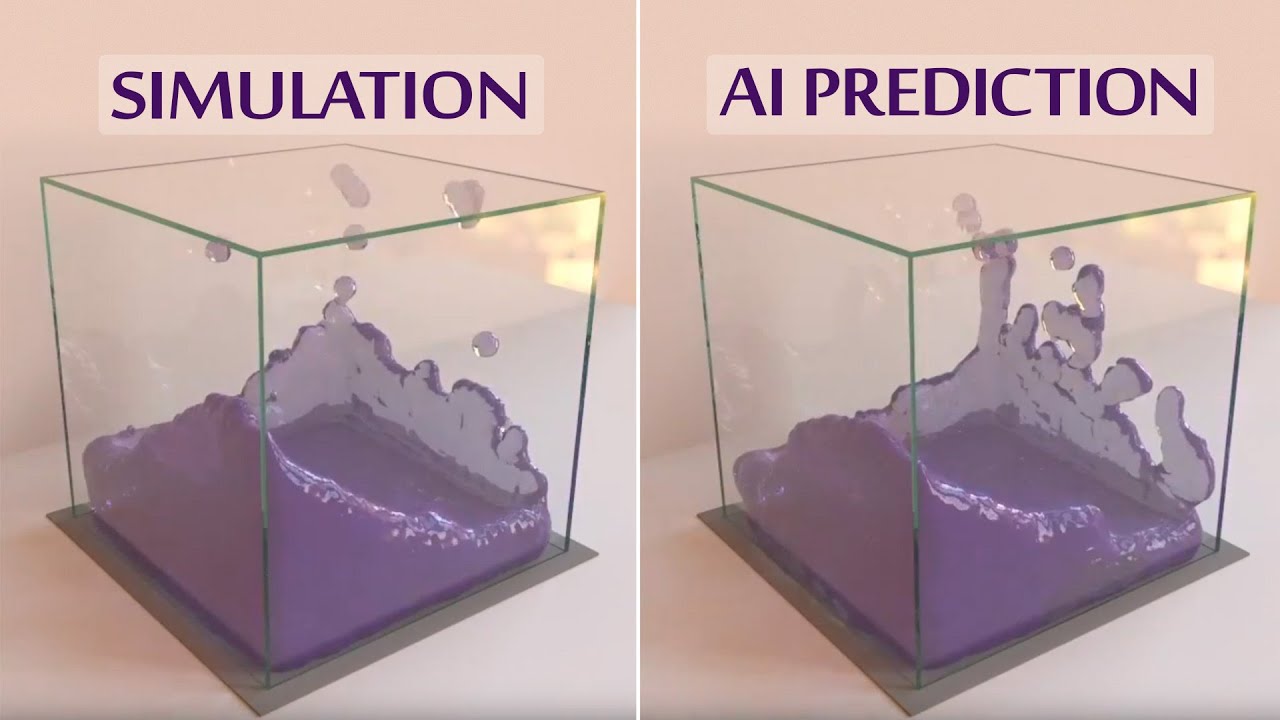
Dear Fellow Scholars, this is Two Minute Papers with Dr. Károly Zsolnai-Fehér. Today we are going to engage in the favorite pastime of the computer graphics researcher, which is…well, this. And believe it or not, all of this is simulated through a learning-based technique. Earlier, we marveled at a paper that showed that an AI can indeed learn to perform a fluid simulation. And just one more paper down the line, the simulations it was able to perform extended to other fields, like structural mechanics, incompressible fluid dynamics, and more. And even better, it could even simulate shapes and geometries that it had never seen before. So today, the question is not whether an AI can learn physics. The question is how well can an AI learn physics? Let’s try to answer that question by having a look at our first experiment. Here is a traditional, handcrafted technique, and the new, neural network-based physics simulator. Both are doing fine so nothing to see he…whoa!

Simulation Accuracy

What happened? Well, dear Fellow Scholars, this is when a simulation blows up. But the new one is still running, even when some traditional simulators blow up. That is excellent. But, we don’t have to bend over backwards to find other situations where the new technique is better than the previous ones. You see the reference simulation here, and it is all well and good that the new method does not blow up, but how accurate is it on this challenging scene? Let’s have a look. The reference shows a large amount of bending, where the head is roughly in line with the knees. Let’s memorize that. Head Got it. Let’s see how the previous methods were able to deal with this challenging simulation. When simulating a system of smaller size…well, none of these are too promising. When we crank up the simulation domain size, the physical modal derivative, PMD in short does pretty well. So, what about the new method? Both bend quite well. Not quite perfect, remember, the head would have to go down to be almost in line with the knees. But, amazing progress nonetheless. This was a really challenging scene, and, in other cases, the new method is able to match the reference simulator perfectly. So far this sounds pretty good, but PMD seems to be a contender, and that, dear Fellow Scholars, is a paper from 2005. From 16 years ago! So why showcase this new work? Well, we have forgotten about one important thing. And here comes the key. The new simulation technique runs from 30 to almost 60 times faster than previous methods. Whoa. How is that even possible? Well, this is a neural network-based technique. And training a neural network typically takes a long time, but, we only need to do this once, and when we are done, querying this neural network typically can be done very quickly. Does this mean…yes!

Conclusion

Yes it does. All this runs in real time for these dinosaur, bunny and armadillo scenes, all of which are built from about ten thousand triangles! And, we can play with them by using our mouse on our home computer. The cactus and hairball scenes require simulating not tens, but hundreds of thousands of triangles, so these took a bit longer as they are running between one and a half and two and a half frames per second. So, this is not only more accurate than previous techniques, not only more resilient than the previous techniques, but is also 30 to 60 timers faster at the same time. Wow. And just think about the fact that just a year ago, an AI could only perform low-resolution fluid simulations, then, a few months ago, more kinds of simulations. And then, today, just one more paper down the line, simulations of this complexity. And just imagine what we will be able to do just two more papers down the line! What a time to be alive! Thanks for watching and for your generous support, and I'll see you next time!

Другие видео автора — Two Minute Papers

Ctrl+V

Экстракт Знаний в Telegram

Экстракты и дистилляты из лучших YouTube-каналов — сразу после публикации.

Подписаться

Дайджест Экстрактов

Лучшие методички за неделю — каждый понедельник