The Tale Of The Unscrewable Bolt! 🔩
5:18

The Tale Of The Unscrewable Bolt! 🔩

Two Minute Papers 21.09.2021 86 787 просмотров 5 338 лайков

Machine-readable: Markdown · JSON API · Site index

Поделиться Telegram VK Бот
Транскрипт Скачать .md
Анализ с AI
Описание видео
❤️ Check out Weights & Biases and sign up for a free demo here: https://wandb.com/papers ❤️ Their mentioned post is available here: https://wandb.ai/mathisfederico/wandb_features/reports/Visualizing-Confusion-Matrices-With-W-B--VmlldzoxMzE5ODk 📝 The paper "Intersection-free Rigid Body Dynamics" is available here: https://ipc-sim.github.io/rigid-ipc/ Scene credits: - Bolt - YSoft be3D - Expanding Lock Box - Angus Deveson - Bike Chain and Sprocket - Okan (bike chain), Hampus Andersson (sprocket) 🙏 We would like to thank our generous Patreon supporters who make Two Minute Papers possible: Aleksandr Mashrabov, Alex Haro, Andrew Melnychuk, Angelos Evripiotis, Benji Rabhan, Bryan Learn, Christian Ahlin, Eric Haddad, Eric Martel, Gordon Child, Ivo Galic, Jace O'Brien, Javier Bustamante, John Le, Jonas, Kenneth Davis, Klaus Busse, Lorin Atzberger, Lukas Biewald, Matthew Allen Fisher, Mark Oates, Michael Albrecht, Nikhil Velpanur, Owen Campbell-Moore, Owen Skarpness, Ramsey Elbasheer, Steef, Taras Bobrovytsky, Thomas Krcmar, Timothy Sum Hon Mun, Torsten Reil, Tybie Fitzhugh, Ueli Gallizzi. If you wish to appear here or pick up other perks, click here: https://www.patreon.com/TwoMinutePapers Thumbnail background image source: https://pixabay.com/images/id-1924173/ Thumbnail background design: Felícia Zsolnai-Fehér - http://felicia.hu Meet and discuss your ideas with other Fellow Scholars on the Two Minute Papers Discord: https://discordapp.com/invite/hbcTJu2 Károly Zsolnai-Fehér's links: Instagram: https://www.instagram.com/twominutepapers/ Twitter: https://twitter.com/twominutepapers Web: https://cg.tuwien.ac.at/~zsolnai/
Оглавление (6 сегментов)

Intro

Dear Fellow Scholars, this is Two Minute  Papers with Dr. Károly Zsolnai-Fehér. I have to say we haven’t had a simulation paper in  a while so today’s episode is going to be my way   of medicating myself. You are more  than welcome to watch the process. And this paper is about performing collision  detection. You see, when we write a simple   space game, detecting whether a collision has  happened or not is a mostly trivial endeavor.

Simulation

However, now, instead, let’s look  at the kind of simulation complexity   that you are expecting from a Two Minute Papers  video…first, let’s try to screw this bolt in   using an industry standard simulation  system, and it is…stuck. Hm…why? Because here, we would need to simulate in  detail, not only whether two things collide,   they collide all the time, but, we need to check  for and simulate friction too! Let’s see what this   new simulation method does with the same scene.   And…oh yes! This one isn’t screwing with us and   does the job perfectly. Excellent. However, this  was not nearly the most complex thing it can do.

Experiment

Let’s try some crazy geometry, with  crazy movements and tons of friction. There we go. This one will do. Welcome  to the expanding lock box experiment. So,   what is this? Look, as we turn the key,  the locking pins retract, and the bottom   is now allowed to fall. This scene contains  tens to hundreds of thousands of contacts,   and yet, it still works perfectly. Beautiful.   I love this one because with this simulation,   we can test intricate mechanisms for robotics and  more before committing to manufacturing anything.    And, unlike with previous methods, we don’t need  to worry whether the simulation is correct or not,   and we can be sure that if we 3D print this,  it will behave exactly this way. So good! Also, here come some of my favorite  experiments from the paper.    For instance, it can also simulate a  piston attached to a rotating disk, or,   smooth motion on one wheel, leading to  intermittent motion on the other one.

Timestep

And, if you feel the urge to build a  virtual bike, do not worry for a second,   because your chain and sprocket mechanisms  will work exactly as you expect to. Loving it. Now, interestingly, look here. The time step size  used with the new technique is a hundred times   bigger, which is great, we can advance the time  in bigger pieces when computing the simulation.

Simulation Time

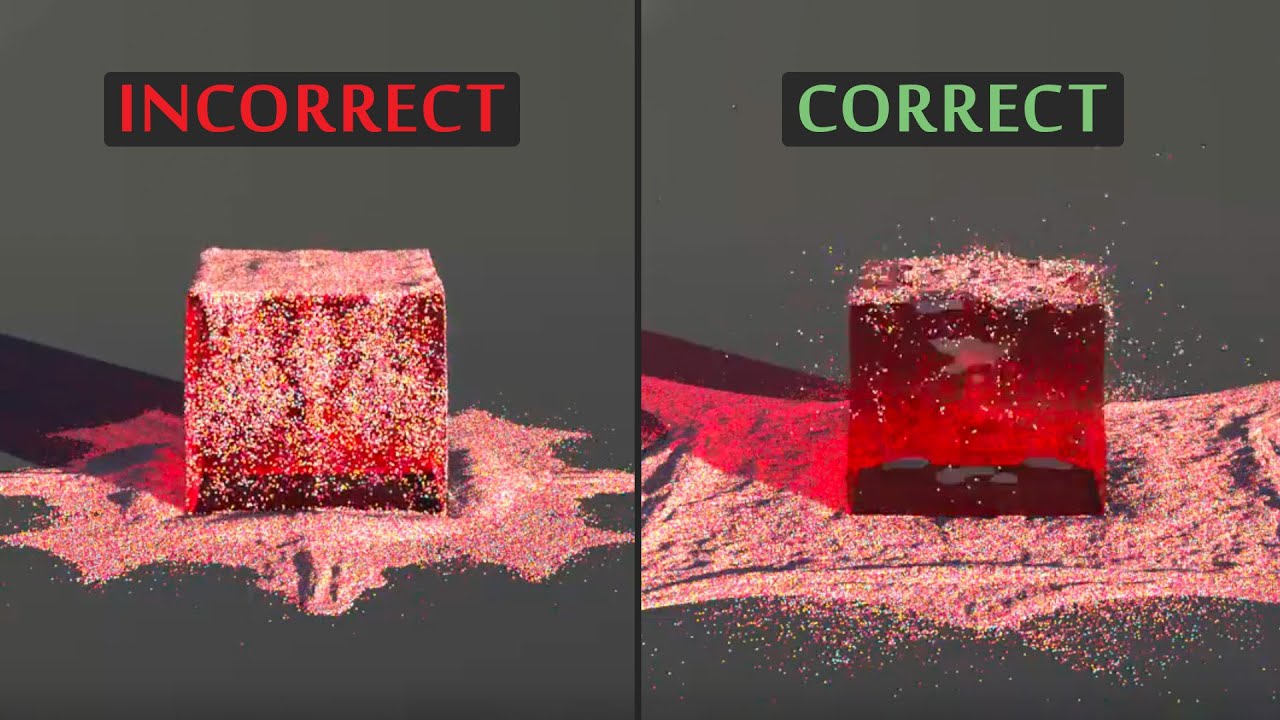
That is good news indeed. However, every time we  do so, we still have to compute a great deal more.    The resulting computation time is still at least  a hundred times slower than previous methods.    However, those methods don’t count, at least  not on these scenes, because they have produced   incorrect results. Look at it some other way -  this is the fastest simulator that actually works. Still, it is not that slow. The one  with the intermittent motion takes   less than a second per time step, which  likely means a few seconds per frame,   while the bolt screwing scene is likely in the  minutes per frame domain. Very impressive! And,

Outro

if you are a seasoned Fellow Scholar, you  know what’s coming, this is where we invoke   the First Law Of Papers, which says that research  is a process. Do not look at where we are,   will be two more papers down the  line. And the line, I am sure   even the more complex simulations will be done  in a matter of seconds. What a time to be alive! Thanks for watching and for your generous  support, and I'll see you next time!

Другие видео автора — Two Minute Papers

Ctrl+V

Экстракт Знаний в Telegram

Экстракты и дистилляты из лучших YouTube-каналов — сразу после публикации.

Подписаться

Дайджест Экстрактов

Лучшие методички за неделю — каждый понедельник