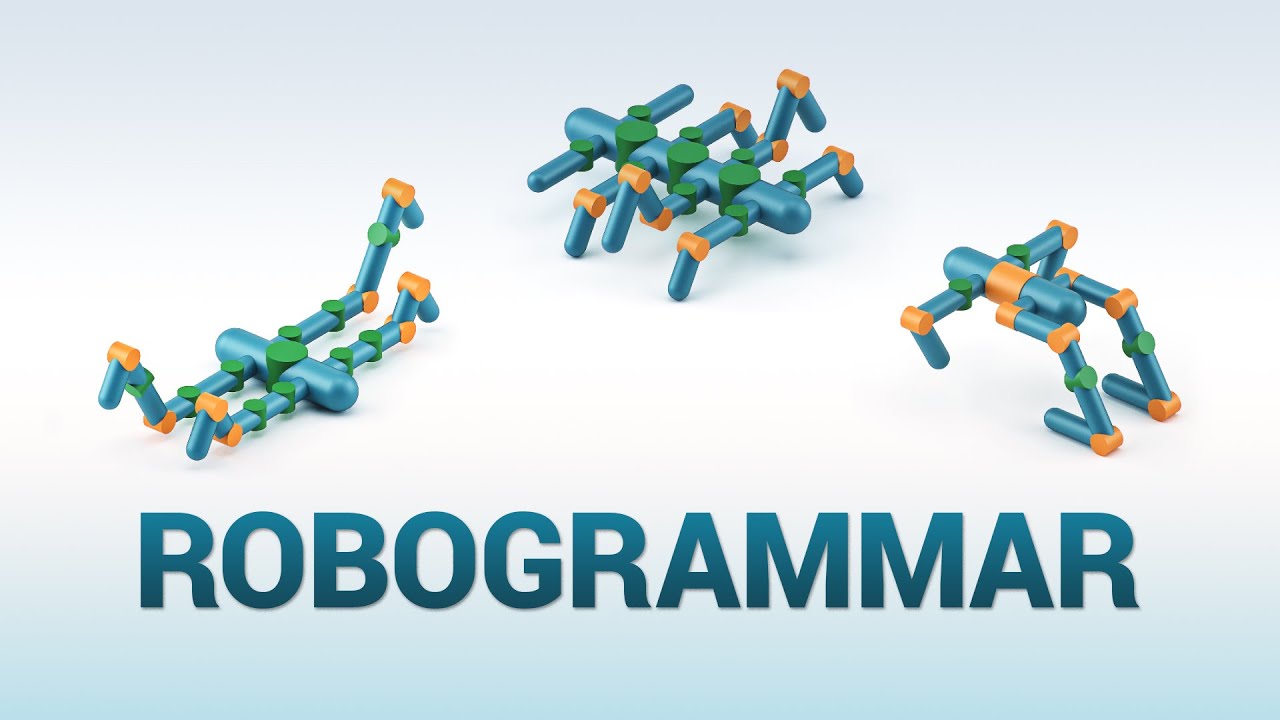
This is Grammar For Robots. What? Why? 🤖
6:22

This is Grammar For Robots. What? Why? 🤖

Two Minute Papers 12.06.2021 131 099 просмотров 8 470 лайков

Machine-readable: Markdown · JSON API · Site index

Поделиться Telegram VK Бот
Транскрипт Скачать .md
Анализ с AI
Описание видео
❤️ Check out Lambda here and sign up for their GPU Cloud: https://lambdalabs.com/papers 📝 The paper "RoboGrammar: Graph Grammar for Terrain-Optimized Robot Design " is available here: https://people.csail.mit.edu/jiex/papers/robogrammar/index.html Breakdancing robot paper: http://moghs.csail.mit.edu/ Building grammar paper: https://www.cg.tuwien.ac.at/research/publications/2015/Ilcik_2015_LAY/ ❤️ Watch these videos in early access on our Patreon page or join us here on YouTube: - https://www.patreon.com/TwoMinutePapers - https://www.youtube.com/channel/UCbfYPyITQ-7l4upoX8nvctg/join 🙏 We would like to thank our generous Patreon supporters who make Two Minute Papers possible: Aleksandr Mashrabov, Alex Haro, Andrew Melnychuk, Angelos Evripiotis, Benji Rabhan, Bryan Learn, Christian Ahlin, Eric Haddad, Eric Martel, Gordon Child, Ivo Galic, Jace O'Brien, Javier Bustamante, John Le, Jonas, Kenneth Davis, Lorin Atzberger, Lukas Biewald, Matthew Allen Fisher, Mark Oates, Michael Albrecht, Nikhil Velpanur, Owen Campbell-Moore, Owen Skarpness, Ramsey Elbasheer, Steef, Taras Bobrovytsky, Thomas Krcmar, Torsten Reil, Tybie Fitzhugh, Ueli Gallizzi. If you wish to appear here or pick up other perks, click here: https://www.patreon.com/TwoMinutePapers Károly Zsolnai-Fehér's links: Instagram: https://www.instagram.com/twominutepapers/ Twitter: https://twitter.com/twominutepapers Web: https://cg.tuwien.ac.at/~zsolnai/

Оглавление (4 сегментов)

Introduction

Dear Fellow Scholars, this is Two Minute Papers with Dr. Károly Zsolnai-Fehér. Today we are going to generate robots with grammars. Wait a second. Grammars? Of all things, what do grammars have to do with robots? Do we need to teach them grammar to speak correctly? No no, of course not! To answer these questions, let’s invoke the Second Law Of Papers, which says that whatever you are thinking about, there is already Two Minute Papers episode on that. Even on grammars. Let’s see if it applies here!

Grammars

In this earlier work, we talked about generating buildings with grammars. So how does that work? Grammars are a set of rules that tell us how to build up a structure, such as a sentence properly from small elements, like nouns, adjectives and so on. My friend, Martin Ilcik loves to build buildings from grammars. For instance, a shape grammar for buildings can describe rules like a wall can contain several windows, below a window goes a window sill, one wall may have at most two doors attached, and so on. A later paper also used a similar concept to generate tangle patterns. So this grammar thing has some power in assembling things after all! So, can we apply this knowledge to build robots! First, the robots in this new paper are built up as a collection of these joint types, links and wheels, which can come in all kinds of sizes and weights.

Robots

Now, our question is, how do we assemble them in a way so that they can traverse a given terrain effectively? Well, time for some experiments! Look at this robot. It has a lot of character, I must say, and can deal with this terrain pretty well. Now look at this poor thing. Someone in the lab at MIT had a super fun day with this one I am sure. Now, these can sort of do the job, but now, let’s see the power of grammars and search algorithms in creating more optimized robots for a variety of terrains! First, a flat terrain. Let’s see…yes, now we’re talking! This one is traversing at great speed… and this one works too. I like how it was able to find vastly different robot structures that both perform well here. Now, let’s look at a little harder level, with gapped terrains. Look, oh wow, loving this. The algorithm recognized that a more rigid body is required to efficiently step through the gaps. And now, I wonder what happens if we add some ridges to the levels, so it cannot only step through the gaps, but has to climb? Let’s see…and we get those long limbs that can indeed climb through the ridges. Excellent! Now, add a staircase, and see who can climb these well! The algorithm says, well, someone with long arms and a somewhat elastic body. Let’s challenge the algorithm some more! Let’s add, for instance, a frozen lake. Who can climb a flat surface that is really slippery? Does the algorithm know? Look, it says, someone who can utilize a low-friction surface by dragging itself through it, or someone with many legs. Loving this. Now, this is way too much fun, so let’s do two more. What about a walled terrain example? What kind of robot would work there? One with a more elastic body, carefully designed to be able curve sharply, enabling rapid direction changes. But it cannot be too long, or else it would bang its head into the wall. This is indeed a carefully crafted specimen for this particular level. Now, of course, real-world situations often involve multiple kinds of terrains, not just one. And of course, the authors of this paper know that very well, and also asked the algorithm to design a specimen that can traverse walled and ridged terrains really well. Make sure to have a look at the paper, which even shows graphs for robot archetypes that work on different terrains. It turns out, one can even make claims about the optimality, which is a strong statement. I did not expect that at all. So, apparently, grammars are amazing at generating many kinds of complex structures, including robots. And note that this paper also has a followup work from the same group where they took it a step further, and made figure skating and breakdancing robots. What a time to be alive! The link is also available in the video description for

Sponsor

that one. Thanks for watching and for your generous support, and I'll see you next time!

Другие видео автора — Two Minute Papers

Ctrl+V

Экстракт Знаний в Telegram

Экстракты и дистилляты из лучших YouTube-каналов — сразу после публикации.

Подписаться

Дайджест Экстрактов

Лучшие методички за неделю — каждый понедельник