Can We Teach Physics To A DeepMind's AI? ⚛
7:43

Can We Teach Physics To A DeepMind's AI? ⚛

Two Minute Papers 01.06.2021 120 346 просмотров 8 366 лайков

Machine-readable: Markdown · JSON API · Site index

Поделиться Telegram VK Бот
Транскрипт Скачать .md
Анализ с AI
Описание видео
❤️ Check out Fully Connected by Weights & Biases: https://wandb.me/papers 📝 The paper "Learning mesh-based simulation with Graph Networks" is available here: https://arxiv.org/abs/2010.03409 🙏 We would like to thank our generous Patreon supporters who make Two Minute Papers possible: Aleksandr Mashrabov, Alex Haro, Alex Serban, Andrew Melnychuk, Angelos Evripiotis, Benji Rabhan, Bryan Learn, Christian Ahlin, Eric Haddad, Eric Martel, Gordon Child, Haris Husic, Ivo Galic, Jace O'Brien, Javier Bustamante, John Le, Jonas, Kenneth Davis, Lorin Atzberger, Lukas Biewald, Matthew Allen Fisher, Mark Oates, Michael Albrecht, Nikhil Velpanur, Owen Campbell-Moore, Owen Skarpness, Ramsey Elbasheer, Robin Graham, Steef, Taras Bobrovytsky, Thomas Krcmar, Torsten Reil, Tybie Fitzhugh, Ueli Gallizzi. If you wish to appear here or pick up other perks, click here: https://www.patreon.com/TwoMinutePapers Meet and discuss your ideas with other Fellow Scholars on the Two Minute Papers Discord: https://discordapp.com/invite/hbcTJu2 Károly Zsolnai-Fehér's links: Instagram: https://www.instagram.com/twominutepapers/ Twitter: https://twitter.com/twominutepapers Web: https://cg.tuwien.ac.at/~zsolnai/
Оглавление (5 сегментов)

Introduction

Dear Fellow Scholars, this is Two Minute  Papers with Dr. Károly Zsolnai-Fehér. If you have been watching this series for  a while, you know very well that I love   learning algorithms and fluid simulations.   But do you know what I like even better?    Learning algorithms applied to fluid simulations,  so I couldn’t be happier with today’s paper. We can create wondrous fluid simulations like  the ones you see here by studying the laws of   fluid motion from physics, and writing a  computer program that contains these laws.    However, I just mentioned learning algorithms.    How do these even come to the picture? If we  can write a program that simulates the laws,   why would we need learning-based algorithms?   This doesn’t seem to make any sense. You see, in this task, the neural networks  can be also applied to solve something that   we already know how to solve. However, if we  use a neural network to perform this task,   we have to train it, which is a long and  arduous process. I hope to have convinced you   that this is a bad, bad idea. Why would anyone  bother to do that? Does this make any sense? Well, it does make a lot of sense! And the  reason for that is that this training step   only has to be done once, and afterwards,  querying the neural network, that is, predicting   what happens next in the simulation runs almost  immediately. This takes way less time than

Simulations

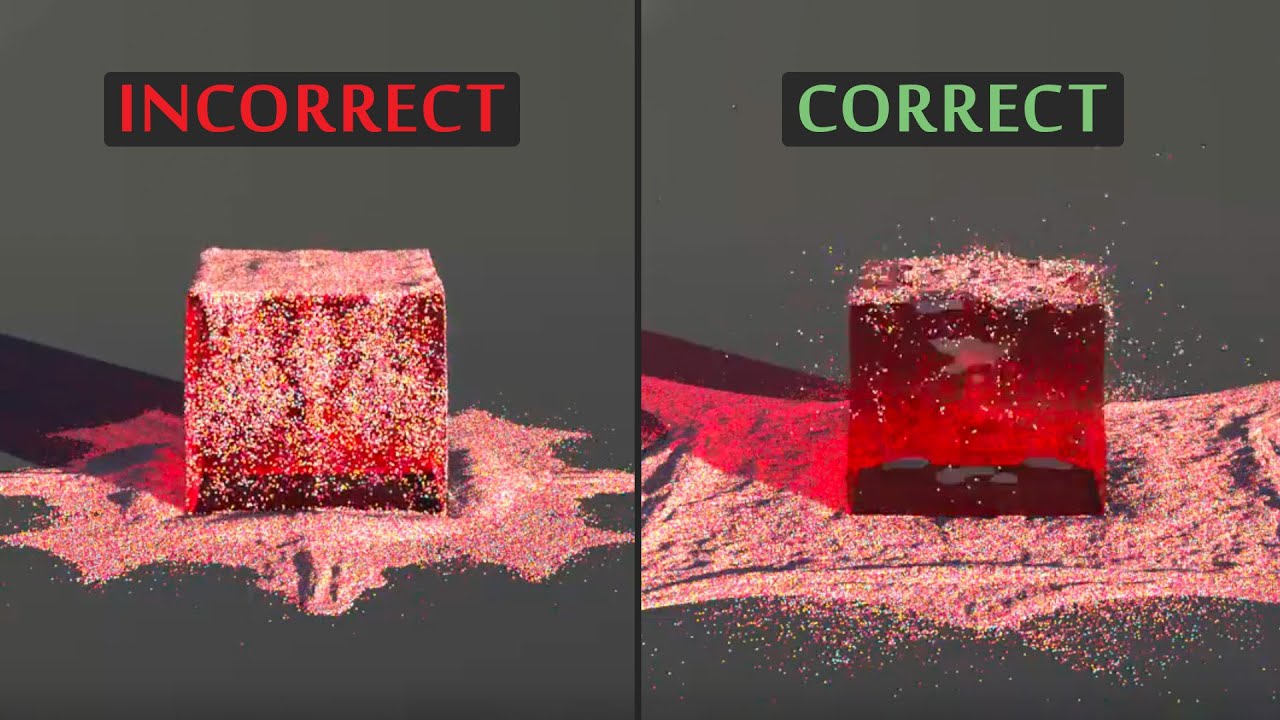
calculating all the forces and pressures in the  simulation while retaining high quality results. This earlier work from last year  absolutely nailed this problem. Look,   this is a scene with the  boxes it has been trained on.    And now, let’s ask it to try to simulate the  evolution of significantly different shapes.    Wow. It not only does well with  these previously unseen shapes,   but it also handles their  interactions really well. But there was more! We could also train it  on a tiny domain with only a few particles,   and then, it was able to learn general  concepts that we can reuse to simulate   a much bigger domain, and also,  with more particles. Fantastic! This was a simple, general model that  truly is a force to be reckoned with.    Now, this is a great leap in neural network-based  physics simulations, but of course, not everything   was perfect there. For instance, over longer  timeframes, solids became incorrectly deformed. And now, a newer iteration of a similar system  just came out from DeepMind’s research lab that   promises to extend these neural networks  for an incredible set of use cases:   aerodynamics, structural mechanics,

Rollouts

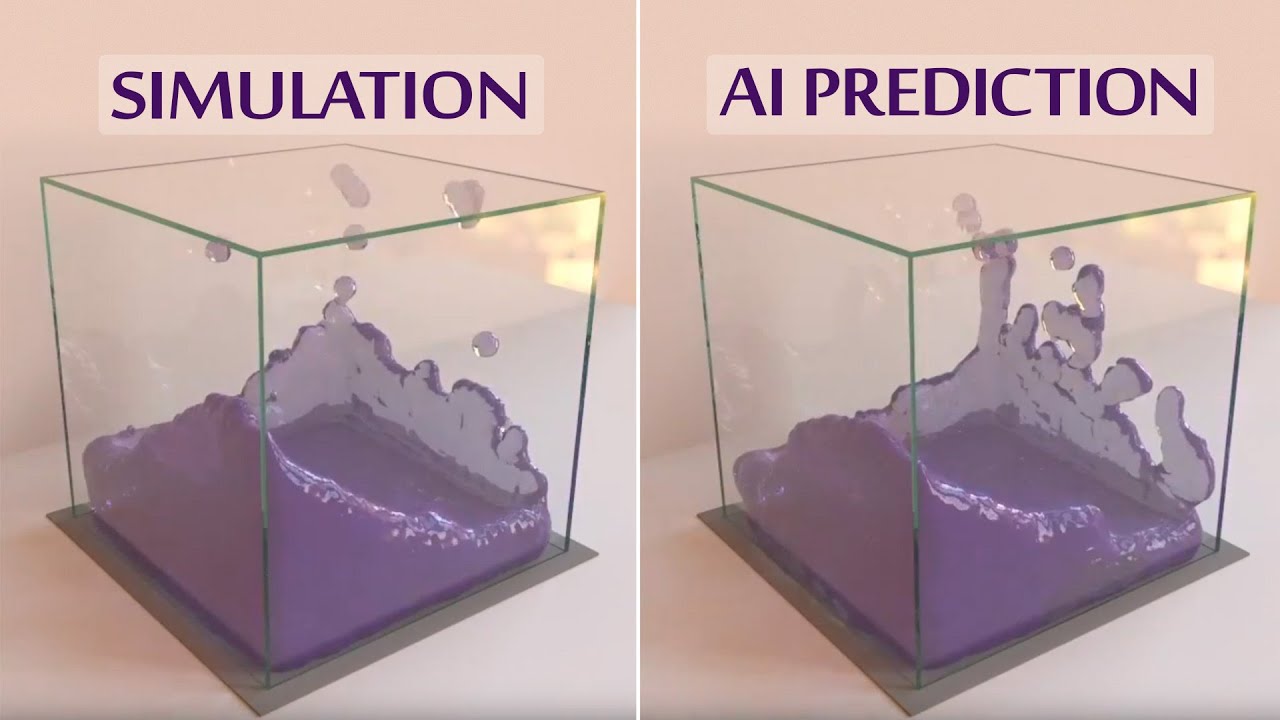
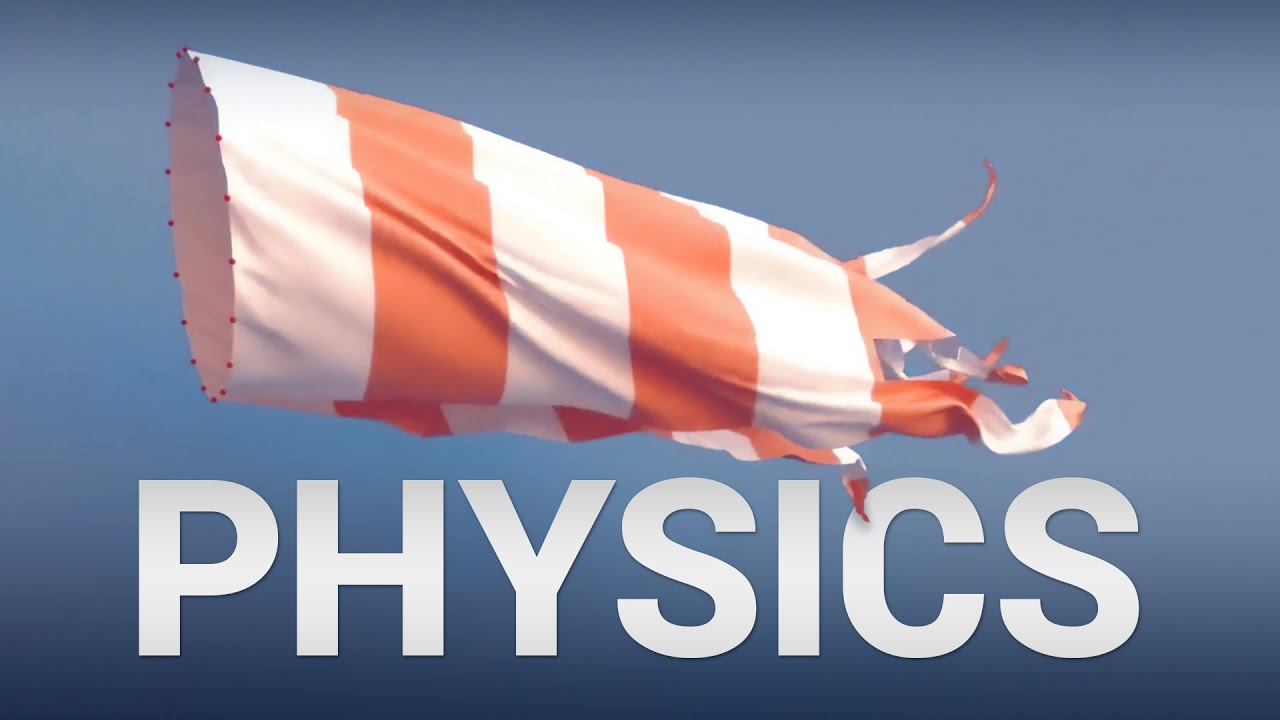
cloth simulations and more. I am very  excited to see how far they have come since! So let’s see how well it does, first, with  rollouts, then, with generalization experiments.    Here is the first rollout experiment, so what  does that mean, and what are we seeing here?    On the left, you see a verified handcrafted  algorithm performing the simulation,   we will accept this as the true data, and  on the right, the AI is trying to continue   the initial simulation. But there is one problem.   And that problem is that the AI was only trained   on short simulations with 400 time steps,  that’s only a few seconds! And unfortunately,   this test will be a hundred times longer. So, it  only learned on short simulations, can it manage   to run a longer one and remain stable? Well, that  will be tough…but, so far so good…still running.    My goodness, this is really something. Still  running and it’s very close to the ground truth! Okay, that is fantastic, but that was just a  piece of cloth. What about interaction with other   objects? Well, let’s see. I’ll stop the process  here and there so we can inspect the differences.    Again, flying colors. Loving it.

Simulation

And, apparently, the same can be said for  simulations in structural mechanics, and   incompressible fluid dynamics. Now, that is one  more important lesson here - to be able to solve   such a wide variety of simulation problems, we  need a bunch of different hancrafted algorithms   that took many-many years to develop. But this  one neural network can learn and perform them all,   and it can do it 10 to a 100 times quicker. And now comes the second half, generalization  experiments. This means a simulation scenario   with shapes that the algorithm has never seen  before. And let’s see if it obtained general   knowledge of the underlying laws of physics  to be able to pull this off. Oh my! Look at   that! Even the tiny piece that is hanging off  of the flag is simulated nearly perfectly. In this one, they gave it different wind speeds  and directions that it hadn’t seen before, and not   only that, but we are varying these parameters  in time, and it doesn’t even break a sweat. And hold on to your papers, because  here comes my favorite - it can even   learn on a small-scale simulation with  a simple rectangular flag, and now,   we throw at it a much more detailed, cylindrical  flag with tassels. Surely this will be way beyond   what any learning algorithm can do today.   And…okay, come on…I am truly out of words. Look. So now, this is official. We can ask an AI to  perform something that we already know how to do,   and it will not only be able to reproduce  similar simulations, but we can even ask things   that were previously quite unreasonably outside  of what it had seen, and it handles all these   with flying colors. And it does this much better  than previous techniques were able to. And it can   learn from multiple different algorithms at  the same time. Wow. What a time to be alive!

Outro

Thanks for watching and for your generous  support, and I'll see you next time!

Другие видео автора — Two Minute Papers

Ctrl+V

Экстракт Знаний в Telegram

Экстракты и дистилляты из лучших YouTube-каналов — сразу после публикации.

Подписаться

Дайджест Экстрактов

Лучшие методички за неделю — каждый понедельник