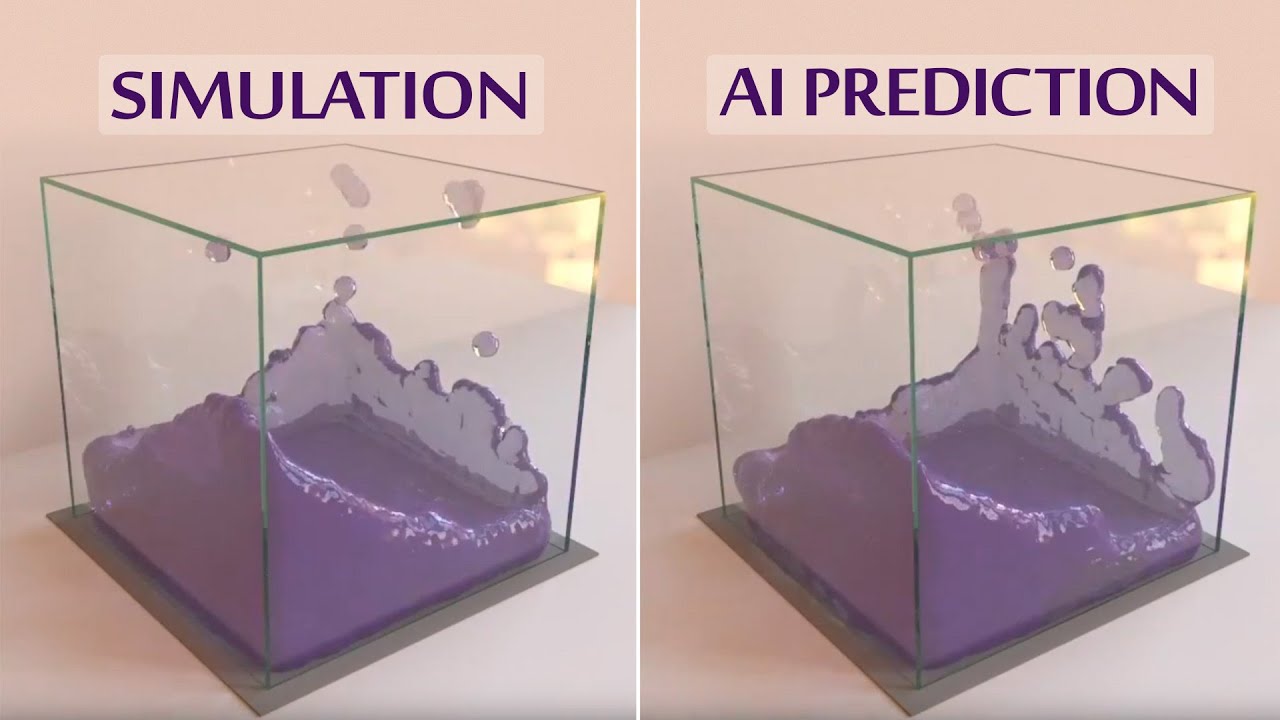
On the geometry side, a followup paper appeared just a year later that could simulate a handful of bubbles colliding, sticking together. Then, three years later, in 2020, Christopher Batty’s group also proposed a method that was capable of simulating merging and coalescing behavior on larger-scale simulations. So, what about today’s paper? Are we going even larger with hundreds of thousands, or maybe even millions of bubbles? No, we are going to take just one bubble… or at most a handful, and have a real close look at a method that is capable of simulating these beautiful evolving rainbow patterns. The key to this work is that it is modeling how the thickness of the surfaces changes over time. That makes all the difference. Let’s look under the hood and observe how much of an effect the evolving layer thickness has on the outputs. The red color coding represents thinner, and the blue shows us the thicker regions. This shows us that some regions in these bubbles are more than twice as thick as others. And there are also more extreme cases, there is a six-time difference between this and this part. You can see how the difference in thickness leads to waves of light interfering with the bubble and creating these beautiful rainbow patterns. You can’t get this without a proper simulator like this one. Loving it. This variation in thicknesses is responsible for a selection of premium-quality effects in a simulation beyond surface vortices, interference patterns can also be simulated, and, deformation-dependent rupturing of soap films. This incredible technique can simulate all of these phenomena. And now, our big question is, okay, it simulates all these, but how well does it do that? It is good enough to fool the human eye, but how does it compare to the strictest adversary of all… reality! I hope you know what is coming. Oh yeah! Hold on to your papers, because now we will let reality be our judge and compare the simulated results to that. That is one of the biggest challenges in any kind of simulation research, so, let’s see. This is a piece of real footage of a curved soap film surface, where these rainbow patterns get convected by an external force field. Beautiful. And now, let’s see the simulation. Wow, this has to be really close. Let’s see them side by side and decide together. Whoa. The match in the swirly region here is just exceptional. Now, note that even if the algorithm is a 100% correct, this experiment cannot be a perfect match because not only the physics of the soap film has to be simulated correctly, but the forces that move the rainbow patterns as well. We don’t have this information from the real-world footage, so the authors had to try to reproduce these forces, which is not part of the algorithm, but a property of the environment. So, I would say that this footage is as close as one can possibly get. My goodness, well done! So, how much do we have to pay for this in terms of computation time? If you ask me, I would pay at the very least double for this. And if you have been holding on to your papers so far, now, squeeze that paper, because now comes the best part, because in the cheaper cases, only 4 to 7% extra computation, which is outrageous. There is this more complex case, with the large deforming sphere. In this case, the new technique indeed makes a huge difference. So, how much extra computation do we have to pay for this? Only 31%. 31% extra computation for this? That is a fantastic deal, you can sign me up right away. As you see, the pace of progress in computer graphics research is absolutely incredible, and these simulations are just getting better and better by the day. Imagine what we will be able to do just two more papers down the line! What a time to be alive! Thanks for watching and for your generous support, and I'll see you next time!