❤️ Check out Snap's Residency Program and apply here: https://lensstudio.snapchat.com/snap-ar-creator-residency-program/?utm_source=twominutepapers&utm_medium=video&utm_campaign=tmp_ml_residency
❤️ Try Snap's Lens Studio here: https://lensstudio.snapchat.com/
🎬Our Instagram page with the slow-motion videos is available here:
https://www.instagram.com/twominutepapers/
📝 The paper "AnisoMPM: Animating Anisotropic Damage Mechanics" is available here:
https://joshuahwolper.com/anisompm
❗Erratum: At 4:17, I should have written "Anisotropic damage (new method)". Apologies!
🙏 We would like to thank our generous Patreon supporters who make Two Minute Papers possible:
Aleksandr Mashrabov, Alex Haro, Alex Paden, Andrew Melnychuk, Angelos Evripiotis, Benji Rabhan, Bruno Mikuš, Bryan Learn, Christian Ahlin, Daniel Hasegan, Eric Haddad, Eric Martel, Gordon Child, Javier Bustamante, Lorin Atzberger, Lukas Biewald, Michael Albrecht, Nikhil Velpanur, Owen Campbell-Moore, Owen Skarpness, Ramsey Elbasheer, Robin Graham, Steef, Sunil Kim, Taras Bobrovytsky, Thomas Krcmar, Torsten Reil, Tybie Fitzhugh.
If you wish to support the series, click here: https://www.patreon.com/TwoMinutePapers
Károly Zsolnai-Fehér's links:
Instagram: https://www.instagram.com/twominutepapers/
Twitter: https://twitter.com/twominutepapers
Web: https://cg.tuwien.ac.at/~zsolnai/
Оглавление (4 сегментов)
<Untitled Chapter 1>
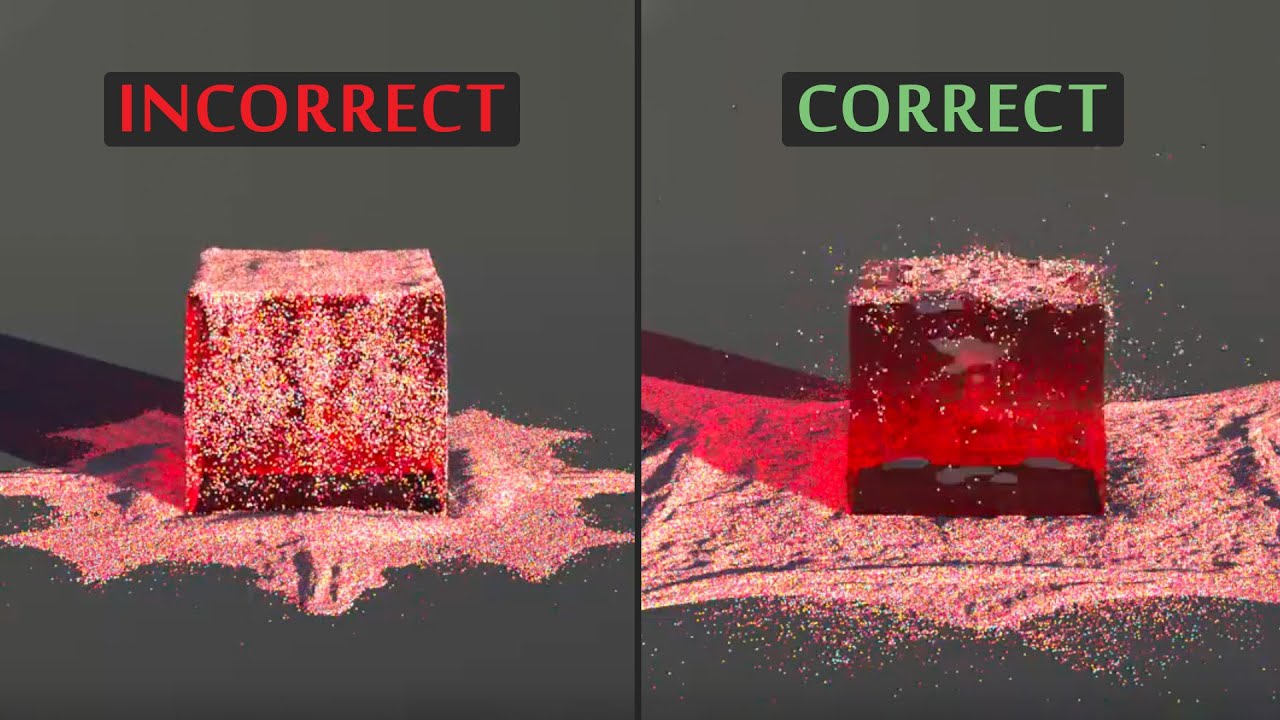
Dear Fellow Scholars, this is Two Minute Papers with Dr. Károly Zsolnai-Fehér. Perhaps the best part of being a computer graphics researcher is creating virtual worlds on a daily basis and computing beautiful simulations in these worlds. And what you see here is not one, but two kinds of simulations. One is a physics simulation that computes how these objects move, and a light transport look. In this video, we will strictly talk about the physics simulation part of what you see on the screen. To simulate these beautiful phenomena, many recent methods build on top of a technique called the Material Point Method. This is a hybrid simulation technique that uses both particles and grids to create these beautiful animations, however, when used by itself, we can come up with a bunch of cases that it cannot simulate properly. One such example is cracking and tearing phenomena, which has been addressed in this great paper that we discussed earlier this year. With this method, we could smash oreos, candy crabs, pumpkins, and much, much more. It even supported tearing this piece of bread apart. This already looks quite convincing, and in this series, I always say, two more papers down the line, and it will be improved significantly. Today, we are going to have a Two Minute Papers moment of truth, because this is from a followup work by Joshuah Wolper, the first author of the previous bread paper, and you can immediately start holding on to your papers, because this work is one of the finest I have seen as of late. With this, we can enrich our simulations with anisotropic damage and elasticity. So what does that mean exactly? This means that it supports more extreme topological changes in these virtual objects. This leads to better material separation when the damage happens. For instance, if you look here on the right, this was done by a previous method. For the first sight, it looks good, there is some bouncy behavior here, but the separation line is a little too clean. Let’s have a look at the new method! Woo-hoo! Now that’s what I am talking about! Let’s have another look. I hope you now see what I meant by the previous separation line being a little too clean. Remarkably, it also supports changing a few intuitive parameters, like eta, the crack propagation speed, which we can use to further tailor the simulation to our liking. Artists are going to love this. We can also play with the Young modulus, which describes the material’s resistance against fractures. On the left, it is quite low, and makes the material tear apart easily, much like a sponge. As we increase it bit, we get a stiffer material, which gives us this glorious floppy behavior. Let’s increase it even more, and see what happens! Yes, it is more resistant against damage, however, in return, it gives us some more vibrations after the break. It is not only realistic, but it also gives us the choice with these parameters to tailor our simulation results to our liking. Absolutely incredible. Now then, if you have been holding on to your papers so far, now squeeze that paper, because previous methods were only capable of tearing off a small piece, or only a strip of this virtual pork, let’s see what this new work will do. Yes, it can also simulate peeling off an entire layer. Glorious! But that’s not the only thing we can peel. It can also deal with small pieces of this mozzarella cheese. I must admit that I have never done this myself, so this will be the official piece of homework for me, and for the more curious minds out there after watching this video. Let me know in the comments if it went the same way in your kitchen as it did in the simulation here! You get extra credit if you post a picture too. And finally, if we tear this piece of meat apart, you see that it takes into consideration the location of the fibers, and the tearing takes place not in an arbitrary way, but much like in reality, it tears along the muscle fibers. So, how fast is it? We still have to wait a few seconds for each frame in these simulations. None of them took too long, there is a fish tearing experiment in the paper that went very quickly, half a second for each frame is a great deal, the pork experiment took nearly 40 seconds for each frame, and the most demanding experiments involved a lance and bones. Frankly, they were a little too horrific to be included here, even for virtual bodies, but if you wish to have a look, make sure to click the paper in the video description. But wait, are you seeing what I am seeing? Those examples took more than 1000 times longer to compute! Goodness! How can that be? Look! As you see here, in these cases, the delta-t-step is extremely tiny, which means that we have to advance the simulation with tiny-tiny time steps that takes much longer to compute. How tiny? Quite! In this case, we have to advance the simulation one millionth of a second at a time. The reason for this is that bones have an extremely high stiffness, which makes this method much less efficient. And of course, you know the drill, two more papers down the line, and this may run interactively on a consumer machine at home. So what’s the verdict? Algorithm design. A+.
Anisotropic
Exposition, A+. Quality of presentation A double plus. And it’s still Mr. Wolper’s third paper in computer graphics. Unreal.
Transverse Isotropic
And we, researchers even get paid to create beautiful works like this. I also couldn’t resist creating a slow-motion version of some of these videos, so if this
Orthotropic
is something that you wish to see, make sure to visit our Instagram page in the video description for more. Thanks for watching and for your generous support, and I'll see you next time!