This Neural Network Learned The Style of Famous Illustrators
5:18

This Neural Network Learned The Style of Famous Illustrators

Two Minute Papers 14.03.2020 80 143 просмотров 3 666 лайков

Machine-readable: Markdown · JSON API · Site index

Поделиться Telegram VK Бот
Транскрипт Скачать .md
Анализ с AI
Описание видео
❤️ Check out Weights & Biases here and sign up for a free demo here: https://www.wandb.com/papers The shown blog post is available here: https://www.wandb.com/articles/better-models-faster-with-weights-biases 📝 The paper "#GANILLA: Generative Adversarial Networks for Image to Illustration Translation" is available here: https://github.com/giddyyupp/ganilla 🙏 We would like to thank our generous Patreon supporters who make Two Minute Papers possible: Alex Haro, Alex Paden, Andrew Melnychuk, Angelos Evripiotis, Anthony Vdovitchenko, Benji Rabhan, Brian Gilman, Bryan Learn, Daniel Hasegan, Dan Kennedy, Dennis Abts, Eric Haddad, Eric Martel, Evan Breznyik, Geronimo Moralez, James Watt, Javier Bustamante, Kaiesh Vohra, Kasia Hayden, Kjartan Olason, Levente Szabo, Lorin Atzberger, Lukas Biewald, Marcin Dukaczewski, Marten Rauschenberg, Maurits van Mastrigt, Michael Albrecht, Michael Jensen, Nader Shakerin, Owen Campbell-Moore, Owen Skarpness, Raul Araújo da Silva, Rob Rowe, Robin Graham, Ryan Monsurate, Shawn Azman, Steef, Steve Messina, Sunil Kim, Taras Bobrovytsky, Thomas Krcmar, Torsten Reil, Tybie Fitzhugh. https://www.patreon.com/TwoMinutePapers Meet and discuss your ideas with other Fellow Scholars on the Two Minute Papers Discord: https://discordapp.com/invite/hbcTJu2 Thumbnail background image credit: https://pixabay.com/images/id-3651473/ Károly Zsolnai-Fehér's links: Instagram: https://www.instagram.com/twominutepapers/ Twitter: https://twitter.com/karoly_zsolnai Web: https://cg.tuwien.ac.at/~zsolnai/
Оглавление (4 сегментов)

Introduction

Dear Fellow Scholars, this is Two Minute Papers with Dr. Károly Zsolnai-Fehér. In the last few years, we have seen a bunch of new AI-based techniques that were specialized in generating new and novel images. This is mainly done through learning-based techniques, typically a Generative Adversarial Network, a GAN in short, which is an architecture where a generator neural network creates new images, and passes it to a discriminator network, which learns to distinguish real photos from these fake, generated images. These two networks learn and improve together, and generate better and better images over time. What you see here is a set of results created with the technique by the name CycleGAN. This could even translate daytime into nighttime images, reimagine a picture of a horse as if it were a zebra, and more. We can also use it for style transfer, a problem where we have two input images, one for content

Results

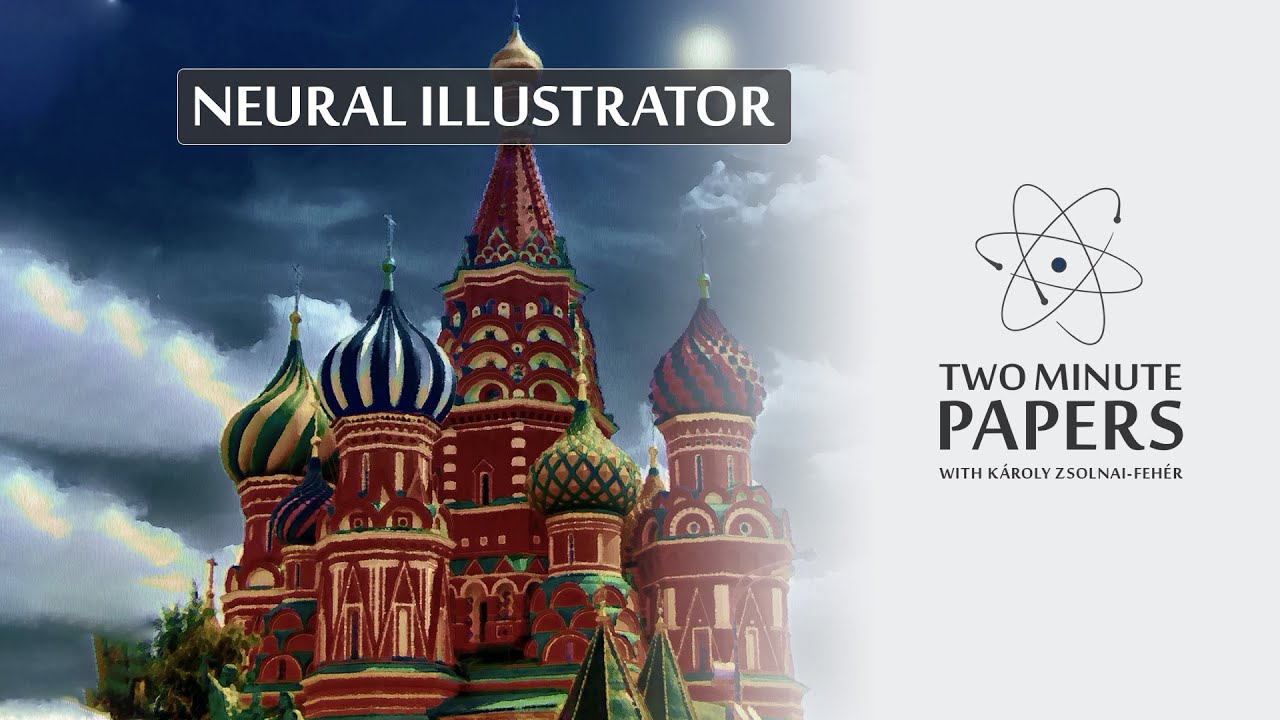
and one for style, and as you see here, the output would be a nice mixture of the two. However, if we use CycleGAN for this kind of style transfer, we’ll get something like this. The goal was to learn the style of a select set of famous illustrators of children’s books by providing an input image with their work. So, what do you think about the results? Well, the style is indeed completely different, but the algorithm seems a little too heavy-handed and did not leave the content itself intact. Let’s have a look at another result with a previous technique. Maybe this will do better. This is DualGAN, which refers to a paper by the name Unsupervised dual learning for image-to-image translation. This uses two GANs to perform image translation, where one GAN learns to translate, for instance, from day to night, while the other one learns the opposite, night to day translation. This, among other advantages, makes things very efficient, but as you see here, in these cases, it preserves the content of the image, but perhaps a little too much, because the style itself does not appear too prominently in the output images. So CycleGAN is good at transferring style, but a little less so for content, and DualGAN is good at preserving the content, but sometimes adds too little of the style to the image. And now, hold on to your papers, because this new technique by the name GANILLA offers us these results. The content is intact, checkmark, the style goes through really well, checkmark. It preserves the content and transfers the style at the same time! Excellent! One of the many key reasons as to why this happens is the usage of skip connections, which help preserve the content information as we travel deeper into the neural network. So, finally, let’s put our money where our mouth is and take a bunch of illustrators, marvel at their unique style, and then, apply it to photographs and see how the algorithm stacks up against other previous works. Wow.

Conclusion

I love these beautiful results. These comparisons really show how good the new GANILLA technique is at preserving content. And note that these are distinct artistic styles that are really difficult to reproduce, even for humans. It is truly amazing that we can perform such a thing algorithmically. Don’t forget that the first style transfer paper appeared approximately 3-3. 5 years ago, and now, we have come a long-long way! The pace of progress in machine learning research is truly stunning! While we are looking at some more amazing results, this time around, only from GANILLA, I will note that the authors also made a user study with 48 people who favored this against previous techniques. And, perhaps leaving the best for last, it can even draw in the style of Hayao Miyazaki. I bet there are a bunch of Miyazaki fans watching, so let me know in the comments what you think about these results! What a time to be alive!

Outro

This episode has been supported by Weights & Biases. In this post they show you how to easily iterate on models by visualizing and comparing experiments in real time. Weights & Biases provides tools to track your experiments in your deep learning projects. Their system is designed to save you a ton of time and money, and it is actively used in projects at prestigious labs, such as OpenAI, Toyota Research, GitHub, and more. And, the best part is that if you are an academic or have an open source project, you can use their tools for free. It really is as good as it gets. Make sure to visit them through wandb. com/papers or just click the link in the video description and you can get a free demo today. Our thanks to Weights & Biases for their long-standing support and for helping us make better videos for you. Thanks for watching and for your generous support, and I'll see you next time!

Другие видео автора — Two Minute Papers

Ctrl+V

Экстракт Знаний в Telegram

Экстракты и дистилляты из лучших YouTube-каналов — сразу после публикации.

Подписаться

Дайджест Экстрактов

Лучшие методички за неделю — каждый понедельник