🔗 Join our WhatsApp Community
Get the latest AI updates, tips, and insights straight to your inbox:
https://join.switchit.app/66b87e62
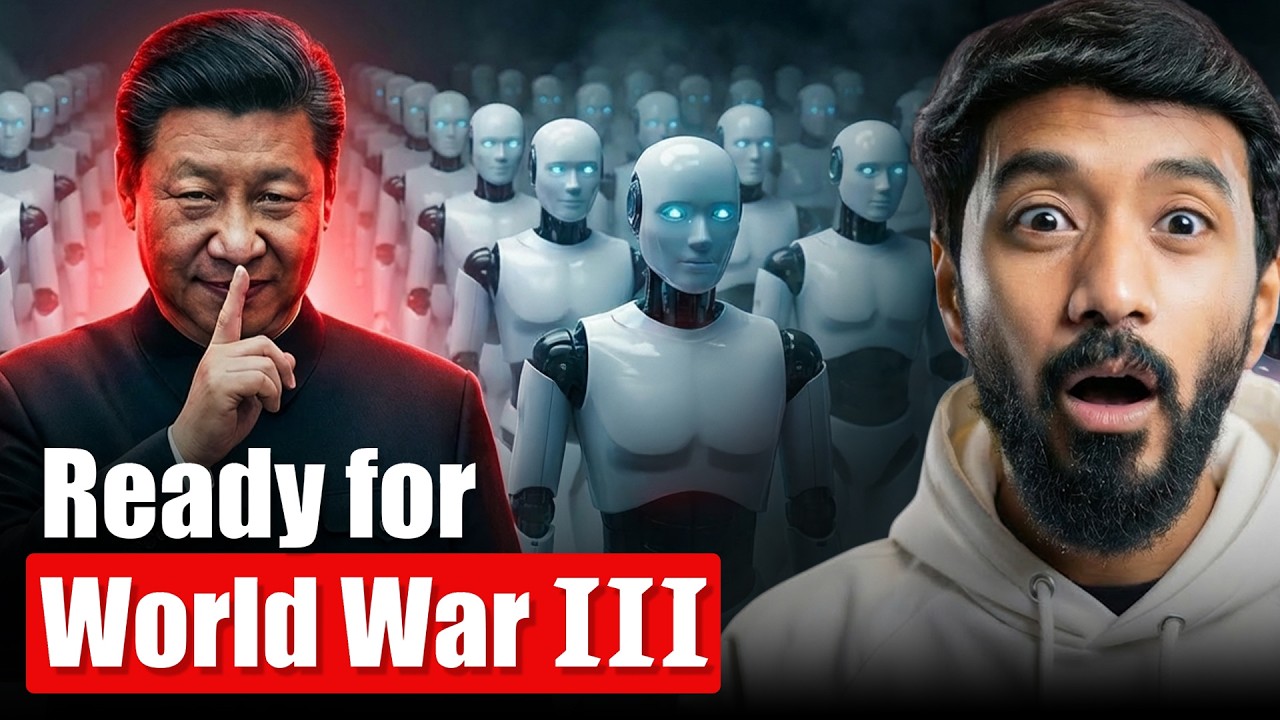
China isn't just developing AI, they're buildiing an entire society around it. From driverless taxis completing 8 million rides to deploying 10,000+ humanoid robots. While the US debates AI regulation and India plays catch-up, China is quietly building something the world has never seen. An entire civilization powered by artificial intelligence. This isn't science fiction. This is happening RIGHT NOW.
TIMESTAMPS :-
00:00 - Introduction: AI in Beijing Today
03:05 - Chapter 1: Mobility (Robotaxis and Autonomous Shipping)
06:34 - Chapter 2: Industries, Cities, and Health
13:25 - Chapter 3: Home and Education
18:00 - Chapter 4: Media, Gaming, and Film
20:21 - Challenges: The Hardware and Trust Limits
24:23 - Conclusion: A World Where Intelligence Lives
--------
To Know More,
Follow Vaibhav Sisinty On ⤵︎
Instagram @VaibhavSisinty
https://www.instagram.com/vaibhavsisinty
Twitter @VaibhavSisinty
https://twitter.com/VaibhavSisinty
Facebook @VaibhavSisinty
https://www.facebook.com/vaibhavsisinty/
LinkedIn - Vaibhav Sisinty
https://www.linkedin.com/in/vaibhavsisinty
Оглавление (7 сегментов)
Introduction: AI in Beijing Today
In Beijing right now, cars are pulling over to pick up passengers with no one in the driver's seat. You climb in and the car glides forward with a confidence most humans can't match. Its cameras, sensors, and algorithms read the entire street like a living map, anticipating every turn and every pedestrian before they move. Across the country, machines like this are already at work. Delivery drones are dropping meals on rooftops. Children are learning from AI tutors that understand their weaknesses better than a human teacher. Factories are running through the night where robotic arms assemble parts with no one watching. This isn't a glimpse of the future. It's the everyday reality in parts of China today. Because while much of the world is still experimenting with AI, China is quietly building an entire society around it. Even industry leaders are watching closely. Nvidia CEO Jensen Huang recently said China is getting very competitive very fast. Public sentiment tells a similar story. An Ipsos survey found that 78% of Chinese citizens believe AI has more advantages than disadvantages compared to just 35% of Americans. While many Western nations remain cautious, China's population appears far more confident. Seeing AI not as a threat to manage, but a tool to master. What's happening in China right now might just change how the rest of the world lives tomorrow. — In the year of 2016, the then President Barack Obama issued two documents policy initiative on promoting artificial intelligence in the US. — In 2016, the United States began to talk seriously about artificial intelligence. President Barack Obama's administration released the first policy initiatives outlining how AI could shape everything from health care and education to national defense. The message was clear. AI was going to define the next era of global power. A year later, China answered. In July 2017, Beijing released the new generation artificial intelligence development plan, a 20-year road map that spelled out an ambition. By 2030, China would become the world leader in AI. It set a simple target with a big number. Build a 150 billion USD domestic AI industry and use it to create more than1 trillion dollars of value across the wider economy. But China's goal was not just to compete. It was to transform. AI for Beijing was never just a technology project. It was a national strategy, a way to upgrade its industries, boost productivity, and prepare for a future where data, not oil, drives power. Factories, farms, hospitals, and classrooms were all part of the plan. For a country facing slowing growth, an aging population, and rising labor costs, AI was not optional. It was essential. In just a few years, that blend of state planning and private innovation created one of the fastest growing AI ecosystems in the world. It is only when you see what China has already built in its streets, schools, and factories that you realize how far ahead it might actually be.
Chapter 1: Mobility (Robotaxis and Autonomous Shipping)
And the first place you see that future is on the road. Shanghai teenager Tang Yuyang paid 21 yen or $3 to ride 6 km in a driverless taxi just for the thrill of being a small part of the city's automotive history. Tang was one of the first passengers in Shanghai. The 16-year-old high school was excited and nervous and he said he felt the experience was close to riding with a human driver but with a touch of technology. Today, the robo taxi is not running just in Shanghai, but in cities like Beijing and Shenzhen. Certain zones have them running them in full swing with hundreds of taxis in operation. In these taxis, there is no steering wheel twitch, no sudden acceleration, just a smooth, deliberate rhythm because this car is not reacting. It's predicting. On its roof, a LAR dome spins slowly, sending out millions of light pulses every second. Cameras mounted along the body form a panoramic view wider than any human field of vision. That's how BU's Apollo Go has quietly turned what once sounded like science fiction into a working public service. In Wuhan, it runs around 400 fully driverless taxis across nearly a thousand km of map streets. Across China, it has completed over 8 million paid rides. Each one tracked, logged, and refined the data set, training the next generation of algorithms that now outperform most human drivers in reaction time and precision. And BU isn't alone. Startups like Pony. aii and Veride are running their own fleets in Guangjo and Shenzhen, operating within geoence zones that keep expanding each month. A few years ago, the cars were curiosities. Now, in many neighborhoods, they're just another way to get home. But the transformation isn't limited to roads. By mid 2024, China had 1. 87 million registered drones, a flying workforce larger than the world's commercial pilots combined. And higher still, new shapes fill the sky. In Guangjo, the company Ahang is testing two-seater electric air taxis, a scene seemingly straight out of sci-fi. These pilotless vertical takeoff aircraft guided by AI systems that talk directly to air traffic software. Shenzhen has already mapped out over 1,000 drone routes and 1,200 landing pads, preparing for a future where urban mobility happens on two levels, street and sky. And while cities test their skies, the coasts and hinterlands are going autonomous, too. At Tanjin Port, one of the world's busiest cranes and trucks now operate without drivers. AI systems schedule arrivals direct electric trucks and keep the port running 24/7, loading and unloading ships with machine precision. Far inland in the coal mines of Inner Mongolia, a convoy of 100 driverless trucks hauls all day and night, navigating dusty terrain without a single human on board. Each truck carries 90 tons per trip, charged automatically, monitored by AI, never missing a shift. Together, they tell a single story of a country that has quietly turned automation from a prototype into public infrastructure. A country where mobility doesn't just move people, it moves itself. But it's not just that. AI is also learning to build, heal, and govern through intelligence. At night in a Shenzhen electronics factory, the lights are mostly out, but the plant is far from asleep. On the assembly line, robot arms directed by AI vision system solder
Chapter 2: Industries, Cities, and Health
and screw with mechanical rhythm. Each motion precise, each correction automatic. An autonomous cart glides across the floor, fing supplies from storage to production, slowing just enough to avoid a technician walking past. This dark factory scene is no longer experimental. It is the new phase of China's manufacturing heartland. Nearly 1. 6 million industrial robots were produced in China in the first nine months of 2025. A 30% jump from the year before as factories race to automate. Many of these robots are now the lifeblood of AI orchestrated assembly lines. In a media appliances plant in Chongqing, more than 1,000 machines are connected through a private 5G network, communicating in real time. Metal panels are cut, drilled, and stamped by machines that hand off parts seamlessly, while AI monitors every step, flagging defects with precision the human eye could never match. These systems have already improved Media's defect detection rate by 10%, ensuring each appliance meets strict standards. Other giants like smartphone maker Foxcon and car maker Jax are building similar lights out production cells. Machines now adapt on the fly to new production schedules calculated by AI, ushering in an era where factories think and optimize for themselves. But you might think that automation in factories would lead to endless number of layoffs. However, Chinese workers are trying to evolve alongside machines. In Foschan, Chenzhen, a 38-year-old former line worker, now operates robotic arms through computer simulations. These are tools he had never used until a training course changed his career trajectory. He has since become an automation specialist managing robot integration projects that once required outside experts. But physical AI in China is not limited to factories. At trade shows, the future of this transformation feels almost alive. At the China Import Expo in Shanghai, a crowd gathers around Unitary Robotics display. A small pack of four-legged cyberdogs trots in formation while a tall humanoid robot raises its arm and waves, mimicking a human with startling grace. The prototype, called H2, stands roughly the size of a teenager and even displays digital eyes on a friendly face screen. It boxes, balances, and dances beside the quadripeds, earning applause from onlookers. Another Chinese company, Agibbot, has humanoid models capable of high precision hand movements for assembly and caregiving tasks. It can even do the Webster flip. What makes these robots remarkable isn't just their shape, it's their intelligence. They embody a concept called embodied intelligence. Unlike traditional AI, which learns through data alone, these machines learn through motion. Every step, stumble, and adjustment becomes a lesson in balance and coordination. Their neural networks train through their bodies just as a child learns to walk by trial and error. This is what makes their movement so natural, almost lifelike. With the government naming robotics a pillar industry, these machines are no longer science projects. — We do know that the central government has put out a venture fund tapping about $138 billion for the development of humanoid robots for industry and for personal use. These humanoids are tomorrow's workers designed to take on the dull, dangerous, and datadriven tasks of modern industry. — China since last year has produced nearly 100 embodied AI robotic products, claiming the country holds 70% of the global market. — Artificial intelligence is transforming healthcare in equally profound ways. For people like Jang Leyang, the intersection of AI and healing has meant a second chance at life. This 23-year-old student in Anway was born with brittle bone disease and relied on a small scooter to get around campus. But with the help of AI assisted design and 3D printing, he and his classmates built a lowcost exoskeleton that helped him stand and walk for the first time. He now dreams of becoming a social entrepreneur in intelligent exoskeletons, designing mobility tools for others who've long been left behind. If you zoom out from an individual to the scale of the city, AI becomes the operating system of urban life. Nowhere is this clearer than in Hjo, home of Alibaba, where the city brain project was born. Walk through the streets and you may not see it, but it sees you, or at least your vehicle. The system ingests data from hundreds of thousands of cameras and sensors across the city, analyzing traffic, transit, weather, and energy use in real time. When City Brain took control of traffic lights at more than 100 intersections in the Xiaoan district, congestion dropped by 15% almost instantly. An ambulance can now glide through synchronized green lights as the system clears its path intersection by intersection. It is as if each city has developed its own nervous system with AI as the mind coordinating every signal. Even far from these skylines, the intelligence continues to spread. In the plains of Helongjang, drones buzz low over wheat fields, spraying fertilizer with machine precision. They are guided by models that combine satellite imagery, soil sensors, and weather data to decide exactly where nutrients are needed. Farmers who once relied on experience and almanac now consult smartphone dashboards that visualize their land in remarkable detail. Need to know the ideal sewing date. The AI suggests when soil temperature and upcoming rainfall will be just right. Worried about pests? An image from a field camera run through an AI trained on millions of bug photos alerts you to an early infestation in the northeast corner of plot. Self-driving tractors guided by the BEu satellite network. Plow and seed through the night, covering more ground than ever before. Water and fertilizer use have dropped sharply under these AI guided systems. A critical step as China tries to feed a fifth of the world's population without expanding farmland. The ancient image of a peasant scanning the sky for rain is giving way to a modern scene. A farmer flying a drone at dawn, tablet in hand, guided by an AI that has processed last night's satellite imagery. Across China, AI is no longer a futuristic idea. You can find factories that think, hospitals that see, cities that respond, and farmlands that tell the farmers what it needs. It has become a hidden infrastructure that is quietly transforming Chinese society. But AI is also stepping into something far more intimate. Homes. Across China, a new kind of teacher is emerging. One that never gets tired, never loses patience, and knows exactly what each student needs. It's not a person, it's a tablet. In millions of households
Chapter 3: Home and Education
devices from education giants like iFLitech, bu and squirrelai are turning the familiar screen into a personalized classroom. At first glance, it looks like any other learning tablet. But open it and you find something remarkable. An AI engine that adapts to the child sitting in front of it. After a short test, the system builds a knowledge map, a realtime model of what the student understands and where the gaps lie. after the student have tested and we could give a knowledge map like this. Uh the green part means this knowledge the student already understand but the red part means the students loophole. — Unlike a traditional app that just displays lessons, this tablet watches, listens and adapts. When a child solves a math problem, the system maps patterns in their answers. It spots hesitation, tracking accuracy, and comparing performance to thousands of students of the same age. If the child struggles with fractions, the tablet instantly adjusts, generating new examples until understanding clicks. Over time, it builds a live profile of the students strengths and weaknesses and quietly designs a curriculum unique to that child. Parents say the results are undeniable. for around 10,000 yen or $1,500 less than a semester of private tutoring. Their children now study with a system that tracks every mistake and turns it into progress. Companies like Zoya have opened thousands of AI learning centers where kids sit in classrooms full of tablets that adapt to them individually. Teachers monitor dashboards showing live progress across dozens of students, each moving through a different path guided by algorithms instead of one-sizefits-all lessons. This is how China's education revolution is unfolding quietly through screens. And it does not stop there. In schools, AI is taking on another role, that of counselor. In Nanjing, a teenager hesitates outside a glass booth installed in a school hallway. Inside, an animated avatar smiles and invites her to talk. The student steps in and confides anxieties about exams and a fight with parents. This is one of hundreds of AI therapy kiosks developed by Lingin Intelligence and deployed across Chinese campuses. The system trained on thousands of counseling transcripts detects emotional cues, ask gentle follow-ups, and offers advice grounded in real therapeutic models. Teachers say these boots have revealed problems that might have gone unnoticed like bullying, loneliness, even depression. At the same time, the government is ensuring teachers are not left behind in this transformation. In Shandong province, authorities have pledged that every teacher will be trained to use generative AI tools by 2028. Over 200 AI smart schools are already equipped with adaptive learning software and pilot programs in Guangshi are testing virtual teachers and chatbot career advisers. The goal is not just to teach math and language, but to integrate emotional support, creativity, and personalized growth into every child's learning experience. And sometimes that intelligence takes a more familiar shape. 9-year-old Annie races back from school in Beijing, not to an empty apartment, but to a small metallic companion wagging its mechanical tail. Developed by Chinese startup Vean and powered by China's response to chat GPT Deepseeks AI model, this one- foot tall robot has become part tutor, part friend, part guard. It quizzes Annie on vocabulary, dances to her music, answers endless why questions, and uses its camera eyes to patrol the house when she is away. Parents say that children ask it everything: weather, history, geography, even moral questions. In many households, Alpha Dog fills multiple roles. a curious companion that teaches kids, takes other pets on walks, and carries things from one place to the other. In less than a generation, Chinese children have gone from memorizing facts by wrote to casually conversing with AI beings as part of their daily routine. And the same intelligence that helps them learn is now teaching China's creative industries how to dream. It is Fist of Fury, an iconic Chinese film from 1972 starring Bruce Lee. Now, it's undergoing restoration. Usually, it's a long drawn out process. But something is different in China. In 2025, a coalition of studios and tech firms unveiled the Kung Fu Movie
Chapter 4: Media, Gaming, and Film
Heritage Project, a $14 million plan to use AI in revitalizing 100 beloved martial arts films. AI algorithms meticulously remove the grainy scratches of old film stock, upscale the resolution to 4K Ultra HD, and even enhance the audio so every punch sounds thunderous. These aren't mere remasters. They are digital facelifts so radical that the movies look like they were shot yesterday. Some of you might be against the use of AI in creative domains, but that's not stopping Chinese filmmakers. — In Chinese studios today, AI is the invisible crew member that never sleeps. What once required months of post-prouction now unfolds in moments. AI is not replacing creativity. It is accelerating it. And nowhere is that acceleration clearer than in gaming. Walk through the China Joy Expo in Shanghai and the future is on display at every booth. At 10 cents Pavilion, developers demo Ginex, an AI game engine that can generate entire 3D cities or fantasy worlds from a single line of text. China's gaming market grew 14% in the first half of 2025. And insiders credit that surge to AI, not because it replaced developers, but because it multiplies imagination. From restored kung fu epics to playerbuilt games and AI assisted films, China's creative industries are not experimenting with artificial intelligence. They are living it. And in doing so, they are blurring the line between human imagination and machine creation. But no leap this large comes without fault lines. Behind the glossy demos and national plans, China's AI project runs into two hard limits. One is made of hardware. For all its progress, China's AI boom still leans heavily on chips designed abroad. The most powerful GPUs
Challenges: The Hardware and Trust Limits
used to train Frontier models are mostly Americans. And since 2022, the US has tightened export controls on advanced semiconductors again and again. Some versions of Nvidia's chips for China have been downgraded, others restricted, reinstated, and restricted again. Beijing knows this is a strategic choke point. For years, it has poured tens of billions of dollars into its own semiconductor ecosystem, backing national chip funds, fabs, and domestic accelerators from companies like Huawei and others. Even now, Chinese AI chips and software still lag the global leaders like Nvidia in performance and adoption. Which means Chinese companies need more ingenuity to squeeze the same results from less compute. That is where the second part of the story begins. In early 2025, a new Chinese chatbot called Deep Seek suddenly dominated tech conversations. It matched the performance of top global models such as GPT4 while using far fewer GPUs. It was so efficient that Nvidia's stock briefly dipped when traders realized what it implied. But while the first fault line is hardware, the second is trust. It's something that might be less visible than hardware, but is just as important, data, privacy, and power. Inside China, AI systems feed on enormous data sets from traffic flows and hospital scans to tutoring logs and social media posts. But outside China, the moment Chinese companies try to operate globally, the question everyone asks is simple. Who can see this data? In the United States, this played out publicly. During a congressional hearing on Tik Tok, lawmakers pressed CEO Shosey Chu with a question that has now become symbolic of the larger fear surrounding Chinese technology. That suspicion has spread far beyond one app. It now hangs over almost every Chinese AI product entering Western markets. Experts in the region describe this anxiety openly. uh context of China, there is a great fear, justifiable or not, that those data coming from, for example, Europe or the US back to China will cause potential government surveillance by the Chinese government. And Chinese companies will always have that perception problem that you know the data they collect will be used for purposes other than purely commercial or maybe used for purposes that are don't fit either the EU or the US frameworks. — That is the core of the trust gap for Chinese AI companies. It is not just export bans on chips. It is an import ban on trust. Western governments argue that Chinese companies exist inside a system where the boundary between the state and private companies is not as sharp as it is in the west and that this creates risks. China, meanwhile, has introduced its own restrictions. In 2021, it passed sweeping data security laws requiring any company handling the personal data of more than a million people to undergo a strict security review before sending that data abroad. China's regulatory framework now only allows Chinese users data to be used in China. Um that might uh hamper Chinese companies going abroad. Um and it also might include sort of tit fortat regulation or tit fortat actions by other companies right who want access to China data. So from a industrial development point of view that may be one drawback — and that leaves China with a paradox. At home, AI is woven into daily life. Abroad, its companies face suspicion, regulation, and geopolitical scrutiny before they take their first step into a new market. Yet, even with these constraints, China does keep pushing forward. In much of the West, AI still feels like something that lives inside screens. It answers questions, drafts emails, adjusts recommendations, and quietly works behind the scenes. It is powerful, but mostly confined to digital spaces. In China, AI has already moved into the
Conclusion: A World Where Intelligence Lives
physical world. It is steering cars through morning traffic, directing cranes at ports, delivering meals by air, monitoring crops across enormous farmlands, and coordinating the flow of entire cities with a kind of steady awareness. That shift is what makes China's approach different. The focus is not only on building more advanced models. It is on creating an environment where those models can work in real space at real scale interacting with real people. Seen this way, the global race around AI looks less like a contest of algorithms and more systems. The real advantage will belong to whoever can create the conditions for intelligent machines to operate widely, safely, and seamlessly in everyday life. In the end, this is not about who creates the smartest AI. It is about who can build the world that intelligence actually lives