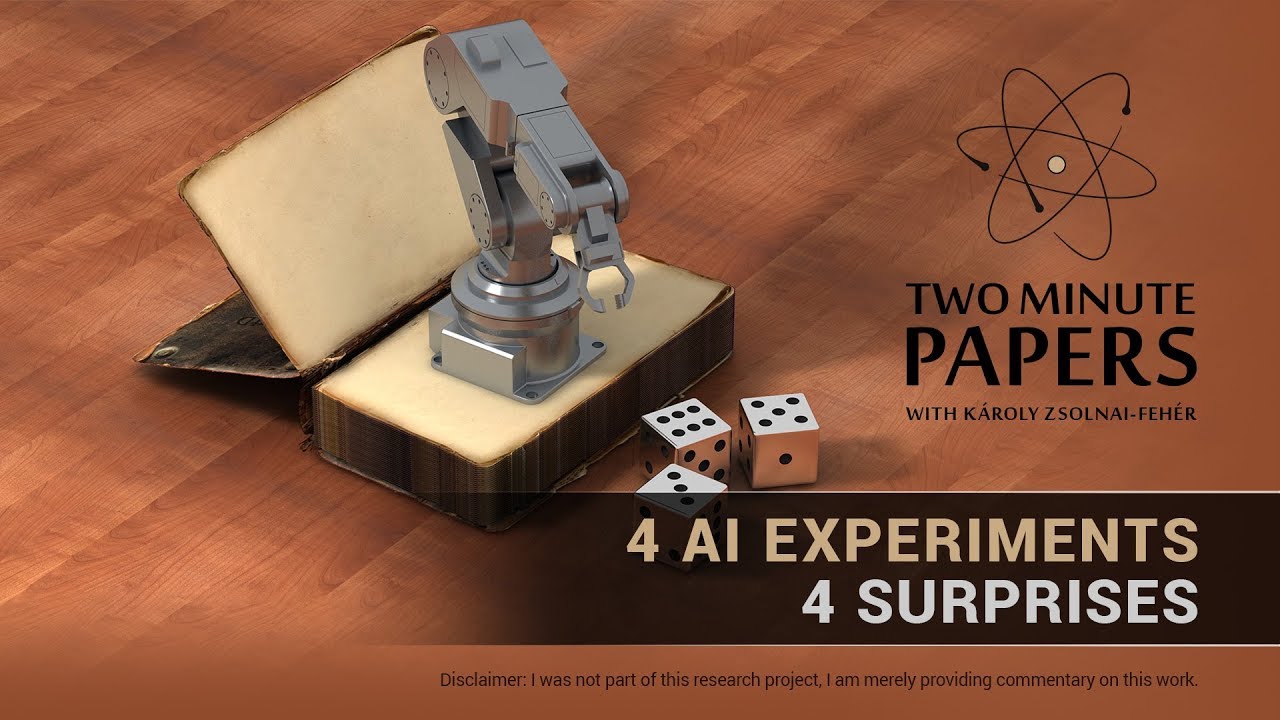
This Robot Throws Objects with Amazing Precision
3:57

This Robot Throws Objects with Amazing Precision

Two Minute Papers 21.05.2019 130 425 просмотров 4 751 лайков

Machine-readable: Markdown · JSON API · Site index

Поделиться Telegram VK Бот
Транскрипт Скачать .md
Анализ с AI
Описание видео
📝 The paper "TossingBot: Learning to Throw Arbitrary Objects with Residual Physics" is available here: https://tossingbot.cs.princeton.edu/ ❤️ Pick up cool perks on our Patreon page: https://www.patreon.com/TwoMinutePapers 🙏 We would like to thank our generous Patreon supporters who make Two Minute Papers possible: 313V, Alex Haro, Andrew Melnychuk, Angelos Evripiotis, Anthony Vdovitchenko, Brian Gilman, Bruno Brito, Bryan Learn, Christian Ahlin, Christoph Jadanowski, Claudio Fernandes, Dennis Abts, Eric Haddad, Eric Martel, Evan Breznyik, Geronimo Moralez, James Watt, Javier Bustamante, John De Witt, Kaiesh Vohra, Kasia Hayden, Kjartan Olason, Levente Szabo, Lorin Atzberger, Marcin Dukaczewski, Marten Rauschenberg, Maurits van Mastrigt, Michael Albrecht, Michael Jensen, Nader Shakerin, Owen Campbell-Moore, Owen Skarpness, Raul Araújo da Silva, Richard Reis, Rob Rowe, Robin Graham, Ryan Monsurate, Shawn Azman, Steef, Steve Messina, Sunil Kim, Taras Bobrovytsky, Thomas Krcmar, Torsten Reil, Zach Boldyga. https://www.patreon.com/TwoMinutePapers Splash screen/thumbnail design: Felícia Fehér - http://felicia.hu Károly Zsolnai-Fehér's links: Facebook: https://www.facebook.com/TwoMinutePapers/ Twitter: https://twitter.com/karoly_zsolnai Web: https://cg.tuwien.ac.at/~zsolnai/ #TossingBot
Оглавление (4 сегментов)

<Untitled Chapter 1>

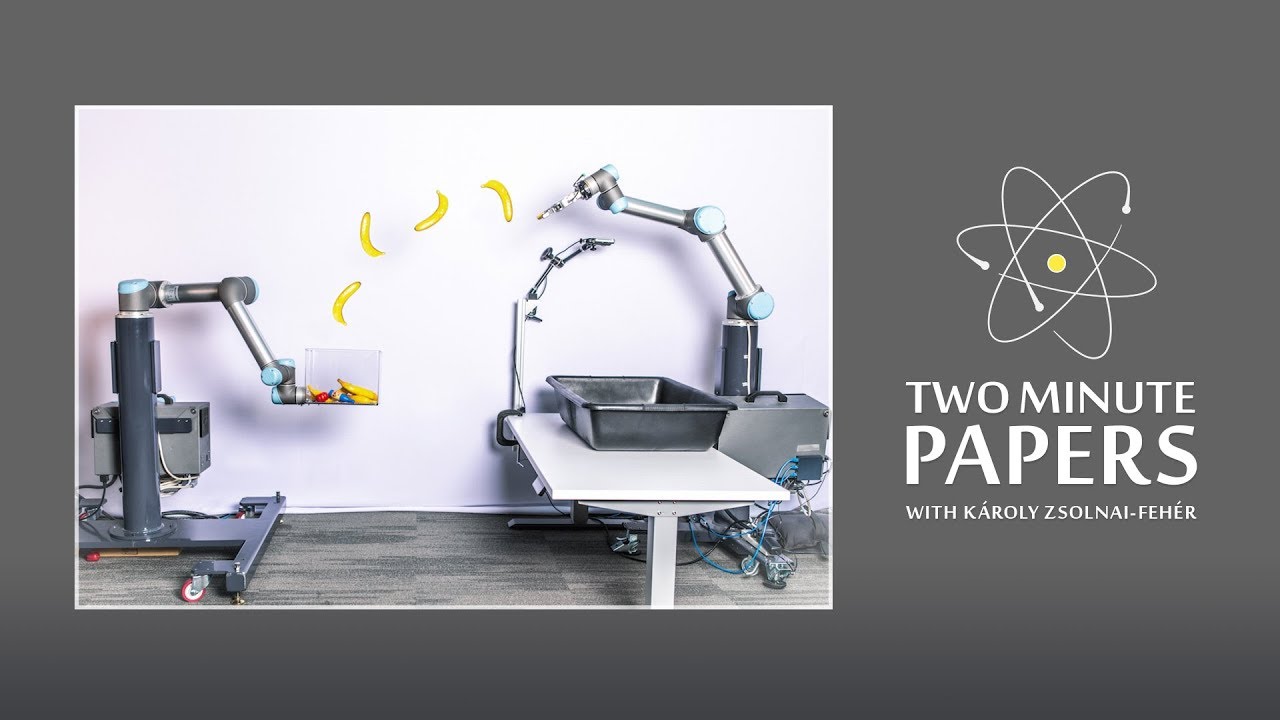
Dear Fellow Scholars, this is Two Minute Papers with Károly Zsolnai-Fehér. In this footage, we have a variety of objects that differ in geometry, and the goal is to place them into this box using an AI. Sounds simple, right? This has been solved long, long ago. However, there is a catch here, which is that this box is outside of the range of the robot arm, therefore, it has to throw it in there with just the right amount of force for it to end up in this box. It can perform 500 of these tosses per hour. Before anyone misunderstands what is going on in the footage here, it almost seems like the robot on the left is helping by moving to where the object would fall after the robot on the right throws it. This is not the case. Here you see a small part of my discussion with Andy Zeng, the lead author of the paper where he addresses this. The results look amazing, and note that this problem is much harder than most people would think at first. In order to perform this, the AI has to understand how to grasp an object with a given geometry, in fact, we may grab the same object at a different side, throw it the same way, and there would be a great deal of a difference in the trajectory of this object. Have a look at this example with the screwdriver. It also has to take into consideration the air resistance of a given object as well. Man, this problem is hard.

Training Process

As you see here, initially, it cannot even practice throwing because its reliability in grasping is quite poor. However, after 14 hours of training, it achieves a remarkable accuracy, and to be able to train for so long, this training table is designed in a way that when running out of objects, it can restart itself without human help. Nice! To achieve this, we need a lot of training objects, but not any kind of training objects. These objects have to be diversified. As you see here, during training, the box position enjoys a great variety, and the object

Generalizing to New Target Locations

geometry is also well diversified. Normally, in these experiments, we are looking to obtain some kind of intelligence. Intelligence in this case would mean that the AI truly learned the underlying dynamics of object throwing, and not just found some good solutions via trial and error. A good way to test this would be to give it an object it has never seen before and see how its knowledge generalizes to that. Same with locations. On the left, you see these boxes marked with orange, this was the training set, but, later, it was asked to throw it into the blue boxes, which is something it has never tried before…and…look! This is excellent generalization. Bravo! You can also see the success probabilities for grasping and throwing here. A key idea in this work is that this system is endowed with a physics-based controller, which contains the standard equations of linear projectile motion. This is simple knowledge from high-school physics that ignores several key real-life factors, such as the effect of aerodynamic drag. This way, the AI does not have to learn from scratch and can use these calculations as an initial guess, and it is tasked with learning to account for the difference between this basic equation and real-life trajectories. In other words, it is given basic physics and is asked to learn advanced physics by building on that. Loving this idea. A simulation environment was also developed for this project where one can test the effect

Analysis in Simulation

of, for instance, changing the gripper width, which would be costly and labor-intensive in the real world. Of course, these are all free in a software simulation. What a time to be alive! Thanks for watching and for your generous support, and I'll see you next time!

Другие видео автора — Two Minute Papers

Ctrl+V

Экстракт Знаний в Telegram

Экстракты и дистилляты из лучших YouTube-каналов — сразу после публикации.

Подписаться

Дайджест Экстрактов

Лучшие методички за неделю — каждый понедельник