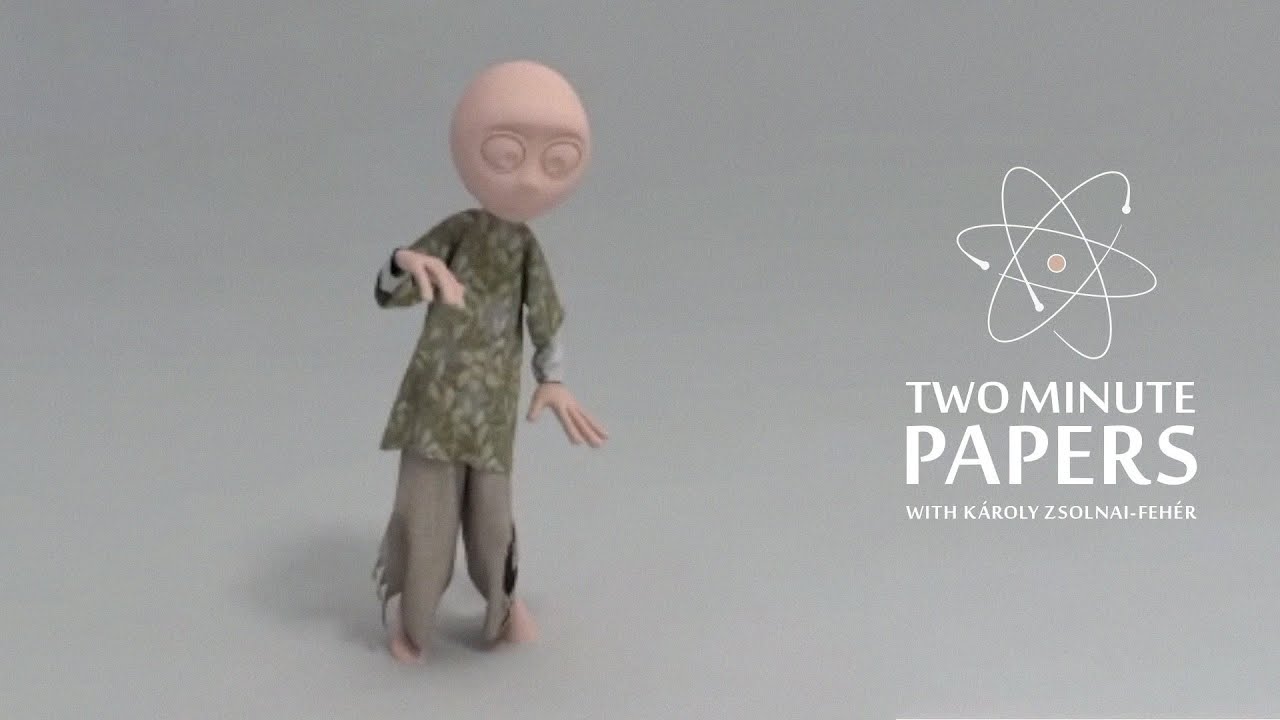
Why Are Cloth Simulations So Hard?
3:14

Why Are Cloth Simulations So Hard?

Two Minute Papers 12.04.2019 139 248 просмотров 3 806 лайков

Machine-readable: Markdown · JSON API · Site index

Поделиться Telegram VK Бот
Транскрипт Скачать .md
Анализ с AI
Описание видео
📝 The paper "I-Cloth: Incremental Collision Handling for GPU-Based Interactive Cloth Simulation" is available here: https://min-tang.github.io/home/ICloth/ ❤️ Pick up cool perks on our Patreon page: https://www.patreon.com/TwoMinutePapers 🙏 We would like to thank our generous Patreon supporters who make Two Minute Papers possible: 313V, Alex Haro, Andrew Melnychuk, Angelos Evripiotis, Anthony Vdovitchenko, Brian Gilman, Bruno Brito, Bryan Learn, Christian Ahlin, Christoph Jadanowski, Claudio Fernandes, Dennis Abts, Eric Haddad, Eric Martel, Evan Breznyik, Geronimo Moralez, Javier Bustamante, John De Witt, Kaiesh Vohra, Kasia Hayden, Kjartan Olason, Levente Szabo, Lorin Atzberger, Marcin Dukaczewski, Marten Rauschenberg, Maurits van Mastrigt, Michael Albrecht, Michael Jensen, Morten Punnerud Engelstad, Nader Shakerin, Owen Campbell-Moore, Owen Skarpness, Raul Araújo da Silva, Richard Reis, Rob Rowe, Robin Graham, Ryan Monsurate, Shawn Azman, Steef, Steve Messina, Sunil Kim, Thomas Krcmar, Torsten Reil, Zach Boldyga, Zach Doty. https://www.patreon.com/TwoMinutePapers Splash screen/thumbnail design: Felícia Fehér - http://felicia.hu Károly Zsolnai-Fehér's links: Facebook: https://www.facebook.com/TwoMinutePapers/ Twitter: https://twitter.com/karoly_zsolnai Web: https://cg.tuwien.ac.at/~zsolnai/

Оглавление (10 сегментов)

Intro

Dear Fellow Scholars, this is Two Minute Papers with Károly Zsolnai-Fehér. Today we are going to talk a bit about the glory and the woes of cloth simulation programs. In these simulations, we have several 3D models of garments that are built from up to several

Benchmark: Twisting

hundreds of thousands of triangles. And as they move in time, the interesting part of the simulation is whenever collisions happen, however, evaluating how these meshes collide is quite difficult and time consuming. Basically, we have to tell an algorithm that we have piece of cloth with a hundred thousand

Benchmark: Sphere

connected triangles here, and another one there, and now, have a look and tell me which collides with which and how they bend and change in response these forces.

Benchmark: Andy

And don’t forget about friction and repulsive forces! Also, please, be accurate because every small error adds up over time, and, do it several times a second so we can have a look at the results interactively. Well, this is a quite challenging problem.

Benchmark: Bishop

And it takes quite long to compute, so much so that 70-80% of the total time taken to perform the simulation is spent with doing collision handling. So how can we make it not take forever? Well, one way would be to try to make sure that we can run this collision handling step

Benchmark: Dress

on the graphics card. This is exactly what this work does, and in order to do this, we have to make sure that all these evaluations can be performed in parallel. Of course, this is easier said than done.

Benchmark: Tiered

Another difficulty is choosing the appropriate time steps. These simulations are run in a way that we check and resolve all of the collisions, and then, we can advance the simulation forward by a tiny amount. This amount of called a time step, and choosing the appropriate time step has always been a challenge. You see, if we set it to too large, we will be done faster and compute less, however, we will almost certainly miss some collisions because we skipped over them. The simulation may end up in a state that is so incorrect that it is impossible to recover from, and we have to throw the entire thing out. If we set it to too low, we get a more robust simulation, however, it will take many hours

Different Time Steps

to days to compute. To remedy this, this technique is built in a way such that we can use larger time steps. That’s excellent news. Also, the collision computation part is now up to 9 times faster, and if we look at the cloth simulation as a whole, that can be made over 3 times faster.

Interactive Cloth Manipulation

As you see here, this is especially nice because we can test how these garments react to our manipulations at 8-10 frames per second. If you have a closer look at the paper, you will also find another key observation which states that most of the time, only a small subregion of the simulated cloth undergoes

Interactive Human Dressing

deformation due to response forces, and this knowledge can be kept track of, which contributed to cutting down the simulation time significantly. Thanks for watching and for your generous support, and I'll see you next time!

Другие видео автора — Two Minute Papers

Ctrl+V

Экстракт Знаний в Telegram

Экстракты и дистилляты из лучших YouTube-каналов — сразу после публикации.

Подписаться

Дайджест Экстрактов

Лучшие методички за неделю — каждый понедельник